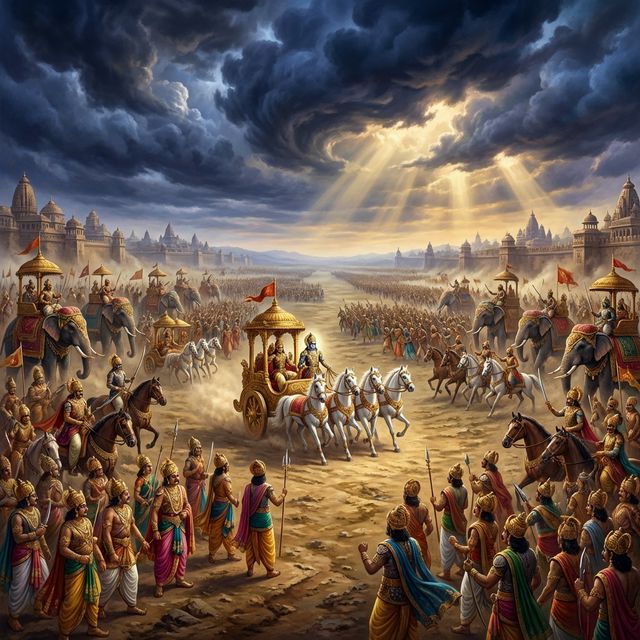
The Wall Before Bhishma
Every Kaurava champion is given one Pandava to stop on the tenth day
Point the Army at One Man
Neither the bow nor the car of Bhishma had suffered any injury. Sanjaya said that plainly to the blind king, because it was the first thing Dhritarashtra wanted to know and the last thing he wanted to hear.
It was the tenth day. That morning Bhishma had told Duryodhana that the vow he made at the beginning was discharged, that he had slain his ten thousand a day and come back from the field each evening as he said he would, and that today he would either sleep on the field himself or kill the sons of Pandu. Then he had gone in among the Kshatriyas scattering shafts, and by mid-morning the Panchalas could not look at him. Sanjaya compared him to the sun standing in the northern solstice, which is a way of saying that men turned their faces away from a thing they could not bear the brightness of.
Into that light came Arjuna, and what he did first was not to shoot.
He looked at the old man's prowess for a while, and then he spoke to the prince beside him, the one the whole Pandava plan for that day rested on. Shikhandi was the son of Drupada who had been born a girl and become a man, and Bhishma had said in the hearing of both armies that he would never raise a weapon against him.
"Proceed towards the grandsire," Arjuna said. "Thou shouldst not entertain the slightest fear of Bhishma today. Even I will throw him down from his excellent car by means of my sharp shafts."
Shikhandi heard it and rushed at the son of Ganga. Dhrishtadyumna heard it and went, joyfully, and Abhimanyu with him. Old Virata and old Drupada went, clad in mail, in the very sight of Duryodhana, and Kuntibhoja with them. Nakula went, and Sahadeva, and king Yudhishthira himself, and after them all the rest.
The whole Pandava army had been pointed at one man.
"As regards thy warriors, O king," said Sanjaya, "that rushed, according to the measure of their might and courage, against those mighty car-warriors united together, listen to me as I speak of them unto thee."
Keep Him Off the Old Man
What Sanjaya recited next was not a battle. It was a list of assignments, and every name in it was a man told to stand in front of somebody and not let him past.
Chitrasena went against Chekitana, who was on his way to Bhishma, and went at him the way a young tiger goes at a bull. Kritavarma resisted Dhrishtadyumna, who had already reached the grandsire's presence. Somadatta's son Bhurishrava, with great activity, took the road in front of Bhimasena, who was furious and wanted Bhishma dead. Vikarna, wanting only to keep Bhishma alive, put himself before Nakula, who was scattering arrows without counting them. Kripa the son of Saradwat, in a rage, blocked Sahadeva as he came toward Bhishma's car. Durmukha rushed at Ghatotkacha, the Rakshasa of cruel deeds, Bhimasena's son. Duryodhana took Satyaki himself. Sudakshina the ruler of the Kambojas turned Abhimanyu. Ashwatthama, excited with rage, went against old Virata and old Drupada together. Drona placed himself in front of the eldest Pandava, king Yudhishthira the just. And Dushasana, that great bowman, set himself against Arjuna, who was coming at speed with Shikhandi in front of him and lighting up the ten quarters as he came.
Every one of those men had been given the same order, which nobody had needed to give them. Keep him off the old man.
On the other side, Dhrishtadyumna, who was the commander of the Pandava host and had been born out of a fire to kill Drona, rode at Bhishma alone, shouting so the troops could hear him over the noise.
"There, Arjuna, that delighter of Kuru's race, is proceeding against Bhishma in battle. Rush ye against Ganga's son. Be not afraid. Bhishma will not be able to attack you in battle. Vasava himself cannot venture to fight with Arjuna in battle. What therefore need be said of Bhishma who, though possessed of bravery in battle, is feeble and old?"
They heard their commander and were filled with joy and went for the car of Ganga's son like a mass of living energy with the shape of men on it.
And the Kauravas received them cheerfully, which is Sanjaya's word, and would not move.
Dushasana abandoned all his fears and rushed at Dhananjaya.
The Continent and the Sea
Then, said Sanjaya, we beheld a highly wonderful incident.
Arjuna came as far as Dushasana's car and could not advance further.
That is the sentence, and it deserves to be read slowly, because of who the two men were. This was the brother who had dragged Draupadi into the assembly by her hair, and the archer who had waited thirteen years to be allowed to do something about it, and on the tenth day of the war the second of them ran into the first of them and stopped, the way the continent resists the surging sea.
Sanjaya, who had no reason to flatter Dushasana, described them as a matched pair. Both foremost of car-warriors. Both invincible. Both, in beauty and splendour, resembling the sun or the moon. Both excited with wrath, and each desiring to kill the other. They encountered each other, he said, like Maya and Sakra in days of old.
Dushasana opened with three shafts into the son of Pandu and twenty into Krishna, who was standing in front of him holding the reins and could not shoot back.
That was the mistake. Arjuna, seeing him of Vrishni's race afflicted, put a hundred shafts into Dushasana, and they went through the armour and drank his blood.
Dushasana answered with five, and then with three sharp ones into Arjuna's forehead, and did not flinch when the hundred went home. Arjuna stood there in his car with three arrows standing out of his brow, and Sanjaya, telling this to the father of the man who had put them there, could not help admiring how it looked. Like Meru with its tall crests, he said. Like a flowering Kinsuka tree, which is the tree that carries scarlet blossom on bare branches and is what the poets of that country reach for when they want to say that a wounded man is beautiful.
Then the son of Pandu, excited with rage, afflicted Dushasana the way Rahu inflamed with rage afflicts the full moon on the fifteenth night of the lighted fortnight.
And Dushasana, bleeding, went on shooting shafts whetted on stone and winged with the feathers of the Kanka bird, and did not give a step.
The Island in Deep Water
Arjuna cut off his bow. Then he split the car with three shafts and sent after them a flight of fierce arrows like the darts of Death, and every one of those arrows was cut out of the air by Dushasana before it could reach him.
All this, Sanjaya said, seemed highly wonderful. He meant it as an unwilling compliment, and it is very nearly the only one anybody in the epic ever pays this man for his skill.
Dushasana, on the wreck of his chariot, pierced Partha again with many shafts of great sharpness. So Arjuna set on the bowstring a number of shafts whetted on stone and furnished with wings of gold, aimed carefully, and sent them all together, and they entered the body of that high-souled warrior the way swans dive into a lake.
That ended it. Dushasana avoided Partha and drove quickly to the car of Bhishma.
Sanjaya put one line on that flight which is worth the whole exchange. Bhishma then became an island unto him who was thus sinking into fathomless waters.
The grandsire did not fight for him and did not need to. The son of Dhritarashtra simply came in under the shadow of the old man's chariot the way a drowning man comes up onto sand, and stood there and got his breath, and let the sight of Bhishma still upright and still shooting do to him what water and rest do to the wounded.
Then he regained consciousness, and went back.
He came out from the island and began once more to resist Partha with sharp arrows, and Sanjaya compared him to Purandara resisting Vritra, which is to say a god holding off the great enemy of the gods, and of huge form he pierced Arjuna again and again.
Arjuna was scarcely pained at all.
That is the flat, terrible last word of the section. The man had gone into the water and come out of it and gone back in to be beaten a second time, for the sake of an old man who had never much liked him, and the archer in front of him hardly felt the arrows.
The Dart and the Meteor
Elsewhere along that wall, Satyaki was trying to get through, and the Kauravas had put a Rakshasa in his way.
Alambusha the son of Rishyasringa was the night-fighter Duryodhana kept for exactly this kind of work, and he met Satyaki in his mail and stopped him. Nine arrows from the bull of Sini's line, delivered smiling. Nine back from the Rakshasa. Then a profusion of shafts from Satyaki, and many sharp ones from Alambusha with a loud shout after them, and Satyaki, deeply pierced, laughed at his wounds and roared.
Into that came Bhagadatta, the old king of Pragjyotisha who rode an elephant and had been a friend of Arjuna's father, and he afflicted the Vrishni hero with sharp arrows the way a driver pierces a huge elephant with the hook. Satyaki abandoned the Rakshasa where he stood and turned everything he had on the king.
Bhagadatta, with one broad-headed arrow and great lightness of hand, cut off Satyaki's large bow.
Satyaki took up another of greater impetus and put many arrows into him, and the old king, deeply pierced, began to lick the corners of his mouth. Then he took up a dart, made wholly of iron, decked with gold and with stones of lapis lazuli, fierce as the rod of Yama himself, and hurled it with the whole strength of his arm.
Satyaki cut it in two in the air, and it fell suddenly, like a great meteor shorn of its splendour.
Duryodhana saw the dart fail and did the arithmetic. He surrounded the Vrishni with a large number of cars and turned to his brothers.
"Take such steps, ye Kauravas, that Satyaki may not, in this battle, escape you and this large division of cars, with life. If he be slain, the vast host of the Pandavas may be regarded as slain also."
So be it, they said, and closed on Sini's grandson in the view of Bhishma.
Nearer the grandsire's car, Sudakshina the ruler of the Kambojas had Abhimanyu. Arjuna's son pierced the king with many straight shafts and then with sixty-four more, and Sudakshina, wanting Bhishma to live, put five into Abhimanyu and nine into his charioteer, and the fight the two of them made was fierce in the extreme, and it went nowhere, which was the point of it.
Two Old Kings and a Young One
Shikhandi rushed at the son of Ganga, and behind him came the two old men.
Virata was the king of the Matsyas, in whose kitchens and cowsheds the Pandavas had hidden through the thirteenth year, and Drupada was the king of the Panchalas, Draupadi's father and Shikhandi's, who had spent half his life on a grudge against Drona. Both were old enough that their own side watched them go forward with anxiety. Both were excited with rage. They went for Bhishma resisting the large host of the Kauravas as they came, which means they were not merely riding forward, they were cutting a road.
Ashwatthama came across them, and the fight that started there was the strangest of the day.
Virata struck Drona's son with broad-headed shafts as he advanced. Drupada pierced him with three sharp ones. Ashwatthama, coming upon those two mighty warriors thus striking him, both of them on their way to Bhishma, pierced them both with many shafts of his own.
And they held.
Wonderful, said Sanjaya, was the conduct that we then beheld of those two old warriors, inasmuch as they checked all those fierce shafts shot by Drona's son. Ashwatthama was the youngest of the great bowmen on that field and the one who would one day burn a sleeping camp, and two grey kings with slow hands stood in front of him and took everything he sent and did not fall.
The rest of the wall was holding too, in its fashion.
Kripa went at Sahadeva like an infuriate elephant rushing at an infuriate compeer, and struck him with seventy shafts decked with gold. Madri's son cut the bow in two and put nine arrows into him. Kripa took up another bow capable of bearing a great strain and, desirous of Bhishma's life, cheerfully struck him with ten, and Sahadeva, desirous of Bhishma's death, struck him in the chest.
Vikarna, the one son of Dhritarashtra who had once stood up in the assembly hall and spoken for Draupadi, pierced Nakula with sixty arrows for the sake of the grandsire, and Nakula pierced him back with seventy-seven, and the two of them stood there striking each other like two bulls in a fold.
Durmukha went against Ghatotkacha, who was slaughtering the army as he came, and took a straight shaft in the chest, and shouted cheerfully, and sent sixty back.
Kritavarma took five iron shafts from Dhrishtadyumna, and fifty in the centre of the chest, and nine more winged with Kanka feathers, and fought on for Bhishma's sake as fiercely, said Sanjaya, as Vritra fought Vasava.
Wait, Wait
Bhima was coming, and the man who went to meet him did it shouting a word that nobody else on that field used.
"Wait. Wait."
Bhurishrava was the son of Somadatta, of the elder branch of the Kuru house, a warrior of the highest rank who would die later in this war with his sword arm cut off while he sat on the ground in prayer. He came at great speed across Bhimasena's path calling him to stop, and when Bhima did not stop he struck him in the centre of the chest with an arrow of exceeding sharpness and golden wings.
Bhima stood with the shaft standing out of his chest, and Sanjaya said he looked beautiful, like the Krauncha mountain in days of old with the dart of Skanda in it.
Then those two bulls among men shot at each other shafts polished bright by their forgers and shining like the sun, and the balance of what they wanted is the whole of that duel. Bhima longed for Bhishma's death. The son of Somadatta desired Bhishma's victory. Each carefully sought to counteract the other's feats, and neither of them was really fighting the other at all. They were both fighting over an old man half a field away who had asked neither of them for anything.
Behind them, Yudhishthira was coming up with a large force, and Drona resisted him.
The king's men heard the rattle of the preceptor's car before they saw it, a sound like the roar of clouds, and the Prabhadrakas began to tremble. That large force, resisted by Drona, exerted itself vigorously and could not advance even one step.
Chitrasena held Chekitana, whose face was full of wrath, and fought him to the utmost of his power, and Chekitana fought back to the utmost of his, and that too was exceedingly fierce, and that too stayed where it was.
Everywhere along the line the wall held.
And at the one place where it mattered, it did not. Arjuna, though he was resisted by all means, compelled Dushasana to turn back, and then crushed the troops behind him, and Dushasana, to the utmost stretch of his power, went on resisting Partha, wishing to protect Bhishma.
The army of Dhritarashtra's son, said Sanjaya, undergoing such slaughter, began to be agitated here and there by many foremost car-warriors of the Pandavas.
Every champion had done his work. Every one of them was still standing where he had been put. And the gap was already open, and Shikhandi was already through it, and behind Shikhandi came a man with three arrows in his forehead who had promised to bring the grandsire down before the sun went.
Dharma Lesson
Duty is usually assigned, not chosen. Not one of these men picked his opponent; each was handed a name and told to stand there, and the whole line did it, some of them for a grandsire who had never much favoured them, and one of them twice over after being broken. The epic does not pretend this made them right, and it does not pretend the wall worked. It records what it costs to hold a position you were given, and lets you notice that faithfulness and a good cause are two different things which do not always arrive together.