The Fall of Bhishma and the Earrings
Indra's Gift, the Grandsire's Bed of Arrows
The Armor Grown From Skin
Of all the warriors gathered for the great war, only one had been born with his armor already on his body. When Kunti, a girl still unmarried, had called the sun-god Surya down with a borrowed mantra, the child she bore came into the world clad in a coat of golden mail that grew from his own skin, and with a pair of earrings that hung from his ears as if budded from his bones. This was Karna. The armor and the earrings were a part of him as much as his hands were. They could not be unbuckled, for there were no buckles. They could not be cut away by any enemy, for the blade would not bite. And so long as Karna wore them, no weapon ever forged - divine or mortal, the bolt of Indra or the dart of Yama - could find his life.
Kunti had set the infant adrift on a river in a basket, ashamed and afraid, and a charioteer named Adhiratha had drawn the basket from the water and raised the boy as his own. So Karna grew up believing himself a low-born suta, a charioteer's son, and burned all his life under the contempt of kshatriyas who would not grant a man of his birth the right to bear arms. Only Duryodhana had given him a crown and called him friend, and for that crown Karna had bound his loyalty to the Kauravas with a vow he would never break.
Karna had a second vow, older and stranger than the first. At the hour of his evening sun-worship, when he stood in the river with his palms full of water and his face turned to his unseen father in the sky, he would refuse no brahmin anything that was asked of him. Anything in his power to give, he would give. He had made the vow young, and he had kept it without exception, and it had become the thing he was proudest of in a life with little enough to be proud of. Men said that at that hour of the day Karna could be asked for his own head and would hand it over with a steady hand.
Far above, in the heaven of the gods, Indra watched the war drawing near and was afraid. For Indra was the true father of Arjuna, just as Surya was the true father of Karna, and Indra knew with a god's certainty what was coming: that one day on the field of Kurukshetra his son Arjuna would stand at last against Karna, and that while Karna wore the golden armor and the earrings, Arjuna would surely die.
Surya's Warning in the Dream
Indra resolved to take the armor and the earrings from Karna by the one means Karna could not refuse: he would come as a brahmin and beg them as alms at the hour of the sun-worship. A theft dressed as charity, a robbery that the victim would help to carry out. It was not a deed worthy of the king of the gods, and Indra knew it, but he was a father, and fathers are not always honorable when their sons are at stake.
Surya, Karna's own father, saw the plan forming in the mind of Indra, and it grieved him. He could not openly oppose the king of heaven. But he could warn his son. And so one night, in the camp of the Kauravas before the war had even begun, Surya came to Karna in a dream, in the shape of a radiant brahmin, and spoke to him as one who loved him.
"My son," Surya said, "hear me, for I tell you this out of love. Indra, the friend of the Pandavas and the father of Arjuna, will come to you disguised as a brahmin and beg for your earrings and the armor that grows on your body. Do not give them to him. Refuse him gently, turn his request aside with sweet words, offer him cattle and gold and villages and women and anything else under heaven - but keep your armor and your earrings. They are your life. Without them you will be a naked man among arrows. With them you are immortal in battle. Do not let love of your own vow blind you to your death."
Karna in the dream bowed his head, but he did not promise. "Holy one," he said, "who are you, that you take such care for me and speak with such authority?"
And Surya, because it was a dream and dreams permit such things, told him the truth. "I am Surya. I am your father. The mother who bore you was Kunti, and you are no charioteer's son but a kshatriya and a prince, elder brother of the very Pandavas you mean to fight. Now you know how much I have to lose. Heed me, and keep what is yours."
But Karna only smiled in his sleep, and the smile was sad. He had already decided.
I Will Not Break My Vow
"Father," Karna answered in the dream, "you know me, and you know what I am. The whole of my life I have been called base-born, a suta's whelp, a man who climbed where he had no right to climb. Birth was denied to me; rank was denied to me; honor among the great ones was denied to me. I have built myself, stone by stone, out of one thing only - my word. When I say I will give, I give. When I say I will not flee, I do not flee. It is all I have that no one handed me, and all I have that no one can take. If I refuse a brahmin at the hour of my prayer to save my own skin, then I am exactly the small, frightened, grasping thing they have always said I was. I will not be that. I would rather die with my name whole than live with it broken."
Surya was silent for a moment in the dream. Then he said, "This is the kind of fame that survives a man, my son, and the kind that kills him. Both at once. I cannot turn you. But hear at least this much counsel, since you will not hear the rest: when Indra comes and you have resolved to give, do not give for nothing. Indra carries a weapon called the Shakti, an infallible dart that never misses its mark and slays whatever it strikes, god or demon or man. Ask him for that in exchange. Do not let him leave you naked and empty-handed. A vow kept is honorable; a vow kept stupidly is only ruin. Bargain, my son. It is the one thing I ask of you."
Karna folded his hands. "For that counsel, father, I thank you, and that I will do. If the king of the gods will pay for my armor with his own thunder-dart, I will take it, and on the day I most need it I will use it to kill the one enemy I most fear. So at least the world will say that Karna got something worthy of Karna for the price he paid."
The dream-brahmin's radiance softened, and he laid an unseen hand on his son's brow. "So be it," said Surya, "my brave and foolish boy." And then the dream thinned, and the sun rose over the plain of Kurukshetra, and Karna woke with the memory bright in his mind and his decision already made.
The Brahmin at Karna's River
Some days later, at the hour when the sun sat low and red on the rim of the world, Karna stood waist-deep in the river performing his evening worship. The water ran cold and gold around him. He had given away much that day already, as he gave away something every day at this hour - cattle to one suppliant, gold to another, a village to a third - and his attendants stood on the bank ready to fetch whatever the next brahmin might ask.
An old brahmin came down to the water's edge, bent and white-haired, leaning on a staff. There was nothing in his appearance to mark him as anything but what he seemed, yet Karna, the moment he saw him, knew. The memory of the dream rose in him whole. He completed his prayer, turned, and bowed to the old man with perfect courtesy.
"Holy one," Karna said, "you have come at the one hour of the day when I refuse no brahmin anything. Ask, and it is yours. Land, gold, cattle, my finest horses, beautiful women, whole villages - name the thing your heart desires and it is already given."
"I want none of those things," the old man said, his voice level and unembarrassed. "I have come for the armor that grows upon your body, and for the earrings in your ears. Cut them from yourself and give them to me. That is the alms I ask."
For a long breath Karna said nothing. The water moved around him. He looked at the bent old figure and he saw, behind it, the thing that it was - the king of the gods, come in beggar's rags to rob a man of his life through the one door that man had sworn never to close. He saw that the request was an act of a father's love for a son he himself had never been allowed to claim. He saw that he could still refuse, that even his own vow permitted exceptions for a gift that would cause the giver's death, that no honest man in the world would blame him for keeping the skin he was born in.
Karna smiled. "Lord of the gods," he said quietly, "for I know who you are, you might have asked me for these as Indra, openly, and I would have given them to Indra. You did not need the disguise. But since you have come as a brahmin to my prayer, you have come the one way I cannot turn you, and I think you knew that. The armor and the earrings are yours. Only wait while I cut them free."
The Cutting and the Dart
Karna waded to the bank, drew his hunting knife, and began to cut the golden armor away from his own living skin. The armor had grown into him; there was no seam at which to lift it; and so the blade went into his flesh, and the skin came away with the metal. Blood ran down his body in long bright sheets and clouded the river at his feet. His face did not change. He worked steadily and without haste, as a man works at a familiar labor, cutting and peeling, cutting and peeling, lifting the heavy golden sheet free of his ribs and his shoulders and his thighs, until at last the whole coat of mail lay folded and dripping on the ground. Then he reached up and twisted the earrings from his ears, two sharp pulls that brought fresh blood from the torn lobes, and laid them on top of the armor.
The attendants on the bank had turned away, unable to watch. Indra himself, who had wanted this and schemed for it, found that he could not look without flinching at the calm with which it was done. There was no flicker of regret in Karna, no plea, no bargaining for mercy. There was only a man keeping his word at the cost of his own body, and doing it as easily as another man might hand over a cup of water.
Karna lifted the bloody bundle in both hands and held it out. "Take it, lord. It is freely given. I ask nothing."
Then Indra cast off his disguise. He stood revealed in his own form, blazing and terrible and golden, and there were tears at the corners of the eyes of the king of heaven. "Karna," he said, and his voice was thick, "in all the worlds there is no second giver like you. The gods themselves will speak of this. But I cannot leave you stripped and empty for the sake of my son. Ask of me something in return. Anything in my power. I will not go without giving."
Karna had his answer ready, for Surya had prepared him. "Then give me your Shakti, the infallible dart that never misses and kills whatever it strikes. Let me have it for the day I most need it, against the one enemy I most fear."
Indra's face tightened, for the dart was meant for Arjuna's protection and Karna's enemy was Arjuna. But a god does not break a bargain freely offered. "Take it," he said, and handed Karna the dread weapon, "but hear its law: the Shakti will slay one enemy, and one only, and then it will return to my hand and serve you no more. Spend it well, for you have but a single throw." He blessed the man he had ruined, and rose into the evening sky, and was gone.
Karna stood alone on the bank, dripping blood from every place his armor had been, the terrible dart heavy and cold across his palms. He had given away his immortality and bought himself one certain kill. He bandaged his wounds slowly, called for ointment, and from that day forward the Shakti rode at his side, a single thunderbolt he was hoarding for Arjuna - though fate, in the dark of a later night, would tear it from him for another purpose, and leave him at the last meeting bare of armor, bare of earrings, and bare of the dart as well.
Ten Days of Slaughter
When the war began at Kurukshetra, the supreme command of the Kaurava host fell to Bhishma, the grandsire, the oldest and the greatest of them all. He was the son of the river Ganga and of king Shantanu, and he had given up his own crown and sworn a terrible vow of celibacy in his youth so that his father might marry, and for that sacrifice the gods had granted him the boon of dying only at the hour of his own choosing. No one could compel his death. He could fall only when he willed it. And he had bound himself, by the iron of his honor, to fight for whoever held the throne of Hastinapura - which now meant fighting for Duryodhana, against the very grandsons he loved.
For ten days Bhishma went across the field like a grass fire across a dry plain. He was old, and his arms were terrible, and his skill with the bow was the skill of a man who had trained under Parashurama himself. He killed ten thousand warriors a day. The Pandava ranks broke before him and re-formed and broke again. No matter how many came against him he stood unwearied, his arrows a continuous silver rain, and behind that rain the Kaurava army surged forward and the Pandava army gave ground.
Each evening the Pandavas met in their tents in tearful council and could not see a way through. Bhishma's boon made him deathless against his will; his skill made him untouchable in arms; and worst of all, no one among them - not Arjuna, not Bhima, not Yudhishthira - had the heart to truly loose a killing weapon at the old man who had carried them as children, who had wept at their exile, who had begged Duryodhana to give them their kingdom and make peace. They lifted their bows against him and their hands shook. He was their grandfather. And he was destroying them.
Krishna's Broken Vow
On one of those days the carnage was so great that Krishna himself could not bear it. He had sworn, before the war, that he would not take up a weapon in the fighting; he had come to the field only as Arjuna's charioteer and counselor, not as a combatant, and on that vow rested much of his dignity and his word. But as he watched Bhishma cut the Pandava host to ribbons, and watched Arjuna fight with a divided and grieving heart, fear for his friends overcame even his own oath.
There came a moment when Bhishma, like a god of death, was scattering the army before him and Arjuna would not fully fight back. Krishna leapt down from the chariot. He snatched up a chariot-wheel from the bloodied ground - or by some tellings the discus itself sprang to his hand - and he ran straight at Bhishma across the field, his yellow robe flying, his eyes blazing, every line of him roaring that he would kill the grandsire with his own hands and let his vow be damned.
Bhishma did not flee. He cast down his own bow, spread his arms wide, and lifted his face with a smile of pure joy. "Come, lord of the worlds," he called out gladly. "Come, dark one, come and slay me with your own hand. There is no death I could want more, and no blessing greater, than to fall under the wheel of God himself. Come, Govinda. I am ready."
It was Arjuna who caught Krishna. He flung himself off the chariot and seized Krishna around the legs and clung to him and would not let go, dragged along the ground as Krishna kept walking, pleading the whole while. "Stop, Madhava, stop, I beg you. Do not break your vow for my sake. The shame of it will outlast the war. I swear to you on my soul that I will fight with all my strength, that I will not spare him, that I will do what must be done. Only do not make a liar of yourself for me. Get back in the chariot. I will fight. I will fight." And at the tenth step, or near it, Krishna let himself be stopped, and the fury went out of him, and he climbed back to the driver's seat, and Arjuna, ashamed, raised Gandiva and fought as he had promised. But still the grandsire could not be felled, and the next night the Pandavas came again to their tents in despair.
The Secret of His Death
At last, on the ninth night, Krishna spoke the thing none of them had dared to say. "We cannot go on like this. If Bhishma is not taken from the field, he will grind us to dust man by man, and the war is already lost. There is only one road left, and it is a strange one. We will go to him - to Bhishma himself - and we will ask him, to his face, how he may be slain. He is a man of perfect truth. He will not lie to us, even now, even though we are his enemies. He has lived too long inside his honor to leave it at the end."
So it was a strange procession that walked into the grandsire's tent that night - Krishna and the five Pandavas, going to beg the secret of his death from the very man they meant to kill. And Bhishma received them not as enemies but as a grandfather receives boys home from a long journey, with warmth and open arms, and made them welcome, and asked what he could do for them. When they had stammered out their impossible question, he was quiet a while, and then he answered them with the calm of a man who had been waiting for this and had perhaps half wished for it.
"You are right that I cannot be killed against my will, and you are right that no warrior on your side can stand against me in fair fight. But there is one path. I have taken a vow that I will never raise a weapon against a woman, nor against one who was born a woman, nor against one who bears a woman's name or has been a woman in any life. In your own army stands such a one. Shikhandi, the prince of Panchala, who in a former birth was the princess Amba, whom I once wronged, and who was reborn for the single purpose of my death. When Shikhandi stands before me, I will not lift my bow. I will let my hands fall. Place Shikhandi at the front of your formation, and Arjuna close behind, and let Arjuna shoot over Shikhandi's shoulder. I will not defend myself. That is the only way I will fall, and I give it to you freely, for it is time, and I am weary, and I have lived too long."
The brothers stood in silence, and the silence was full of grief. Krishna bowed. They went out into the night, and the grandsire's smile as they left was the same warm smile he had given them when they were small boys playing in his lap.
The Reborn Amba
There was an old wound behind the secret Bhishma had just given away, and Shikhandi was its living edge. Long ago, in his strength, Bhishma had carried off three princesses of Kashi - Amba, Ambika, and Ambalika - to be wives for his half-brother Vichitravirya. But Amba, the eldest, was already pledged in her heart to the king of Shalva, and Bhishma, on learning it, released her to go to the man she loved. Shalva, however, would not take her back, his pride stung that she had been won by another and only then returned. Amba came again to Bhishma and demanded that he marry her, since it was he who had ruined her prospects; but Bhishma was bound by his vow of celibacy and could not. Rejected by all, Amba's grief curdled into a single vast purpose: the destruction of Bhishma.
She sought out warriors to fight him for her and found none who could. She went to Parashurama, Bhishma's own teacher, and Parashurama fought Bhishma for her sake for many days and could not defeat him. At last Amba turned to the only power that remained. She left the world of men and gave herself to terrible austerities, and to the fire, praying with all her ruined heart for a rebirth in which she might be the cause of Bhishma's death. The god Shiva granted her the boon. She would slay Bhishma in her next life.
And so she was born again as a daughter of king Drupada of Panchala, raised as a son, named Shikhandi, and by the working of fate and a forest spirit she became a man, a prince, a warrior - and she carried within her, beneath the new name and the new body, the old unappeased fury of Amba. Bhishma knew all of this. He had always known it. He knew that the child of Drupada who rode in the Pandava host was the very soul that had sworn his death by the fire, and his own vow, made in honor a lifetime ago, was the lock to which Shikhandi was the only key. He had told the Pandavas the truth: he would not, could not, lift a weapon against the one who had been Amba. The wheel had come all the way around.
The Tenth Day
At dawn on the tenth day the Pandava formation moved up the field in a new shape. At its heart, in the foremost chariot, rode Shikhandi, and tucked close behind him, half-hidden, came Arjuna with Gandiva strung. The two armies closed, and Bhishma went forward as he had gone forward for nine days, terrible and tireless, his arrows falling like rain.
Then he saw Shikhandi before him. And exactly as he had promised, the grandsire lowered his bow. He let his arms fall to his sides. He would not loose a single shaft at the one who had been Amba, though it cost him everything, for his vow was dearer to him than his life and always had been. He stood open and undefended in the center of the storm, an old man with his weapons down, waiting.
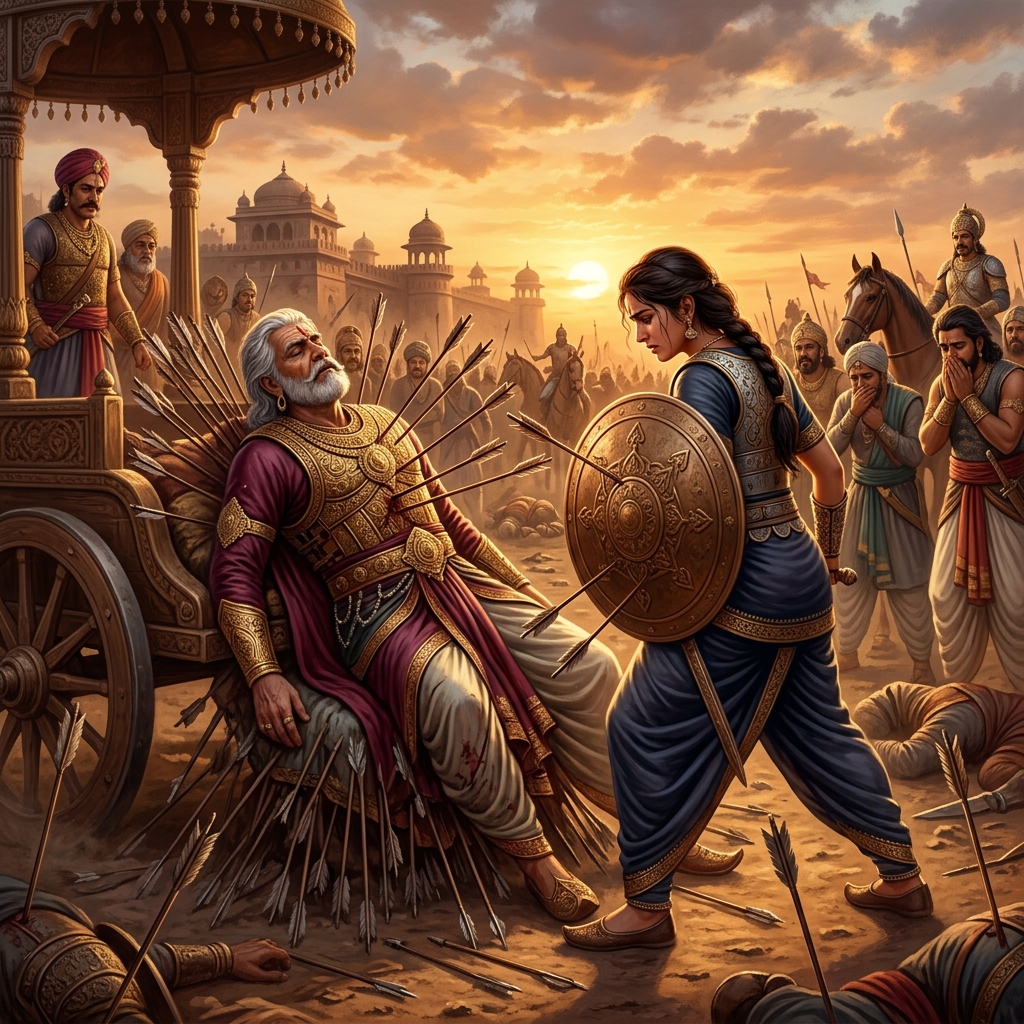
From behind Shikhandi's shoulder, Arjuna shot. He shot with tears running down his face, drawing Gandiva to his ear again and again, sending his arrows over Shikhandi and into the body of the grandsire he loved. He shot for hours. The arrows came in volleys of a hundred and a hundred more. Bhishma stood upright through all of it and let them take him, and the other Kaurava warriors flung themselves before him and were cut down, and still Arjuna shot, and still Bhishma did not fall. By the end of the day there was no inch of the grandsire's body that was not pierced. He bristled with arrows like a porcupine, like a pincushion of his own approaching death, and yet by the strength of his boon his life would not leave him until he gave it leave.
At last, as the sun went down, Bhishma toppled. But he did not strike the earth. The arrows that had passed clean through him and buried themselves in the ground stood thick all around, and he came to rest upon their upright shafts, suspended a hand's breadth above the dust, lying full-length on a bed of his own arrows. The whole field fell still. The fighting stopped on both sides at once. And in a silence broken only by the wind, the warriors of both armies, Pandava and Kaurava together, laid down their weapons and came forward to gather around the fallen grandsire.
The Bed of Arrows
Bhishma lay on the lattice of his own arrows, his head hanging back unsupported, and the first thing he asked for was a pillow. Duryodhana, weeping, hurried forward with soft cushions of silk and down, the finest in the camp, and held them out. The grandsire smiled and shook his head. He turned instead to Arjuna. "A pillow worthy of a warrior, grandson," he said. "You know the kind I mean."
Arjuna understood. Through his tears he fitted three arrows to Gandiva and shot them into the ground beneath the grandsire's head, points up and tight together, so that they rose to cradle the old man's neck exactly. Bhishma sighed and let his head settle back upon the hard pillow of arrowheads, and he was content. "That," he said, "is how the grandsire of the Kurus should rest. You have understood me, child, as you always did."
Then he said, "I thirst. Bring me water - but not in a pot, and not from a hand. Bring it from beneath the earth." Again it was Arjuna who understood. He took up Gandiva, circled the grandsire, invoked a mantra, and shot a single arrow straight down into the ground beside Bhishma's face. Where it struck, a spring of pure cold water leapt up out of the earth and arched, clear and sweet, into the grandsire's mouth. Bhishma drank, and the water ran down his white beard, and he sighed with deep relief and blessed his grandson.
Then the old man looked around at the silent gathered host, Pandava and Kaurava together in the dusk, and he spoke so that all could hear. "My time is not yet come. I have the boon of choosing my own hour, and I will not spend it now, in the dark of the moon. I will wait until the sun turns north into the uttarayana, the bright half of the year, the hour fit for a soul to depart. Until then I will lie here on this bed of arrows. The war must go on without me - go and fight it. But when each day's killing is done, come to me, both of you, both armies, and sit beside me in the evenings. There is much I have learned in a long life, and little time left to give it away, and I would not carry it out of the world unspoken."
Both armies bowed to him. Then they drew back from the bed of arrows and made their camps, and in the morning the war resumed without its grandsire; but each evening, for as long as the war lasted and beyond it, the warriors of both sides walked off the bloodied field and came and sat in the dust around the dying Bhishma to hear him speak. He lay there through the whole of the remaining war and after it, neither living as men live nor dead, waiting on his bed of arrows for the sun to turn north and release him to the hour he himself had chosen.
Dharma Lesson
A great vow is also a kind of trap: Bhishma's vow protected him so completely that only deception could end him, and Karna's vow to give any Brahmin anything cost him his very life. The strong are killed not by stronger enemies but by their own promises. And the dying have things to teach that the busy living cannot hear - Bhishma's lessons lasted longer than his war.