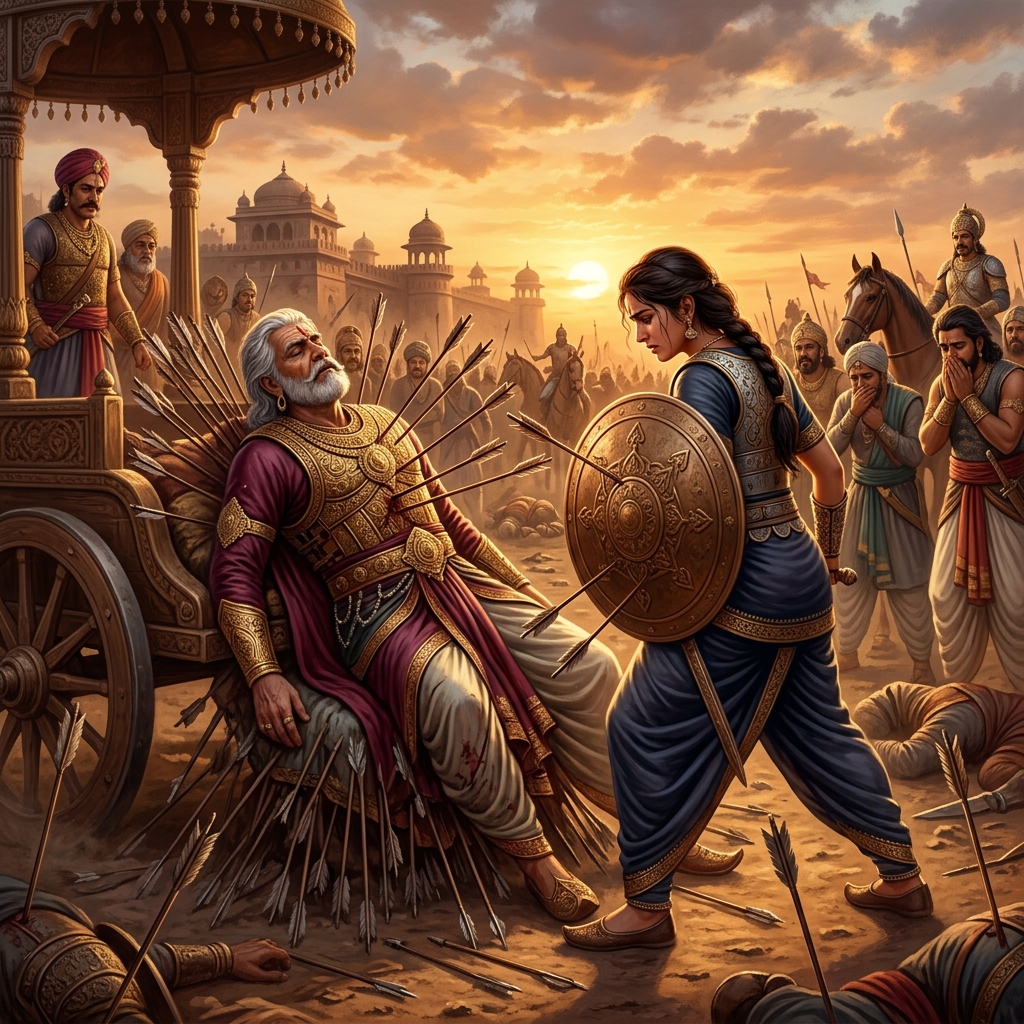
The Accusation in the Night
The accusation had come the night before, in the Kaurava council tent, and it had lodged itself in Bhishma's chest like a splinter that would not be pulled free. Duryodhana, watching eight days of war grind past without the swift victory he had promised himself, had turned on the grandsire in front of the assembled generals and said the one thing an honorable man cannot simply let pass: that Bhishma fought the Pandavas with half a heart, sparing them out of old love, holding back the full weight of his strength because some part of him still wished them to live.
It was not true, or not entirely true, but that did not matter. A man who has kept every vow he ever swore, who gave up a kingdom and a wife and the ordinary comforts of a life so that his father might have his happiness, cannot hear himself called a traitor to his salt and let the words lie where they fell. Bhishma had answered Duryodhana with a promise instead of an argument: tomorrow, he said, he would fight as he had never yet fought in this war, and by evening either the Pandava army would be broken or he himself would be dead upon the field.
He rose on the ninth morning having slept perhaps two hours, and something in the set of his shoulders told the soldiers near him that the old restraint - the restraint that had let this war run nine days without Bhishma using the full measure of what he could do - had been set aside. He took up his bow, and the calm on his face was not peace. It was the calm of a man who has decided something and does not intend to decide it twice.
The Lines Give Way
By midmorning it was clear to everyone on the field, Pandava and Kaurava alike, that the Bhishma of the ninth day was not the Bhishma of the eight days before him. He drove into the Pandava ranks the way a flood moves through a dry riverbed, and the great captains who tried to stand against him - warriors who had held their ground against lesser men without flinching - found themselves pushed back step by step, their chariots shattered, their nerve, harder to break than any chariot, beginning to crack as well.
Yudhishthira watched from behind the line, and dread settled into him with the particular weight of a fear he had been quietly carrying since the war began: that Bhishma, if he ever chose to fight without the mercy he had shown so far, might simply be unstoppable. Company after company gave ground before him, and everyone who could see the field understood that a bend, held long enough, becomes a break.
In the middle of it all, Arjuna's chariot held its place, and Arjuna's arrows kept flying, and yet Krishna, driving him, could feel something wrong in the rhythm of the bow beside him - a hesitation between the draw and the release that had not been there on any other day of the war. Arjuna was shooting at his grandfather. Whatever else Bhishma had become that morning, he was still the old man who had bounced Arjuna on his knee, who had taught him the names of the stars, and no vow of dharma yet spoken had found a way to make an arrow forget that.
The Wheel
Krishna watched Arjuna's arrows land soft where they should have landed hard, watched the Pandava line bend further with every minute that Bhishma's advance went half-answered, and made a decision that broke, in an instant, a promise he had given at the war's very start - that he himself would not raise a weapon in this war, only drive the chariot and counsel the man beside him.
He threw down the reins. He leaped from the moving chariot into the dust of the field, and as he ran toward Bhishma there was a broken chariot wheel lying half-buried in the churned earth - some earlier casualty of the day's fighting - and Krishna snatched it up without breaking stride, lifted it over his shoulder like a discus, and came on toward the grandsire with nothing between himself and the deadliest bow on the field but bare ground and his own two feet.
Bhishma saw him coming and, astonishingly, lowered his bow. There was no fear in the old man's face, only something close to joy. "Come," he called out, loud enough for both armies to hear him, "come, slayer of Madhu. Kill me with your own hand, and I will go from this world having died at the hands of the Lord of all creation. What death could any warrior ask for that is higher than that?"
He meant it. Of all the deaths the war might yet hand him, this was the one Bhishma would have chosen for himself, and for one suspended moment on the ninth day of Kurukshetra, the war's grandest promise - that Krishna would never lift a hand in violence - stood one heartbeat from breaking, because the one man on the field seemed almost eager to let it.
Ten Steps
Arjuna reached them before the wheel fell. He had leaped from the chariot the instant Krishna did, and he closed the distance at a dead run, and when he caught up to Krishna he did not stop to argue - he wrapped both arms around Krishna's legs from behind and simply held on, letting his whole weight drag against Krishna's stride the way a man might try to stop a chariot with his own body.
Krishna did not slow at once. He took perhaps ten more strides with Arjuna hanging from him, dust and fury in his eyes, the wheel still raised, before the weight and the pleading together finally brought him to a halt within a few paces of Bhishma's chariot.
"Forgive me," Arjuna said, still holding on, his voice cracking with something that was not quite fear and not quite shame. "I swear to you, I swear on everything I hold sacred, that from this hour forward I will fight as the war requires me to fight - with my whole strength, without dividing my heart from my hand, whatever it costs me to see him as an enemy and not as my grandfather. But you gave your word at the start of this war that you would not raise a weapon. Let that word stand. Let this vow of yours be the one thing this war does not manage to break. I will keep the fighting true. Only put down the wheel."
Krishna looked at him for a long moment, and then at Bhishma, still smiling that strange, luminous smile of a man who had been offered his own death as a gift and had it taken away from him. Slowly, Krishna lowered the wheel. He let it fall into the dust between them, and without another word he turned and walked back toward the waiting chariot, and Arjuna walked beside him, and behind them Bhishma, still smiling, took up his bow once more.
In the Grandsire's Tent
That night, when the fighting had stopped and the fires were lit on both sides of the field, Yudhishthira did a thing that struck his own brothers as close to madness: he called for a chariot, gathered Arjuna and Krishna to ride with him, and drove across the no-man's-land between the two camps to the Kaurava lines, to the tent of the very man who had very nearly broken the war's oldest vow that morning trying to reach his own death.
The guards let them pass. Bhishma received his enemies as he had always received them, with an old man's plain and unguarded love, and asked after their health as though they had come from a hunting trip rather than a battlefield. Yudhishthira, kneeling before him, asked the question that had brought him across the field: how could Bhishma be defeated at all, when even his restrained, half-hearted fighting had come near to breaking the Pandava army in a single morning.
Bhishma did not make him ask twice, and he did not soften the answer to spare anyone's feelings. "While I stand and choose to fight, this war cannot be won," he said. "I tell you this not to boast of it but because it is simply true, and because I love you too well to let you go on hoping otherwise." He told them, then, plainly and without bitterness, of the one condition under which his bow would fall silent - the presence on the field of a warrior he had sworn, for reasons of his own old grief, that he would never raise a weapon against.
Yudhishthira thanked him, and wept a little, and Bhishma let him weep without embarrassment on either side. When the Pandavas rode back across the dark field toward their own fires, none of them spoke of what waited for the old man they had just embraced. The tenth day was coming, and what it would ask of the warrior Bhishma would not fight, and of Arjuna standing behind him, was a story the field itself would tell.
Dharma Lesson
Bhishma's near-broken vow and Krishna's own broken promise reveal that even the most sacred oaths bend under the pressure of love and grief - yet what matters is not that the pressure exists but how it is answered. Arjuna's vow to fight truly, and Bhishma's insistence that his word about Shikhandi still binds him, both restore the order that had nearly come undone. Even in enmity, honesty and love need not be sacrificed; Bhishma's warm welcome to the men who will one day end his life shows that dharma and affection are not enemies.