The Sage at the Gate
Long before the great war, before the dice and the disrobing and the blood of Kurukshetra, there was a girl named Pritha who would one day be called Kunti. She was the natural daughter of the Yadava chief Shurasena, but she had been given in childhood to his cousin, the childless King Kuntibhoja, who raised her as his own and gave her his name.
She grew up in the king's house on the green banks of the Charmanvati, a clever and gentle girl with quick eyes and a quieter heart. Kuntibhoja loved her, and because he trusted her judgment more than that of any servant in the palace, he laid upon her a heavy duty.
For a great and terrible guest had come to his gate. The sage Durvasa, an aspect of fierce austerity himself, famous through all the three worlds for the fire of his penance and the shortness of his temper, had chosen to lodge in Kuntibhoja's kingdom. Sages of his kind were not turned away. Nor were they easily pleased. A single slight, a single late meal or careless word, could call down a curse that no king's army could undo.
"Daughter," Kuntibhoja said, taking her hands, "I have promised the holy one that he will be served as the gods are served. Honest men fear his anger, and I will not pretend that I do not. You are patient where others are proud. You do not answer back. You watch and you remember. To you, and to no one else, I give the care of the great Durvasa. Serve him as you would serve your own god, and do not let your devotion fail, however he tries you."
Kunti bowed her head. "I will serve him, father," she said, "so that he leaves your house with a blessing and not a curse." She did not yet know how strangely that blessing would come, nor what it would cost her.
Serving the Irascible One
It was no small thing she had taken upon herself. Durvasa was a guest the way a fire is a guest in a dry field.
He asked for his meal at dawn, and then would not eat until dusk. He asked for it at midnight, and Kunti rose and kindled the cooking fire without complaint. Some days he called for food and, when it was set before him, swept it aside and demanded something else entirely. Some days he would not eat at all, but only wished to be bathed, or anointed with sandal paste, or have his feet washed in cool water and then in warm. He came home from the forest smeared with mud and ash, and she cleaned him without flinching. He spoke harshly to her for faults she had not committed, and she answered only, "It is my fault, holy one. Forgive me."
Weeks turned into seasons. The sage tested her the way a smith tests metal, looking for the crack, the moment of resentment, the flicker in the eye that says, I am tired of you. He did not find it. When he raged, she grew gentler. When he changed his mind a dozen times in an hour, she simply began again. She kept his fire fed and his vessels clean and her own face calm, and she never once let him see that she was weary.
"You do not sleep," he observed one night, watching her over the rim of his cup. "You wait on me as if I were a god, though I have given you nothing but trouble."
"My father charged me to serve you well," she answered, "and a guest is a god. There is no trouble in it, only duty, and I am glad of the duty."
The sage said nothing, but something in his fierce face softened, and he went on testing her, for he was not a man who blessed lightly.
The Boon of the Mantra
At last the day came when Durvasa was satisfied. He had stayed a full year in Kuntibhoja's house, and in all that year the girl had never failed him, never frowned, never made him feel the weight of his own difficult nature. Such constancy was rarer to him than any wonder of the forest.
He called her before him. "Child," he said, and for once his voice was not a storm, "you have served me as no one in this world has served me. I came as a trial and you bore me as a blessing. Pleased am I with you, daughter of kings, and the pleasure of one such as I is not an empty thing. Receive from me a gift that will repay your patience."
Kunti folded her hands. "To have served you and earned no curse is gift enough, holy one."
"That is why you shall have more," the sage said. "Listen, and learn this mantra well, and guard it." Then, in the quiet of the inner room, he taught her a secret incantation, syllable by syllable, until it was fixed in her memory. "This is its power. By it you may summon any god of the heavens whom you choose to call. Whichever deity you invoke with this mantra, he must appear before you, bound by the word, and by his grace you shall obtain a son who carries the splendor of that god in his blood. This is my boon. Use it wisely, when the time is right."
Kunti's heart fluttered with the strangeness of it. "My lord, I am unmarried, a girl in my father's house. What use have I for such a thing now?"
"Keep it for the day you have need," Durvasa said. "A gift is given when the giver pleases, not when it is wanted." And with that, his penance done and his hospitality repaid, the great sage took up his staff and departed, leaving Kunti alone with a word that could call the gods down from the sky.
Curiosity at Dawn
The mantra lived in Kunti like a coal under ash. She told no one. But a young heart cannot hold a secret of that size and feel nothing.
Seasons passed. She went on as before, the dutiful princess, but now and again the words would rise unbidden to the edge of her tongue, and she would press them back down. Could it be true? Could a girl alone in a quiet room truly call a god out of the burning heavens? Or had the strange sage spoken in riddles, as holy men did, and given her only a string of meaningless sounds to humor an old vow?
One morning before the household woke, Kunti rose and went to her window. The east was beginning to redden. The first light slid across the river and turned the water to beaten copper, and over the trees the disc of the sun lifted itself, vast and golden and burning.
She was very young. The wish to know, simply to know whether the thing was real, swelled in her until it was larger than caution. I will only test it, she told herself. I will call a god and see his face, and then I will let him go, and no harm will be done. It is a small thing, surely, to look once upon a wonder.
Her eyes fixed upon the rising sun. Almost without deciding to, the way one speaks in a dream, she gathered the syllables Durvasa had given her, and with her gaze upon Surya, the lord of light, she spoke the mantra aloud and bade the sun god come to her.
The words left her lips. For a heartbeat the world was ordinary - the cool floor, the bird-noise, the river. Then the light at the window changed.
Surya Descends
The brightness in the window did not stay in the window. It grew, and gathered, and came toward her, and out of it stepped a being so radiant that Kunti's eyes streamed and she could scarcely look. He wore garlands of gold and earrings that flashed like two small suns, and a glory poured off his body that filled the little room and pressed upon her like noon at its fiercest. It was Surya himself, drawn down out of the sky by the sage's word.
Kunti shrank back, suddenly cold with terror at what she had done. "Forgive me, lord," she stammered. "I called you only to test the truth of a boon. I am a maiden, unmarried, in my father's house. I meant no summons in earnest. Return, I beg you, return to the heavens, and let no harm come of my foolishness."
The sun god looked upon her with a face both kind and inexorable. "Maiden, I cannot come and go for sport," he said, and his voice was like warmth itself made into sound. "The mantra of Durvasa does not call idly. You have summoned me, and I have come, and I am bound by the very power that brought me here. It does not return empty. By that sacred word you must receive of me a son, and I, drawn down against the order of the sky, cannot go back as I came. This is no fault of mine, nor wholly yours - it is the nature of the boon you were given."
"Then I am undone," Kunti whispered. "What will my father say? What will the world say of an unwed girl with a child? Spare me this, great lord."
"I will spare you all I can," Surya answered gently. "Hear me. The son you bear shall be a hero among heroes, and your maidenhood shall remain untouched and whole, so that no shame falls on you before men. This I grant by my own power, that you may yet hold up your head. The rest the boon decides." And so it was, by the will of the god and the binding of the mantra, that Kunti conceived a son, while Surya returned at last to his place in the burning sky.
The Hidden Months
What had been done could not be undone. The light went out of the room, the god was gone, and Kunti was left alone with a secret that grew heavier with every passing day.
She was clever, and fear made her cleverer still. With the help of a faithful nurse who had raised her and who would have died before betraying her, Kunti withdrew into the inner apartments. She let it be put about that the princess was unwell, that she needed quiet and seclusion, and the women of the household asked no questions of a king's daughter. Through the long months she kept herself apart, hidden behind veils and closed doors, while the child of the sun grew within her.
They were terrible months. By day she walked among her companions and smiled and spoke of small things, and her heart beat in her throat for fear of being found out. By night she lay awake and turned the thing over and over - how she had called the god only to test a boon, how curiosity had cost her so much, how a single morning's wish to know had reshaped the whole of her life. She wept, but quietly, so that the walls would not hear.
And yet, strangely, she could not hate the child. As the months wore on she felt him move, and a love she did not want and could not refuse rose up in her against all reason. He was hers. Whatever came of it, whatever the world would say, the small fierce life inside her was her own, and the part of her that was a mother grieved already for what the part of her that was a frightened girl knew she would have to do.
The nurse held her hands in the dark. "Whatever you decide, child," the old woman murmured, "I will keep your secret to my grave." Kunti pressed those worn hands to her wet face and said nothing, because there were no words for the choice that was coming.
A Son Born of the Sun
In the fullness of time, in the deepest secrecy of the inner chamber, with only the faithful nurse beside her, Kunti gave birth to her son.
And from the first moment they saw him, both women knew that this was no ordinary child. He came into the world already shining. Upon his body, fitted to him as if grown there, gleamed a coat of golden armor - kavacha - that no smith of men had forged; and in his ears hung earrings - kundala - of the same celestial gold, bright as the orbs of the sun itself. His face was beautiful and lion-like, and a soft radiance clung to his skin, the unmistakable splendor of his father in the sky. He was a portion of Surya himself walking the earth.
Kunti gathered him to her, and for one long hour she was only his mother and nothing else. She traced the small jeweled ears, the breastplate that was a part of his very flesh, and she marveled even through her tears. "My son," she breathed. "My beautiful son, born of the light. Forgive me. Forgive me for what I am about to do, for I have no other road to walk."
For the truth was a knife. She was unmarried. She was a king's daughter, and the honor of Kuntibhoja's house and of all her kin hung upon her name. If it were known that the princess had borne a child, the shame would fall not on her alone but on her father, her family, the very kingdom that had sheltered her. She had earned the boon by virtue and lost herself to a child's curiosity, and now virtue and curiosity alike demanded the same cruel price. She could not keep him. To save them all, she would have to give him to the river and to fate.
So she did not let herself weep too long. There was a thing to be made ready, and the night was passing, and a frightened girl who was also, now, a mother, set about losing the only thing she had ever made.
The Basket Upon the Water
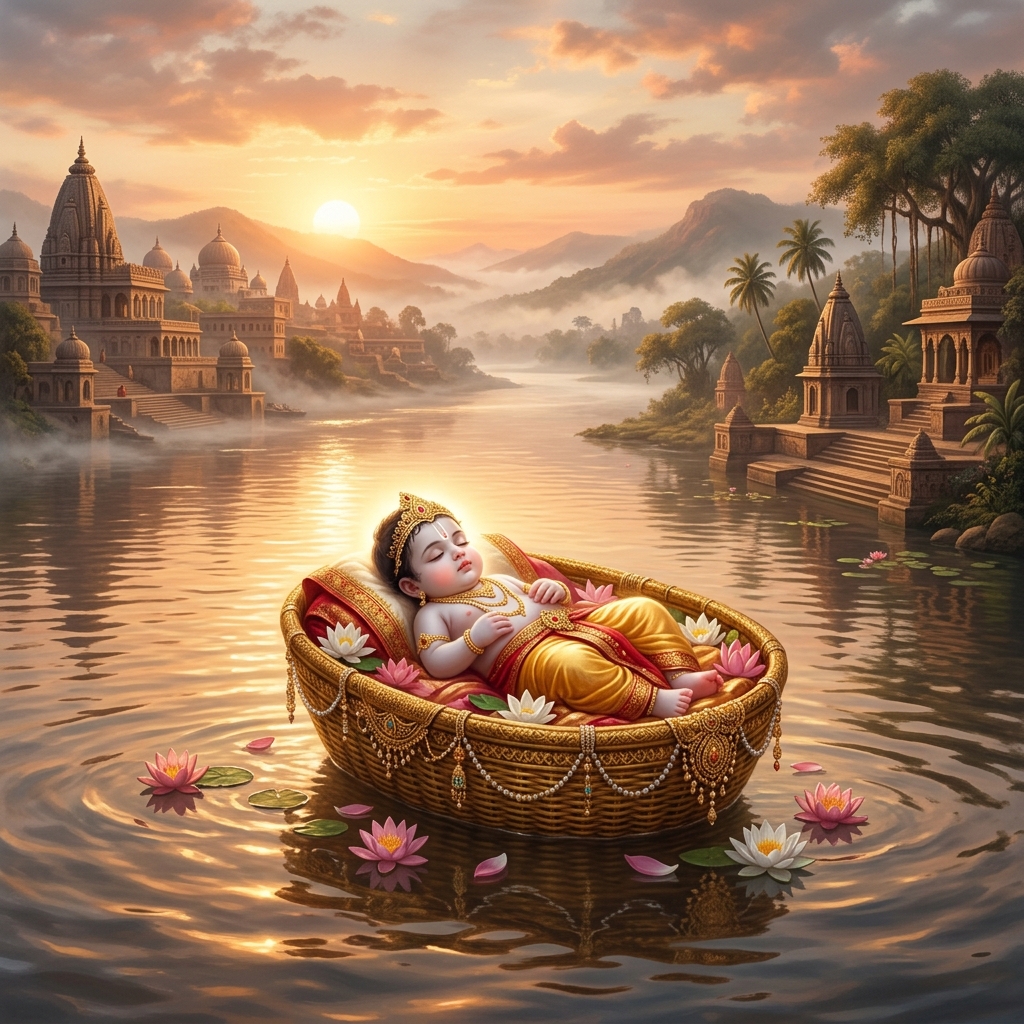
Through the dark hours before dawn, Kunti and the old nurse worked with quiet, shaking hands. They took a wide basket of woven wicker and made it watertight, smearing it well with wax so that no water might seep in. They lined it with the softest cloth, and over that a bed of silk, fit for the prince he should have been. Into this little ark, warm and sealed, Kunti laid her sleeping son, the golden armor glinting in the lamplight, and she covered him against the cold of the river.
Then, wrapped in plain dark veils so that no watchman would know the princess, the two women slipped out through a side gate and went down through the sleeping town to the water. There, where the river ran broad and dark beneath the last of the stars, Kunti knelt at the edge with the basket in her arms, and her resolve nearly broke.
She kissed his forehead. Her tears fell upon the golden breastplate and slid away. "Go, my child," she whispered. "May the waters keep you that I cannot. May they that dwell on land and in the river and in the sky watch over you on this road. May your father's own light go before you. Wherever the current carries you, whoever finds you, may they love you as I love you, and may we meet again in some kinder hour than this."
And then, because to wait was only to suffer more, she set the basket upon the water and let it go.
The river took it gently. It turned once in the slow current, righted itself, and began to drift away from the shore, away from the lamps of the town, a small dark shape upon the wide pale water. Kunti stayed kneeling at the bank, one hand pressed to her mouth, and watched until the darkness and the distance swallowed her son entirely. Then the nurse drew her up, and they went back the way they had come, and the princess walked into her old life as though nothing had been torn out of it - while down the river, through stream after stream, the basket bearing the child of the sun floated on toward a stranger's hands.
Adhiratha and Radha
The little ark did not sink, and it did not stop. Carried from the Charmanvati into greater waters, and at last into the broad and holy current of the Ganga, it drifted on through the country of the Kurus, past fields and ghats and grazing cattle, until it came near the place where a certain charioteer made his home.
His name was Adhiratha, a suta - a man of the charioteer caste, neither low nor noble, who drove the cars of kings and stood close to the great without being of them. He served the house of Hastinapur, and he was a good and gentle man. His wife was Radha, and the two of them had long grieved over a single sorrow: in all their years together they had never been blessed with a child of their own, and the silence of their house had become a quiet, constant ache.
It was Radha who saw it first. She had gone down to the river that morning, and there upon the water, caught and turning in an eddy near the bank, was a sealed basket. Something about it drew her - perhaps only chance, perhaps the design of greater powers - and she called to her husband, and together they drew it from the stream and lifted the lid.
Within lay an infant boy, alive and well, asleep upon silk. And as the morning light fell on him, both of them cried out in wonder, for he was clad in golden armor that was part of his own body, and in his ears hung earrings of celestial gold, and a glow lay upon his face like a small fragment of the sun come down to earth. Radha had never seen, never dreamed of, anything so lovely.
"Husband," she said, scarcely able to speak, her empty arms aching toward him, "the gods have heard us. They have sent us a son upon the water."
The Charioteer's Son
Adhiratha looked upon the child, and his careful heart warred with his hope. Who could have set such a babe upon the river? The golden mail, the blazing earrings, the unearthly light - this was no foundling of poor folk. This was a child marked by the heavens. And yet here he was, given to the water, given, it seemed, to whoever the current chose. To Adhiratha and Radha, the childless, the longing, the kind.
"He is no common infant," the charioteer said softly, touching the warm gold of the armor. "Some great sorrow set him adrift, some secret we will never know. But the river has brought him to our door, and we who have no son have found one. If the gods have given him to us, who are we to refuse the gift?"
Radha was already weeping with joy, the child held close against her breast at last. "He is ours," she said. "From this day he is ours, and no one shall ever love him better."
So the charioteer and his wife took the child of the sun into their home and raised him as their own true son. Because of the golden armor in which he was born, rich with treasure, they called him Vasusena, the one born with wealth; and Radha loved him so dearly that men would also know him as Radheya, the son of Radha. In later days, for his radiance and his cutting of his own divine armor, the world would call him Karna. By his foster-mother's milk and his foster-father's trade he became, in the eyes of all, a suta's son, a charioteer's boy, with no hint of the throne and the goddess-mantra and the burning god from which he truly sprang.
Neither Adhiratha nor Radha ever learned the truth. Nor did the boy himself. Kunti, far away in her father's house, kept her secret locked in her breast and told no living soul, carrying her grief in silence for the rest of her days.
The Radiant Boy
Karna grew up in the charioteer's quarter, among the smell of horses and harness and river mud, and he grew like a young flame. Even as a boy there was something about him that made men turn their heads. He was taller than his fellows, broader, stronger; his step had a lightness and his eyes a brightness that did not belong to the dusty lanes where he played. The golden armor grew with him, fitted always to his body, and the earrings shone in his ears, and though folk wondered at them, no one guessed their meaning. They were simply Vasusena's strange and lovely marks.
He was generous beyond his station and brave beyond his years. He honored his foster-parents, did his share at the work of the stables, and learned to handle horses as his father did. But always there burned in him a hunger that a charioteer's life could not feed - a longing for arms and arrows, for glory, for some greatness he could not name and did not understand. He would watch the warriors and the princes ride out, and his heart would strain after them, and he could not have said why the suta's quarter felt to him like a borrowed coat that did not fit.
The secret of his birth lay buried in the river and in his mother's silent heart. He did not know that the sun was his father, that a princess had wept over him at the water's edge, that the proudest blood of the Kurus and the Yadavas ran in his veins. He believed himself only Radha's son, the charioteer's boy, and on that single false belief the whole long tragedy of his life would turn.
Yet the splendor in him could not be hidden, nor the nobility, nor the doom. The child set adrift to save a girl's honor would grow into one of the mightiest warriors the world had ever seen - generous, loyal, forever wounded by the question of who he was. And it had all begun with a sage at a gate, a girl's patient devotion, and one curious morning when she looked upon the rising sun and spoke a word she should have kept unspoken.
Dharma Lesson
The circumstances of one's birth do not define one's greatness. Karna, abandoned at birth and raised by a charioteer, became the most generous warrior of his age. Yet his story also warns that the wounds of rejection, if left unhealed, can drive even noble souls toward destructive alliances.
Common Questions
Is Karna older than Yudhishthira?
Yes. Karna is Kunti's firstborn, conceived by the sun god Surya before her marriage to Pandu, which makes him older than all five Pandavas including Yudhishthira. Had his birth been known he, not Yudhishthira, would have held the elder claim, and the truth surfaced only after his death.
Why did Kunti abandon Karna?
Kunti was an unmarried princess when the sage Durvasa's mantra summoned Surya and she bore a son. Fearing disgrace, she set the armored infant in a basket on the river. The epic presents this as terror rather than cruelty, and her lifelong silence becomes the wound that shapes Karna's whole life.
Who raised Karna?
Karna was found floating on the river by Adhiratha, a charioteer or suta of Hastinapura, and raised by him and his wife Radha - hence the names Radheya and suta-putra. The caste of his upbringing, not his solar birth, determined how the Kuru court treated him for life.
What curses was Karna given?
Two curses shape his end. Parashurama, learning Karna had lied about his birth to study under him, cursed that his weapon knowledge would desert him at the crucial moment. A brahmin whose cow he killed by accident cursed that the earth would seize his chariot wheel in his hour of greatest danger.