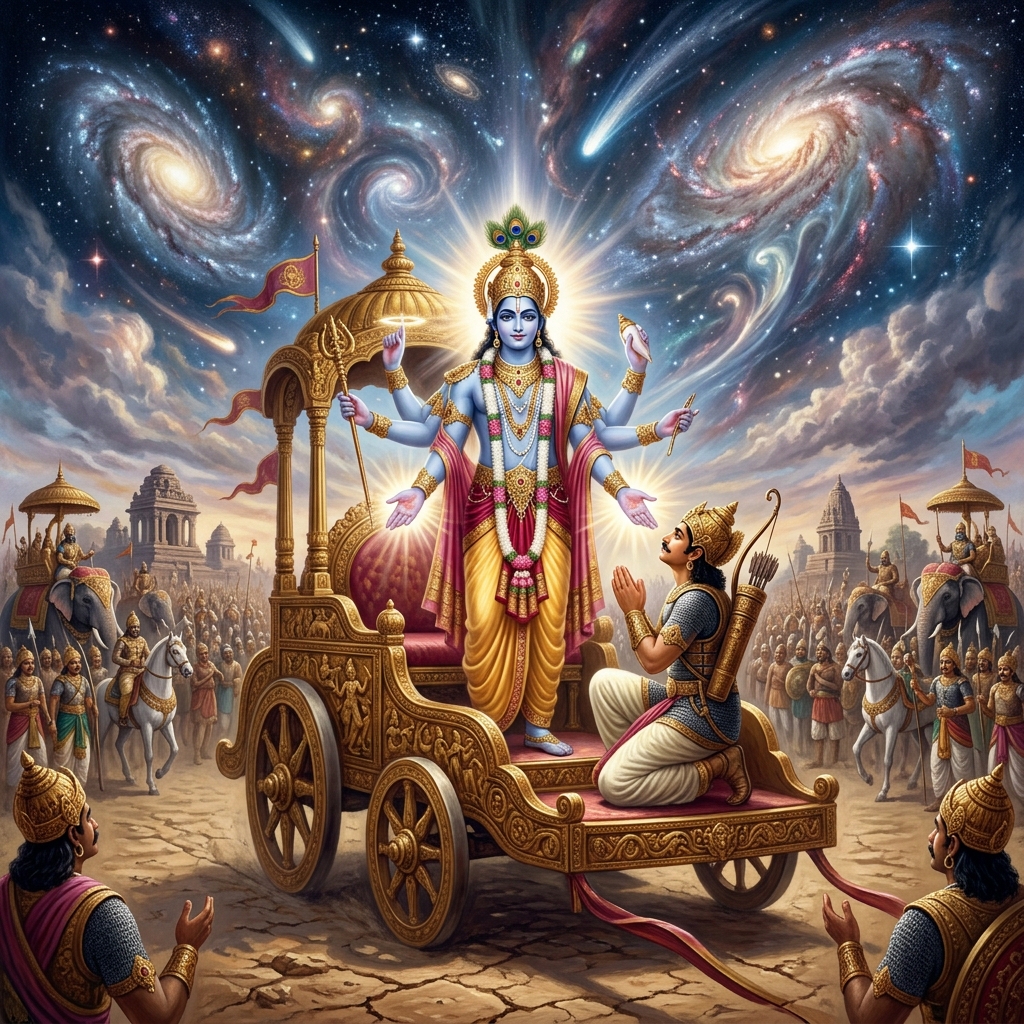
Halt Between the Hosts
The sacred plain of Kurukshetra stretched to the horizon, and upon it stood the two greatest armies the world had ever gathered. On one side waited the eleven divisions of the Kauravas, a sea of elephants, chariots, horses, and men whose banners darkened the sky. Facing them stood the seven divisions of the Pandavas, fewer in number but burning with the certainty of a wronged cause. The dust of marching feet hung in the morning air, and the silence before war was heavier than any sound.
Conch shells shattered that silence. Bhishma, the grandsire, blew his conch like a lion's roar, and the Kaurava drums and trumpets answered until the very earth seemed to tremble. Then from the Pandava lines Krishna lifted the Panchajanya to his lips, and Arjuna sounded the Devadatta, and Bhima the great Paundra, and the noise of those conches filled heaven and earth and pierced the hearts of Dhritarashtra's sons.
Among the Pandava ranks one chariot shone brighter than the rest. Its horses were white as river foam, its banner bore the image of Hanuman, and its wheels were wreathed in the light of a thousand vows. In it sat Arjuna, the finest archer in all the worlds, his great bow Gandiva resting across his knees. And holding the reins before him sat his charioteer and friend, Krishna - the dark lord of Dwaraka, the eternal one wearing a mortal face.
"Krishna," said Arjuna, "drive my chariot into the space between the two armies, so that I may look upon those who have come here eager for battle, and see with whom I must fight on this terrible day."
Krishna took up the reins and guided the white horses forward, halting the splendid chariot in the open ground between the hosts, in full view of Bhishma and Drona and all the assembled kings. "Behold, Arjuna," he said quietly, "the Kurus gathered together."
The Sight of Kinsmen
From the center of the field Arjuna let his eyes travel slowly across the enemy ranks, and what he saw drained the strength from his limbs. These were not strangers. These were not faceless foes to be cut down without grief. These were his own.
There stood Bhishma, the grandsire who had taken him upon his knee when he was a child, who had wept over his cleverness and loved him as his own grandson. There stood Drona, the teacher who had placed the bow in his hands and made him the archer he was, who had loved him above all his other pupils. He saw uncles and grand-uncles, fathers-in-law and well-wishers, cousins he had grown beside, companions of his youth, and the sons of those companions, all standing in their armor with weapons drawn, ready to kill and ready to die.
A terrible compassion rose in him and overwhelmed his warrior's resolve. "Krishna," he said, and his voice was not steady, "when I see my own people gathered here, longing to fight, my limbs fail and my mouth goes dry. My body trembles and the hair stands up upon my skin. The Gandiva slips from my hand and my very skin seems to burn. I cannot stand. My mind reels."
He looked again at the faces he loved arrayed for slaughter, and grief swallowed him whole. "I see evil omens, Krishna. I see no good can come of killing my own kinsmen in battle. I do not desire victory, nor kingdom, nor the pleasures of a throne. What use is a kingdom to us, what use is enjoyment, what use even is life, when the very people for whose sake we would want all these things now stand before us prepared to give up their lives and their wealth?"
Arjuna Drops the Bow
"Teachers, fathers, sons, grandfathers, uncles, fathers-in-law, grandsons, brothers-in-law, and kinsmen - these I do not wish to kill, Krishna, even if I am killed myself, not even for the kingship of the three worlds, how much less for the sake of this earth."
"What joy could there be for us, having slain the sons of Dhritarashtra? Sin alone would cling to us if we struck down these men, criminals though they are. We have no right to kill our own kinsmen. How could we ever be happy again with the blood of our own family upon our hands?"
He spoke of the ruin that follows war, of families broken and ancient laws forgotten, of the chaos that comes when the protectors of a people destroy one another. The more he spoke, the heavier his heart grew, until the weight of it bent him down. "Far better," he said at last, "that the armed sons of Dhritarashtra should slay me in battle, unresisting and unarmed, than that I should raise my hand against them."
And then the greatest archer of the age, who had never once faltered in the face of any foe, let the great bow Gandiva slip entirely from his grasp. It fell against the floor of the chariot. His splendid armor felt suddenly like a shroud, and he sank down upon the seat of the chariot, his mind overwhelmed with sorrow.
"I will not fight," he said. And he fell silent, tears upon his face, in the open ground between the two armies, while the conches still echoed and a hundred thousand warriors waited for the battle to begin.
This sorrow of Arjuna, this collapse of the hero on the threshold of war, the wise would later call the Arjuna-vishada, the despondency from which the whole song of God would be born.
The Deathless Self
Krishna looked upon his friend, trembling and weeping in the chariot, and there was no anger in his gaze, only an infinite tenderness and an infinite knowing. He saw the man Arjuna, undone by love and pity. But he saw also the cosmic hour that had arrived, the dharma that hung in the balance, and the eternal truth that lay hidden beneath the illusion of death.
"You grieve for those who should not be grieved for," Krishna said, "and yet you speak words that sound like wisdom. The truly wise mourn neither for the living nor for the dead. Never was there a time when I did not exist, nor you, nor these kings before us. Nor will there ever be a time when we shall cease to be."
"As the soul wears these bodies of childhood, youth, and old age and passes through them, so it passes into another body at death. The wise are not deceived by this."
He spoke then of that which cannot die. "That which pervades all this is indestructible. No one can bring about the destruction of the imperishable. The bodies are said to have an end, but the dweller within them is eternal, beyond measure, beyond destruction. He who thinks the self can slay, and he who thinks the self can be slain, both are mistaken. The self does not slay, nor is it slain."
"It is never born and it never dies. It has not come into being, and it will not cease to be. Unborn, eternal, changeless, ancient - it is not killed when the body is killed. As a man casts off worn-out garments and puts on others that are new, so the embodied self casts off worn-out bodies and enters into others that are new."
"Weapons do not cut it, fire does not burn it, water does not wet it, and the wind does not dry it. It is everlasting, all-pervading, unchanging, and immovable. Knowing this, Arjuna, you should not grieve."
One's Own Dharma
"And consider your own duty," Krishna went on, "for that too should keep you from trembling. You are a warrior, born to the order of the kshatriya, and for a warrior there is no higher good than a righteous war. Happy are the warriors who are offered such a battle, for it is an open door to heaven. But if you refuse to fight this righteous fight, then you abandon your own duty and your own honor, and you take upon yourself the burden of sin."
"People will speak of your disgrace forever, and for one who has been honored, dishonor is worse than death. The great warriors who esteem you now will think that you withdrew from battle out of fear, and you will fall low in the eyes of those whose regard you once cherished. Your enemies will mock your strength with cruel words. What could be more painful than that?"
Then Krishna lifted the teaching higher, beyond reward and beyond reputation, to the very heart of right action. "If you are slain, you gain heaven. If you triumph, you enjoy the earth. Therefore rise up, Arjuna, resolved to fight. Treat pleasure and pain alike, gain and loss, victory and defeat, as one and the same, and then engage in battle. So doing, you shall incur no sin."
Arjuna listened, and something in the storm of his grief began to still, though he did not yet understand. Krishna saw the question forming in him and did not wait for it. "What I have told you so far is the wisdom of right understanding. Now hear the wisdom of right action, by which, when you possess it, you shall break the bonds of karma itself."
Action Without Its Fruits
"You have the right to your action alone," Krishna said, "but never to its fruits. Let not the fruit of action be your motive, and let not your attachment cling to inaction. Established in yoga, perform your work, abandoning attachment, remaining the same in success and in failure. This evenness of mind is what is called yoga."
This was the teaching of karma-yoga, the path of selfless action, and Arjuna leaned toward it like a man hearing a familiar song. "Action is far superior to inaction," Krishna told him. "You could not even keep your body alive without acting. But action done as sacrifice, without selfish desire, without grasping after its result, does not bind. It is selfish craving that binds the soul, not action itself. The one who acts and yet renounces the fruit of action within the heart is the true renouncer."
"The one whose every undertaking is free from selfish desire, whose deeds are burned clean in the fire of wisdom - him the wise call a sage. Content with whatever comes, beyond the pairs of opposites, free of envy, balanced in success and failure, such a one is not bound even though he acts."
"Better is one's own duty, though imperfectly done, than the duty of another well performed. Better to die fulfilling one's own dharma. The duty of another is full of danger."
The sun climbed higher over Kurukshetra, and still the armies waited, for to Arjuna it was as though time itself had paused so that this one soul might be set right before the killing began. He drank in the words, and slowly the despair that had felled him began to lift, replaced by a wonder he could not yet name.
Devotion and Knowledge
"There are many paths," Krishna continued, "but they lead to one summit. Some come to me by the path of knowledge, jnana, learning to see the one Self in all things, learning that the field and the knower of the field are not the same, that the wise look with equal eyes upon a learned and humble brahmin, a cow, an elephant, and even an outcast, for they perceive the one imperishable presence that dwells equally in all."
"And some come to me by the path of devotion, bhakti, and this path is dear to me above all. Fix your mind on me, be devoted to me, worship me, bow down to me, and you shall come to me. Whatever you do, whatever you eat, whatever you offer, whatever you give away, whatever discipline you practice, do it as an offering to me. Even if the worst of sinners worships me with undivided love, he is to be counted among the good, for he has rightly resolved."
"Whoever offers me with devotion a leaf, a flower, a fruit, or even water, that offering of love, of the pure of heart, I accept. I am the same to all beings. None is hateful to me and none especially dear. But those who worship me with devotion live in me, and I in them."
Then Krishna spoke of his own hidden presence in all the world, and his voice seemed to widen until it filled the space between the armies. "I am the source of all. From me everything proceeds. I am the taste in water, the light in the moon and sun, the sacred sound in all the scriptures, the sound in the air, the courage in men. I am the pure fragrance of the earth and the brightness in fire. I am the life in all that lives. Of all that is, I am the beginning, the middle, and the end. Whatever is glorious, beautiful, or mighty in this world springs from a fragment of my splendor."
Show Me Your True Form
Arjuna's heart was full to overflowing, and his grief was now utterly gone, washed away by the words of his friend. Yet a longing rose in him deeper than any he had known. He had heard Krishna speak of himself as the origin and dissolution of all beings, as the eternal one pervading the worlds. Now he ached to behold it, not in words but in truth.
"You have spoken to me of your supreme mystery," Arjuna said, joining his palms, "and my delusion is gone. But Lord, if you think that I am able to bear the sight of it, then show me your imperishable Self. Show me, O master of yoga, your true and cosmic form."
Krishna smiled, and there was an ocean of love in that smile and something vast and terrible behind it. "Behold, Arjuna, my hundreds and thousands of forms, of many kinds, of many colors and shapes. Behold the whole universe, the moving and the unmoving, gathered together in this my body, and whatever else you wish to see. But with your mortal eyes you cannot perceive me. Therefore I give you a divine eye. Behold now my sovereign power."
And with those words Krishna, the great lord of yoga, revealed to Arjuna his supreme and absolute form. The mortal eyes were opened to a divine sight, and what unfolded before the trembling warrior cannot be wholly told in the speech of men.
The Universal Form
Arjuna beheld the Vishvarupa, the Universal Form, and it was as if a thousand suns had risen at once into the sky, their combined radiance the glory of that boundless being. He saw within the single body of Krishna the whole of creation, all that was scattered and many gathered into one. He saw countless mouths and countless eyes, countless wondrous shapes, decked with celestial ornaments and divine weapons beyond number, wearing heavenly garlands and robes, anointed with the fragrances of paradise - a form facing everywhere at once, infinite, marvelous, and without beginning, middle, or end.
The brilliance of it was unbearable, blazing like fire and the sun, immeasurable, filling all the space between heaven and earth and pouring into every corner of the four directions. Arjuna saw the gods themselves entering into that form. He saw sages and serpents and hosts of celestial beings gazing upon it in astonishment. He saw all the worlds, with their fear and their wonder, contained within one.
His hair stood on end. Bowing his head, joining his palms, his whole body shaking, he found his voice and said, "O Lord, I see within your body all the gods and all the orders of beings, the sages, the divine serpents. I see you without end or middle or beginning, infinite in power, with countless arms, the sun and the moon your eyes, your mouth a blazing fire, your radiance scorching all this universe. The space between heaven and earth is filled by you alone. The three worlds tremble at this terrible vision of you."
Time, the Destroyer of Worlds
But the vision did not stay only glorious. As Arjuna gazed, the form grew terrible. He saw the warriors of both armies rushing into Krishna's blazing mouths as moths fly headlong into a flame. He saw Bhishma and Drona and Karna, and the chiefs of the Kauravas, and the warriors of his own side as well, being swept into those fearful jaws, some caught between the gleaming teeth, their heads crushed to powder. As many rivers run swiftly to the sea, so these heroes of the world of men poured into those flaming mouths and were consumed.
Arjuna's heart shook within him. "Tell me who you are, fierce in form," he cried. "I bow to you, be gracious to me. I long to know you, you who were before all, for I do not understand what you are doing."
And the answer came like thunder rolling over the plain. "I am Time," said the Lord, "the mighty destroyer of the worlds, and I have come forth to consume all these beings. Even without you, the warriors arrayed in the opposing ranks shall cease to exist. Therefore arise and win glory. Conquer your enemies and enjoy a prosperous kingdom. By me alone they are already slain. Be merely the instrument, Arjuna."
"Drona and Bhishma and Jayadratha and Karna and all the other heroes of war have already been struck down by me. Slay them, and do not waver. Fight, and you shall conquer your foes in battle."
Trembling Awe and Surrender
Hearing these words from the crowned lord of the universe, Arjuna pressed his palms together, trembling, and bowed again and again. His voice came choked with awe as he praised the form before him. "Rightly does the world rejoice and delight in your glory. The demons flee in terror to every quarter, and all the hosts of the perfected ones bow down to you. And how should they not bow, O great soul, first cause of all, infinite, lord of the gods, refuge of the universe? You are the imperishable, the supreme to be known, the ultimate resting place of all this. You are the eternal guardian of the everlasting law."
Then, remembering all the careless words he had spoken in friendship, he was struck with shame and fear. "Whatever I said rashly, calling you simply Krishna, or my comrade, or my friend, not knowing your greatness, in carelessness or in love, and whatever disrespect I showed you in jest, at play, at rest, at meals, alone or before others - for all of it, immeasurable one, I beg your forgiveness."
"You are the father of the world, of all that moves and does not move. There is none equal to you in all the three worlds. How could any surpass you, whose power is beyond compare? Therefore I bow down, I prostrate my body, I beg your grace, O adorable Lord. As a father bears with his son, a friend with his friend, a lover with his beloved, so bear with me. I have seen what was never seen before, and I rejoice, yet my heart is shaken with fear. Show me again your other form, be gracious, O Lord of gods, refuge of the worlds."
Taking Up the Gandiva
Moved by his devotee's plea, Krishna gently withdrew the overwhelming vision. The thousand suns faded, the countless arms and blazing mouths were gone, and once again the dark and gracious friend stood before Arjuna in his familiar human shape, comforting the frightened warrior with his gentle form. The terror passed from Arjuna's heart, and he came back to himself.
"Now that I see again your gentle human form," Arjuna said, breathing slowly, "my mind is composed and I am restored to my own nature." And Krishna told him, "This form of mine that you have seen is hard to behold. Even the gods long forever to glimpse it. Not by the scriptures, not by penance, not by gifts, not by sacrifice can I be seen as you have seen me. But by undivided devotion alone can I be known in truth, seen in truth, and entered into."
Then Krishna drew the long teaching to its close. "I have given you wisdom more secret than all secrets. Reflect upon it fully, and then do as you choose." And at the last, the deepest word of all: "Abandon all other duties and come to me alone for refuge. Do not grieve, for I shall free you from all sins."
Arjuna lifted his head. The despair that had felled him was utterly gone, and in its place was a clear and steady resolve. "My delusion is destroyed," he said, "and by your grace I have regained my memory of who I am. I stand firm, with my doubts dispelled. I will act according to your word."
And the greatest archer of the age stooped, took up the great bow Gandiva from where it had fallen, and rose to his feet upon the chariot. Krishna gathered the reins of the white horses. The conches were ready, the armies stirred, and on the field of Kurukshetra, his sorrow burned away and his purpose made whole, Arjuna stood at last prepared to do his duty.
Dharma Lesson
When duty and emotion conflict, one must rise above personal attachment and act according to dharma. Krishna's teaching to Arjuna - to perform one's duty without attachment to the fruits - is the eternal lesson of the Gita: You have the right to action, never to its fruits.
Common Questions
What is the Bhagavad Gita?
The Bhagavad Gita is a 700-verse dialogue between the warrior Arjuna and Krishna, his charioteer, set on the Kurukshetra battlefield moments before the war begins. It sits inside the Mahabharata's Bhishma Parva and teaches dharma, selfless action, knowledge and devotion as converging paths to liberation.
How many chapters and verses does the Bhagavad Gita have?
The Gita has 18 chapters and about 700 verses. In most tellings the count is exactly 700, though a few recensions differ by several verses. The chapters group loosely into karma yoga (action), jnana yoga (knowledge) and bhakti yoga (devotion), with chapter 11's vision of the cosmic form at the center.
Why did Krishna teach the Gita on a battlefield?
Because that is where Arjuna's crisis happened. Seeing his teachers, grandfather and cousins in the opposing army, Arjuna dropped his bow and refused to fight. Krishna answered in the moment of collapse, which makes the battlefield a figure for every human situation where duty, grief and conscience collide.
Who wrote the Bhagavad Gita?
The Gita is traditionally ascribed to Vyasa, the sage credited with composing the whole Mahabharata. Within the epic it is not narrated directly but repeated by Sanjaya to the blind king Dhritarashtra. Scholars generally date the text to roughly the second century BCE to the second century CE.