The Wound of Envy
The Rajasuya sacrifice was over, and the world had bowed to Yudhishthira. From every corner of the earth kings had come to Indraprastha bearing tribute, and Yudhishthira had been consecrated emperor while gods and sages looked on. No house had ever shone so brightly. And in the heart of one man, that brightness burned like a brand.
Duryodhana, eldest son of the blind king Dhritarashtra, had wandered through the great assembly hall of Indraprastha that the demon-architect Maya had built for the Pandavas. It was a hall of marvels and illusions. Floors of polished crystal looked like pools of water, and pools of clear water lay so still that they seemed to be floors of stone. Mistaking solid ground for a lake, Duryodhana had gathered up his robes to wade; mistaking water for marble, he had stepped forward and fallen, drenched, into a pond. And the Pandavas had laughed. Bhima had laughed loudest, and Draupadi had smiled from her gallery, and the servants had hidden their faces.
Duryodhana had said nothing then. But the laughter followed him home to Hastinapura the way a thorn follows the foot that treads on it. Day and night he saw the wealth of the Pandavas, their hall, their empire, their queen who had laughed. He stopped eating. His color faded. He grew thin with a sickness no physician could name, for the disease was envy, and envy has no cure but ruin.
"I cannot bear it," he confessed at last. "To see them prosper is fire in my chest. I would rather die than live as the lesser man in my own kingdom."
Shakuni's Counsel
There was one who watched Duryodhana waste away with a cold and patient interest. This was Shakuni, prince of Gandhara, brother of Queen Gandhari, and uncle to the hundred sons of Dhritarashtra. He had his own old grievance against the house of Kuru, and in his nephew's hatred he saw a door swinging open.
"Why do you grieve, child of kings?" Shakuni asked, sitting beside the sickened prince. "You speak of dying. But the Pandavas can be undone without a single sword being drawn."
Duryodhana lifted his head. "How? In open war Arjuna would scatter our armies like dry leaves. Bhima alone could break our gates. They are protected by Krishna and beloved by the people. There is no field on which we could meet them and win."
"There is one field," Shakuni said, and he smiled. He opened his hand, and in his palm lay a pair of dice, worn smooth and pale as old bone. "What cannot be won by war can be won by play. I am a master of the dice as Arjuna is master of the bow. No throw escapes me; the numbers fall as I command them. Yudhishthira loves the game and has no skill in it, and being a man of honor he cannot refuse a challenge. Invite him to gamble, and I will play in your name. By dusk you shall hold everything that is his."
Duryodhana's eyes kindled with the first joy he had known in months. To take the empire, the wealth, the very dignity of the cousins who had mocked him, and to take it while they sat helpless and watched - it was sweeter to him than any victory in battle. "Then it is settled," he said. "But my father must agree, and the assembly must be summoned. Without his word, there is no game."
The Indulgent King
Duryodhana went to his father, and Shakuni went with him. Dhritarashtra sat in his darkness, and as always his ears bent toward the voice of his eldest son before all others.
"Father," said Duryodhana, "I am consumed. I have seen the glory of the Pandavas and it has made my life worthless to me. Let me invite Yudhishthira to a friendly game of dice. Let us build a great hall and summon him as a guest, and let the dice decide what fortune favors which house. It is only a game. There is no shame in it among kinsmen."
Dhritarashtra hesitated, for even in his fondness he felt a cold breath of foreboding. "Let me first take counsel with Vidura," he said. "My brother is wise, and he sees what I cannot."
"If you ask Vidura, he will forbid it," Duryodhana cried, "and then I will surely die. He loves the sons of Pandu more than he loves your sons. Decide as a father, not as a man afraid of his own counselor. Will you let me perish for the sake of your nephews?"
The blind king's resolve, never firm where this son was concerned, melted away. He loved Duryodhana with a love that could refuse him nothing, even when refusal would have been mercy. "Build the hall," he said at last, against his own better knowledge. "Let the game be played. The gods have ordained what will be; who am I to stand against fate?" And so a man hid his weakness behind the word fate, and gave the order that would drown his house in sorrow.
The Summons to Indraprastha
A hall of a hundred pillars and a thousand doors was raised at Hastinapura, gleaming with gold and gems, furnished for the comfort of kings. When it was ready, Dhritarashtra sent Vidura himself to Indraprastha to carry the invitation, for an invitation from a brother and elder could not lightly be set aside.
Vidura went, but he went with a heavy heart, for he understood exactly what was being prepared. He came before Yudhishthira and spoke the words he had been sent to speak, and then he could not stop himself from adding his own.
"Your uncle the king invites you to come and see the new hall, and to play at dice with your cousins in friendship," Vidura said. And then, more quietly: "I bring this message because I was commanded to bring it. But I do not approve of it. No good will come of this game. I beg you, do not consent."
Yudhishthira looked at the man he trusted above almost all others. "Uncle, you tell me this is an evil thing, yet you bring me the invitation. What am I to do? Gambling breeds quarrels and ruin; I know this. But the king my elder has summoned me, and a challenge to play has been laid before me. I am a kshatriya. I have taken a vow never to refuse one who calls me to the dice or to battle. The whole world rests upon destiny. If fate wills my downfall, I cannot escape it by hiding. I will come."
So Yudhishthira, bound by his own oath and by the code of his caste, set out for Hastinapura with his brothers and with Draupadi, walking with open eyes toward a snare he had been warned of and could not avoid.
The Hall of a Thousand Doors
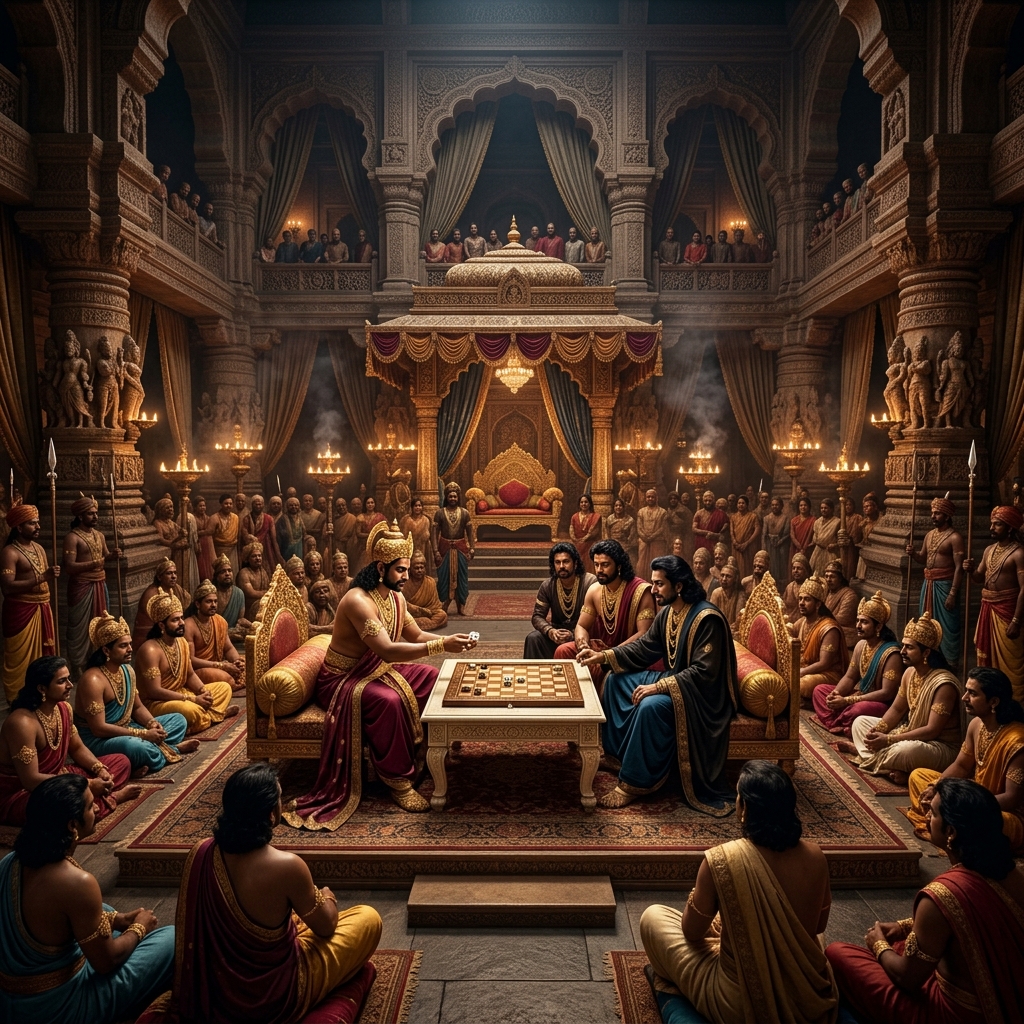
The Pandavas were received with every courtesy. They rested the night, and in the morning they entered the great gambling hall, where the elders and princes of the Kuru house had assembled. Bhishma the grandsire was there, and Drona the teacher, and Kripa, and Vidura, and Karna, and Dhritarashtra upon his high seat, his sightless face turned toward a game he could not see but had chosen not to stop.
Yudhishthira looked across the polished board and saw, not Duryodhana, but Shakuni seated to play. A small chill touched him.
"I have heard that you delight in dice, son of Pandu," said Shakuni smoothly. "Come, sit, and let us match our fortunes."
"Gambling is a vice and a cheat," Yudhishthira answered. "It is no honest contest of valor. Why do you praise it? The wise do not boast of victories won at the dice-board, for there is deceit in it. Do not conquer us by crooked means, Shakuni."
"A player who knows the numbers, who studies the throw, who understands the game - is he a cheat?" Shakuni replied. "The skilled overcome the unskilled in every art. If you are afraid, withdraw. No one compels you."
That word, afraid, found the one place where Yudhishthira could not yield. "Having been challenged, I do not turn back," he said. "That is my vow. So be it. With whom shall I play, and what wealth is staked against mine?"
"The wealth and the gems are mine to provide," said Duryodhana, stepping forward eagerly. "But my uncle Shakuni will cast the dice for me. Let the game begin." It was an irregularity, one man staking and another throwing, and a murmur went through the hall, but no elder rose to forbid it. The dice were placed upon the board.
The First Throws
Yudhishthira staked a string of pearls set in pure gold. "Let this be my wealth," he said.
"I have wealth to match it," answered Duryodhana through his uncle. Shakuni took up the dice. He knew the game as a serpent knows the dark. He cast, and looked at the fallen numbers, and said lightly, "Lo, I have won."
"You have won by a trick, and you boast of it," said Yudhishthira, frowning. "Let us play again. I stake a hundred jars filled with a thousand gold coins each, and my inexhaustible treasury besides."
Shakuni cast. "Lo, I have won."
And so it went, throw after throw, the same two words falling each time like a hammer. Yudhishthira staked his royal chariot, the great car bright as the sun, hung with golden bells, drawn by the finest of steeds. Lost. He staked a thousand rutting war-elephants with tusks like plough-shafts. Lost. He staked his serving women, skilled in song and dance, adorned in gold. Lost. He staked his menservants, his thousands of attendants robed and turbaned and obedient. Lost.
With each defeat something tightened behind Yudhishthira's eyes, and yet he did not stop. There is a fever that comes upon a gambler, a heat in the blood that whispers that the next throw will turn everything around, that to stop now is to admit the loss, that one more cast will redeem all. That fever was upon him now. The man who governed an empire with calm wisdom sat at the board like a man possessed, naming his treasures one by one and watching them swallowed.
"Lo, I have won," said Shakuni again, and gathered the stake. "What else have you, king? What will you set against me now?"
The Kingdom Cast Away
"I have countless cattle and horses," said Yudhishthira, "milk-cows and goats and sheep, every beast within the bounds of my realm. These I stake." Shakuni cast. "Won."
"I have my city, my country, the land itself, and all the wealth of every subject within it, save only the property of the brahmanas. This I stake." Shakuni cast. "Won."
Piece by piece the empire that had been crowned at the Rajasuya was raked across the board into Duryodhana's keeping. Indraprastha, the city the gods had helped to build, passed from its emperor in the space of a breath. The kings who had brought tribute now belonged, with their tribute, to another. And still the fever did not break.
"The ornaments of my brothers," Yudhishthira said, his voice grown strange and far away, "the earrings, the necklaces, all that they wear upon their bodies - these I stake." Shakuni cast. "Won."
Across the hall, the elders sat as if turned to stone. Bhishma's old hands gripped the arms of his seat. Drona's face was grey. Vidura looked from one to another, his eyes pleading, but no one met them. Bhima's breath came hard and loud; Arjuna sat rigid; the twins Nakula and Sahadeva stared at their brother as though at a stranger. They could not interfere, for in their world the word of the eldest was law, and a kshatriya did not snatch the dice from his king's hand. So they suffered in silence and watched the ruin widen.
"You still have much, king," said Shakuni, soft and relentless. "Search yourself. Surely there is something left to stake."
The Brothers Staked
Then Yudhishthira did a thing that froze the marrow of all who watched. He looked down the row of his brothers, and he began to wager them.
"This is Nakula," he said, "dark and bright-eyed, the handsome son of Madri. He is my wealth, and I stake him." Shakuni cast the dice. "Won. The fair prince Nakula is ours. Whom will you stake next?"
"This is Sahadeva," said Yudhishthira, "who teaches the world its justice, who is wise beyond his years. Dear as he is to me, I set him at the board, though it should never be set." Shakuni cast. "Won. Both sons of Madri are taken. But you love the sons of Kunti more, surely. What of them?"
Shakuni's tongue was a knife now, prying at the bonds between brothers, and still Yudhishthira would not rise from the board. "This is Arjuna," he said, "the conqueror, the unconquered, the hero who alone holds back whole armies. By him we have lived. With him I play, unworthy though it is." Shakuni cast. "Won."
"And this is Bhima," Yudhishthira went on, his voice breaking, "our shield in every battle, the strongest man alive, the foremost wielder of the mace, who has no equal among men. With this prince I play." Shakuni cast. "Won. The mighty Bhima is ours."
Four brothers, the pillars of the Pandava house, were now the slaves of Duryodhana by the fall of loaded bone. Bhima's eyes burned with a fury that would one day drink the blood of every Kaurava, but he sat still, bound by his elder's authority, and said nothing.
Himself Upon the Board
"There is yet one stake left to you," said Shakuni, leaning close. "Yourself. You alone remain unwagered, O king. Set yourself against me. If you win, you shall recover everything you have lost. Stake yourself, son of Pandu."
Yudhishthira sat alone now in the wreck of his fortune, his brothers gone, his kingdom gone, his name as emperor a thing of yesterday. And in the depth of his madness he saw only one road back. "I will stake myself," he said. "If I lose, I shall be your slave, and do whatever a slave must do."
Shakuni cast the dice. He looked at the numbers. "Won," he said. "This was an evil thing you have done, to lose your own self, when wealth still remained to you elsewhere."
For at that moment, Yudhishthira had nothing left of his own to wager. He had given away his realm, his goods, his servants, his brothers, and now his own freedom. He was a slave, and a slave can stake nothing, for he owns nothing. The game should have ended there, in the silence after that final loss. The fever should have burned itself out against the wall of utter ruin.
But Shakuni and Duryodhana had not yet reached the prize they truly hungered for. The humiliation of the Pandavas was not yet complete while one thing of value remained that Yudhishthira held dearer than himself - the thing he had loved enough to lose his soul trying to win back the means to protect it.
Vidura's Last Warning
Now Shakuni spoke the words that had been the whole purpose of the game from its first throw. "There is one stake left to you still, beloved of fortune, one that even a slave may set, if his masters allow it. Draupadi, the princess of Panchala, your wedded queen. Win her, and win yourself and all your brothers back along with her."
"Yes," said Yudhishthira, far gone now beyond reason, his honor and his judgment alike drowned in the fever of the board. "With Draupadi, who is neither too short nor too tall, neither too dark nor too pale, whose eyes are like the petals of the autumn lotus - with her I play. I stake the daughter of Drupada, the dearest of all my treasures."
A roar of horror and a roar of triumph went up together in the hall. "Shame! Shame!" cried the righteous among the elders, covering their faces. But Duryodhana's faction shouted in delight, and Karna laughed aloud, and Dushasana smiled.
Then Vidura could endure no more. He rose to his feet, trembling, and cried out so that the whole assembly heard him. "Listen to me, you who sit here! This wretch who is now a slave has no power to stake anything, for a slave owns nothing, not even his own wife. He lost himself before he named her; he had no right to wager her at all. The whole game is poisoned. Duryodhana, you climb a tree to gather fruit and you are sawing through the branch beneath your feet. You wake a tiger asleep in its den. Turn back even now, before this sin destroys the house of Kuru root and branch!"
But they called Vidura a fool and a traitor, and Duryodhana mocked him, and Dhritarashtra upon his throne said not one word. Bhishma was silent. Drona was silent. The elders who held the dharma of the realm in their keeping sat dumb while it was trampled, and their silence was louder than any voice in the hall.
The Order Is Given
Shakuni took the dice into his hand for the last time. The hall fell so quiet that the small bones could be heard rattling in his palm. He cast them across the board.
"Lo," he said. "I have won."
Draupadi was lost. The queen of five kings, the daughter of fire, the empress crowned beside Yudhishthira at the Rajasuya, was now, by the fall of cheating dice, claimed as a slave by the house of Dhritarashtra. The thing that could never be won by war, the thing that war itself would one day be fought to avenge, had been won at a gaming-table by a trick of the wrist.
Duryodhana's joy was a terrible thing to behold. Every wound of envy, every memory of the laughter in the crystal hall, every year of feeling himself the lesser man, found its release in this single moment of total mastery over the cousins who had mocked him. The empire was nothing beside this. He had taken from the Pandavas the one possession a man cannot lose and remain a man, and he meant to display it before the entire court.
He turned and called for a servant. "Go now to the inner apartments where the wife of these men sits. Tell Draupadi that she is no longer a queen but a slave, won fairly at the dice, the property of the Kurus. Bid her come and take up her duties here in the hall, and sweep the floors with the other servants. Go - bring her before us!"
The servant hesitated, looked at the stricken faces of the elders, looked at the burning eyes of Bhima, and went. And in the silence that followed, while the wise men of Hastinapura sat with their gazes fixed upon the floor, the footsteps of the messenger could be heard passing out of the hall toward the women's quarters, going to summon Draupadi to the assembly, and the deeper sorrow of the Mahabharata began.
Dharma Lesson
Addiction to vice can destroy even the greatest of men. Yudhishthira's fatal flaw was not the dice but his inability to walk away when dharma demanded it. The silence of the elders - Bhishma, Drona, Vidura - teaches us that complicity in injustice is itself a form of adharma.
Common Questions
Why did Yudhishthira agree to gamble?
A kshatriya invited to a game of dice was bound by custom not to refuse, and Yudhishthira loved the game while playing it badly. Dhritarashtra's formal invitation left no honorable exit, and Shakuni rolled for Duryodhana with loaded skill, so the outcome was effectively decided before the first throw.
How was Draupadi saved in the dice game?
When Dushasana tried to strip her, the garment became endless and could not be removed - credited in most tellings to Krishna, though the oldest text simply says dharma protected her. Dhritarashtra, alarmed by evil omens, then granted her boons that freed her husbands and returned the kingdom.
What were the terms of the Pandavas' exile?
After a second dice game the Pandavas had to spend twelve years in forest exile and a thirteenth year living unrecognized. Discovery during that final year would restart the entire cycle. Only on completing both terms were they to receive their kingdom back - a promise Duryodhana later refused to honor.
Why did Bhishma and Drona stay silent when Draupadi was dragged into court?
Bhishma answered that the law of property was subtle: he could not say whether a man who had already gambled himself away still owned his wife. The epic offers that reasoning and then condemns it, treating the elders' silence as complicity and as one of the war's true causes.