The Fire-Born Children
King Drupada of Panchala had never forgotten his humiliation. Years ago, his old schoolmate Drona had come to him as a poor brahmin asking for charity, and Drupada had laughed him away, saying that friendship could only exist between equals. Drona had answered that insult not with words but with the Pandava princes he trained, who marched into Panchala, scattered Drupada's army, and dragged the king bound before their teacher. Drona took half the kingdom and let Drupada go. The wound never closed. Day after day the king brooded, hungering not for war but for a son who could one day kill Drona, and a daughter worthy of the greatest archer alive.
So Drupada sought out two brahmins of fierce austerity, Yaja and Upayaja, and persuaded them to conduct a sacrifice that would grant his wish. The fire was kindled at Kampilya, the chief city of Panchala, and the chants rose for many days. When at last the priests poured the final oblation and called Drupada's queen to come and receive the fruit of the rite, she was not yet purified and asked them to wait. But the sacrifice could not be held back.
From the blazing altar there rose a young man, armored, crowned, sword in hand, terrible as the noonday sun. A voice from the sky declared that he was born to destroy Drona. They named him Dhrishtadyumna. And then, from that same fire, stepped a maiden, dark and dazzling, with eyes like lotus petals and the fragrance of blue lilies clinging to her. A heavenly voice proclaimed that this woman, born for a high purpose, would bring about the doom of many kshatriyas. They called her Krishnaa for her dark beauty, but the world would know her as Draupadi, daughter of Drupada.
Drupada gazed upon his fire-born children and felt his old grief at last begin to ease. In the boy he saw his revenge. In the girl he saw something greater - a destiny he did not yet understand, and a means to bind to himself the one warrior he most desired as a son-in-law.
The Bow and the Fish
When Draupadi came of age, Drupada resolved to hold a swayamvara, a gathering at which his daughter might choose her husband from among the assembled kings. But the king's true intention was hidden in his heart. He had heard rumors that the Pandavas had perished in the burning of the lac house at Varnavata, the trap laid by the jealous Duryodhana. Drupada did not believe it. No fire, he thought, could so easily consume Arjuna, the archer whose fame had spread to every kingdom. The king designed his contest so that only one man on earth could win it, and that man, he hoped, was the third son of Pandu.
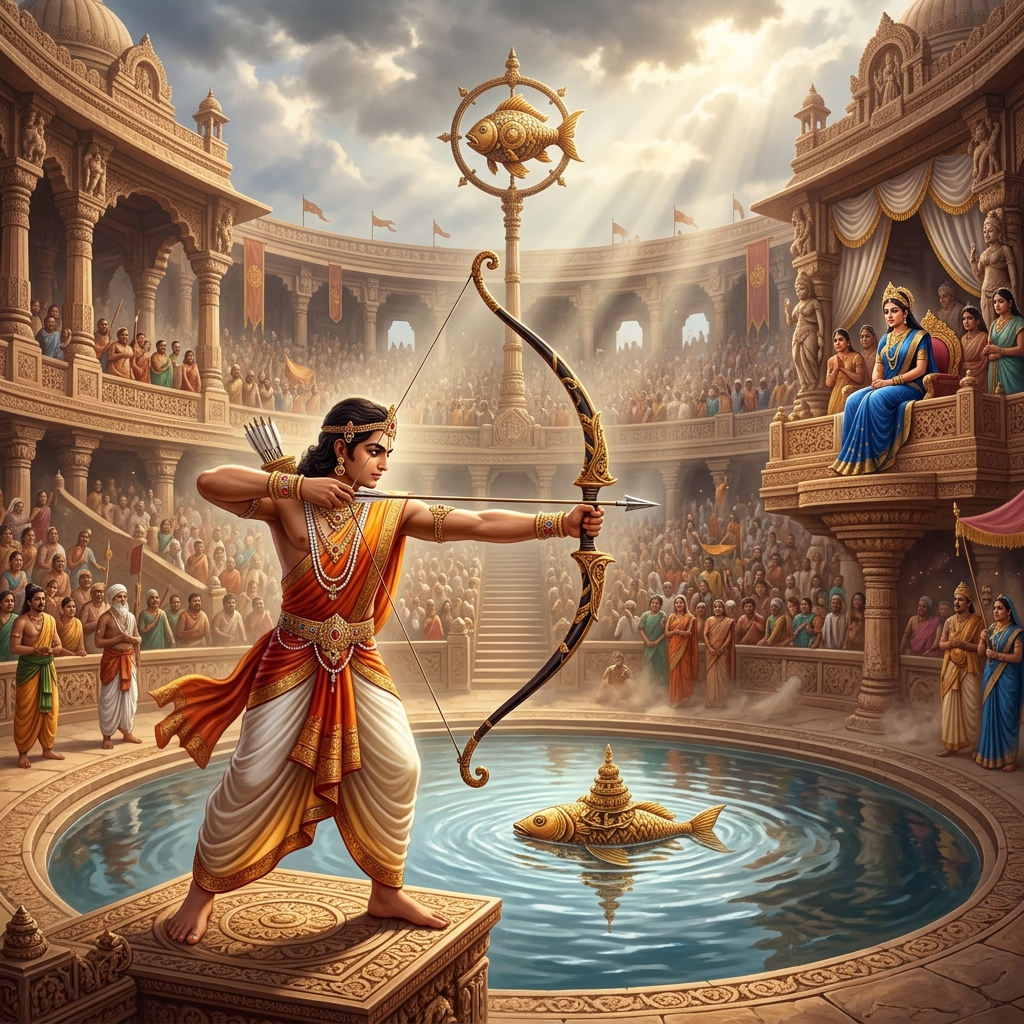
In an open field outside Kampilya his craftsmen raised a vast arena, ringed with palaces and pavilions and galleries hung with garlands and banners. At its center they set a bow of enormous size, stiff and heavy, that no ordinary man could even lift, much less bend. High above, upon a tall revolving pole, they mounted a contrivance that turned ceaselessly, and from it hung the figure of a fish. Below, on the ground, they placed a basin of clear water.
"This is the test," Drupada announced to the heralds who would carry word to every court. "Whoever can string this bow, and with its arrows pierce the eye of the turning fish above, while gazing not at the target but only at its reflection in the water below, that man shall win the hand of my daughter Krishnaa."
It was a feat of impossible difficulty, demanding strength to wield the bow, steadiness to hold it, and a precision that bordered on the divine. Drupada smiled to himself as the proclamation went out across the land. He had built a riddle, and somewhere, he prayed, the one man who could answer it still lived.
Kings From Every Land
From every corner of Bharatavarsha the kings came. Word of Draupadi's beauty and of the marvelous contest drew rulers and princes who would not have crossed a river for any lesser prize. Duryodhana came with his brothers and with Karna, his dearest friend, riding in splendor from Hastinapura. Shishupala of Chedi came, and Jarasandha the mighty emperor of Magadha, and Shalya the king of Madra, and Shakuni of Gandhara with his clever, restless eyes. Rulers of Kosala and Anga, of the eastern and western lands, filled the road to Kampilya for days.
Along the same road, on foot and unnoticed, walked five brahmins with their mother. They were the sons of Pandu, who had not died in the lac house at all. Warned in time by their uncle Vidura, they had escaped through a tunnel dug beneath the floor while a poor woman and her five sons perished in the flames in their place, and the world believed the Pandavas dead. Since then they had wandered in disguise through the forests, slaying the demon Hidimba, killing the rakshasa Baka at Ekachakra, living quietly as mendicants. Hearing of the swayamvara from passing brahmins, and urged on by the sage Vyasa whom they met upon the way, they turned their steps toward Panchala.
They entered Kampilya as humble holy men and took shelter in the workshop of a potter, sleeping among the wheels and the drying clay. Each day they went out begging for alms as brahmins did, and each evening they laid what they gathered before Kunti, who divided it among them. No one in that city of thronging kings looked twice at five ash-smeared ascetics. Yet Arjuna, who could string any bow on earth, sat in the potter's quarter while in the arena the proud kings prepared to fail.
The Gathering in the Arena
For sixteen days the festival ran before the contest itself began, with music and dancing, gifts of gold and gems, and feasting that no guest could exhaust. Then, on the appointed morning, the arena filled. The kings took their high seats in the galleries, glittering with ornaments, each surrounded by his ministers and his pride. Crowds of citizens pressed against the barriers. Brahmins gathered in their own quarter to watch and to receive the honors of the day, and among them, unremarked, sat the five sons of Pandu.
When the gathering was complete, Dhrishtadyumna led his sister into the arena. Draupadi came clad in silk, a garland of bright flowers in her hands, her dark beauty hushing the whole assembly into silence. Her brother raised his voice so that all could hear.
"Hear me, you kings assembled here. This is the bow. These are the arrows. And there above turns the target. Pierce the eye of that fish through the opening of the wheel, looking only upon its image in the water, and if your birth, your beauty, and your strength are worthy, this maiden, my sister, shall be your bride."
Then, turning to Draupadi, he named the kings one by one as they sat in their galleries, reciting the lineage and the deeds of each, that she might know the suitors who contended for her. Duryodhana he named, and Karna, Shalya, Shishupala, Jarasandha, and a hundred more, the flower of the warrior race of the age. Draupadi listened, the garland trembling in her hands, and waited to see whose neck it would adorn.
The Mighty Fail
One after another the kings rose to attempt the feat, each certain that he would be the one. They came down into the arena adorned and confident, smiled toward Draupadi's seat, and approached the great bow as though it were a thing already mastered.
But the bow defeated them. Jarasandha of Magadha, whose strength was a byword in every land, set his hands upon it and strained until his frame shook, yet could not bend it to the string. Shalya of Madra tried, and the bow flung him back so that he fell upon the ground before the watching crowd. King after king grasped the weapon, and the weapon mastered them. Some could not lift it at all. Some raised it only to be hurled aside by its spring as it sprang straight again. Some pulled with all their might and were left bruised and breathless, their ornaments scattered, their pride in the dust. The fish turned on, untouched, far above, and the water below held only the reflection of an empty sky.
The galleries that had begun in laughter and boasting fell quiet, then grim. These were the proudest warriors of the age, and one by one they were being made to look like children before the eyes of the woman they had come to win. The kings who had not yet tried grew uneasy, and those who had failed returned to their seats with faces dark and downcast. Draupadi watched it all, and the garland stayed in her hands.
Karna Rises and Is Refused
Then Karna rose. The crowd stirred, for here was a man whose archery rivaled the greatest, the friend of Duryodhana, the warrior born with golden armor whom no one could match in the use of the bow. He came down into the arena with the unhurried confidence of one who knew his own power, and the kings who had failed watched him with grudging hope and envy mingled.
Karna walked to the bow, and where a hundred had wrestled it, he lifted it as if it weighed nothing. In one smooth motion he strung it, bending that stubborn arc until the cord sang taut, and a gasp ran through the whole assembly. He set an arrow to the string and turned his gaze toward the basin of water, ready to send the shaft up through the wheel into the eye of the fish. In that moment it seemed certain that the contest was won.
But Draupadi's voice rang out across the arena before he could loose the arrow. "I will not wed a suta," she said. "I will not choose the son of a charioteer."
The words struck Karna where no weapon could reach. He stood a moment with the strung bow in his hands and the arrow nocked, his face turning dark with a shame and a fury he had carried all his life, the shame of a low birth fastened upon a soul made for kingship. Then he looked up once at the sun, smiled bitterly, as if to say that valor was nothing if the world would weigh only the womb that bore a man, and laid the bow down. He turned and walked back to his seat beside Duryodhana, who burned with anger on his friend's behalf. So the one rival who might have won was set aside, and the fish still turned above the silent crowd.
The Brahmin Steps Forward
When every king had failed or been refused, a murmur of contempt and disappointment spread through the arena. The proud assembly had been humbled, and it seemed that Drupada's impossible test would have no victor at all.
Then, from among the brahmins, a young man rose and walked toward the bow. He was lean and quiet, dressed in the plain garments of a holy man, his body marked with the ash of austerity, yet he moved with a grace and a steadiness that did not belong to a beggar. It was Arjuna, though no one in that place knew it.
An outcry went up at once from the kshatriyas. A brahmin, a man of prayer and not of war, presuming to lift a bow that emperors could not bend? It was an insult to the warrior race, they cried, and a mockery of the contest. Some shouted that he should be driven out. But others among the brahmins, watching the young man's calm approach, slapped their arms in delight and called out that there was no shame if one of their own should triumph where kings had failed.
Drupada, watching from his royal seat, felt his heart quicken. He looked at the brahmin's shoulders and the way he carried himself, and an old hope stirred in him. "Let him try," the king said. "Valor and skill are not the property of birth alone. Let the brahmin take the bow."
Arjuna came to the weapon that had thrown down the mightiest men of the age. He stood before it with bowed head for a moment, as if in prayer, then reached out and took it up.
The Eye of the Fish
Arjuna lifted the great bow as easily as a man lifts a flower. The arena, which had watched kings struggle and fall, drew a single breath and held it. He bent the stubborn arc and strung it in a heartbeat, the cord settling into place with a deep, singing note that rang across the silent field.
He took up five arrows. He set the first to the string and walked to the basin of water, and there he stood, his eyes fixed not upon the fish far above but only upon its shifting reflection in the trembling surface below. He stilled his breath. The wheel turned, the fish spun within it, and Arjuna read its motion in the water as a man reads a page. Then he drew the bowstring to his ear and loosed.
The arrow flew up through the opening of the whirling wheel and struck the fish through the eye, and the target fell to the ground. A roar broke from the brahmins and from the watching crowd. Drums sounded, conches were blown, flowers rained down from the galleries, and the heralds proclaimed the victory. The impossible feat that Drupada had devised, that no king on earth could perform, had been accomplished by an unknown brahmin standing in the dust.
Draupadi rose. Without hesitation she walked to the young man who had won her, and with her own hands she placed the garland of victory about his neck. The fire-born daughter of Panchala had chosen, and she had chosen the archer her father had dreamed of all along, though neither she nor the watching kings yet knew his name.
The Brawl of the Cheated Kings
The garland had scarcely settled on the brahmin's shoulders when the cheated kings rose in fury. They had been humbled before the woman they desired, and now a man of prayer had carried her off in front of them all. They turned upon Drupada, crying that he had insulted the whole warrior race by setting his daughter as a prize and then giving her to a brahmin, that the contest was a trick and the king deserved death for it. Weapons flashed in the galleries, and a host of armed rulers surged down into the arena to seize Draupadi and to strike down the man who had won her and the king who had shamed them.
Arjuna and his brother Bhima placed themselves between the maiden and the onrushing kings. Bhima, with his unequaled strength, tore up a great tree by the roots, stripped it of its leaves, and stood swinging it like a club, scattering the foremost attackers before him. Arjuna strung the great bow again and met the charge with arrows, holding back the press of warriors with a wall of flying shafts.
Karna came against Arjuna, the two greatest archers of the age trading arrows in a duel that drew the eyes of all, neither able to overcome the other, each marveling in his heart at the skill of the man before him. Shalya of Madra closed with Bhima, and the two giants grappled and wrestled, hurling and throwing each other until Bhima at last lifted Shalya bodily and cast him to the ground. The two brahmins, alone, were holding off the armed might of a hundred kings, and the assembly began to wonder what manner of men these truly were.
Then Krishna, who had come to the swayamvara and had recognized the brothers despite their disguise, raised his voice and spoke to the angry kings. He told them that the maiden had been won fairly, by the test that Drupada had set, and that there was no dishonor in it. His calm words and his presence cooled their rage. One by one the kings drew back, their anger spent, and the brawl subsided. The brothers, with Draupadi between them, withdrew from the arena and made their way back through the city toward the potter's quarter where their mother waited.
Share What You Have Brought
The brothers came at last to the potter's house where they lodged, their hearts high with the day's triumph, and Draupadi walked beside them in wonder at the strange turn her fortune had taken. As they reached the door, in the playful custom of brahmins returning from their begging, one of them called out to their mother before crossing the threshold.
"Mother, see what we have won today. Come and look at the alms we have brought home."
Kunti was within, and she did not look out to see what they meant. Thinking only of the food they gathered each evening, and never imagining what they truly carried home, she answered as she always answered. "Whatever it is, my sons, share it equally among yourselves, and enjoy it together."
The words were spoken, and a mother's command could not be unspoken. When Kunti turned and saw the maiden standing in the doorway, she was struck with dismay, for she had told her sons to share a wife among them, and her word, once given, could not be made false. She took Draupadi's hand and turned to Yudhishthira, the eldest, distressed at the sin into which her careless speech might lead them, and asked him to find some way to keep her word true without committing a wrong.
Yudhishthira pondered. He saw the love that all his brothers, and Arjuna who had won her, bore toward Draupadi, and he feared that so rare a beauty might divide the brotherhood that had survived exile and fire. He remembered, too, a destiny long foretold. And so he declared that Draupadi should be the wife of all five brothers, that no jealousy might ever come between them, and that their mother's word should stand.
The Sanction of Vyasa
Drupada, when he learned where his daughter had been taken, sent Dhrishtadyumna to follow her in secret. The prince hid near the potter's house and watched the five brahmins. He saw how they spoke of arms and armies, how they sat and rose like warriors and not like beggars, and he carried word back to his father that these were no common holy men. Drupada's heart leaped, for he began to hope that the archer who had won his daughter was indeed Arjuna, son of Pandu, alive after all.
The king sent invitations and gifts, and at last brought the brothers to his palace, where their true identity was revealed. Joy filled Drupada to learn that his fire-born daughter had been won by the very prince he had longed for as a son-in-law, and that the Pandavas, believed dead, were living. But when he learned that Draupadi was to be married not to Arjuna alone but to all five brothers, he was troubled. Such a marriage, he said, was against custom and against the law, for one woman to wed five men was a thing unheard of among the righteous.
Then the sage Vyasa himself arrived, the great seer who had foreseen all. He told Drupada the secret of Draupadi's former births and the boon she had once won, in which she had asked a husband again and again until the favor was granted five times over. He revealed that the five brothers were portions of divine power and that this marriage was no sin but the working out of a destiny ordained long before. With Vyasa's sanction the king's doubts were stilled, and he gave his blessing.
So Draupadi, the fire-born daughter of Panchala, was wedded to the five sons of Pandu, each brother taking her as his bride in turn. The Pandavas, who had wandered hidden and homeless since the burning of the lac house, now stood revealed and allied with the powerful house of Drupada. The marriage that began with a careless word in a potter's house had bound together a kinship that would change the fate of all the kingdoms of the earth.
Dharma Lesson
True worth is measured by skill and character, not by lineage or appearance. Arjuna's victory at the swayamvara proved that destiny favors the prepared. Draupadi's marriage to all five Pandavas reminds us that dharma sometimes demands unconventional paths.
Common Questions
Why did Draupadi marry five husbands?
Arjuna won her, but the brothers announced their prize at the door and Kunti, without looking, said to share it among themselves. Bound by their mother's word, and by Yudhishthira's sense that all five had desired her, they married her jointly. Vyasa sanctioned it, citing a boon from her earlier birth.
Who won Draupadi's swayamvara and how?
Arjuna, disguised as a poor brahmin. The test was to string Drupada's massive bow and shoot through the whirling eye of a fish mounted overhead, aiming only by its reflection in water below. Kings and warriors failed or were barred, and the unknown brahmin struck the target cleanly.
Why was Karna refused at Draupadi's swayamvara?
In most tellings Draupadi declared she would not wed a charioteer's son, and Karna stepped back from the bow. Some recensions omit the refusal or simply have him fail the shot. Either way the episode deepens the humiliation that binds Karna permanently to Duryodhana's cause.
Was Draupadi's marriage to five brothers considered dharmic?
Traditionally yes, but it had to be argued for. Drupada objected that polyandry reversed custom; Vyasa justified it by divine sanction and a boon from her past life, and Kunti's inadvertent command bound them. Critics ancient and modern read the passage as the epic straining to legitimize an unusual arrangement.