The Lonely King
Years had passed since the river-goddess Ganga had risen from the waters of Hastinapura and returned to her own bright country, leaving behind her gift and her grief - the boy Devavrata, now grown into the finest prince the House of Kuru had ever raised. King Shantanu ruled wisely, and his people loved him, but in the great halls of his palace there was a silence that no minister and no festival could fill.
He was a king who had once held a goddess in his arms and watched her walk away. After that, ordinary days felt thin to him, like cloth worn at the edges. He threw himself into hunting and into the care of his kingdom, and he taught himself not to look too long at the river, because the river remembered her and he did not wish to remember.
Devavrata watched his father with the quiet attention of a devoted son. He saw how the king's laughter came a beat too late, how his eyes drifted to the western window where the light fell on the water. "My father carries something he will not set down," the prince thought. "A man may rule a kingdom and still be poor in his own heart."
But Shantanu spoke of none of it. He was a king, and kings learn early that longing is a private thing. He folded his loneliness small and carried it, and went on, season after season, walking out alone in the early hours when no one would see the look on his face.
Fragrance on the Wind
It was the hunting season, and Shantanu rode out along the wooded banks of the Yamuna, following the deer through the long grass until his companions fell behind and he found himself alone among the reeds. The river ran wide and slow there, dark green under the morning sun, and the air was sweet with mud and blossom.
Then the wind shifted, and a fragrance came to him that he had never known - not flower, not incense, not any perfume sold in the markets of the world. It was warm and clean and impossibly sweet, and it seemed to draw the breath out of his chest and pull him forward. He let his reins go slack and let his horse carry him toward the source of it, his whole being narrowed to that single thread of scent on the air.
The fragrance led him to a ferry-crossing, where a boat lay drawn up on the bank. And there, working among the nets, stood a young woman of the fisher-folk. She was dark and slender, with great calm eyes, and as she moved the sweetness moved with her, rising from her very skin. Shantanu understood, with the slow astonishment of a man waking, that the perfume that had haunted the riverbank was hers.
He sat his horse and could not speak. He, who had spoken to a goddess, found his throat dry before a fisher-girl mending nets. For the first time in many years, the dull ache in his chest had gone quiet, and in its place was something bright and dangerous and alive.
Satyavati of the Yamuna
Her name was Satyavati, and though she lived among the fisher-folk and plied the ferry across the Yamuna, there was a story in her that the king could not have guessed. She had been born of strange beginnings and raised by Dasharaja, the chief of the fishermen, who loved her as his own daughter. Once her body had carried the smell of fish, as was the way of her people, but a wandering sage had blessed her, and now from her flesh there rose instead this fragrance that travelled a full yojana on the wind. The river-folk called her Yojanagandha for it, she-whose-scent-carries-a-league.
She looked up from her nets and saw the rider on the bank, his fine clothes and his stillness marking him at once as no common traveller. She did not lower her eyes in fear. She had ferried many across the water and learned to read men, and she saw in this one's face neither cruelty nor mockery but something more unsettling - a hunger that was tender.
"You have lost your way, lord?" she asked, for he had the look of a man who had ridden farther than he meant to.
"I think," said Shantanu slowly, "that I have only just found it."
She did not answer that. She went on coiling her line, calm as the river itself, and the king watched her hands and felt the years of his loneliness gathering behind his eyes. When at last he asked her name and her father's house, she told him plainly, and pointed up the bank to where Dasharaja the fisher-chief kept his settlement. Then she stepped into her boat and pushed off across the bright water, and Shantanu sat a long while on the empty shore.
The King Asks the Fisherman
Shantanu was a king, and a king who desires does not skulk. He rode to the settlement of Dasharaja and presented himself before the fisher-chief openly, asking for the hand of Satyavati in marriage. He did not send envoys; he came in his own person, and that alone told the old fisherman the depth of what he faced.
Dasharaja received him with all proper respect, his weathered face giving nothing away. He was a plain man of the river, but he was not a foolish one, and he understood at once that the ruler of all the Kurus had come to his door humbled by love. A lesser man might have wept with joy and surrendered his daughter that very hour. Dasharaja folded his hands and considered.
"Great king," he said, "who would not give his daughter to the lord of Hastinapura? There is no higher house in the land, and no nobler husband I could wish for her. Yet I am her father, and a father must think past the wedding-fire to all the years that follow. There is a thing I must say to you, and you may find it bitter."
Shantanu, his heart already racing toward yes, inclined his head. "Say it, fisherman. Name what you will."
And so the old man named it, slowly, like a fisherman paying out a line he knew would go taut.
The Hard Condition
"This is my condition, O king," said Dasharaja, and he looked Shantanu full in the face. "If I give you my daughter, then the son she bears you, and that son's sons after him, shall sit upon the throne of Hastinapura. Her child shall be your heir, and the kingdom shall pass through her line and no other. Grant me this, and Satyavati is yours. Refuse it, and I cannot give her, however my heart aches to honour you."
The words fell on Shantanu like cold water. He stood very still. For he had a son already - Devavrata, born of Ganga, the crown prince, the trained and beloved heir whom the whole court adored, a warrior with no equal among the young, a youth as wise as he was strong. To accept this condition was to disinherit that son, to set aside the rightful prince in favour of an unborn child of a fisher-girl. It was unthinkable. It was the one price the king could not pay.
"You ask me to wrong my son," Shantanu said at last, and his voice was low. "Devavrata is the joy of my age and the pride of my house. The throne is his by every law of the world."
"I ask nothing," Dasharaja answered, not unkindly. "I only say the terms. You are a great king and a just one - that is why I dare to speak so plainly. Take my words home with you, lord. Weigh them. And if you cannot grant them, then go in peace, and let us both forget this day."
Shantanu mounted his horse and rode back toward Hastinapura, and the fragrance of the river followed him a long way down the road, and would not let him go.
The Silent Heartbreak
The king came home, and the brightness that had lit him by the river curdled into a slow, wasting sorrow. He could not have the woman without wronging his son; he would not wrong his son; and so he could only ache. He told no one. He locked the matter in his chest as he had once locked away the loss of Ganga, and he went grey beneath the weight of it.
He stopped riding out to hunt. He ate little and slept less. He sat for long hours at the western window, gazing toward the Yamuna, and when his ministers brought him the business of the realm he answered them as a man speaks in a dream. His servants whispered that some sickness had taken the king, but the physicians could find no fever in him and no flaw in his blood. It was a sickness no medicine could touch.
Devavrata saw it all. He saw his father fade, and he could not bear it. "A king does not waste away over fevers the doctors cannot name," the prince reasoned. "Something has wounded him in the heart, and he is too proud or too kind to speak of it." He went first to his father, kneeling before the throne, and begged the king to share his grief. But Shantanu only smiled the thin late smile that had become his habit and said it was nothing, only the tiredness of years.
So Devavrata went instead to the old charioteer who attended the king on his hunts, a man who had ridden behind Shantanu down to the Yamuna and seen where his eyes had turned. And from that faithful servant, gently and patiently, the prince drew out the whole truth - the fisher-maiden, her fragrance, the king's love, and the one hard condition that no honourable father could grant at the cost of his own son's inheritance.
Devavrata Goes to the River
When Devavrata understood, he did not hesitate for the space of a breath. To him the matter was simple, as the great matters of his life would always be simple: his father suffered, and a son's duty was to end that suffering, whatever the price to himself. The throne, the years of training, the love of the court - all of it weighed nothing against the grey grief in his father's face.
He gathered the elders of the kingdom and the chief among the warriors, and with them as witnesses he rode down to the settlement of Dasharaja on the banks of the Yamuna. The fisher-chief came out to meet the prince and bowed low before him, marvelling that the crown prince of Hastinapura should come in person to his humble crossing.
"Fisherman," said Devavrata, and his voice was clear and even as the river, "I know your condition. You ask that the throne pass to the son of Satyavati and to his line. Hear me, then, and let these elders bear witness. I renounce it. Here, before all these men, I give up my claim to the kingdom of Hastinapura. Let the son born of your daughter be king after my father. Never shall I sit upon that throne, nor any son of mine. The crown is your grandson's. I want nothing of it."
The elders murmured in dismay, for they had hoped to see this prince rule. But Devavrata's face was calm and his renunciation was absolute. He had set down the kingdom as easily as a man sets down a cloak in summer, and he did not look back at it once.
The Fisherman's Lingering Doubt
Dasharaja heard the renunciation, and a lesser man would have been satisfied. But the old fisherman had not haggled with kings for nothing, and a deeper fear stirred in him even as the prince spoke. He folded his hands and bowed, and then he spoke the doubt that troubled him.
"Noble prince," he said, "there is no man on earth more truthful than you, and what you have given up this day would shame the gods themselves with its greatness. I do not question your word - not for an instant. But I am a father, and I must look down the long years. You renounce the throne for yourself, and I believe you. Yet you will marry one day, as all men do, and you will have sons. And those sons - mighty as their father, born of this royal line - what oath will bind them? They did not stand here. They made no promise. When my grandson sits upon the throne, your sons may rise against him and take by the strength of their arms what their father gave away in his honour. It is not you I fear, prince. It is the children you have not yet fathered."
The elders fell silent, for the old fisherman had named a true thing. A renunciation could die with the man who made it. The crown that Devavrata had given up might yet be seized back by a son who had sworn nothing. There was only one way to close that door forever, and every man on the riverbank understood, with a slow cold horror, what it would have to be.
Devavrata stood among them, and his face did not change. He had heard the doubt, and he had already answered it in his heart.
The Terrible Vow
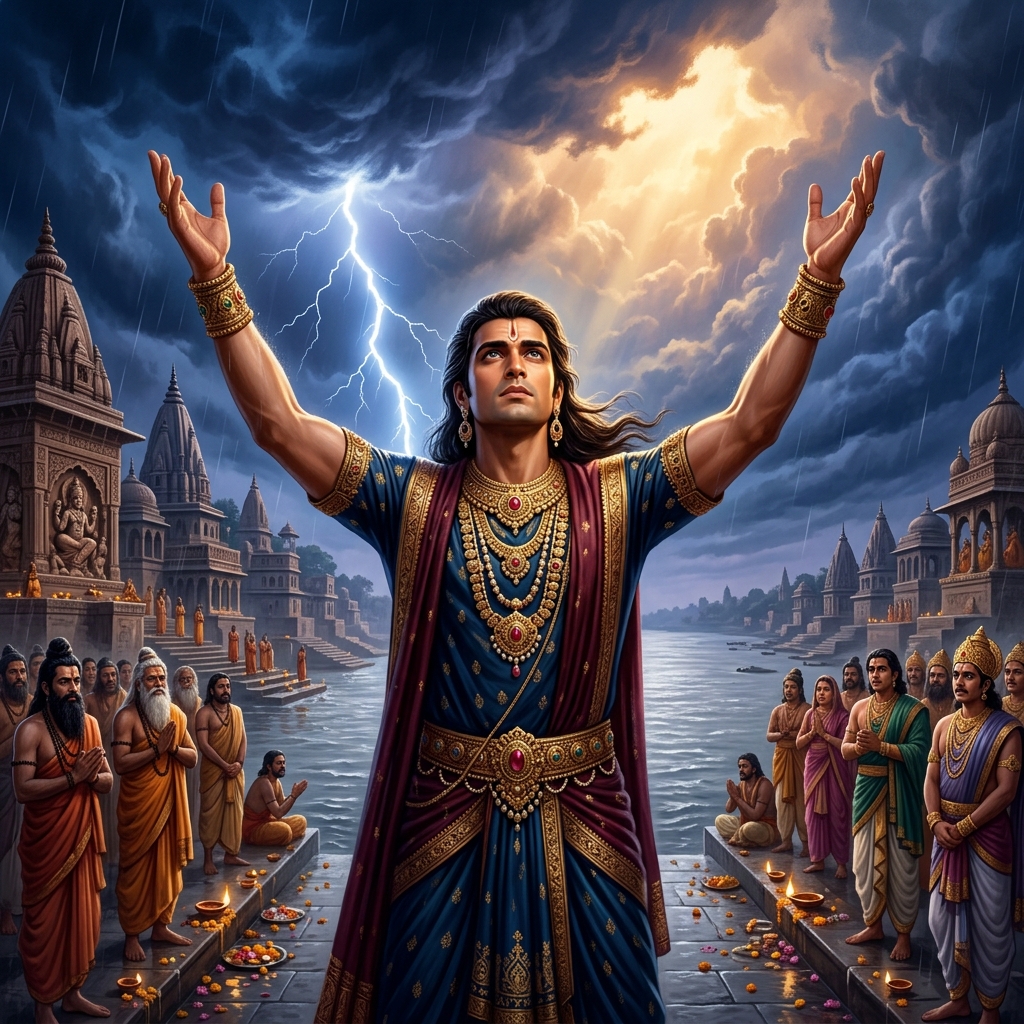
Devavrata raised his hand, and a hush fell over the river. The elders watched; the fisher-folk drew near; even the water seemed to slow against the bank.
"Hear me, then, fisherman," he said, "and let earth and heaven be my witnesses. For my father's sake I have given up the throne. That was easily done. Now, that no doubt may ever live in your house, I give up more. From this day I take the vow of brahmacharya. I shall never marry. I shall never know a woman. I shall never father a child, neither son nor daughter, while I live. The seed of my body shall end with my body, and no descendant of mine shall ever stand to claim this kingdom, for there shall be no descendant of mine at all. This I swear, and I will not break it though the world should end."
The vow was monstrous in its completeness. To renounce a throne was the act of a noble prince; to renounce love, marriage, children, all the future a man might hope for, all for the comfort of an aging father - that was a sacrifice the like of which the world had never heard. He cut away his own line at the root, so that no son of his could ever exist to threaten the children of a woman he had never met.
Dasharaja fell to his knees, overcome. There was nothing left to fear, and nothing left to ask. Before him stood a man who had given away everything and kept only his word. With a trembling voice the old fisherman gave his blessing to the union, and consented that his daughter should go to King Shantanu as queen.
The Rain of Flowers
In that same moment, the heavens answered. The gods and the celestial sages, who watch the deeds of mortals, looked down upon the prince standing by the Yamuna and were filled with awe at what they had seen. The drums of the gods sounded in the high air, and from the cloudless sky there fell a soft rain of blossoms, drifting down over Devavrata's head and shoulders and over the dark river, sweet and silent.
And a voice came from the heavens, ringing over the water for all to hear: "This is Bhishma! This is Bhishma!" - the awful one, the terrible one, the maker of the dreadful vow. For bhishma means the one whose oath is terrible to behold, and from that day the prince Devavrata was Devavrata no longer. He was Bhishma, and by that name the world would know him forever after.
The elders bowed before him. The fisher-folk stared, half in worship and half in fear, at this young man who had quietly torn his own future from his hands and let it blow away like petals on the wind. He stood among the falling flowers with the same calm he had carried all his life, neither proud of his sacrifice nor sorry for it. He had done what duty asked. That was enough for him; it had always been enough.
Then Bhishma turned to Satyavati, who had come down to the bank, and bowed to her with perfect courtesy, as a son bows to a mother. "Come, mother," he said. "The king my father is waiting. Let me bring you home."
Satyavati Comes Home
Bhishma seated Satyavati in his own chariot and drove her up from the river-crossing toward Hastinapura, and the fragrance that had once haunted a lonely king now rode openly through the gates of his city. Word ran ahead of them through the streets, and the people came out to see the bride - and to see, with wonder and with grief, the prince who had given up the throne to fetch her.
When they reached the palace, Bhishma led Satyavati before the king. Shantanu rose from his long sorrow like a man rising from sleep, scarcely able to believe what stood before him. His son told him all that had passed at the river - the renunciation, the fisherman's doubt, the vow of celibacy, the rain of flowers and the name the gods had given. And as he listened the king's joy was shot through with a pain so sharp it nearly broke him.
For he understood the price his son had paid. To win him a wife, Devavrata had unmade his own life. There would be no grandchildren through this beloved son, no line of his blood upon the throne, only a long and solitary keeping of a terrible word. Shantanu wept then, and held his son, and could not find the breath to thank him, for there are gifts too great for thanks.
Moved beyond measure by such devotion, Shantanu blessed Bhishma with a boon that was itself a kind of legend: that death itself should never take him against his will, but should wait upon his word and come only when he chose to summon it. Then Satyavati was made queen of Hastinapura, and the king was happy at last - though it was a happiness built upon the buried life of the noblest son a father ever had, the grandsire-to-be of an age, who would stand guard over the House of Kuru, alone and unmarried, for all the long years to come.
Dharma Lesson
The greatest sacrifice is made not for oneself, but for the happiness of those we love. Devavrata gave up his kingdom, his future, and his chance at family - all so that his father might find happiness. This is the highest form of filial duty.