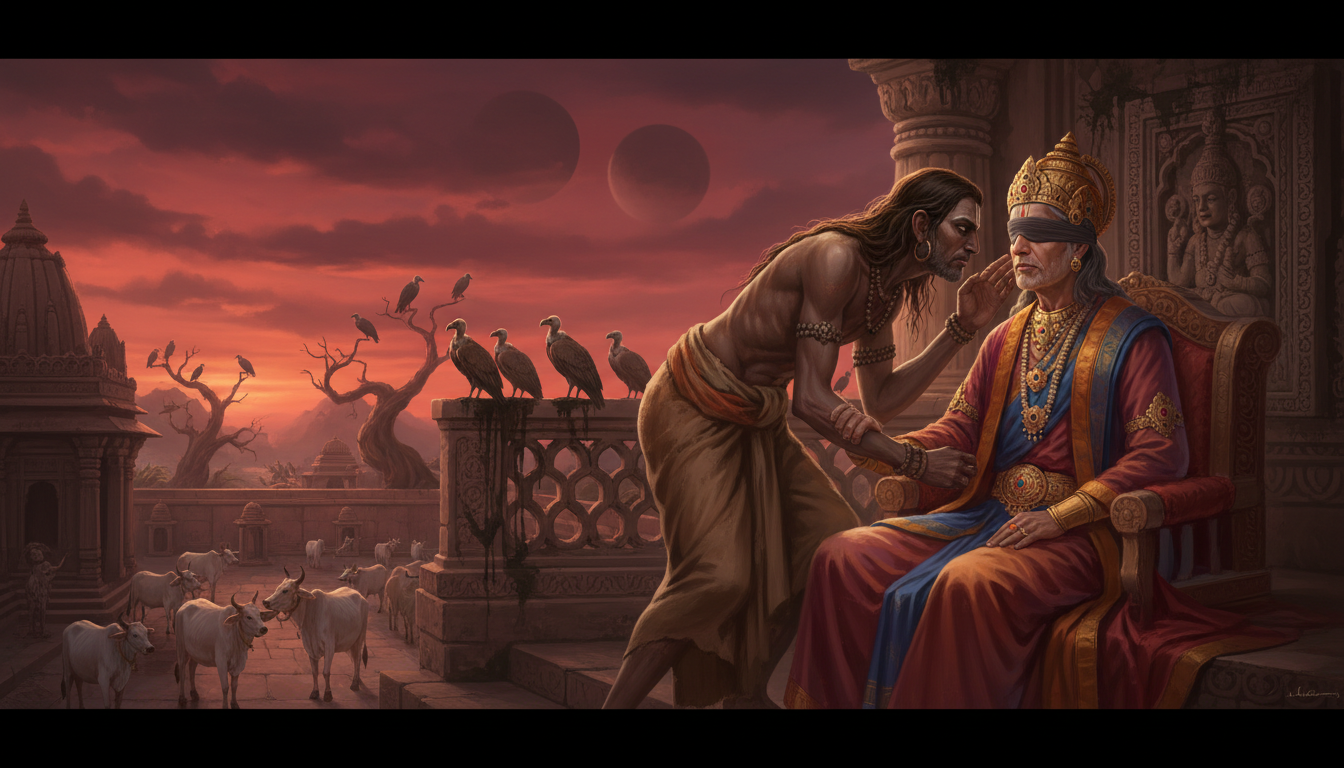
The Signs Before the War
What Vyasa saw in the sky, the cattle and the birth-rooms
In Private, With the Armies Already Formed
Vaishampayana said to Janamejaya: the two armies were standing on the east and the west, ready for the fierce battle that was impending, when the holy Rishi Vyasa, the son of Satyavati, came to the royal son of Vichitravirya and spoke to him in private.
He found the king distressed and giving way to sorrow, reflecting on the evil policy of his sons.
"O king," Vyasa said, "thy sons and the other monarchs have their hour arrived. Mustered in battle they will kill one another. O Bharata, their hour having come, they will all perish. Bearing in mind the changes brought on by time, do not yield thy heart to grief. O king, if thou wish to see them fighting in battle, I will, O son, grant thee vision. Behold the battle."
"O best of regenerate Rishi," Dhritarashtra said, "I like not to behold the slaughter of kinsmen. I shall, however, through thy potency hear of this battle minutely."
So the boon went sideways, to the man standing at the king's shoulder. Vyasa turned to Sanjaya the son of Gavalgani and gave him what the king had refused.
"This Sanjaya, O king, will describe the battle to thee. Nothing in the whole battle will be beyond this one's eyes. Manifest or concealed, happening by day or by night, even that which is thought of in the mind, Sanjaya shall know everything. Weapons will not cut him and exertion will not fatigue him. This son of Gavalgani will come out of the battle with life.
"As regards myself, the fame of these Kurus, as also of all the Pandavas, I will spread. Do not grieve. This is destiny, O tiger among men. It behoveth thee not to give way to grief. It is not capable of being prevented. As regards victory, it is there where righteousness is."
Then, having said that, the grandsire of the Kurus stayed where he was and began on the other thing he had come to say.
The Birds Are Already Waiting
"Great will the slaughter be, O monarch, in this battle. I see here also numerous omens indicative of terror.
"Hawks and vultures, and crows and herons, together with cranes, are alighting on the tops of trees and gathering in flocks. These birds, delighted at the prospect of battle, are looking down on the field before them. Carnivorous beasts will feed on the flesh of elephants and steeds. Fierce herons, foreboding terror, and uttering merciless cries, are wheeling across the centre towards the southern region.
"In both the twilights, prior and posterior, I daily behold the sun during his rising and setting to be covered by headless trunks. Tri-coloured clouds with their extremities white and red and their necks black, charged with lightning, and resembling maces in figure, envelope the sun in both twilights.
"I have seen the sun, the moon, and the stars to be all blazing. No difference in their aspect is to be noted in the evening. I have seen this all day and all night. All this forbodes fear. On even the fifteenth night of the lighted fortnight in the month of Kartika, the moon, divested of splendour, became invisible, or of the hue of fire, the firmament being of the hue of the lotus.
"Many heroic lords of earth, kings and princes, endued with great bravery and possessed of arms resembling maces, will be slain and sleep lying down on the earth. Daily I notice in the sky during night time the fierce cries of battling boars and cats."
The king said nothing. Vyasa went on, because a catalogue is a kind of argument and he had not yet reached his conclusion.
The Images Sweat
"The images of gods and goddesses sometimes laugh, sometimes tremble, and sometimes again these vomit blood through their mouths, and sometimes they sweat, and sometimes fall down.
"O monarch, drums, without being beaten, give sounds, and the great cars of Kshatriyas move without animals yoked to them. Kokilas, woodpeckers, jays, water-cocks, parrots, crows and peacocks utter terrible cries. Here and there, cavalry soldiers, cased in mail, armed with weapons, send forth fierce shouts, and there is nobody there. At sunrise flights of insects by hundreds are seen. In both twilights the cardinal quarters seem to be ablaze, and the clouds, O Bharata, shower dust and flesh.
"She who is celebrated over the three worlds and is applauded by the righteous, even that constellation Arundhati, keepeth her lord Vasistha on her back. The planet Sani also appeareth afflicting the constellation Rohini. The sign of the deer in the moon hath deviated from its usual position. A great terror is indicated. Even though the sky is cloudless, a terrible roar is heard there.
"The effulgence of the constellation known by the name of the seven high-souled Rishis hath been dimmed. Rahu of fierce deeds is afflicting the constellation Kirtika, and rough winds, portending fierce danger, are constantly blowing.
"The animals are all weeping, and their tears are falling fast."
That was the end of the first list. Dhritarashtra sat in the chair he had been sitting in when the news of every previous disaster in his reign had reached him, and made no reply, and the Rishi began the second list, which was worse.
Asses Out of Cows
"Asses are taking births in kine. Some are having sexual pleasure with mothers. The trees in the forests are exhibiting unseasonable flowers and fruits. Women quick with child, and even those that are not so, are giving birth to monsters.
"Carnivorous beasts, mingling with carnivorous birds, are feeding together. Ill-omened beasts, some having three horns, some with four eyes, some with five legs, some with two sexual organs, some with two heads, some with two tails, some having fierce teeth, are being born, and with mouths wide open are uttering unholy cries. Horses with three legs, furnished with crests, having four teeth, and endued with horns, are also being born.
"O king, in thy city is also seen that the wives of many utterers of Brahma are bringing forth Garudas and peacocks. The mare is bringing forth the cow-calf, and the bitch is bringing forth jackals and cocks, and antelopes and parrots are all uttering inauspicious cries. Certain women are bringing forth four or five daughters at a time, and these, as soon as they are born, dance and sing and laugh.
"A bird with but one wing, one eye and one leg, hovering over the sky in the night, screameth frightfully in wrath, as if for making the hearers vomit blood. Infants, as if urged by death, are drawing armed images, and are running against one another, armed with clubs, and desirous of battle are also breaking down the towns they erect in sport. Lotuses of different kinds and lilies are growing on trees. Strong winds are blowing fiercely and the dust ceaseth not. The earth is frequently trembling."
He was describing the king's own city, street by street, to a man who could not see it and had heard nothing of it from anyone else in the household.
He Read the Sky Like a Ledger
"Rahu approacheth towards the sun. The white planet stayeth, having passed beyond the constellation Chitra. All this particularly bodeth the destruction of the Kurus.
"A fierce comet riseth, afflicting the constellation Pushya. This great planet will cause frightful mischief to both the armies. Mars wheeleth towards Magha and Vrihaspati towards Sravana. The sun's offspring, approaching towards the constellation Bhaga, afflicteth it. The planet Sukra, ascending towards Purva Bhadra, shineth brilliantly, and, wheeling towards the Uttara Bhadra, looketh towards it. The white planet, blazing up like fire mixed with smoke, stayeth, having attacked the bright constellation Jeshtha that is sacred to Indra. The constellation Dhruva, blazing fiercely, wheeleth towards the right. Both the moon and the sun are afflicting Rohini. The fierce planet hath taken up its position between the constellations Chitra and Swati.
"Those two blazing planets, Vrihaspati and Sani, having approached the constellation called Visakha, have become stationary there for a whole year.
"And there is this. A lunar fortnight had hitherto consisted of fourteen days, or fifteen days as usual, or sixteen days. This, however, I never knew, that the day of new moon would be on the thirteenth day from the first lunation, or the day of full moon on the thirteenth day from the same. And yet in the course of the same month both the moon and the sun have undergone eclipses on the thirteenth days. The sun and the moon, therefore, by undergoing eclipses on unusual days, will cause a great slaughter of the creatures of the earth. Indeed, Rakshasas, though drinking blood by mouthfuls, will yet not be satiated."
He had counted the days himself. That was the part he kept returning to: not the monsters, not the blood in the sky, but a calendar that had stopped behaving.
Blood in the Milk
"The earth that produceth particular crops at particular seasons is now covered with the crops of every season. Every barley stalk is graced with five ears, and every paddy stalk with a hundred. And they that are the best of creatures in the worlds and upon whom depends the universe, the kine, when milked after the calves have had their suck, yield only blood.
"Radiant rays of light emanate from bows, and swords blaze forth brilliantly. It is evident that the weapons behold the battle before them, as if it were already arrived. The hue of weapons and of water, as also of coats of mail and standards, is like that of fire.
"The great rivers are flowing in opposite directions. The waters of rivers have become bloody. The wells, foaming up, are bellowing like bulls. Meteors, effulgent like Indra's thunderbolt, fall with loud hisses. From the mountains of Kailasa and Mandara and Himavat thousands of explosions are heard and thousands of summits are tumbling down. In consequence of the earth's trembling, each of the four oceans, having swelled greatly, seems ready to transgress its continents.
"The sacrificial fire, when Brahmanas pour libations on it, becomes blue, or red, or yellow. Its flames bend towards the left, yielding a bad scent, accompanied by loud reports. Touch, smell and taste have, O monarch, become what they were not. The standards of warriors, repeatedly trembling, are emitting smoke, and drums and cymbals are throwing off showers of coal dust. From the tops of tall trees all around, crows, wheeling in circles from the left, are uttering fierce cries of pakka, pakka, and are perching upon the tops of standards for the destruction of the kings. Vicious elephants, trembling all over, are running hither and thither, urinating and ejecting excreta. The horses are all melancholy.
"Fierce clouds, portentous of danger, drop bloody showers during the night. When this night passeth away, evil consequences will overtake you. People, for meeting together, coming out of their houses with lighted brands, have still to encounter a thick gloom all round.
"Great Rishis have said that in view of such circumstances the earth drinks the blood of thousands of kings. In this battle of the Kurus with the Pandavas the earth will be a river of blood with the standards of warriors as its rafts.
"Hearing all this, let that be done which is suitable, so that, O Bharata, the world may not be depopulated."
Destiny, Said the King
Dhritarashtra had listened to all of it without interrupting once, and when it was finished he gave his answer.
"I think all this hath been ordained of old. A great slaughter of human beings will take place. If the kings die in battle observing the duties of the Kshatriya order, they will then, attaining to the regions reserved for heroes, obtain only happiness. These tigers among men, casting away their lives in great battle, will win fame in this world and great bliss for ever in the next."
That prince of poets concentrated his mind in supreme yoga. He contemplated for a short space of time. Then he tried once more.
"Without doubt, O king of kings, it is Time that destroyeth the universe. It is Time also that createth the worlds. There is nothing here that is eternal. Show the path of righteousness to the Kurus, to thy kinsmen, relatives and friends. Thou art competent to restrain them. The slaughter of kinsmen hath been said to be sinful. Do not do that which is disagreeable to me.
"O king, Death himself hath been born in the shape of thy son. Slaughter is never applauded in the Vedas. It can never be beneficial. The usages of one's race are as one's own body. Those usages slay him that destroyeth them. In the shape of thy kingdom hath calamity come to thee. Thy virtue is sustaining a very great diminution. Show what righteousness is unto thy sons. O thou that art invincible, of what value is that kingdom to thee which bringeth sin to thee? Take care of thy good name, thy virtue, and thy fame. Thou wilt then win heaven.
"Let the Pandavas have their kingdom, and let the Kauravas have peace."
He said it in a sorrowful tone, and the king, who was accomplished in speech, answered him accomplishedly.
"My knowledge of life and death is similar to thine. The truth is known to me as regards these. Man, however, in what concerns his own interests, is deprived of judgment. O sire, know me to be one who is an ordinary person. Of immeasurable power thou art. I pray thee to extend thine towards us. Of soul under complete control, thou art our refuge and instructor. My sons are not obedient to me, O great Rishi. My understanding too is not inclined to commit sin. Thou art the cause of the fame, the achievements, and the inclination for virtue, of the Bharatas. Thou art the reverend grandsire of both the Kurus and the Pandavas."
Nobody was sent to fetch Duryodhana.
What Victory Looks Like
"O royal son of Vichitravirya," Vyasa said, "tell me freely what is in thy mind. I will remove thy doubts."
The king had one question left, and it was not about peace.
"O holy one, I desire to hear from thee of all those indications that happen unto those that become victorious in battle."
So the Rishi, who had just spent the evening telling him that the world was ending, told him instead how to recognise a winner.
"The sacred fire assumes a cheerful radiance. Its light ascends upwards. Its flame bends towards the right. It blazes up without being smoky. The libations poured on it yield a fragrant scent. It is said that these are the indications of future success. The conches and cymbals yield sounds that are deep and loud. The sun as well as the moon gives pure rays.
"Crows, whether stationary or on their wings, utter cries that are agreeable. Where vultures, swans, parrots, cranes and woodpeckers utter delightful cries and wheel towards the right, the Brahmanas say that their victory in battle is certain. They whose divisions, in consequence of ornaments, coats of mail and standards, or the melodious neigh of their steeds, become resplendent and incapable of being gazed at, always conquer their foes. They who utter cheerful shouts, those warriors whose energies are not damped and whose garlands do not fade, always cross the ocean of battle. They who utter even kind words to the enemy, and who, before striking, forewarn the foe, win victory.
"Whether the army be small or large, cheerfulness as an attribute of the combatants is said to be a certain indication of victory. One soldier, struck with panic, can cause even a large army to take fright and fly. And when an army, struck with panic, takes to flight, it causes even heroic warriors to take fright. If a large army is once broken and put to rout, it cannot, like a herd of deer disordered in fright or a mighty current of water, be easily checked.
"It is said that that success which is won by negotiation and other means is the very best. That which is achieved by producing disunion among the foe is indifferent. While that success which is won by battle is the worst. In battle are many evils, the initial one, as it is said, being slaughter. Even fifty brave men who know one another, who are free from family ties and who are firmly resolved, can crush a large army. Even five, six, seven men who are unretreating win victory. The strength in number, therefore, of an army is not always the cause of victory.
"Victory is uncertain. It depends on chance. Even they that become victorious have to sustain loss."
The Question He Asked Instead
Having said those words unto Dhritarashtra, Vyasa took his departure.
And Dhritarashtra, having heard them, began to reflect in silence. He reflected for only a short space of time. Then he began to sigh repeatedly, and then he sent for Sanjaya, who had been standing there the whole while with the new sight in his head and nothing yet to use it on.
"O Sanjaya, these kings, these lords of earth, so brave and taking delight in battle, are for smiting one another with weapons of diverse kinds, being prepared to lay down their very lives for the sake of earth. Incapable of being restrained, they are, indeed, smiting one another for increasing the population of Yama's domain. Desirous of prosperity connected with the possession of earth, they are incapable of bearing one another. I, therefore, think that earth must be possessed of many attributes. Tell me all these, O Sanjaya. Many thousands, many millions, many tens of millions of heroic men have come together at Kurujangala. I desire to hear, with accurate details, about the situation and dimensions of those countries and cities from which they have come."
So Sanjaya, who had been given eyes that could see through night and distance and into the thoughts of men, was set to describe real estate.
"O thou of great wisdom, I will recount to thee the merits of earth according to my knowledge. Behold them with thy eye of wisdom. Creatures in this world are of two kinds, mobile and immobile. Of mobile creatures the foremost are men and animals. Of creatures that are domestic, men are foremost, while lions are the foremost of those that have their abode in the woods. All creatures support their life by living upon one another.
"Everything springeth from the earth, and everything, when destroyed, mergeth into the earth. The earth is the stay and refuge of all creatures, and the earth is eternal. He that hath the earth hath the entire universe with its mobile and immobile population.
"It is for this that, longing for the possession of the earth, kings slay one another."
The warning had been delivered, understood, and answered in full, by a man who could recite the whole doctrine of Time and had merely declined to act on it. Vyasa had told him plainly that he was competent to restrain them. Outside, on the plain by the Hiranvati, eighteen armies were making their fires for the night, and in the morning the drums went.
Dharma Lesson
A warning understood and not acted on is worse than one never given, because it removes the excuse of ignorance. Dhritarashtra could recite the doctrine of Time as well as the sage could, and used it as a reason to do nothing. Knowledge that is not permitted to touch a decision is not wisdom but decoration.