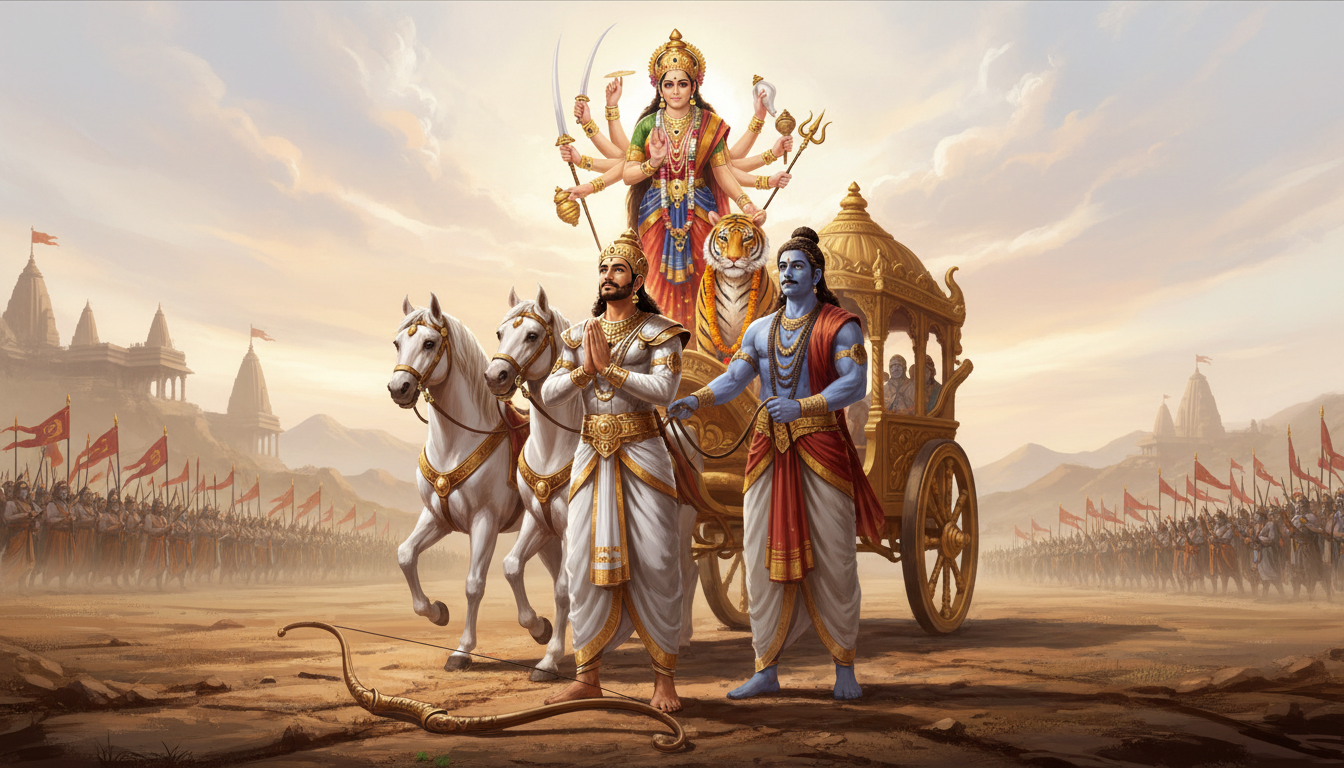
The Hymn Before the Conches
Krishna sends Arjuna down from the chariot to praise the goddess
The Questions of a Man Who Cannot See
"When the sun rose, Sanjaya, which of them went forward first, gladly, wanting it? My army under Bhishma, or the Pandava army under Bhima?"
Sanjaya had come back from the field with the sight Vyasa had given him still burning behind his eyes, and the blind king would not let him sit down until he had emptied it.
"To which side were the sun and the moon and the wind hostile? Against whom did the beasts of prey cry out their evil sounds? Who were those young men whose faces were bright that morning? Tell me all of it, truly and in order."
"Both armies were joyful, O king," Sanjaya said. "That is the first thing to say. When they were drawn up, both of them were joyful, and both of them were beautiful. They had the look of woods coming into blossom. Both were thick with elephants and cars and horses. Both were vast and terrible to look upon, and neither could bear the sight of the other. Both had been arrayed to conquer heaven itself, and both were made of excellent men."
"You have told me nothing."
"I have told you that they were equal in everything a man can count. Now hear the things a man cannot count. Your Kauravas stood facing the west. The sons of Pritha stood facing the east. Your host had the aspect of the army of the chief of the Danavas, and theirs had the aspect of the army of the celestials. And the wind, O king, got up behind the Pandavas and blew into the faces of your sons. The beasts of prey yelled, and they yelled against your sons. Your elephants would not stand quiet in their ranks, because that same wind carried them the smell of the temporal juice running down the huge elephants on the other side, and they could not bear it."
Dhritarashtra sat with his hands on his knees and said nothing for a long moment. Sanjaya waited. There was no kindness in the account and there was no lie in it either, and both men knew which of those the king had asked for.
"Go on," Dhritarashtra said. "Tell me how Bhishma set them out."
The White Mountain at the Head of the Line
"Your son rode in the very centre of the Kurus," Sanjaya said, "on an elephant of the complexion of the lotus, its temples rent and running, a golden Kaksha on its back and a coat of steel net-work over it. The bards and the eulogists walked beside it praising him as he went, and over his head they held a white umbrella with a golden chain, and it had the effulgence of the moon. Behind him came Sakuni the ruler of the Gandharas, with his mountaineers placed all around.
"At the head of everything stood the venerable one. A white umbrella above him. A white headgear. A white banner on his car and white steeds yoked to it, and his bow and his sword in his hands. From where I stood, O king, your grandsire looked like a white mountain that had come down onto the plain to stand there.
"In Bhishma's own division were all your sons, and Sala the countryman of the Valhikas, and those Kshatriyas called the Amvastas, and the Sindhus, and the Sauviras, and the fighting men of the country of the five rivers. Behind all the troops, protecting them the way Indra protects, was Drona on a golden car with red steeds yoked to it, bow in hand and heart that has never failed, the preceptor of very nearly every king on that field. Saradwat's son Kripa, who is called Gautama, took the northern point with the Sakas and the Kiratas and the Yavanas and the Pahlavas about him. Kritavarman went to the south with the car-warriors of the Vrishni and the Bhoja races and the well-armed men of Surashtra. And ten thousand cars of the Samasaptakas went out, who were created for one purpose only, the death of Arjuna or the fame of it, and who had sworn to follow at his heels wherever he went; and the brave Trigartas went out with them.
"You had a thousand elephants of the foremost fighting powers, O Bharata. To every elephant a hundred cars. To every car a hundred horsemen. To every horseman ten bowmen. To every bowman ten combatants with sword and shield. That is how Bhishma disposed your divisions, and as each day dawned he changed the shape of them, the human array one morning, the celestial the next, then the Gandharva, then the Asura. Thronged with Maharathas, roaring like the very ocean, it stood facing the west and waited.
"Your army was past counting, O ruler of men, and it was terrible. And still the smaller army opposite seemed to me the larger and seemed to me unbreakable, because Kesava and Arjuna were at the head of it."
How the Few Overcome the Many
"Before any of that, O king, when Kunti's son first looked at what Bhishma had built, he gave way to grief. I saw his face go pale. He turned to Arjuna and spoke like a man who has already lost.
"'How are we to fight the Dhartarashtras with the Grandsire for their chief combatant? Look at that array. It is immovable and it cannot be penetrated. It has been designed according to the rules laid down in the scriptures by that grinder of foes, and there is no gap in it that I can find. Our troops have begun to doubt. Where is our victory to come from, in the face of such a host?'
"And Arjuna answered him, O king, not with comfort but with a rule.
"'Hear how soldiers few in number vanquish the many who possess every quality. You are without malice, so I may tell you the means. The Rishi Narada knows it. Bhishma knows it, and Drona knows it too. In the old war between the gods and the Asuras the Grandsire of all creatures said this to Indra and the celestials: they that desire victory do not conquer by might and energy so much as by truth, by compassion, by righteousness and by energy. Discriminate then between righteousness and unrighteousness. Understand what covetousness is and what it costs. Then put out your whole exertion and fight without arrogance. Victory is there where righteousness is.
"'Narada said a shorter thing than that, and a harder one. There is victory where Krishna is. Victory is inherent in him and follows Madhava about. As victory is one of his attributes, so humility is another. His energy is infinite, and in the midst of immeasurable foes he is without pain, and he is the most eternal of male beings. Appearing long ago as Hari he called aloud to the gods and the Asuras together, which of you would be victorious? And the very side that was losing answered him, with Krishna in the front we will conquer. It was through Hari's grace that Sakra and the gods obtained the three worlds. You have the Sovereign of the Universe standing on this field wishing victory to you, brother. I cannot find in you the slightest cause of sorrow.'"
The Counter-Array, and the Man Set in the Middle of It
"Then Yudhishthira disposed his own troops against Bhishma's divisions and urged them on. 'The Pandavas have arrayed their forces as the scriptures lay down,' he said. 'Fight fairly, you sinless ones, desiring the highest heaven.'
"In the centre he placed Sikhandin and his troops, and Arjuna to protect them. Dhrishtadyumna moved in the van, with Bhima to protect him. The southern division he gave to that mighty bowman Yuyudhana of the Satwata race, who stood there looking like Indra himself. Yudhishthira took his station on a car fit to carry Mahendra, with an excellent standard on it, variegated with gold and gems, golden traces on the steeds, and he set himself in the middle of his elephants. His pure white umbrella with the ivory handle was raised over his head, and great Rishis walked around him uttering his praise, and priests and Siddhas walked with them wishing the destruction of his enemies by Japas and Mantras and efficacious drugs and every propitiatory rite they knew. And that chief of the Kurus gave away to the Brahmanas kine and fruits and flowers and golden coins with cloths, and went forward like Sakra.
"Arjuna's car had a hundred bells on it, O king, and was decked with Jamvunada gold of the best kind, and had excellent wheels and the effulgence of fire, and white steeds were yoked to it, and it looked like a thousand suns together. On that ape-bannered car, with Kesava holding the reins, stood the man with Gandiva in his hand whose peer does not exist on earth and never will. For the crushing of your sons' troops, Bhimasena went into the van with the twins beside him, that one who when his weapons are gone pounds men and horses and elephants to dust with his bare hands. Your warriors looked at him standing there like a proud leader of an elephant herd, and their strength was weakened by fear, and they began to tremble like elephants sunk in mire.
"And Janardana said to Arjuna, standing in the midst of his troops: 'He who scorches us with his wrath and stays in the middle of his forces, he who will fall on our troops like a lion, he who performed three hundred horse-sacrifices, that banner of Kuru's race, that Bhishma, stays yonder. Great warriors rank around him on every side like clouds shrouding the bright luminary. Slay those troops, O foremost of men, and seek battle with yonder bull of Bharata's race.'"
Come Down From the Car
"Then your army began to move, O king. The whole western line came on at once for the fight, and the sound of it reached us across the field before the dust did.
"Arjuna had his hand on Gandiva. And Krishna, holding the reins, said a thing that had nothing to do with the bow.
"'Cleanse yourself, O mighty-armed one, and on the eve of the battle utter your hymn to Durga, for the defeat of the foe.'
"He did not explain it, and Partha did not ask him to. Understand what I am telling you, O king. The Dhartarashtra host was walking towards him. The conches had not yet gone but every man on both sides had his hands on his weapon. And the driver told the archer to get down.
"So Arjuna alighted from the car. He purified himself there in the open, in front of two armies, with the noise of your elephants coming across the plain at him, and then he stood on the ground beside the wheel with his palms joined and his head bent, and he began to name her.
"He named her by everything she is. He named her by the terrible names and the gentle ones together, by her weapons and by her kindred, by the sciences she is and the sleep she is, and he did not hurry, though your army was coming. I heard every word of it, and I have carried it since. Hear it now, and hear who it was that was standing behind him while he said it."
The Names of the Fierce One
"'I bow to you, O leader of Yogins, O you that are identical with Brahman, O you that dwell in the forest of Mandara, O you that are freed from decrepitude and decay. O Kali, O wife of Kapala, O you that are of a black and tawny hue, I bow to you.
"'O bringer of benefits to your devotees, I bow to you. O Mahakali, O wife of the universal destroyer, I bow to you. O proud one, O you that rescue from dangers, O you that are endowed with every auspicious attribute, O you that are sprung from the Kata race, O you that deserve the most regardful worship, I bow to you.
"'O fierce one. O giver of victory, and victory's own self. O you that bear a banner of peacock plumes and are decked with every ornament. O you that bear an awful spear, that hold a sword and a shield.
"'In inaccessible regions, where there is fear, in places of difficulty, in the houses of those that worship you, and in the nether regions of Patala, there you always dwell. You always defeat the Danavas. O great goddess, let victory attend me always through your grace upon the field of battle.'
"He said it, O king, standing on the ground with his car empty behind him and Gandiva laid aside, and he said it the way a man says a thing he has said every morning of his life. There was nothing new in his mouth. That is the part I want you to hear. Your sons had been told for thirteen years that Arjuna was a bowman. He was a bowman who got down off his car with an army walking at him and gave the first moments of the war away to a goddess, because the one who held his reins told him to, and because he had never in his life supposed that the arrow was the beginning of anything."
Sister of the Chief of the Cowherds
"'O you that are the younger sister of the chief of the cow-herds. O eldest one. O you that were born in the race of the cowherd Nanda.
"'O you that are always fond of buffalo's blood. O you that were born in the race of Kusika. O you that are dressed in yellow robes. O you that devoured the Asuras, having taken upon yourself the face of a wolf. I bow to you that are fond of battle.
"'O Uma. O Sakambhari. O you that are white in hue and you that are black in hue. O you that slew the Asura Kaitabha. O yellow-eyed one, O diverse-eyed one, O you whose eyes have the colour of smoke, I bow to you.
"'You are the Vedas, and the Srutis, and the highest virtue. You are propitious to Brahmanas engaged in sacrifice. You have knowledge of the past. You are ever present in the sacred abodes that men have raised to you in the cities of Jamvudwipa. I bow to you.'
"Consider what he was doing there, O king, and to whom. The younger sister of the chief of the cow-herds. Born in the race of the cowherd Nanda. He was standing at the wheel of a car and calling the goddess by the household she belongs to, and the man holding the reins of that car was the son of that same house, who had been carried across a river in the night into it. Arjuna was praising her, and he was naming her brother while he did it, and the brother was standing three paces behind him listening and did not say one word."
The Sleep From Which There Is No Waking
"'Among the sciences you are the science of Brahma. You are that sleep of creatures from which there is no waking.
"'O mother of Skanda. O you that possess the six highest attributes. O Durga, O you that dwell in regions no man can reach. You are described as Swaha and as Swadha, as Kala and as Kashta, as Saraswati, as Savitri the mother of the Vedas, and as the science of Vedanta. With my inner soul cleansed, I praise you.
"'You are the unconsciousness, the sleep, the illusion, the modesty and the beauty of all creatures. You are the twilight and you are the day. You are Savitri and you are the mother. You are contentment, you are growth, you are light. It is you that support the sun and the moon and make them shine. You are the prosperity of the prosperous. The Siddhas and the Charanas behold you in contemplation.'
"That was the end of it, O king. There were no other names left in him.
"And it is worth saying aloud what he had just asked her to be. He had called her the sleep from which creatures do not wake, and then in the same breath he had asked her for victory on a field where a hundred thousand men were standing in the sun waiting to be given exactly that sleep. He did not soften either half of it. Your grandsire, who taught him, would have understood the honesty of that. A man about to kill on a scale nobody had ever attempted does not get to pretend he is asking for something small."
The Goddess in the Firmament
"She understood the measure of Partha's devotion, O king, and she is always graciously inclined towards mankind. So she came.
"She appeared in the firmament over that field, in the open sky above two armies that were already moving. And here is the thing I would have you hold, Dhritarashtra: she did not appear before Arjuna, who had praised her. She appeared in the presence of Govinda, and it was to Govinda's charioteer standing on the ground that she spoke.
"'Within a short time you shall conquer your foes, O Pandava. O invincible one, you have Narayana again to aid you. You cannot be defeated by any enemy, not even by the wielder of the thunderbolt himself.'
"The boon-giving goddess said that and was gone almost at once, and the sky over Kurukshetra was only sky again.
"Kunti's son, having obtained that boon, regarded himself as a man whose business was already finished. He climbed back onto his excellent car. He took up Gandiva. And then those two, seated on the same car, filled their lungs and blew their celestial conches, and the sound went out over the plain and into your lines, and your sons heard it and did not know what it was they were hearing.
"They heard two men on a chariot. That is all they heard. Not the goddess who had just spoken above their heads and named the pair of them, not the promise she had made and not the name she used."
Recite It at Dawn
"There is a virtue in that hymn beyond the day it was said, O king, and I will tell it to you because you will not get it from your sons.
"The man who rises at dawn and recites it has no fear at any time from Yakshas, or Rakshasas, or Pisachas. He can have no enemies. He has nothing to fear from snakes, or from any animal with fangs and teeth, or from kings. He is victorious in all disputes. If he is bound, he is freed from his bonds. He gets over difficult places, and he is freed from thieves, and he is ever victorious in battle, and he wins the goddess of prosperity and keeps her. With health and with strength, he lives a hundred years.
"I have known all of this through the grace of Vyasa, who is endowed with great wisdom, and I say it to you plainly. Your sons, all of them entangled in the meshes of death, do not know from ignorance that those two on that car are Nara and Narayana. Nor do they know, being in the same meshes, that the hour of this kingdom has come.
"Dwaipayana prevented your son. Narada prevented him. Kanwa prevented him, and the sinless Rama prevented him. He would not accept the words of any of them.
"There where righteousness is, there are glory and beauty. There where modesty is, there are prosperity and intelligence. There where righteousness is, there is Krishna, and there where Krishna is, there is victory."
Then the armies met. The combatants of both were cheerful, O king, and the flowery garlands and the perfumes of both gave out the same fragrance. The musical instruments and the blare of the conches and the noise of the drums and the shouts of brave men roaring at one another became one loud uproar, and the elephants uttered obstreperous grunts, and the two hosts came together staring at each other with joy in their faces, and the collision was dreadful.
Dharma Lesson
Before the hand that will do the work is raised, the head that guides it should be bowed. Arjuna is the finest bowman alive and the enemy is already moving, and still the first act of the war he performs is to get down off his car and praise someone else. The one who asks for victory honestly must also name what victory costs, and he calls her the sleep from which creatures do not wake in the same breath in which he asks her for the field.