The Terms Sworn at Dawn
The sun came up over Kurukshetra on ground that had been swept bare by the hooves of a hundred thousand horses. There was no grass left on the plain, no bird in the air above it. There were only the two armies, and the space between them, and the dust hanging over both like a second sky.
Eleven akshauhinis stood to the north under Bhishma. Seven stood to the south under Dhrishtadyumna. Each akshauhini counted twenty-one thousand eight hundred and seventy chariots, an equal number of elephants, sixty-five thousand six hundred and ten horsemen and a hundred and nine thousand three hundred and fifty men on foot, and when eighteen of them were drawn up on one field the earth complained under the weight.
Before a single bow was strung, heralds rode out from both hosts into the open ground and the fighting stopped before it had begun. Yudhishthira spoke the terms himself, standing in his chariot so that both armies could hear him.
"Let equals fight equals," he said. "Chariot against chariot, horseman against horseman, elephant against elephant, foot soldier against foot soldier. Let no man strike another who has turned away, or laid down his weapon, or lost his armour, or asked for quarter. Let no man strike one already engaged with another. Let charioteers, drummers, conch blowers, water carriers and the men who tend the animals go untouched. Let the fighting begin when the sun is up and end when it goes down, and let those who have fought each other by day visit each other's camps by night as kinsmen."
Bhishma listened with his white beard moving in the wind and his palm banner standing straight above his chariot.
"Let it be so," the grandsire answered. "On these terms we fight."
And the strangest thing on that plain was the sight of men who had come to destroy one another agreeing, carefully and in good faith, upon the courtesies of killing.
Yudhishthira Walks to the Elders
Then Yudhishthira did a thing that made his own army think, for one cold moment, that he had lost his nerve.
He took off his armour. He set down his bow, stepped out of his chariot, folded his hands, and began to walk across the open ground toward the Kaurava host, alone and on foot.
Bhima started after him and was held back. Duryodhana's captains reached for their weapons and were stopped by a lifted hand. The eldest Pandava walked the length of that terrible field in silence, and the eleven akshauhinis parted for him without being told to.
He came first to Bhishma and touched his feet.
"Grandfather, we are going to fight you. Give me leave, and give me your blessing."
"Child," Bhishma said, and his voice was not steady, "if you had not come to me I would have cursed you for a fool. My body belongs to Hastinapura. It was bought long ago with the bread of that house, and today it stands where it was bought to stand. But my heart is with you. Fight, and ask me for a boon."
"How do we defeat you?"
"Not today," the grandsire said. "Ask me again when the time has come, and I will tell you."
He went to Drona and asked the same question, and his teacher answered that a man is a slave to wealth and that wealth had made a slave of him, but that where dharma stood, victory would follow. He went to Kripa, who wept and blessed him. He went last to Shalya, his own uncle by marriage, driving now for the enemy, who promised him what he had promised before and gave him leave to go.
Then he called across the field, offering a place in his army to anyone in the Kaurava host who would come. One man came: Yuyutsu, son of Dhritarashtra by a serving woman, who crossed the open ground and stood with his cousins.
Yudhishthira put his armour back on.
Gandiva Falls
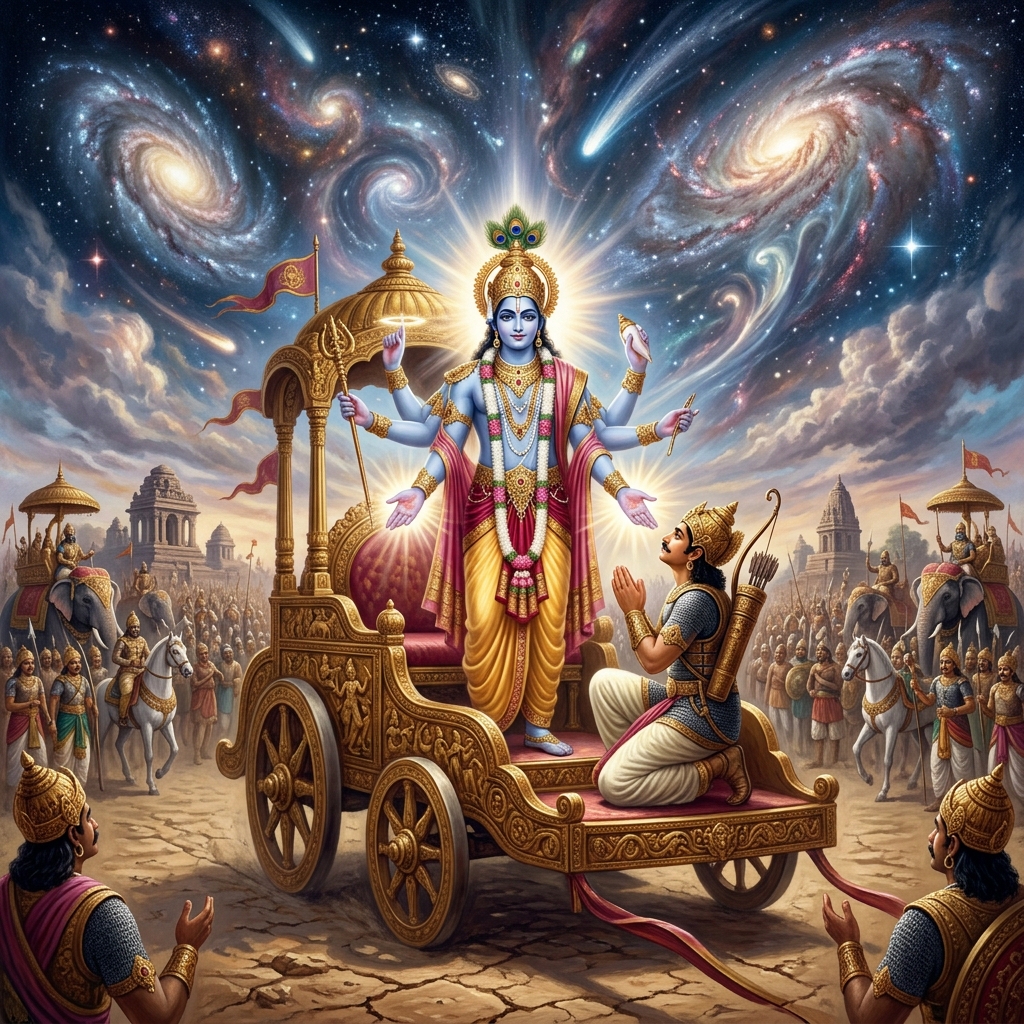
"Krishna," Arjuna said, "take me out between the armies. I want to see who has come here to die."
The white horses moved, and the chariot with the monkey banner rolled out into the gap where no man stood, and stopped. Arjuna looked north.
He had expected to see an army. What he saw were faces.
Bhishma, who had carried him on his shoulders through the corridors of Hastinapura and had wiped his mouth when he was a child. Drona, who had put his first bow into his hands and taught him to see nothing but the eye of the bird. Kripa, who had taught him letters. Shalya, his uncle. Somadatta, Bahlika, Bhurishravas, the old men of his own blood. Cousins he had wrestled with in the dust of the practice yard. Sons of men who had held him. Every rank of that ocean of iron had somebody in it whose name he knew.
His skin went cold. His mouth dried. His arms would not hold their strength, and Gandiva, the bow of the fire god, the bow no other man on that field could string, slid out of his fingers and struck the floor of the chariot.
"I will not do this," he said. "What is a kingdom worth, bought with these? Let them kill me. I will not lift a weapon."
And Krishna, holding the reins of four white horses in the narrow space between four million armed men, turned around and began to speak.
What he said there is remembered whole. It is the song that men have carried out of that morning ever since, seven hundred verses on the deathless self, on action without hunger for its fruit, on the duty that belongs to you being better than the duty that belongs to another, and at the end of it a vision so vast that Arjuna begged for the ordinary face of his friend to come back.
When it was finished, Arjuna picked up his bow.
"Drive on," he said. "My confusion is gone."
He lifted Devadatta to his lips and blew, and Bhishma answered him, and the eighteen akshauhinis began to move.
The Grandsire's Harvest
The first day belonged to the old man in the golden chariot.
Bhishma did not fight the way other men fought. He stood in one place and the Pandava lines came apart in front of him, rank by rank, as though a wind were pulling at cloth. His arrows left the bow so fast that no eye on the field could find the moment of drawing; men only saw the string blurred and the ranks thinning. Wherever the Pandava captains repaired a break, the break opened again a little to the left of where they had mended it.
Into that storm rode Uttara, the young prince of Matsya, who had been Arjuna's student for a single season and had been a boy at the beginning of that year. He came on an elephant, and he drove it straight at the chariot of Shalya, king of Madra.
The elephant crushed the chariot. It broke the yoke, killed the horses, and stood over the wreck with the young prince shouting from its neck, and for one bright moment the Matsya soldiers roared as if the day had turned.
Shalya came out of the ruin on foot with an iron dart in his hand. He looked up once, took his time, and threw. The dart went through Uttara's mail and through Uttara, and the prince of Matsya fell from the elephant's neck onto the churned ground, the first king's son to die in that war.
His brother Shweta saw him fall.
What Shweta did that afternoon is still counted among the great rages of the age. He drove into the Kaurava centre alone, broke seven divisions, unhorsed Kritavarma, scattered Shalya's rescuers, and came at last to the golden chariot itself, and for a while the grandsire of the Kurus was fighting for his life against a boy who did not care whether he lived.
Bhishma killed him at sunset with an arrow like a length of flame, and the Matsya banners went down together, brother after brother, in the same hour.
The Count at Nightfall
The conches sounded the end of the fighting while there was still light enough to see the field, and by the terms sworn that morning every hand came down.
On the northern side of the plain the drums did not stop. Duryodhana went from chariot to chariot with his face shining, and men who had been afraid of him that morning cheered him without being ordered to. He came to Bhishma last and touched his feet in front of the whole army.
"Grandfather, you have given me the war in a single day. Two of Virata's sons are dead. Their divisions are broken. There are heaps of them out there that our chariots cannot drive over. Tomorrow we finish it."
"Tomorrow," Bhishma said, "is not today." He was looking south, where the Pandava lamps were being lit one by one, and there were fewer of them than there had been at dawn.
In the Pandava camp nobody spoke above a murmur. Virata sat on the ground outside his tent with his sons' armour in front of him and would not have it taken away. Yudhishthira went to him and could think of nothing to say that was not an insult, so he sat down beside the old king in the dirt and said nothing at all, which was the only thing that helped.
Later, in the lamplight, Yudhishthira said what everyone in that tent was thinking.
"We cannot beat him. You saw it. He stood in one place and our army walked into him and stopped existing. Krishna, I have brought these men here to be killed by an old man who loves me."
"You have brought them here," Krishna said, "because thirteen years of asking politely came to nothing. One day is one day. Bhishma is a wall, and a wall is not beaten by grief. Tomorrow you will not throw your soldiers at him in a line. Tomorrow you will give Dhrishtadyumna a shape to fight with."
Out on the plain, the jackals had already come.
Dharma Lesson
Men who have decided to kill each other still take the trouble to agree on how it shall be done, and that agreement is the last thread of dharma left in a war. Rules of engagement do not make slaughter innocent, but they hold a line that, once crossed, cannot be found again. The first day is remembered not for who won it but for what both sides promised before it began.
Common Questions
Why did Arjuna refuse to fight on the first day?
Seeing his grandfather, teachers and cousins arrayed against him, Arjuna's limbs went weak and Gandiva slipped from his hand; he said no kingdom was worth killing his own family. Krishna's answer to that collapse is the Bhagavad Gita, after which Arjuna took up his bow and fought.
Who died on the first day of the Kurukshetra war?
The first royal dead were the Matsya princes: Uttara, Virata's son, killed by Shalya, and his brother Shweta, killed by Bhishma. Bhishma's arrows scattered the Pandava lines and the day went clearly to the Kauravas - an ominous opening for the Pandava side.
What were the rules of the Kurukshetra war?
Before the first day both sides swore a code: fight only equals and only by daylight, never strike a man disarmed, fleeing, surrendered or already engaged, and spare charioteers, animals and non-combatants. Almost every one of these rules is broken before the eighteen days are over.
How large were the armies at Kurukshetra?
Eleven akshauhinis fought for the Kauravas against seven for the Pandavas, eighteen divisions in all - a number matching the epic's eighteen books and the war's eighteen days. One akshauhini is traditionally reckoned at 21,870 chariots, 21,870 elephants, 65,610 horsemen and 109,350 foot soldiers.