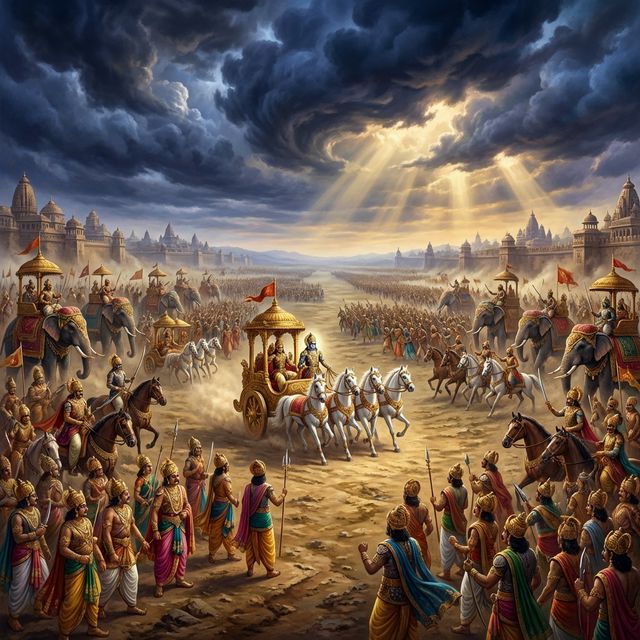
Eighteen Days of Destruction
The Kurukshetra War teaches that there is no such thing as a 'clean' war.
The Armies Face Each Other
यदा यदा हि धर्मस्य ग्लानिर्भवति भारत
Yadā yadā hi dharmasya glānir bhavati Bhārata
The plain of Kurukshetra stretched to the horizon in every direction - a vast, flat expanse of earth that had been sacred ground since the dawn of the age. Here, millennia ago, King Kuru had plowed the land with his own hands, sanctifying it with his sweat and blood. Now that sacred soil would be sanctified again - with the blood of four million warriors.
The armies were arranged at dawn. The Kaurava forces - eleven Akshauhinis strong - covered the northern half of the field like a living ocean of iron and flesh. Each Akshauhini contained 21,870 chariots, 21,870 elephants, 65,610 cavalry, and 109,350 foot soldiers. Eleven such formations created a host so vast that the dust raised by their positioning darkened the morning sky.
Facing them from the south stood the Pandava army - smaller at seven Akshauhinis, but led by commanders of incomparable skill and burning with the righteous fury of men who had endured thirteen years of exile for crimes they did not commit.
Bhishma, the grandsire, commanded the Kaurava forces. He sat in his golden chariot, his white beard flowing in the morning wind, the palm-tree banner of Hastinapura flying above him. He was the greatest warrior of the previous generation - a man who had been offered the throne of heaven and refused it. He did not want this war. He loved the Pandavas. But his vow bound him to whoever sat on the throne of Hastinapura, and that was Dhritarashtra.
Across the field, Arjuna stood in his chariot, the divine Gandiva bow in his hand, his quiver stocked with celestial arrows. Before him - and this was the source of his sudden, devastating crisis - he could see his grandfather Bhishma, his teacher Drona, his uncle Shalya, his cousins, his childhood friends. Every face he saw was a face he had loved.
"I cannot do this," Arjuna whispered, and the bow slipped from nerveless fingers.
Krishna - God incarnate, pretending to be a charioteer - turned to look at his friend. And in the space between the two armies, in the silence before the first arrow flew, the most sacred conversation in human history began.
The Bhagavad Gita.
Seven hundred verses. The nature of the soul. The meaning of duty. The path to liberation through action, through knowledge, through devotion. Krishna revealed his cosmic form - a vision so vast and terrible that Arjuna trembled and begged him to return to his human shape.
"Arise, Arjuna," Krishna concluded, his voice containing within it the sound of every river, every storm, every heartbeat that had ever occurred. "Do your duty without attachment to results. Fight - not for victory, but because fighting is right. The soul is eternal. Those you grieve for have already died a hundred times and been born a hundred more. Death is only a change of garments."
Arjuna picked up his bow.
The conch shells sounded. First Krishna's Panchajanya - deep and resonant as the ocean. Then Arjuna's Devadatta - clear and piercing as lightning. Then Bhima's Paundra - thunderous enough to shake the earth.
From the Kaurava side, answering conches rose in a wall of sound that made birds fall from the sky and animals flee in terror.
The war of Kurukshetra had begun.
Bhishma's Ten Days of Terror
For ten days, the grandsire Bhishma raged across the battlefield like a force of nature.
He was over a hundred years old, but his bow arm had lost none of its power, and his tactical mind was sharper than any blade. Each morning, he arranged the Kaurava forces in formations of increasing complexity - the Krauncha (Crane), the Mandala (Circle), the Garuda (Eagle) - each designed to exploit the Pandavas' weaknesses.
On the first day alone, Bhishma killed ten thousand Pandava soldiers. His arrows did not merely fly - they moved as if guided by divine will, weaving between shields and armor to find flesh. Warriors who faced him spoke of arrows that curved around obstacles, that struck from impossible angles, that hummed through the air with an almost musical precision.
The Pandava generals despaired. Arjuna, their greatest weapon, could not bring himself to fire at full force against his beloved grandfather. Every time he drew his bow against Bhishma, his hands faltered. Every arrow he shot was deliberately aimed to miss vital organs.
"You are not fighting him," Krishna observed on the evening of the third day. "You are performing a ritual of grief."
"He raised me," Arjuna said, his voice hollow. "He carried me on his shoulders. He taught me to shoot my first arrow. How can I kill the man who was more of a father to me than my own father ever was?"
Meanwhile, the war created horrors that neither side had anticipated. The Rakshasa Alambusha attacked the Pandava flank with supernatural powers. Bhima's son Ghatotkacha countered with his own demonic abilities - growing to the size of a mountain, raining boulders down on the Kaurava formations. Days and nights blurred together as the fighting continued past sunset under torchlight and moonlight.
Uttara, the young prince of Virata who had been Arjuna's student, was killed on the very first day - one of thousands of young warriors who marched into battle believing in glory and found only oblivion.
By the end of the tenth day, the Pandava army had lost nearly a third of its strength to Bhishma's rampage. Something had to change - or the war would end before it truly began.
And so the Pandavas went to Bhishma himself.
They went to his tent at night - enemies visiting the commander of the army they were fighting. This was the strange morality of the Mahabharata: even in war, family bonds could not be entirely severed. Bhishma received them with tears in his eyes.
"I love you," the grandsire told the Pandavas. "I always have. But my vow holds me to the throne. I cannot stop fighting."
"Then tell us," Yudhishthira asked, "how to defeat you."
And Bhishma - bound by his oath to the Kauravas but bound by his love to the Pandavas - told them the secret of his own destruction.
The Fall of the Grandsire
The tenth day of the war. The day the Pandavas deployed their most controversial weapon - not a divine missile or a celestial arrow, but a person.
Shikhandi.
Born as Amba, a princess of Kashi whom Bhishma had abducted decades ago for his brother's wedding. Amba had loved another man - King Salva - and when Bhishma returned her, Salva rejected her as "another man's property." Amba was ruined. She swore revenge against Bhishma, performed terrible penances, and was eventually reborn as Shikhandi - a man who was once a woman.
Bhishma had sworn that he would never fight someone who had been born female. It was a vow rooted in his ancient code of chivalry - the same code that had once led him to take the vow of celibacy.
On the tenth morning, Arjuna placed Shikhandi at the front of his chariot and advanced toward Bhishma.
The grandsire saw them coming. He lowered his bow.
"I see you, Shikhandi," Bhishma said, his voice carrying across the battlefield. "I know who you are. I know what you were. And I will not raise my weapon against you."
Behind Shikhandi, Arjuna drew his Gandiva.
What followed was the most heartbreaking sequence of the war. With Shikhandi as his shield, Arjuna poured arrows into the man who had raised him - the man he loved more than almost anyone alive. Each arrow pierced Bhishma's ancient body. One through the shoulder. One through the chest. One through the thigh. The old warrior's chariot was shattered. His banner fell. His armor was pierced in a hundred places.
And still Bhishma smiled.
He smiled because he had been waiting for this. He had lived too long - over a century, bound by a vow that had stolen his youth, his love, his chance at ordinary happiness. He had watched the kingdom he had sworn to protect descend into corruption. He had sat silent in the sabha while Draupadi was humiliated. This was his penance for that silence.
Bhishma fell from his chariot, and the arrows that pierced his body were so numerous that when he landed, he did not touch the ground. He lay suspended on a bed of arrows - a bed of his own making.
"Water," the grandsire whispered.
Arjuna, weeping openly, shot an arrow into the earth. A spring of pure water erupted from the wound in the ground, arching over the bed of arrows to touch Bhishma's lips.
"Thank you, child," Bhishma said. "Now I will wait. My time has not yet come. I will wait for the auspicious moment of Uttarayana - when the sun turns north - and then I will depart this world."
Bhishma lay on his bed of arrows for fifty-eight more days - teaching, counseling, passing on the wisdom of a hundred years to those who came to listen. Warriors from both sides visited him. Even his enemies paid their respects.
The greatest of the Kurus was fallen, but not yet gone. He would watch the war unfold from his terrible bed, unable to intervene, bearing witness to the destruction his silence had helped create.
Drona's Ruthless Command
After Bhishma's fall, Drona assumed command of the Kaurava armies. The transformation was shocking. The gentle teacher - the man who had patiently trained children for years - became a monster of efficiency on the battlefield.
Drona fought without the grandsire's restraint. He deployed formations of devastating lethality. He used divine weapons recklessly. He killed not with reluctance but with the cold precision of a man who had nothing left to lose.
His target was clear: capture Yudhishthira alive. If the eldest Pandava could be taken prisoner, the war would effectively end. Drona designed formation after formation specifically to penetrate the Pandava defenses and reach Yudhishthira.
For five days - days eleven through fifteen - the war reached a fever pitch of intensity. Drona's Chakravyuha (the labyrinth formation) was deployed on the thirteenth day, and it resulted in the war's most heartbreaking single casualty.
But that is the next chapter of this story.
Duryodhana, growing impatient with Drona's inability to capture Yudhishthira, confronted his commander openly. "You promised to capture the Pandava king! Every day you promise, and every day you fail!"
The accusation stung Drona - this proud Brahmin warrior who had served the Kuru household for decades. His resolve hardened into something dark. He began to fight not just with skill but with rage, cutting through Pandava battalions like a scythe through wheat.
On the fourteenth day, Drona massacred an entire Akshauhini of the Pandava forces in a single afternoon. One Akshauhini - over two hundred thousand warriors - destroyed by one man in a few hours. It was an act of such terrifying power that even the gods hesitated to intervene.
The Pandavas realized that Drona - like Bhishma before him - could not be defeated by conventional means. He was too skilled, too experienced, too fueled by the terrible energy of a teacher who believed his own students had betrayed him.
They would need a weapon more devastating than any arrow.
They would need a lie.
The Boy in the Labyrinth
अभिमन्युः प्रजज्वाल दहन्निव रणे रिपून्
Abhimanyuḥ prajajvāla dahaniva raṇe ripūn
The thirteenth day. The day that would haunt Arjuna until his own death and beyond.
Drona deployed the Chakravyuha - the Labyrinth Formation. It was a spiral of concentric rings, each manned by a different great warrior, designed to trap anyone who entered and destroy them from all sides. Only two people in the entire Pandava army knew how to penetrate it: Arjuna and his teenage son, Abhimanyu.
But Arjuna had been drawn away to a distant part of the battlefield by a deliberate feint. The Trigarta warriors had challenged him to a duel that was, in reality, a trap designed to separate him from the main army. Arjuna - bound by Kshatriya honor - could not refuse a direct challenge.
The Chakravyuha stood between the Pandava army and Drona's assault. If no one broke through, Yudhishthira would be captured.
Abhimanyu was sixteen years old.
He had learned the technique for entering the Chakravyuha while still in his mother Subhadra's womb - listening to his father Arjuna describe the process to her during pregnancy. But Subhadra had fallen asleep before Arjuna explained how to exit. Abhimanyu could enter. He could not leave.
"I know how to break in," the boy told Yudhishthira, his young face blazing with the fearless confidence of a warrior's son. "I will open the way. Follow me through."
"We will be right behind you," Bhima promised, his massive hand clasping the boy's shoulder. "Enter, and we will follow."
Abhimanyu drove his chariot into the Chakravyuha. His skill was breathtaking - arrow after arrow found its mark, warrior after warrior fell before his advance. He broke through the first ring. The second. The third. Each layer of defense crumbled before a boy who fought with the terrifying precision of his father.
Behind him, the gap should have remained open for the Pandava army to follow.
But Jayadratha - the king of Sindhu, Duryodhana's brother-in-law, the man who had once tried to abduct Draupadi - stood at the breach. Jayadratha had been granted a boon by Shiva that allowed him to stop all four Pandavas (except Arjuna) for one day. He sealed the gap. Bhima, Yudhishthira, Nakula, Sahadeva - all of them were held back by divine power.
Abhimanyu was alone inside the labyrinth.
For hours, the boy fought. He faced Drona. He faced Karna. He faced Duryodhana. He faced Ashwatthama. He faced every great warrior the Kauravas had - AND HE HELD HIS OWN. His bow was broken. He fought with his sword. His sword was broken. He fought with a chariot wheel. Six of the greatest warriors in the world attacked a sixteen-year-old boy simultaneously - violating every rule of fair combat - and even then, it took them the better part of a day to bring him down.
When Abhimanyu finally fell, pierced by arrows from every direction, the Kaurava soldiers who had witnessed his stand did not cheer. Many of them wept. Even Drona - who had orchestrated the trap - hung his head in shame.
That evening, when Arjuna returned and learned what had happened, the sound that came from his throat was not a cry. It was the sound of a world breaking.
"Who closed the Chakravyuha behind my son?" Arjuna demanded.
"Jayadratha."
"Then hear my vow: TOMORROW, BEFORE THE SUN SETS, I WILL KILL JAYADRATHA. If I fail, I will walk into fire."
Arjuna's Oath - Jayadratha Must Die
The fourteenth day of the war was unlike any other. It was the day Arjuna became death.
The Kauravas knew Arjuna's vow. If he could be kept from Jayadratha until sunset, Arjuna would be honor-bound to immolate himself. Duryodhana arranged every remaining warrior - every formation, every strategy, every weapon - into a single purpose: protect Jayadratha until sundown.
Arjuna and Krishna rode into this wall of defense at dawn, and what followed was the single most devastating display of archery the world had ever seen.
Arjuna did not merely fight his way through the Kaurava army. He annihilated it. His arrows fell like rain - not the gentle rain of monsoon, but the rain of a cataclysm, the kind that ends civilizations. Entire battalions were destroyed in minutes. Warriors who had fought bravely for thirteen days turned and fled at the sight of Arjuna's chariot bearing down on them, Krishna's divine hands on the reins, the Gandiva bow singing its song of death.
He fought through Drona's defenses. He fought through Kripacharya, through Ashwatthama, through Shalya, through Vikarna. Each great warrior who stood against him was brushed aside like a leaf in a hurricane. Arjuna was not fighting with human skill anymore - he was channeling something cosmic, something that made the air around his chariot crackle with divine energy.
But the Kauravas were not fools. They had hidden Jayadratha deep behind seven layers of protection. And as the day wore on, the sun began its descent toward the western horizon.
Arjuna fought with increasing desperation. He could see the shadows lengthening. He could feel the day dying. And somewhere - behind walls of warriors, behind formations of elephants and chariots - Jayadratha waited, alive, breathing, existing, while Arjuna's time ran out.
Then Krishna acted.
The Lord of the Universe, who had vowed not to fight in this war, exercised the one power he had reserved for himself: the power of illusion. He summoned his Sudarshana Chakra - his divine discus - and used it to create the appearance of a premature sunset. The sky darkened. The sun appeared to touch the horizon.
Jayadratha, believing the day was over and Arjuna's vow had failed, emerged from his hiding place. He stood in the open, triumphant, ready to watch his enemy burn.
Krishna dispelled the illusion. The sun blazed back to its true position - still above the horizon.
And Arjuna, who had been waiting for this precise moment with the coiled patience of a serpent, drew the Pashupatastra - the arrow given to him by Shiva himself.
"Jayadratha!"
The king of Sindhu turned. His face changed from triumph to terror in the span of a heartbeat.
Arjuna's arrow did not merely kill Jayadratha. It severed his head and carried it through the air - mile after mile, over the battlefield, over the camps - until it landed in the lap of Jayadratha's father, who was meditating in a distant forest. The old king, startled, let the head fall to the ground. And because Jayadratha's father had once blessed his son with a boon that whoever caused his head to fall to the ground would themselves die, the old man's own head exploded.
The vow was fulfilled. The sunset was real. And Arjuna - who had fought from dawn to dusk against an entire army - finally, allowed himself to breathe.
Ghatotkacha's Night of Fire
The fighting on the fourteenth day continued past sunset - the first time in the war that battle raged through the night. And in the darkness, a new horror emerged.
Ghatotkacha, Bhima's Rakshasa son, came into his full power.
Rakshasas grew stronger at night. Their illusions became more potent, their bodies more massive, their appetites for destruction more insatiable. Ghatotkacha grew to the size of a mountain. His eyes blazed like furnaces. His roar shattered the nerves of warriors who had faced death calmly in daylight.
He waded into the Kaurava army like a giant through a field of ants. He hurled boulders the size of houses. He breathed fire that incinerated entire battalions. He created illusions of monstrous armies that drove Kaurava soldiers mad with terror.
Duryodhana was frantic. "Karna! Use the Vasavi Shakti! KILL HIM NOW!"
Karna held the Vasavi Shakti - Indra's divine javelin, the weapon that could kill with absolute certainty. He had been saving it for Arjuna. One throw. One kill. He had planned to use it against his greatest rival, the one enemy who stood between Duryodhana and victory.
But Ghatotkacha's rampage was destroying the Kaurava army. If Karna did not act, there would be no army left by morning.
The choice was devastating: use the one weapon that could kill Arjuna to save the army now, or hold it and risk total annihilation.
Karna chose loyalty over strategy. He always did.
He hurled the Vasavi Shakti. The divine javelin streaked through the night sky like a comet - burning, blazing, impossible to dodge. It struck Ghatotkacha in the chest.
The Rakshasa prince fell like a mountain collapsing. His body, reverting to its enormous true form in death, crushed an entire section of the Kaurava army beneath it. Even in death, he dealt devastation.
Across the battlefield, Krishna smiled. He knew. The Vasavi Shakti was spent. Arjuna was now safe from the one weapon that could have killed him. Ghatotkacha's sacrifice - unwilling, unknowing - had tilted the war decisively toward the Pandavas.
Bhima wept for his son. But in the calculus of war, one loss had purchased an ultimate advantage.
The Fall of Drona
सत्यमेव जयते नानृतम्
Satyam eva jayate nānṛtam
By the fifteenth day, the Pandavas had exhausted every conventional option against Drona. The teacher-turned-commander was too skilled, too powerful, too driven by rage and duty to be overcome by force of arms.
Krishna proposed a strategy that would stain the Pandava cause forever.
"Drona will only stop fighting if he believes his son Ashwatthama is dead," Krishna told the council of war. "Nothing else will break him. If he hears that Ashwatthama has fallen, his will to live - and fight - will collapse."
"But Ashwatthama is alive," Yudhishthira protested. "You are asking me to lie."
"I am asking you to end a war that is consuming the world."
The plan was set in motion. Bhima killed a war elephant named Ashwatthama - a beast that shared the name of Drona's son. He then rode to the front lines and bellowed at the top of his lungs: "ASHWATTHAMA IS DEAD! ASHWATTHAMA HAS FALLEN!"
Drona heard the cry. His bow arm faltered for the first time in the war. But he did not believe Bhima - Bhima who was known for his exaggerations, Bhima who bragged and boasted as naturally as he breathed.
"I will not believe this unless Yudhishthira confirms it," Drona said. "Yudhishthira has never spoken an untruth in his entire life."
Every eye turned to the Dharma King.
Yudhishthira - the man whose chariot had always floated four inches above the ground because of his perfect adherence to truth - spoke the words that would haunt him for eternity:
"Ashwatthama is dead - "
Then, quietly, almost inaudibly:
" - the elephant."
Krishna, at that precise moment, blew his conch shell. The blast drowned out the qualifying words. Drona heard only: "Ashwatthama is dead."
The great teacher laid down his weapons. His hands fell to his sides. His eyes - those brilliant, fierce eyes that had intimidated generations of warriors - went blank with grief.
And in that moment of surrender, Dhrishtadyumna - Draupadi's brother, the man who had been born specifically to kill Drona - stepped forward and cut off the teacher's head.
Drona died believing his son was dead. He died deceived by the student he had trusted most. His soul, the texts say, was seen ascending to heaven in a pillar of light - but even that light seemed dimmed by sorrow.
Yudhishthira's chariot, which had floated above the ground for his entire life, sank to the earth and never rose again.
The price of a lie. The cost of victory. The Mahabharata does not judge Yudhishthira's choice - but it makes certain that neither the characters nor the readers ever forget what it cost.
Karna vs Arjuna - The Final Duel
The seventeenth day. Karna's day.
[The full account of Karna's final battle and death is told in 'The Fallen Sun - Karna's Complete Tragedy.' Here we record what the battlefield saw.]
When Karna fell - when the Anjalika arrow severed the head of the man who was secretly the eldest Pandava - the Kaurava army broke.
Not physically. They had endured worse. They had survived Bhishma's fall and Drona's death. But Karna was different. Karna was not their commander by obligation - he was their champion by choice. He was the common soldiers' general, the man who spoke to them as equals, who shared their food and knew their names.
When Karna's golden crown rolled in the dust, and his divine earrings - restored by death - gleamed one last time in the fading light, something irreplaceable died in the Kaurava army's heart.
Duryodhana wept openly. He had not wept for Bhishma, whom he had always feared more than loved. He had not wept for Drona, whom he respected but never trusted. But for Karna - his friend, his sword, the only person who had given him unquestioning loyalty - Duryodhana's grief was genuine and devastating.
"With Karna gone," Duryodhana said, "the war is lost. But I will not surrender. I will fight until my last breath, because that is what Karna would have done."
Shalya assumed command for the eighteenth and final day - a reluctant general, a tricked ally, a man fighting for a cause he knew was wrong. His command lasted less than twelve hours. By midday, the Kaurava army existed only in fragments.
The war was reaching its bloody conclusion.
Duryodhana's Last Stand
सुखदुःखे समे कृत्वा लाभालाभौ जयाजयौ
Sukha-duḥkhe same kṛtvā lābhālābhau jayājayau
By the afternoon of the eighteenth day, the Kaurava army was annihilated. Of the eleven Akshauhinis - nearly 2.5 million warriors - that had marched onto the field eighteen days earlier, only a handful survived.
Duryodhana fled to a lake outside the battlefield. Using his knowledge of the mystic arts, he entered the water and suspended himself beneath the surface, breathing through magic, hiding from the inevitable.
The Pandavas found him.
"Come out, Duryodhana!" Yudhishthira called across the water. "You who sent us to die in a palace of lac. You who rigged a game of dice. You who ordered our wife disrobed. You who rejected every offer of peace. Come out and face the consequences of your choices."
Duryodhana rose from the lake. Even now - defeated, alone, stripped of everything - he was magnificent. His golden armor was dented but unbroken. His mace rested in his grip with the easy familiarity of an extension of his own arm.
"I will fight," Duryodhana said. "Choose any one of you. I will fight him in single combat - mace against mace - and if I win, you return my kingdom."
It was a generous offer from a desperate man, and the Pandavas should not have accepted it. In mace fighting, Duryodhana was the equal of Bhima. But Bhima stepped forward before anyone could object.
"Me," said Bhima. "It was always going to be me."
The mace duel between Bhima and Duryodhana was the last formal combat of the Kurukshetra war. Two titans - both trained by the same teacher, Balarama - circled each other with maces that could shatter stone.
They fought for hours. Back and forth, blow after massive blow, each impact sending shockwaves that could be felt a mile away. Balarama himself stood watching, having arrived for this final confrontation. The rules of mace fighting were sacred: no strikes below the waist.
Then Bhima remembered.
He remembered Draupadi dragged by her hair. He remembered Duryodhana slapping his own thigh - that obscene gesture that had invited Draupadi to sit on it. He remembered his vow, spoken in the sabha of Hastinapura, ringed by fire and witnessed by the gods.
Bhima swung his mace low.
The blow struck Duryodhana's thigh - shattering it completely, breaking bone and sinew, dropping the prince of Hastinapura into the dust.
"FOUL!" Balarama screamed, lunging forward with his plow weapon. "Below the waist! That is against every rule of mace fighting!"
Krishna intercepted his brother. "And where were the rules," Krishna asked, "when Draupadi was dragged by her hair? Where were the rules when Abhimanyu was surrounded by six warriors? Where were the rules during the game of dice?"
Balarama turned away in disgust. But Duryodhana lay in the dust, his thigh shattered, his war lost, his dynasty destroyed.
"I lived as a king," Duryodhana gasped, his breath coming in ragged bursts. "I fought as a warrior. I die on the battlefield. What more can any Kshatriya ask? It is YOU, Pandavas, who must live with the methods you used to defeat me."
These were his last coherent words on the battlefield. And the terrible thing is - he was not entirely wrong.
The Night Massacre
The war should have ended with Duryodhana's fall. It did not.
Three Kaurava warriors survived the battlefield: Ashwatthama, Kripacharya, and Kritavarma. Ashwatthama - Drona's son, a man consumed by grief and rage over his father's death - visited the dying Duryodhana on the evening of the eighteenth day.
"Avenge me," Duryodhana whispered. "Kill them all."
What Ashwatthama did that night would become the darkest chapter of the entire Mahabharata.
Under cover of darkness, guided by the fierce intelligence of a warrior raised by the greatest teacher in the world, Ashwatthama crept into the Pandava camp. The Pandavas themselves were not there - they had gone to rest at a different location, guided by an instinct or perhaps by divine warning. But their sons were there. The Upapandavas - five young men, one born to each Pandava through Draupadi - slept in their tents, exhausted by eighteen days of war.
Ashwatthama killed them all.
He killed Dhrishtadyumna - the man who had beheaded his father Drona - by suffocating him with a kick as he slept. He killed Shikhandi. He killed camp followers and guards. And he killed all five Upapandavas, cutting them down in their sleep, mistaking them for the Pandavas themselves.
When Draupadi learned what had happened - when she was told that all five of her sons were dead, their bodies cold in the ruins of the camp - her scream was heard across the battlefield, carried by the wind to every corner of Kurukshetra.
Arjuna pursued Ashwatthama. The confrontation ended when Ashwatthama, cornered, launched the Brahmashira - a weapon of absolute destruction, aimed at the unborn child in Abhimanyu's widow Uttara's womb. It was the last, most desperate act of a man who had lost everything.
Krishna intervened. He deflected the weapon's full force but could not prevent it entirely. The child in Uttara's womb was struck dead - but Krishna entered the womb with his own divine power and resurrected the infant.
The child was named Parikshit - the last heir of the Pandava line.
Ashwatthama's punishment was cursed immortality: he was condemned to wander the earth for three thousand years, covered in sores and wounds that would never heal, forever bearing the guilt of his crimes.
The Mahabharata war was over. Eighteen days. Four million dead. Both sides destroyed.
Ashes of Victory
The morning after the night massacre, the Pandavas walked through the battlefield.
There are no words adequate to describe what they saw. The Mahabharata tries - it speaks of rivers of blood, mountains of corpses, fields carpeted with broken chariots and dead elephants - but even its epic language falls short of the reality.
Four million warriors had entered Kurukshetra. Twelve survived - seven Pandavas allies and five Kauravas. Every other soul that had walked onto that plain had departed it.
Yudhishthira walked among the dead, and with each step, his victory tasted more like ash. There lay Bhima's son Ghatotkacha - the Rakshasa prince who had laughed in battle. There lay Abhimanyu - the boy who had fought alone against the world. There lay Drupada, father of Draupadi, who had dreamed of this war as revenge and found only death. There lay Virata, who had sheltered the Pandavas during their year of hiding.
Gandhari - the blindfolded queen mother - came to the battlefield. She had worn her blindfold for fifty years, in solidarity with her blind husband. Now she came to count her dead sons. One hundred sons. One hundred corpses. She knelt beside each one, touched their faces, and named them.
When she found Duryodhana - the eldest, the one whose ambitions had started it all - she cradled his broken body and screamed at Krishna.
"YOU COULD HAVE STOPPED THIS! You are GOD! You could have prevented every death on this field! Why didn't you?"
Krishna was silent.
"Then hear my curse, Govinda. Your own people - your beloved Yadavas - will destroy each other just as my sons were destroyed. They will kill each other in a drunken brawl, and your city of Dwaraka will sink into the sea. Thirty-six years from today, you will be alone, friendless, and killed by a common hunter's arrow."
Krishna accepted the curse.
"Everything you say will come to pass," he told Gandhari. "Your curse carries the weight of a mother's grief, and that is the most powerful force in creation. But know this: my work was not to prevent suffering. My work was to restore dharma. And dharma has been restored - not through victory, but through the lesson that even righteous wars carry a price that no victory can pay."
The Pandavas ruled for thirty-six years. They ruled well - with justice, compassion, and the hard-won wisdom of men who had seen the worst that power could do. But they never forgot Kurukshetra. The nightmares never stopped. The guilt never faded.
And when the time came, they walked into the Himalayas to die - five brothers and one wife, ascending toward heaven, falling one by one from the mortal world they had fought so hard to save.
Only Yudhishthira reached the summit. And when he arrived at the gates of heaven, Indra told him to leave behind the dog that had followed him the entire way.
"I have left behind my brothers and my queen," Yudhishthira replied. "I will not leave behind a creature that has shown me loyalty."
The dog transformed into Dharma - the god of righteousness, Yudhishthira's divine father - and embraced his son.
The lesson of the Mahabharata, spoken in the ashes of Kurukshetra, heard in the silence of heaven: Dharma is not found in victory or defeat, in power or humility. It is found in the choices we make when the cost of doing right is everything we have.
Dharma Lesson
The Kurukshetra War teaches that there is no such thing as a 'clean' war. Even a war fought for the most righteous cause - to restore dharma, to avenge the humiliation of the innocent - carries a price that stains the victors as deeply as the vanquished. The Pandavas won, but they lost their children, their innocence, and their peace of mind. Yudhishthira told a lie that brought his chariot to earth. Bhima broke the rules of combat. Arjuna killed his own brother without knowing it. The war was necessary - the Mahabharata never questions that - but it refuses to let us forget what 'necessary' costs. The deeper lesson is about the complicity of silence. Bhishma, Drona, Vidura - every elder who sat in the sabha and let Draupadi be humiliated - contributed to the war as surely as Duryodhana or Shakuni. When good people choose comfort over justice, the price of eventual justice becomes catastrophic.