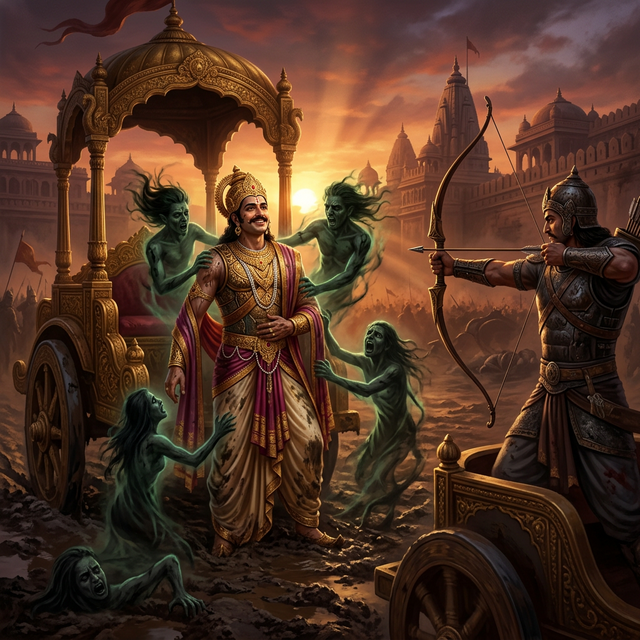
The Fallen Sun
Karna's story is the Mahabharata's deepest meditation on the cruelty of fate and the power of loyalty.
A Basket on the River
Before the world knew his name, before the armies clashed and the earth drank the blood of kings, there was a girl standing at the edge of a river, weeping.
Her name was Kunti. She was barely more than a child herself - perhaps fifteen, perhaps sixteen - a princess of the Yadava clan, unmarried and terrified. In her arms lay a newborn boy who blazed with an impossible light. He had come into the world wearing golden armor fused to his skin - the Kavacha - and golden earrings - the Kundala - that marked him as the son of Surya, the Sun God himself.
The story of his conception was both miraculous and devastating. Years earlier, the sage Durvasa had given young Kunti a boon: a mantra that could summon any god to give her a child. She had been foolish enough to test it, invoking Surya out of curiosity. The Sun God appeared in her chamber, radiant and irresistible, and the mantra's power left no room for refusal. The child was conceived before Kunti could understand what she had done.
Now she stood at the banks of the Ganga, holding her firstborn - a child she loved with the desperate intensity of a mother who knows she must give him up. She was unmarried. In the rigid world of ancient Bharatavarsha, an unwed mother was a scandal that would destroy not just her life but her entire family's honor.
"Forgive me," she whispered to the infant, who stared up at her with eyes that already seemed to understand. "Forgive me, my son. I am too weak. I am too young. The world is too cruel."
She placed him in a basket lined with silk. She kissed his forehead - the first and last time she would kiss her firstborn for decades. Then she set the basket upon the waters of the Ganga and watched the current carry him away.
The basket floated downstream, past villages and forests, past sleeping fishermen and patient cranes, until it came to rest at the feet of Adhiratha, a charioteer of Dhritarashtra's court. Adhiratha and his wife Radha had prayed for a child for years. They pulled the golden infant from the water and named him Vasusena.
The world would know him as Karna - the one whose ears were adorned by divine gold. And his life would be a tragedy so profound that even the gods would weep at its telling.
The boy who was born a prince would be raised as a charioteer's son. The warrior destined to be the greatest would be denied his rightful place. And the mother who abandoned him would one day face him on the eve of a war that would determine the fate of civilization - and ask him to switch sides.
But all of that was yet to come. For now, there was only a basket on a river, and a girl crying at the water's edge.
The Charioteer's Son
Karna grew up in the dusty lanes of a charioteer's quarter, far from the marble palaces where his birth entitled him to live. But even as a boy, there was something about him that set him apart. He was taller than other children. Stronger. When the morning sun rose, his golden earrings caught its light and made him glow as if fire lived within his skin.
He had a warrior's instinct - a natural grace with weapons that no amount of training could explain. He would fashion bows from bamboo and arrows from reeds, and hit targets that made seasoned soldiers shake their heads in disbelief. But when he asked to train at the royal school - at the feet of Dronacharya, the greatest teacher of martial arts in the world - he was turned away.
"I teach princes," Drona told him, not unkindly but with the finality of a closed door. "You are a Suta-putra. A charioteer's son. This is not your place."
Those words - Suta-putra - would follow Karna like a shadow for the rest of his life. In the rigid caste hierarchy of ancient India, birth determined destiny. It did not matter that Karna's arms were stronger than most princes, that his aim was truer, that his courage was boundless. He was the son of a charioteer, and that single fact was a wall higher than any fortress.
But Karna was not a man who accepted walls.
He traveled to the ashram of Parashurama - the legendary warrior-sage who taught only Brahmins. Karna lied about his caste, claiming to be a Brahmin boy seeking knowledge. Parashurama, impressed by his dedication, accepted him as a pupil and poured all his knowledge into the young warrior.
For years, Karna learned in bliss. He mastered every weapon. He learned the Brahmastra - the ultimate missile of destruction. He became, in Parashurama's own words, "the equal of any warrior who ever lived."
And then fate struck its first blow.
The Guru's Curse
कर्मण्येवाधिकारस्ते मा फलेषु कदाचन
Karmaṇy evādhikāras te mā phaleṣu kadācana
One afternoon, while Parashurama slept with his head on Karna's lap, an insect bored into Karna's thigh. It was no ordinary insect - it was a demon in disguise, or perhaps divine fate wearing the mask of nature. The creature drilled deep into Karna's flesh, through skin and muscle, and blood began to flow in a warm red stream.
The pain was excruciating. But Karna did not move. He did not flinch. He sat as still as stone because his guru was sleeping, and a devoted student would die before disturbing his teacher's rest.
When Parashurama awoke and saw the blood pooling beneath Karna's thigh, his face changed. Wonder gave way to suspicion, and suspicion hardened into fury.
"No Brahmin could endure such pain in silence," the sage said, his voice cold as mountain ice. "Only a Kshatriya is trained to bear suffering without flinching. You have lied to me. WHO ARE YOU?"
Karna's head bowed. The shame of his deception weighed heavier than any wound. "Forgive me, Guru. I am Karna, son of Adhiratha, a charioteer of Hastinapura. I told you I was a Brahmin because no other teacher would accept me."
Parashurama's eyes blazed with the terrible wrath of a sage betrayed.
"Since you have learned my knowledge through deception, hear my curse: At the moment when your life depends upon it most - at the very instant when you need your supreme weapon to save yourself - you will FORGET how to use it. The Brahmastra will desert your memory when you need it more than breath itself."
The words seared themselves into Karna's soul. He had gained the knowledge of the greatest warrior-sage in history, and that knowledge was now poisoned. He would carry the weapon in his mind for decades, only to have it dissolve at the moment of truth - like water cupped in the hands of a man dying of thirst.
This was the first of the curses. There would be more. Fate was not finished with Karna - not by a long measure.
Later, a Brahmin whose cow Karna had accidentally killed while practicing archery would add his own curse: "You will die when your chariot wheel sinks into the earth, and you stand helpless before your enemy."
Two curses. Both would come true on the same day - the seventeenth day of the Kurukshetra war - in the final moments of Karna's life.
But Karna absorbed each curse as he absorbed all suffering: with dignity, without complaint, with the quiet acceptance of a man who had learned very early that the universe was not built to be fair.
The Arena of Shame
The day of the tournament dawned clear and hot over Hastinapura. Drona had arranged a grand display of martial arts - a graduation ceremony where princes would demonstrate their skills before the entire court and the assembled masses of the city.
The arena was magnificent. Silken canopies shaded the royal gallery where Dhritarashtra sat with Gandhari, Kunti, and the court elders. Below, thousands of citizens packed the stands, their faces upturned with excitement and expectation.
The princes performed brilliantly. Duryodhana displayed his devastating mace work. Bhima countered with his own thunderous club. Nakula and Sahadeva showed their sword work. But it was Arjuna who stole the arena - firing arrows with such speed and precision that it seemed as if ten bows were shooting at once. The crowd erupted. Drona beamed with pride. Arjuna was declared the supreme archer of his generation.
And then, from the gate of the arena, came a voice like rolling thunder.
"WHATEVER ARJUNA CAN DO, I CAN DO BETTER!"
Karna strode into the arena. He was tall - taller than any prince - and the sun caught his golden earrings and armor and made him blaze like a second sun. Without preamble, he replicated every feat Arjuna had performed, matching them arrow for arrow, and then demonstrated techniques that even Drona had never seen.
The crowd went silent. Then they went wild.
"Who is this warrior?" they whispered in awe. "Where did he come from?"
Kripa, one of the royal instructors, stepped forward. "Before challenging a prince to single combat," he announced formally, "a warrior must declare his lineage and rank. You must be of equal birth. What is your name? Who is your father? What kingdom is yours?"
The question was a knife aimed at Karna's heart - and everyone in the arena knew it.
Karna opened his mouth but no words came. His father was a charioteer. He had no kingdom. In the eyes of this society, he was nobody - a skilled nobody, but nobody nonetheless.
In the royal gallery, Kunti watched the scene unfold and felt the earth dissolve beneath her. She recognized him. How could she not? Those golden earrings. That unmistakable face. Her firstborn. Her abandoned son. Standing in an arena, being humiliated for the crime of having been born to a mother too afraid to keep him.
She fainted.
Bhima laughed from the arena floor. "Go back to your chariot, Suta-putra! The arena is for kings, not for the sons of horse-grooms!"
The insult was delivered with casual cruelty - the kind that only those who have never doubted their own worth can inflict. It scarred Karna deeper than any sword could.
A Crown from a Friend
In that moment of Karna's deepest humiliation - standing in the arena, his skills proven but his worth denied by the accident of birth - a hand reached out to him.
Duryodhana, prince of Hastinapura, eldest of the hundred Kauravas, strode to Karna and embraced him before the entire assembly. It was an act of pure political genius disguised as human compassion - or perhaps it was genuine human compassion that also happened to be politically brilliant. With Duryodhana, one could never be entirely sure.
"If lineage is the barrier," Duryodhana announced in a voice that carried to the farthest stands, "then I REMOVE that barrier! I, Duryodhana, Crown Prince of Hastinapura, hereby crown this warrior as KING OF ANGA!"
He took a golden crown from his own treasury and placed it on Karna's head. Priests were summoned. Holy water was poured. In the span of minutes, the charioteer's son became a king - not by birth, not by conquest, but by the gift of a man who saw in Karna exactly what he needed: a warrior who could match Arjuna, a champion who would fight for him with undying loyalty.
Karna fell to his knees. Tears streamed down his face - Karna, who had endured Parashurama's curse without weeping, who had sat motionless while an insect bored through his flesh - wept openly, undone not by pain but by kindness.
"Whatever you need," Karna said, his voice thick with emotion. "Whatever you ask. My life is yours. From this day until my last breath, I am your man."
It was a vow that Karna would keep with terrifying fidelity. He would stand by Duryodhana through every act of cruelty the prince committed. He would fight for the wrong side in the greatest war in history. He would die for a friendship that was born in the single moment when the whole world had turned its back on him and one man said: "You are worthy."
This was Karna's tragedy in miniature. His loyalty - his greatest virtue - was the very thing that damned him. Had Arjuna or Yudhishthira reached out to him in that arena, had they recognized his skill without demanding his pedigree, the entire course of the Mahabharata might have been different. But they did not. And Duryodhana did.
In that charioteer's son's heart, a loyalty was forged that day that was harder than diamond and just as impossible to break. Karna would be Duryodhana's sword, Duryodhana's shield, Duryodhana's last hope - all the way to the blood-soaked fields of Kurukshetra.
Adhiratha, the old charioteer, watched his adopted son receive a crown and wept - whether from joy or from the premonition that this crown was the first step on a road that led to a funeral pyre, we will never know.
Kavacha and Kundala
दातव्यमिति यद्दानं दीयतेऽनुपकारिणे
Dātavyam iti yad dānaṃ dīyate'nupakāriṇe
As the shadow of war lengthened across Bharatavarsha, the gods themselves grew uneasy. Arjuna was Indra's son - the king of the gods had a father's investment in his survival. And Indra knew what everyone knew: as long as Karna wore his divine Kavacha (armor) and Kundala (earrings), gifted at birth by his father the Sun God, he was invincible. No weapon in creation could kill him while he wore them.
Indra devised a plan as cunning as it was cruel. He disguised himself as a Brahmin beggar and approached Karna during Karna's morning ritual of charity. Every day, without exception, Karna gave alms to anyone who asked. It was his sacred vow - no one who came to Karna at dawn would leave empty-handed. Not ever. For any reason.
This was known to all the world, and Indra intended to exploit it.
Surya, Karna's divine father, appeared to his son in a dream the night before. "Tomorrow, a Brahmin will come and ask for your armor and earrings. DO NOT give them. He is Indra in disguise, and without the Kavacha and Kundala, you will be vulnerable on the battlefield."
Karna listened. He understood. And then he gave his answer:
"Father, I know what Indra wants. I know that giving away my armor means my death. But if I refuse a supplicant, I become something less than Karna. My generosity is all I have that is truly mine - not given by birth, not bestowed by a king, not earned by the accident of lineage. It is the one thing that makes me who I am. If I lose that, I lose everything worth keeping."
At dawn, Indra arrived in the guise of a withered Brahmin. Karna recognized him immediately - the air around the beggar shimmered with celestial energy that no mortal mendicant possessed.
"Great Karna," Indra said, barely concealing his divine arrogance, "they say you refuse no one. I have come to test that legend. Give me your Kavacha and Kundala."
Karna smiled - a smile that contained the full weight of his tragedy, the knowledge of his approaching death, and his absolute refusal to be anything less than magnificent.
"They are yours."
He cut the golden armor from his own body. The Kavacha was fused to his skin - it had been part of him since birth. Removing it was like peeling away his own flesh. Blood flowed. Karna did not flinch. He had endured worse in Parashurama's lap.
He pulled the golden earrings from his ears - the Kundala that had marked him as the son of the Sun since the day he was placed in a basket on the Ganga. He handed them to Indra with bleeding hands and a smile that would have broken the heart of any being capable of feeling.
Even Indra was shaken. Even the king of the gods - who had come to rob a mortal of his invulnerability - felt shame.
"In return," Indra said, unable to leave without some compensation, "I give you the Vasavi Shakti - a divine javelin that will kill whoever you throw it at. But you may use it only once."
One weapon. One kill. In a war where Karna would face a hundred enemies.
Karna accepted. He had given away his immortality and received a single shot in return.
The Sun dimmed that morning. The birds fell silent. Even the wind stopped, as if the universe itself was bowing to the generosity of the man who gave his life away with open hands.
A Mother's Confession
The armies were assembled. Millions of warriors stretched across the plain of Kurukshetra in formations that blotted out the earth. The war was days away - perhaps hours. And in the darkness before dawn, a figure in a white sari walked alone through the military camps to a tent that stood apart from the rest.
Kunti had come to see Karna.
For more than forty years, she had carried the secret of his birth like a stone in her chest. She had watched him grow from a distance - watched him be insulted, crowned, glorified, and condemned - and said nothing. She had chosen her five legitimate sons over her firstborn, chosen social acceptance over maternal truth, chosen silence over shattering the foundations of two warring dynasties.
Now, with the scent of death hanging over the land like smoke from a distant fire, she had come to make her final, desperate plea.
Karna was performing his sunrise prayer when she arrived. He stood facing the east, his arms raised to his father the Sun, the light turning his scarred body - scarred where the Kavacha had been torn away - into a landscape of gold and shadow.
"Karna."
He turned. His eyes widened - not with surprise, exactly, but with the look of a man who has been expecting this visit for a very long time.
"I know who you are," he said, before she could speak. "I have always known. Or perhaps I always suspected. The Sun is my father. That makes you - "
"Your mother," Kunti whispered. "I am your mother, Karna. You are my firstborn. You are the eldest Pandava."
The words hung between them like a sword.
Kunti told him everything - the mantra, Surya's appearance, the basket on the river, the years of guilt that had eaten at her like a slow poison. And then she made her request:
"Come to our side. You are the eldest son of Kunti. The throne of Hastinapura is yours by right - not Yudhishthira's, not Duryodhana's. Yours. If you join the Pandavas, there will be no war. If you fight for them, the Kauravas will submit."
Karna was silent for a long time. The sun was fully up now, blazing at his back, and his shadow fell across Kunti's feet like a dark road leading to a place neither of them wanted to go.
When he finally spoke, his voice was gentle - perhaps the gentlest sound that had ever come from that powerful throat.
"You ask me to betray the only man who ever believed in me? Duryodhana gave me a crown when the whole world gave me contempt. He called me friend when your own sons called me Suta-putra. He embraced me when Arjuna tried to deny me the right to exist."
He paused. "You are my mother. I believe you. But Adhiratha is my father - the man who raised me, who loved me, who never asked what blood ran in my veins. And Duryodhana is my king - the man who gave me honor when the world gave me none."
"I will not switch sides."
Kunti's world collapsed, silently, inside her chest.
But Karna - generous even in refusal, noble even in his doom - gave her a gift she did not deserve.
"I make you this promise, Mother: I will not kill Yudhishthira, Bhima, Nakula, or Sahadeva. I will fight only Arjuna. One of us will die. Either way, you will have five sons when this war is over."
Five sons. The same number she had walked away with when she abandoned him in a basket on the river. The symmetry was as cruel as it was perfect.
Kunti walked away from Karna's tent with tears streaming down her face - tears she had owed him for forty years. Behind her, Karna stood watching the sun, which seemed, for the first time in his life, to be weeping alongside him.
Commander of the Kaurava Host
Karna's hour of supreme glory came on the sixteenth day of the war, when Duryodhana, desperate after the fall of Bhishma and Drona, appointed him Commander-in-Chief of the Kaurava armies.
It was the moment Karna had waited for his entire life - not the command itself, but the recognition it represented. Finally, after decades of being dismissed as a charioteer's son, after watching lesser men lead armies while he was forced to wait, the greatest warrior of his generation stood at the head of eleven Akshauhinis.
But the command came poisoned. Bhishma, from his bed of arrows, had refused to fight alongside Karna - calling him a "half-trained charioteer" who was "not worthy to stand among Kshatriyas." The grandsire's contempt, sustained across decades, had kept Karna out of the first ten days of the war entirely. Ten days in which Karna had paced his tent like a caged lion, listening to the sounds of battle and knowing he could have changed its course.
Now Bhishma was fallen. Drona was dead. The Kaurava army was battered, demoralized, bleeding from a thousand wounds. And into this maelstrom stepped Karna, burning with the twin fires of devotion and destiny.
His first act as commander was characteristic. He visited every battalion - the infantry, the cavalry, the elephant corps, the remaining chariot divisions. He spoke to common soldiers by name. He shared their food. He listened to their fears. By dawn, the man the court had always dismissed as low-born had won the love of an army that the highest-born commanders had failed to inspire.
"I will not ask you to fight for Hastinapura," he told his soldiers. "I will not ask you to fight for Duryodhana or for glory. I ask you to fight for each other. Every man here has someone standing beside him - a brother, a friend, a fellow warrior. Fight for him. Die for him if you must. That is the only loyalty that matters on a battlefield."
The soldiers roared their approval. For two days - the sixteenth and seventeenth - Karna led the Kaurava forces with a brilliance that made the Pandavas tremble. He fought like ten warriors, his arrows darkening the sky, his chariot cutting through enemy formations like a golden blade through silk.
He kept his promise to Kunti. He fought Bhima to a standstill but did not kill him. He defeated Nakula and Sahadeva but let them live, saying only: "Go back to your mother and tell her Karna keeps his word."
The brothers did not understand the words. They would not understand until after the war, when Kunti finally confessed everything.
But it was Arjuna that Karna wanted. Only Arjuna. The one rivalry that had defined both their lives since that first day in the tournament arena when a charioteer's son had dared to challenge a prince.
The final duel was approaching, as inevitable as sunrise.
The Day All Curses Came True
हतो वा प्राप्स्यसि स्वर्गं जित्वा वा भोक्ष्यसे महीम्
Hato vā prāpsyasi svargaṃ jitvā vā bhokṣyase mahīm
The seventeenth day of the Kurukshetra war. The day the world had been building toward since a princess set a basket upon a river.
Karna and Arjuna faced each other across a battlefield littered with the bodies of heroes. Two chariots. Two archers. Two men who had been rivals since childhood, brothers by blood though neither had known it for most of their lives.
Krishna drove Arjuna's chariot. Shalya - the king of Madra, who had been tricked into serving the Kauravas - drove Karna's. But Shalya was no Krishna. Throughout the day, the Madra king whispered poison into Karna's ears: "You cannot win. Arjuna is superior. You are, after all, just a charioteer's son."
Even in his final battle, the insult followed him.
The duel was apocalyptic. Their arrows collided in midair, creating explosions of light that blinded soldiers on both sides. Karna's divine weapons met Arjuna's divine weapons - Nagastra against Varunastra, fire against water, wind against mountain. The earth shook. The sky darkened. Even the gods in their celestial seats leaned forward to watch.
Then Karna reached for the Brahmastra - the ultimate weapon, the one he had learned from Parashurama at the cost of a curse.
And it happened. Exactly as the sage had promised.
The incantation - which Karna had practiced ten thousand times, which was as familiar to him as his own name - dissolved from his memory like mist in the morning sun. He reached for the words and found nothing. The Brahmastra, his greatest weapon, had abandoned him in his greatest need.
Parashurama's curse had come true.
Meanwhile, his left chariot wheel began to sink into the earth. Slowly at first - a slight tilt, a grinding sound - then faster. The wheel plunged into soft ground as if pulled by invisible hands. The chariot lurched. Karna stumbled.
The Brahmin's curse. The curse that said he would die helpless, with his chariot wheel stuck in the earth.
Karna leapt from the tilting chariot and seized the wheel with both hands. He pulled with the strength of the Sun God's son - strength that had moved mountains and split rivers. But the earth held fast. The wheel would not budge.
"Wait!" Karna called to Arjuna, straightening up. Even now - covered in blood, his armor stripped away, his memory cursed, his chariot crippled - his voice carried the authority of a king. "By the laws of fair combat, you must wait until I free my wheel. We are both Kshatriyas. Honor demands it."
Arjuna hesitated. His bow lowered. For one heartbeat, the greatest archer in the world considered granting his enemy a fair chance.
Then Krishna spoke.
The Brother They Never Knew
"Where was your dharma," Krishna asked, his voice cutting through the chaos of battle like a flute through thunder, "when you helped Dushasana drag Draupadi by her hair? Where was fair combat when six warriors surrounded the boy Abhimanyu in the Chakravyuha and butchered him? Where was honor when you mocked a queen and called her a slave?"
Each word was a nail in the coffin of Karna's appeal for mercy. Each word was true.
Karna's hands fell from the wheel. His face changed - the defiance shifting to something deeper, something almost like acceptance. He knew, in that moment, that every choice he had ever made - every act of loyalty to Duryodhana, every complicity in injustice, every silence when he should have spoken - had led him to this precise spot, standing beside a stuck chariot wheel, facing the divine judgment he had earned.
He reached for his bow one final time. But his fingers - the same fingers that had once outshot Arjuna in an arena - trembled. Whether from the curses, from exhaustion, or from the unbearable weight of a lifetime's accumulated sorrow, his grip faltered.
Arjuna drew the Anjalika - a massive crescent-shaped arrow, blessed by Indra. He aimed at Karna's neck.
Karna saw it coming. He did not dodge. He stood straight-backed, face turned toward the sun - toward his father, the only parent who had never abandoned him - and closed his eyes.
The arrow severed his head.
Karna - son of Surya and Kunti, king of Anga, the greatest friend Duryodhana ever had, the greatest archer the world had ever overlooked - fell to the earth. His golden earrings, restored by death, gleamed one last time in the fading light.
The sun set that evening in colors no one had ever seen before - crimson and gold and a deep, grieving violet that stained the horizon like a wound. Soldiers on both sides of the war said that the sun was weeping for its son.
After the war, when the funeral pyres had burned and the living had stopped counting the dead, Kunti gathered her five surviving sons and told them the truth.
"Karna was your brother. Your eldest brother. The firstborn son of Kunti."
The silence that followed was different from any silence Yudhishthira had ever known. It was not the silence of the sabha during the dice game or the silence of the battlefield at dawn. It was the silence of a man discovering that he had killed his own brother - that the greatest enemy he had ever faced was the family member he had never been allowed to know.
Yudhishthira fell to his knees.
Arjuna wept - great, heaving sobs that shook his warrior's frame. The hands that had drawn the Anjalika arrow now covered his face.
Bhima, who had mocked Karna as a charioteer's son in the arena, who had laughed at his lineage - Bhima walked away in silence and was not seen for three days.
The Pandavas performed Karna's funeral rites as a brother - rites that should have been his all along. They wept for him not as an enemy defeated but as a brother lost.
And in the annals of the Mahabharata, Karna remains the most tragic figure of all: a man born to royalty but raised in dust, gifted with divine power but cursed by fate, loyal to a fault and destroyed by his loyalty. He was not a villain. He was not a hero. He was something far more human than either - a good man on the wrong side of a war, fighting for the only people who had ever loved him, dying for a cause he knew was doomed.
The sun still sets in colors of gold and crimson. And those who know the story say that it does so in memory of its fallen son.
Dharma Lesson
Karna's story is the Mahabharata's deepest meditation on the cruelty of fate and the power of loyalty. He was denied his birthright, cursed by his teacher, stripped of his armor, and killed while defenseless - yet he never once complained about fairness. His life asks the most uncomfortable question of the epic: Is fate just? Can a man be righteous and still be destroyed? The answer the Mahabharata offers is unsettling: sometimes, yes. Sometimes the most generous heart, the most loyal friend, the most skilled warrior loses - not because of who he is, but because of the side he stands on. Karna's tragedy warns us that loyalty without discernment can be as destructive as treachery. He stood by Duryodhana through every atrocity because Duryodhana had given him dignity. But dignity bought at the cost of complicity in evil is a bargain with the devil. Yet even Karna's flaws cannot diminish his magnificence. He gave away his invulnerability to maintain his honor. He refused to betray his friend even when his mother offered him the world. In the end, the Mahabharata does not judge Karna - it weeps for him.