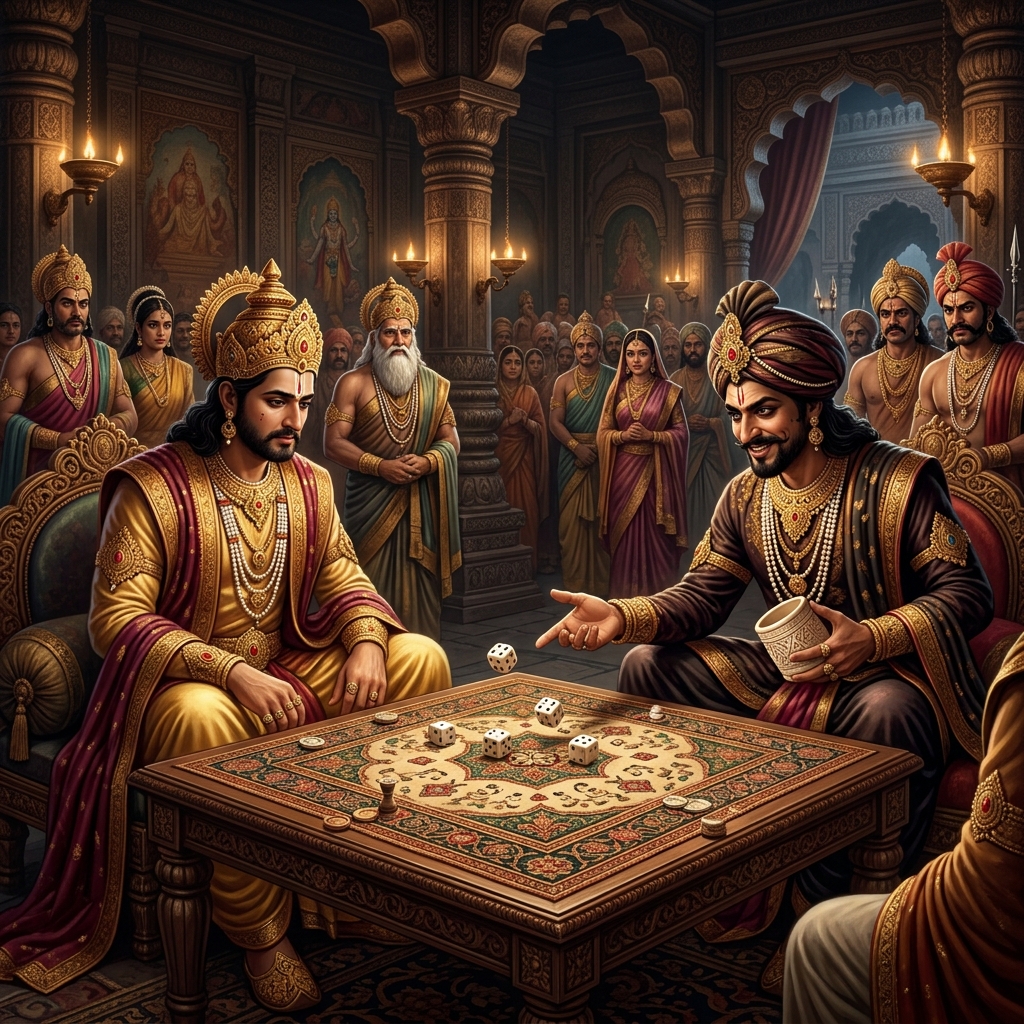
The Fall of Dharma
The Fall of Dharma teaches the most terrifying lesson of the Mahabharata: that evil does not triumph through its own strength alone.
The Golden City's Shadow
Indraprastha was the jewel of the world. Built by Maya Danava, the divine architect of the Asuras, it shimmered like a second heaven upon the earth. Its walls were made of crystal that caught the sunlight and scattered it into a thousand rainbows. Its gardens bloomed with flowers that never wilted, fed by fountains that sang like celestial musicians. Kings who visited could not tell where water ended and marble began, where glass walls became open air, where reality dissolved into illusion.
At the heart of this miraculous city stood the Mayasabha - the Hall of Illusions - where Emperor Yudhishthira held court. The Rajasuya Yagna had been completed. Kings from every corner of Bharatavarsha had acknowledged Yudhishthira as Samrat, the sovereign emperor. The five Pandava brothers, once homeless exiles believed dead, now ruled the greatest empire the world had ever seen.
But envy is a poison that needs no vessel to spread.
Duryodhana, prince of Hastinapura and eldest of the hundred Kaurava brothers, had attended the Rajasuya as a guest. He had walked through the Maya Sabha and fallen into a crystal pool, mistaking it for solid ground. Draupadi and her attendants had laughed - or so Duryodhana believed. That laughter, real or imagined, burned in his memory like acid on silk.
He returned to Hastinapura with fury in his heart and a single thought consuming his mind: the Pandavas must be destroyed. Not on the battlefield - for Arjuna was invincible and Bhima unstoppable - but through cunning. Through the one weakness that even the most righteous king possessed.
"Uncle," Duryodhana whispered to Shakuni, the master of dice, "I know how to take everything from them."
Shakuni smiled. He had been waiting for this moment for decades. In his hand, he carried dice made from the bones of his father - dice that would never lose. "Tell me, nephew," he said. "I am listening."
And so, in the golden shadow of Indraprastha's glory, the darkest conspiracy in the history of Bharatavarsha was born.
The Invitation That Was a Trap
The invitation arrived at Indraprastha carried by a royal messenger, sealed with the insignia of Hastinapura. King Dhritarashtra, the blind monarch, invited his beloved nephews - the Pandavas - to a friendly game of dice. A celebration of family bonds. A harmless entertainment between cousins.
Yudhishthira read the parchment and felt the first stirring of unease. He was a man of dharma, bound by the codes of Kshatriya honor that dictated a warrior must never refuse a challenge. But he was also a man cursed with a weakness he could not control: the intoxication of gambling.
"This is a trap," Draupadi warned, her dark eyes narrowing as she read the invitation over his shoulder. "Shakuni will be there. You know what he is - a master of deception. His dice obey no law of chance."
"I know," Yudhishthira replied, his voice heavy with the weight of inevitability. "But a Kshatriya cannot refuse a direct invitation from the king of Hastinapura. To refuse is to declare enmity. To refuse is to dishonor our family."
Vidura, the wise minister of Hastinapura, had sent his own secret message, hidden within the folds of the official invitation. It read simply: "Beware the serpent that smiles." But Yudhishthira, bound by duty and perhaps blinded by that strange compulsion that drew him to the rattle of dice, chose to go.
Bhima protested with volcanic anger. "Let them come and fight us if they dare! Why should we walk into a den of vipers?"
Arjuna said nothing, but his hand rested on his bow.
Nakula and Sahadeva exchanged worried glances.
Kunti, their mother, simply prayed.
The Pandavas rode to Hastinapura in their finest chariots, dressed in silks and gold, their banners flying proud. They did not know they were riding toward the darkest day of their lives. They did not know that by sundown, they would have lost everything - wealth, kingdom, freedom, honor, and the woman who was their shared soul.
The gates of Hastinapura opened wide to receive them, like the jaws of a great beast.
The Hall of Serpents
अनृतं तु सदा ध्यूते प्रवदन्ति मनीषिणः
Anṛtaṃ tu sadā dhyūte pravadanti manīṣiṇaḥ
The great assembly hall of Hastinapura was filled with the most powerful men in Bharatavarsha. Bhishma, the grandsire, sat upon his elevated seat - the man who had witnessed generations come and go, whose vow of celibacy had shaped the destiny of nations. His face was carved from stone, but his eyes held a troubled light.
Drona, the supreme teacher who had trained both the Pandavas and Kauravas in the arts of war, sat beside his son Ashwatthama. The great archer's hands, which had held the bow that never missed, now rested uneasily on his knees.
Vidura, the wisest man in the court, stood near the door like a sentinel. He alone had argued against this invitation. He alone had warned Dhritarashtra: "You are lighting a fire that will consume your own house." The blind king had listened, wavered, and ultimately yielded to his son's insistence.
Karna was there too - Karna the magnificent, Karna the generous, Karna who hated the Pandavas with a passion born of a lifetime of humiliation. He sat beside Duryodhana like a sheathed sword, his golden earrings catching the lamplight.
And at the center of it all sat Shakuni - uncle to Duryodhana, prince of Gandhara, the man whose entire life had been sculpted by vengeance. The dice he carried were not ordinary. They were carved from the ankle bones of his own dead father, consecrated with dark mantras, responsive to his will alone. When Shakuni rolled these dice, chance ceased to exist.
The Pandavas entered the hall and touched the feet of the elders. Yudhishthira embraced Duryodhana - his cousin, his rival, his eventual destroyer - with genuine warmth. That was the tragedy of Yudhishthira: he saw goodness in everyone, even those who had plotted his death since childhood.
"Come, cousin!" Duryodhana said with theatrical warmth. "Let us play. It is merely a game."
A game. The word hung in the air like the scent of poison flowers.
"I shall roll the dice on behalf of my nephew," Shakuni announced, his voice smooth as oiled silk.
Yudhishthira agreed. What choice did he have? The entire Kuru court was watching. Every eye was upon him. To refuse now would be to admit fear, and a Dharma King fears nothing.
The first dice were cast.
The sound they made as they struck the board - that sharp clatter of bone on polished wood - would echo through eternity.
The Spiral of Madness
The first stake was modest - a string of pearls. Yudhishthira lost.
"Again?" Shakuni asked, his eyebrows raised in mock surprise.
"Again," said Yudhishthira.
Gold coins, heaped in gleaming piles. Lost. Chariots with horses of the finest Kamboja breed. Lost. War elephants armored in silver and bronze. Lost. The treasury of Indraprastha - that vast accumulation of tribute from conquered kings - vanished with a single roll.
Each time, Shakuni's dice landed precisely as he willed. The bones of his father danced to his command, and each throw stripped another layer of Yudhishthira's empire away.
Bhima was trembling with rage. His fingers left grooves in the armrest of his seat. "Stop this, brother," he hissed. "Can you not see what they are doing?"
"One more game," Yudhishthira whispered. His eyes had taken on a glassy, fevered quality - the look of a man in the grip of a demon he could not fight. "Just one more, and I will win it all back."
This is the nature of gambling's curse. It does not merely take your wealth; it takes your reason. The more you lose, the more certain you become that the next throw will reverse everything. Tomorrow. One more hand. One more roll. The gambler's prayer, answered only by ruin.
Yudhishthira staked his servants - ten thousand loyal men and women who had served the Pandavas with devotion. He lost them as easily as he had lost his pearls.
Then he staked his army. The Akshauhinis that had marched under Pandava banners, the soldiers who had sworn oaths of loyalty - all reduced to prizes in a rigged game.
The court watched in horrified silence. Even Duryodhana's allies shifted uncomfortably. This had gone further than anyone expected.
"And now?" Shakuni's voice was barely above a whisper, intimate as a lover's. "What else do you have to offer, O Emperor?"
Yudhishthira looked at his brothers.
"I stake Nakula," he said.
A sound like a collective intake of breath rippled through the sabha. To stake one's brother as a slave - even in the formalized madness of dice - was beyond the pale of decency.
Nakula lost. Then Sahadeva. Then Arjuna, the greatest warrior alive. Then Bhima, whose strength rivaled the gods.
"And yourself?" Shakuni prompted, leaning forward.
"I stake myself," said Yudhishthira, the Dharma King, the man whose name meant 'steady in war.' In that moment, he was steady in nothing. He was a leaf in a hurricane, a man drowning in his own weakness.
He lost.
The Pandavas - five brothers who had survived assassination, exile, and a palace of burning lac - were now slaves. The emperor who had performed the Rajasuya Yagna knelt before his enemies, owned like cattle.
But the worst was yet to come.
"I Stake... Draupadi"
यस्य बुद्धिर्बलं तस्य निर्बुद्धेस्तु कुतो बलम्
Yasya buddhir balaṃ tasya nirbuddhes tu kuto balam
Silence. A silence so deep that the hissing of oil lamps sounded like thunder.
"You still have one possession," Duryodhana said, unable to contain the triumph that blazed in his eyes. "You have Panchali. You have Draupadi."
Even Shakuni paused. Even the architect of this catastrophe hesitated at the threshold of this particular horror. To stake one's wife - the queen of the mightiest empire in the world - this was not merely against the rules of the game. It was against every law of heaven.
Vidura leapt to his feet. "This cannot be permitted!" he cried, his voice cracking with anguish. "Yudhishthira has already lost himself. A slave cannot stake the free. Draupadi is not his to wager!"
"But she is his wife," Duryodhana replied smoothly. "And a wife's fate follows her husband's. Is that not dharma, Uncle Vidura?"
Dhritarashtra sat on his throne, his blind eyes moving restlessly, his fingers gripping the armrests. He should have stopped this. Every fiber of his being knew it. But the blind king's greatest blindness was not of his eyes - it was of his heart, forever captive to the love of his wicked son.
"I stake... Draupadi," Yudhishthira said.
The words fell like stones into still water. Bhima's roar of protest was drowned by the rattle of dice. Arjuna's hand shot toward his bow, but what enemy could he fight? His own brother had done this willingly.
The dice tumbled. Shakuni's eyes gleamed.
"Won!" he cried. "I have won!"
In her chambers deep within the palace, Draupadi - daughter of fire, born from the sacrificial flames of King Drupada's yagna - felt a cold wind pass through her soul. She did not yet know what had happened. But something ancient and terrible stirred within her, like a sleeping serpent roused by distant thunder.
The queen of five kings had just become a slave.
Dragged by Her Hair
"Bring her!" Duryodhana's voice rang through the assembly like a war drum. "Bring the queen - no, the slave girl - to this court!"
He sent Pratikami, an attendant, to summon Draupadi. When Pratikami reached the women's quarters, he found Draupadi in her private chambers, wearing a single garment, her hair unbound - she was in the midst of her monthly seclusion, a period considered sacred and inviolable in every civilized kingdom.
"My lady," Pratikami stammered, unable to meet her eyes, "the court... the princes... you have been..."
"Speak clearly," Draupadi commanded. Even now, in the first moments of catastrophe, her voice carried the authority of a queen.
"You have been won in a game of dice. Prince Duryodhana commands your presence in the sabha."
The words struck Draupadi like a physical blow. But she did not weep. She did not collapse.
"Go back," she said, her voice steady as the mountains. "Ask the sabha this question: Did my husband stake me before or after he lost himself? If he was already a slave when he wagered me, then the bet is invalid. A slave owns nothing - not even his wife."
Pratikami returned with the question. The sabha erupted in debate. Bhishma, the greatest authority on dharma, was asked to rule. The grandsire, bound by his own terrible vow to serve whoever sat on the throne of Hastinapura, struggled with the question.
"The law of dharma is subtle," Bhishma said finally, his voice laden with torment. "I cannot answer definitively."
It was not the answer Draupadi needed. It was not the answer justice demanded.
Duryodhana, impatient, sent his brother Dushasana. "Drag her here," he ordered. "If she will not come willingly, bring her by force."
Dushasana was a brute - a man whose strength was surpassed only by his cruelty. He strode to the women's quarters, seized Draupadi by her long, dark hair, and began to drag her through the corridors of the palace.
She fought. She screamed. She clawed at the marble floors, leaving trails of blood from her fingertips. But Dushasana was relentless. Through courtyard after courtyard, past horrified servants and cowering attendants, he dragged the queen of the Pandavas by her hair toward the assembly hall.
When the doors opened and Draupadi was thrown at the feet of the assembled court - bloodied, disheveled, clothed in a single garment stained with her own blood - even the stones of Hastinapura seemed to weep.
The five Pandavas sat in their places, their bodies rigid with impotent fury. They were slaves now. They had no right to speak, no right to protest, no right to lift a hand against the men who were humiliating their wife before the world.
Bhima's eyes had turned red. A low growl, like distant thunder, rumbled in his chest.
The Infinite Sari
What happened next would become the most infamous moment in the history of Hastinapura - a moment that would stain the Kuru dynasty forever and light the fuse of a war that would consume millions.
"She is our slave now," Duryodhana declared, his voice thick with triumph and cruelty. "And a slave has no right to the garments of a queen." He turned to his brother. "Dushasana - strip her."
The words fell upon the assembly like a hammer upon glass.
Draupadi's eyes widened. She looked at Bhishma - the grandsire, the guardian of dharma, the man who had protected the Kuru dynasty for five generations. He sat frozen, his jaw clenched, his eyes fixed on the ground.
She looked at Drona - her husbands' teacher, the man who had sworn oaths to uphold righteousness. He turned his face away.
She looked at Vidura - the wisest minister. He was shouting protests, but his words dissolved like rain on hot stone.
She looked at her husbands. Five warriors who had humbled kings and slain demons sat helpless, bound by chains more powerful than iron - the chains of a lost wager, the chains of kshatriya honor that demanded they accept defeat.
Dushasana grabbed the end of Draupadi's sari. She clutched it with both hands, her knuckles white, her body trembling - not with fear, but with a fury that transcended the mortal.
In that moment, Draupadi Panchali did the only thing left to her. She let go of her garment, raised both hands to the heavens, and cried out to the one being who had never abandoned her.
"Govinda! Krishna! He Nath! You who are the protector of the helpless, the destroyer of evil, the ocean of mercy - hear me now! I have no one. My husbands sit mute. My elders have failed. The laws of men have crumbled. You alone remain. YOU ALONE!"
A thousand miles away in Dwaraka, Krishna sat in his meditation chamber. His eyes opened. A single tear rolled down his divine cheek.
Dushasana pulled. The sari should have ended in moments - one garment, one woman, one act of terrible violence.
But the sari did not end.
Yard after yard of silk emerged - of colors no mortal loom had ever woven. Gold and crimson, sapphire and emerald, dawn-pink and midnight-black. Finer than spider silk, stronger than chain mail. Dushasana pulled with both hands, grunting, sweating, his muscles straining. Five yards. Ten. Fifty. A hundred.
The courtiers stared in stupefied wonder as mountains of divine fabric piled around Dushasana's feet. And still Draupadi stood covered, untouched, unbowed.
Finally - after what seemed like hours - Dushasana collapsed from sheer exhaustion. He lay panting in a sea of celestial cloth, his arms too weak to rise.
And Draupadi stood. Not naked and shamed, but clothed in the infinite protection of the Divine. Her eyes blazed with a light that was not entirely human.
In the stunned silence that followed, even the oil lamps seemed to burn brighter.
Vows Written in Blood
न चैनं क्लेदयन्त्यापो न शोषयति मारुतः
Na chainaṃ kledayanty āpo na śoṣayati mārutaḥ
The miracle had shattered something in the assembly - some barrier between the possible and the impossible, between the world of men and the world of gods. In the silence that followed Dushasana's collapse, Draupadi rose to her full height.
She reached up and pulled her hair loose from its last remaining binding. Those long, dark tresses - the same hair by which she had been dragged through the palace like an animal - fell wild and disheveled around her face. She held a fistful toward the assembly, and when she spoke, her voice was no longer the voice of a woman pleading for justice.
It was the voice of fire itself.
"I make this vow before every man in this hall, before the gods who watch, before dharma itself! I shall NOT bind my hair again until I have washed it in the blood of Dushasana! Let every sunrise that lights this unbound hair remind you of the crime committed here today!"
The words struck the sabha like thunderbolts. Men who had sat silent through the disrobing - who had averted their eyes and swallowed their protests - now felt the cold fingers of prophecy wrap around their hearts.
Then Bhima rose.
Even as a slave, even as a man who had lost every right, Bhima son of the Wind God was a sight that made brave men tremble. He was the tallest, the broadest, the strongest being in the room. His body shook not with impotence but with a rage so vast it seemed to warp the air around him.
"Hear me, Kauravas!" Bhima's voice was a thunderclap. "I, Bhimasena, son of Kunti and the Wind God Vayu, make these oaths that I will keep even if it costs me heaven itself!
I WILL tear open Dushasana's chest and DRINK his blood! These hands - " he raised them, massive as iron pans - "will rip him apart while he screams for mercy he never showed my wife!
And YOU, Duryodhana - " he turned to the prince, whose triumphant smirk had frozen on his face - "you who bared your thigh to mock my queen - I WILL shatter that thigh with my mace! I will break every bone in your body and watch you die in the dirt like the dog you are!"
Arjuna spoke next, his voice quiet but carrying the lethal precision of his arrows: "Every warrior who sat and watched today - who saw dharma violated and did nothing - will face my Gandiva on the battlefield. This I swear."
Even Sahadeva, the youngest and gentlest, made his vow: "I will kill Shakuni. The man who rolled the dice will have his skull split by my sword."
The court of Hastinapura had become a forge of oaths. And every oath spoken that day would be fulfilled, down to the last terrible word, on the blood-soaked plains of Kurukshetra.
The Elders' Shame
In the aftermath of the vows, a terrible awareness descended upon the assembly. The air itself seemed to thicken with the weight of what had been done - and what had been allowed to happen.
Dhritarashtra, the blind king, finally spoke. Whether moved by fear of divine retribution, the counsel of Vidura, or simply the dawning realization of what his son had wrought, the old king's voice trembled as it filled the hall.
"Draupadi," he called her by name, something he rarely did. "My daughter. Ask me for a boon. You who have suffered what no queen should ever suffer - ask, and I will grant it."
Draupadi's response was measured with the precision of a woman who knew exactly where power lay. "Free my husband Yudhishthira," she said. "Let him be released from slavery."
"Granted," said Dhritarashtra. "Ask another."
"Free Bhima, Arjuna, Nakula, and Sahadeva. Return their weapons and their chariots."
"Granted. Ask a third?"
"I need no third boon," Draupadi replied, and her words carried an edge that cut deeper than any blade. "A Kshatriya queen does not beg like a beggar at a feast. Two boons are sufficient. My husbands are free. They are warriors. They will recover the rest themselves."
The words hung in the air like a prophecy.
Karna, who had been watching with ill-concealed contempt, sneered from his seat. "Remarkable," he said loudly. "Draupadi is the boat that carries the Pandavas to safety. Five husbands, and she saves them all like a mother rescuing her children from a flood."
The insult was deliberate and precise. It struck at the heart of Draupadi's unusual marriage - five husbands, a source of whispered scandal even among those who accepted it as divine will.
Bhima turned toward Karna, his eyes promising a reckoning that would indeed come on the seventeenth day of the war.
But the immediate crisis had shifted. Dhritarashtra, afraid of the curses taking root, returned everything to the Pandavas - their kingdom, their wealth, their freedom. For a brief, shining moment, it seemed as if the catastrophe might be undone. The Pandavas prepared to leave, their pride wounded but their bodies and holdings intact.
Then Duryodhana intervened.
"Father!" he hissed, pulling the blind king aside. "You are giving it all back? After everything we achieved? One more game - just ONE more - and this time, the loser goes into exile for thirteen years. Twelve in the forest, one in hiding. If they are discovered in the thirteenth year, the exile begins again."
Dhritarashtra's resolve crumbled like clay in the rain.
The second game of dice was announced.
And Yudhishthira - released, restored, warned by every fiber of his being - walked back to the table like a man walking into his own grave. The disease of gambling had sunk its teeth too deep. The Dharma King sat down, picked up the dice, and lost for the final time.
Thirteen years of exile. The five princes and their queen would wander the forests and kingdoms of Bharatavarsha as homeless wanderers, their glory reduced to ashes, their crown replaced by bark garments.
The elders of the court - Bhishma, Drona, Kripa, Vidura - watched them leave. Not one of them had stopped it. Not one had stood up when it mattered. Their silence was a sin that would haunt them until their dying breaths.
As Draupadi passed through the gates of Hastinapura, she turned back one final time. Her unbound hair streamed behind her like a dark banner of war.
"Remember this day," she said to the city that had witnessed her humiliation. "Remember it well. For I shall return - and when I do, I will bring a reckoning."
Seeds of Kurukshetra
The Pandavas walked away from Hastinapura with nothing but their weapons and the clothes on their backs. Behind them, the city's golden spires caught the afternoon sun and blazed like funeral pyres.
Yudhishthira walked at the front, his face a mask of calm that concealed an ocean of guilt. He knew - he had always known - that his weakness had caused this catastrophe. The knowledge would eat at him for thirteen years, through trackless forests and nameless villages, through hunger and fear and the daily humiliation of a king reduced to a beggar.
Bhima covered his face as he passed through the city gate, not in shame, but so that no one would see the murder in his eyes. He had made vows that day, and Bhima was a man who kept his vows. In thirteen years, he would tear Dushasana's chest open with his bare hands and drink the blood within. He would shatter Duryodhana's thigh with a single blow of his mace. These were not idle threats. They were promises to the future, as certain as the rising sun.
Arjuna draped black cloth over his Gandiva bow - a warrior's way of declaring that his weapon slept, but would wake. When it woke, the world would tremble.
Nakula covered himself with dust. Sahadeva smeared his face with ash. Both walked with their eyes fixed on the road ahead, counting the days until their return.
And Draupadi - Draupadi walked with her hair unbound, a streaming cascade of black silk that caught the wind like a battle standard. She did not weep. She had passed beyond tears into a place of cold, absolute resolve. Her hair would remain unbound until it was washed in the blood of the man who had dragged her by it. That day would come. She was as certain of it as she was of her own name.
Behind them, in the sabha of Hastinapura, the elders sat in a silence heavier than stone. Bhishma stared at his hands - the same hands that had once been raised to the heavens in a vow to protect the Kuru throne. Today, those hands had done nothing.
"What have we permitted?" whispered Drona.
No one answered. No one needed to.
The seeds of Kurukshetra had been planted in the soil of injustice, watered with the tears of a queen, and fertilized with the silence of good men who did nothing. In thirteen years, those seeds would bloom into a harvest of blood that would claim the lives of four million warriors and reshape the world forever.
The Mahabharata war did not begin on the first day of battle. It began here, in this hall, with the rattle of loaded dice and the screams of a woman that no one answered.
Dharma Lesson
The Fall of Dharma teaches the most terrifying lesson of the Mahabharata: that evil does not triumph through its own strength alone. It triumphs through the silence of the righteous. Bhishma, Drona, Kripa - every elder in that hall had the power to stop the dice game. None did. They hid behind duty, behind protocol, behind the veil of legality. And their silence made them as guilty as the men who rolled the dice. Moreover, this story warns of addiction's power to consume even the most virtuous mind. Yudhishthira was the very embodiment of dharma - yet he destroyed everything he loved at a gaming table. No virtue is safe when we surrender to our weaknesses. Every generation must answer Draupadi's question: 'Is there no dharma left?' The answer lies not in philosophy but in action - in who stands up when it matters.