A Question Unanswered
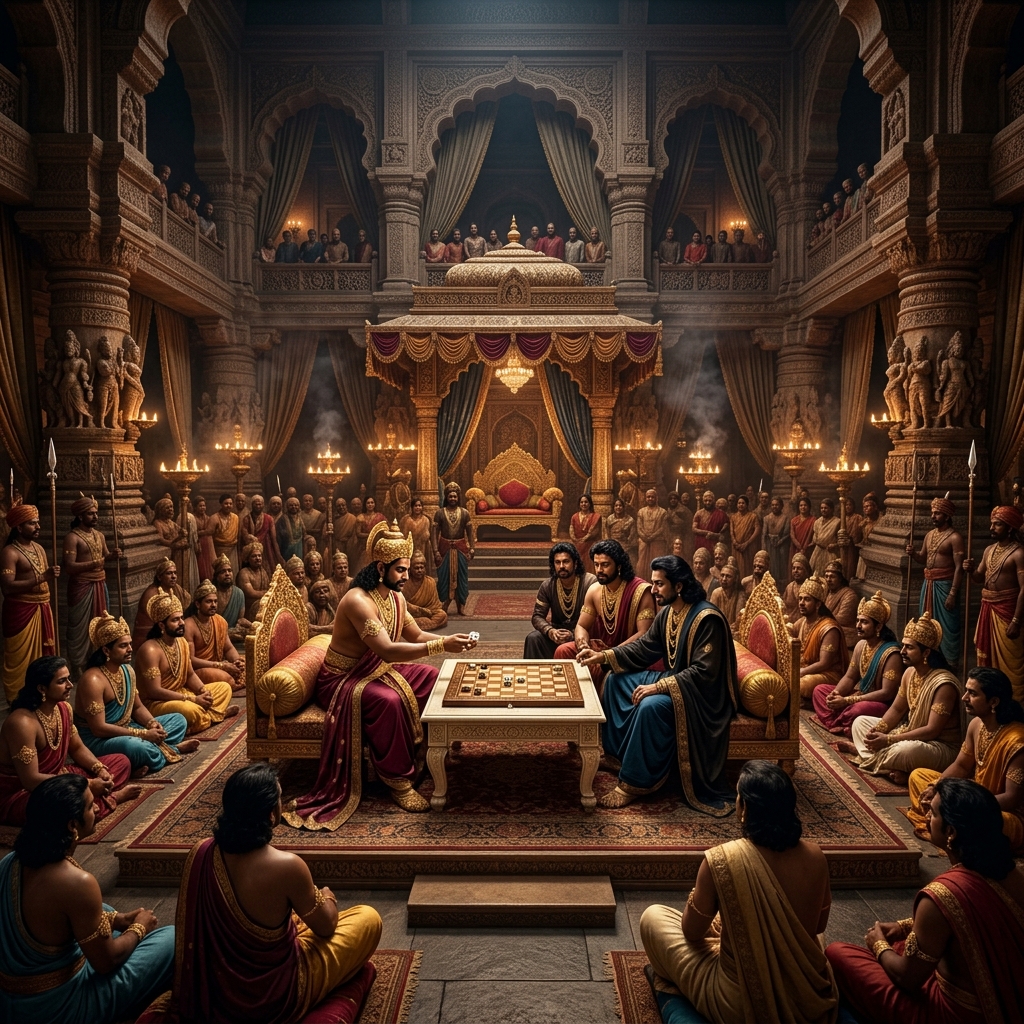
The game of dice had gone further than any game should ever go. Yudhishthira, staking one possession after another under Shakuni's goading, had lost his kingdom, his brothers, and at last himself, and having lost himself he had staked and lost Draupadi too. Now, at Duryodhana's command, Dushasana had gone to the women's quarters and dragged the Pandava queen into the hall by her hair, her single garment disordered, her question flung again and again into a silence that would not answer her.
"Tell me plainly," Draupadi said, standing before the assembled elders and kings of the Kuru court, her voice shaking with fury more than fear, "did my husband stake himself before he staked me? And if a man has already lost himself, if he is no longer his own master, what right does he have to wager what belongs to another? Answer me, you who call yourselves keepers of dharma. Was I won lawfully, or was I not?"
No one answered. Bhishma, the grandsire whose word could have silenced the entire hall, sat with his eyes lowered, and when at last he spoke it was only to confess his own confusion. "Draupadi, the matter you raise is subtle indeed. Yudhishthira himself must decide whether he was his own master when he staked you, and Yudhishthira has not spoken. I confess I cannot resolve so fine a question of dharma."
Drona, teacher of every prince in that hall, said nothing at all. Vidura, the one man who had argued from the very first throw that the game should never have begun, spoke again as he had spoken before, but his was a voice long since grown familiar to Kaurava ears and just as long ignored. Karna laughed openly at Draupadi's distress, and Duryodhana, delighting in his enemy's humiliation, bared his left thigh and bade her sit upon it as a slave might sit upon her master's lap. Bhima's eyes burned with a rage he could not yet act upon, bound as he was by his elder brother's silence. In that hall of a hundred princes and a dozen elders, no one moved to answer the queen's question, and no one moved to stop what was happening before them.
One Brother Stands
It was into this silence that one voice finally rose, and it belonged to the man least expected to raise it. Vikarna was the third of Dhritarashtra's hundred sons, a Kaurava by birth and by loyalty, one of Duryodhana's own brothers who had shared his cradle and his ambitions. Yet as he watched Draupadi standing exposed and unanswered before the court, something in him could no longer stay seated.
He rose to his feet, and the hall, startled that any Kaurava would speak against his own brother's triumph, fell quieter still. "I have heard the elders debate this question and I have heard no one answer it," Vikarna said, his young voice carrying to every corner of the hall. "Let me answer it, then, since my betters will not. It is said that a man who has lost himself in a wager is no longer master of his own possessions, for how can one who does not own himself claim to own another? Yudhishthira staked himself and lost. Only after that loss did he stake Draupadi. By the very logic of the game, she was not his to wager, and therefore she was not lawfully won."
A murmur ran through the assembly, some of astonishment, some of something closer to hope. Vikarna pressed on, his voice steadier now that the first words had been spoken. "Consider too that Draupadi is wife to all five Pandavas, not to Yudhishthira alone. Even if he had the right to stake his own person, by what right did he stake a woman who belongs equally to four other men, none of whom gave their consent to the wager? I say this plainly before this hall: Draupadi has not been won according to dharma, and she should be released, not held as a slave to be shamed before kings."
For a moment it seemed the tide of the hall might turn, that other voices might follow where Vikarna had led. Bhishma's brow furrowed as he weighed the young prince's argument, and even Dhritarashtra, blind and uneasy on his throne, seemed to lean forward as though listening for the first time. Vikarna alone, among the sons of Dhritarashtra, had chosen to stand against his own brother's cause, and every eye in the hall now turned to see how Duryodhana's faction would answer him.
Karna's Rebuke
Karna rose before Duryodhana himself could speak, his face twisted with contempt for the younger prince who had dared to interrupt the court's triumph. "Vikarna," he said, his voice cutting across the hall, "you are a child prattling words you have memorized from your tutors, splitting hairs over dharma while wiser men than you sit silent. Look around this hall. Bhishma, the grandsire of our house, says nothing. Drona, who taught you the bow, says nothing. If men of such age and wisdom will not condemn what has happened here, what right has a boy of your years to stand and lecture kings?"
He turned then to address the hall at large, his contempt widening to take in Draupadi herself. "As for this claim that she was not lawfully won, I say the Pandavas lost everything they possessed, wife included, in a game to which they agreed freely and without compulsion. A woman with five husbands is no woman of virtue in the first place, and it matters little whether she is brought into this hall clothed in one garment or none. Dushasana, since this brother of Duryodhana's is so eager to free her, strip the Pandavas of the fine garments they still wear, for those too were staked and lost along with everything else."
The hall erupted at Karna's command, and Dushasana moved to obey, and it was in that same terrible moment that Draupadi's prayer to Krishna was answered and her garment flowed on endlessly no matter how much of it Dushasana pulled away, until at last he gave up in exhaustion and shame. But before that miracle unfolded, Vikarna had already been shouted down, his careful argument buried beneath Karna's mockery and the crowd's fear of contradicting Duryodhana in his own hall.
Vikarna looked to Bhishma once more, hoping the grandsire might now add his weight to what had been said, but Bhishma only repeated that the question was too subtle for him to settle, that dharma itself seemed to walk a hidden path in this matter. Vikarna understood then that no other voice would join his own, that he stood alone among a hundred brothers and a hall full of kings, and that his words, however true, would change nothing that was happening in that room on that day.
A Word That Cannot Be Unsaid
Vikarna sat down at last, his face burning, not with shame at what he had said but with the bitterness of having said it to no effect. He had spoken the truth as clearly as he knew how, had staked his own standing among his brothers to do it, and the hall had answered him with laughter and contempt rather than agreement. Duryodhana did not even trouble himself to rebuke his brother directly; he let Karna's scorn do the work, confident that no one else would follow where Vikarna had dared to go.
And yet something had changed, even if no one in that hall could yet see it. A word once spoken cannot be unspoken, and Vikarna's judgment that Draupadi had not been lawfully won would be remembered long after the dice had been swept from the board, long after Duryodhana's laughter had faded from that hall. It sat now in the ears of Bhishma, who could never again claim total ignorance of what dharma required in that hour. It sat in the ears of Yudhishthira, who would carry the memory of one Kaurava's fairness through thirteen years of exile. It sat, above all, in the ears of Draupadi herself, who did not forget kindness any more than she forgot cruelty, and who would remember that of a hundred sons of Dhritarashtra, only one had stood to call her ordeal unjust while it was still happening.
Bhima, seated among his brothers with his fists clenched through the whole exchange, watched Vikarna sit back down and said nothing then, but he did not forget either. In the years that followed, as the Pandavas nursed their vows of vengeance in the forest and later at Virata's court, Vikarna's name was sometimes spoken among them not with the hatred reserved for Duryodhana and Dushasana and Karna, but with a strange, reluctant respect, the respect owed to an enemy who had, for one moment in a hall gone mad, chosen truth over blood.
None of that respect would save him from what was to come. Vikarna had chosen to stand for dharma in the dice hall, but he had also chosen, in every hour before and after, to remain a Kaurava brother, bound by loyalty to march beside Duryodhana into whatever war his elder brother's pride would eventually bring upon them all.
The Fourteenth Day
Years later, the dice hall had become a memory buried beneath a war that had swallowed nearly every man who had sat in it that day. On the fourteenth day of the battle at Kurukshetra, amid the chaos that followed Abhimanyu's death and Jayadratha's, Bhima found himself facing Vikarna across the churned field, each bound by the same terrible logic that had brought brothers to kill brothers beneath the same sky.
Bhima recognized him at once, and for a moment something like sorrow crossed his features, rare on that grim day. "Vikarna," he said, lowering his mace for a breath, "of all Dhritarashtra's hundred sons, you alone spoke justly in that hall when Draupadi was dragged before us. I have not forgotten it, and I do not come to this fight gladly."
Vikarna met his eyes without flinching. "I have not forgotten that hall either, Bhima. I knew then, and I know now, that Duryodhana's cause was never just. I said so once and I would say so again. But he is my brother, and I was raised at his side, and a man does not abandon his own blood merely because he has judged it wrong. I made my choice long before this war began. Do what you must, Bhima. I do not blame you for it."
There was no more to say after that. Duty is duty on a battlefield, and Bhima, sworn to vengeance upon every Kaurava who had wronged Draupadi, could not set his oath aside even for the one Kaurava who had once tried to save her. The fight was brief and ended as such fights end, with Vikarna fallen upon the field of Kurukshetra among so many other sons of Dhritarashtra.
But Bhima, who had killed brother after brother of Duryodhana's without a backward glance, stood over Vikarna's body and wept, the only tears he shed that day for any Kaurava. He had told the truth in the dice hall once, Bhima said to those nearby, and he told it again just now, at the cost of his life. Of all the sons of Dhritarashtra, Vikarna alone had died with dharma and loyalty both intact, having chosen never to abandon either, even when the two pulled him in opposite directions.
Dharma Lesson
Dharma sometimes demands a lone voice against one's own kin, even when that voice changes nothing in the moment. Vikarna spoke truth to a hall that would not hear it and paid for his family loyalty with his life, yet died the one Kaurava whom even his enemy mourned. A single act of conscience is never wasted, even when it arrives too late to save anyone.