The Imperial Ceremony
The Rajasuya story contains a profound teaching about divine patience and justice.
The Hall of Maya
Indraprastha had risen from the ashes of the Khandava forest, and now it gleamed like a city carved out of the dawn. The Pandavas ruled it in peace, and their wealth and fame spread to every kingdom of Bharatavarsha. Yet Yudhishthira wanted something more lasting than riches - he wanted righteousness made visible, a kingdom ordered so well that the gods themselves would approve.
It was Maya, the great architect of the Asuras, who gave that wish its shape. Spared from the fires of Khandava by Arjuna and Krishna, Maya had vowed to repay them. "Let me build for you," he said, bowing before Yudhishthira, "a sabha, an assembly hall, such as no mortal eye has ever seen."
For more than a year Maya labored. He brought rare gems from the mountain Mainaka, a celestial club for Bhima, and the great conch Devadatta for Arjuna. And in the heart of Indraprastha he raised a hall ten thousand cubits wide, its pillars of gold and crystal, its floors so polished they seemed to ripple like still water.
When it was finished, kings and sages came simply to marvel at it. Crystal looked like pools, and pools like crystal. Lotus ponds were so clear that men stepped into them thinking the surface was solid stone. It was a place of beauty and of illusion, and one day its illusions would wound a proud heart beyond all healing.
The Dream of Empire
One evening the sage Narada came wandering into the new hall, his vina humming softly, and he found Yudhishthira surrounded by his brothers and his counsellors. Narada spoke of the assembly of the gods, of Indra's court and Yama's, of the great kings of old who had performed the Rajasuya sacrifice and won the title of emperor over all the earth.
"Your father Pandu desired this honor," Narada said gently, "yet he did not live to claim it. Do you, his son, intend to perform the Rajasuya?"
The thought lodged in Yudhishthira's heart and would not leave. To perform the Rajasuya was to invite every king of the land either to acknowledge him as overlord or to refuse and make war. It was no small ambition. It would touch every throne in Bharatavarsha.
Yudhishthira was a cautious man, and he did not trust his own desire. So he sent messengers to Dwaraka, asking Krishna to come and counsel him. "There is no one," he told his brothers, "whose judgment I trust above his. He sees what we cannot."
When Krishna arrived and heard the proposal, he did not flatter Yudhishthira. He weighed the matter as a friend weighs a risk. The dream of empire was just, he said - but there was one obstacle standing between Yudhishthira and the throne of emperor, and until that obstacle was removed, the Rajasuya could not even begin.
The Shadow of Jarasandha
"That obstacle," said Krishna, "is Jarasandha, king of Magadha."
The name fell heavily on the assembly. Jarasandha was the mightiest king in the land, born of two halves joined by the demoness Jara into one terrible whole. He had conquered kingdom after kingdom until eighty-six kings sat as his prisoners in the city of Girivraja. He was gathering a hundred, and when he had them, he meant to offer all hundred as a human sacrifice to Lord Shiva.
"While Jarasandha lives and holds those kings," Krishna said, "no man can call himself emperor of the earth. They are still his captives, not your subjects. He has driven my own people from Mathura to the sea at Dwaraka. He is my enemy as much as your obstacle."
Yudhishthira's heart sank, for Jarasandha seemed beyond defeat. He had withstood the armies of the Yadavas times beyond counting. "Then perhaps," Yudhishthira said heavily, "the Rajasuya is not for me. I will not spend the lives of thousands to feed my own ambition."
But Bhima would not hear such talk, and Arjuna stood beside him. Krishna smiled. "Jarasandha need not be met in open war," he said. "He is proud, and he honors the laws of single combat. Send not an army but three men. Let me go, and Bhima, and Arjuna. We will challenge him hand to hand, and the matter will be settled by one duel and not by ten thousand deaths."
Three Guests at Girivraja
Disguised as wandering brahmanas, Krishna, Bhima, and Arjuna crossed the rivers and forests into Magadha. They did not enter Girivraja by its proper gate. Instead they broke through the peak of the three great drums that guarded the city, the towering symbols of Jarasandha's power, and walked into his palace garlanded and unarmed.
Jarasandha received them with the courtesy due to holy guests. But their bearing was not that of brahmanas - their shoulders were scarred by the bowstring, their eyes were the eyes of warriors. "You wear the garb of priests," the king said, "yet you broke my drums and you scorn my hospitality. Brahmanas do not enter by a broken wall. Tell me who you truly are."
Then Krishna spoke without disguise. "We are Krishna of the Yadavas, and these are Bhima and Arjuna, sons of Pandu. We have come to free the kings you hold and to end the cruelty you intend. You mean to sacrifice men to a god. We have come to demand their release - or to fight you."
Jarasandha laughed, unafraid. "I took those kings by the strength of my own arms. I will not free them at a beggar's word." He turned his scornful eyes upon Krishna. "And you - you fled from me to the edge of the sea. Why should I fear you now?"
"Then choose," said Krishna evenly. "Which of us will you fight? Single combat, by your own laws." Jarasandha looked from the slight Krishna to the lithe Arjuna, and then to the mountain that was Bhima. "That one," he said, pointing at Bhima. "He is worthy of me."
The Wrestling of Bhima
They met in the wrestling arena, and the duel that followed lasted not one day but thirteen. Bhima and Jarasandha came together like two storm clouds, like two bull elephants in rut. They struck blows that shook the ground. They lifted and threw each other, locked arms and crushed ribs, and neither would yield.
By night they rested as guests in the same house, and by day they returned to the killing ground. The people of Magadha gathered to watch their king fight, and they saw, for the first time, that he could be matched. Bhima was the stronger, but Jarasandha would not fall. Each evening Bhima dragged himself away exhausted, and each morning Jarasandha rose whole again, for he had been born of two halves and joined into one, and his body seemed always to mend.
On the fourteenth day Bhima, near the end of his strength, looked to Krishna for help. Krishna understood the secret of Jarasandha's birth. He bent and snapped a twig in two, then cast the halves apart, in opposite directions. The meaning was plain: the king who had been joined together must be torn apart and his halves flung so far that they could never join again.
Bhima seized Jarasandha, lifted him whirling over his head, and brought him down across his knee. He tore the king's body into two and hurled the halves far apart. But the two halves crawled together and rejoined, and Jarasandha rose once more. Again Bhima tore him apart - and this time, remembering Krishna's sign, he threw the right half to the left and the left half to the right, so that the legs and head were crossed and could not find their way back. Jarasandha fell at last, and did not rise. The mightiest king of the age was dead.
The Conquest of the Four Directions
From the dungeons of Girivraja the three guests freed the imprisoned kings. Krishna placed Jarasandha's own son Sahadeva upon the throne of Magadha, and the freed kings, grateful and humbled, pledged their loyalty to Yudhishthira. With the great obstacle gone, the road to the Rajasuya lay open.
Now the four younger Pandavas set out upon the digvijaya, the conquest of the four quarters of the world, to gather the tribute and allegiance that an emperor must have. Each brother took an army and a direction.
Arjuna marched to the north, into the snowbound lands beyond the mountains, subduing the kingdoms of the Himalayas, the lands of the Kashmiras and Kambojas, even the cities of the celestial Kimpurushas. Bhima turned east, breaking the strength of the proud kings of the river country, of Anga and Vanga and the lands by the eastern sea. Sahadeva went south, into the Deccan and beyond, even reaching toward the kingdoms by the ocean, gathering pearls and sandalwood and gold. Nakula rode west into the desert and the lands of the Sindhu, subduing the Mlecchas and the kings of the western shore.
Not all the kings were conquered by the sword. Many, hearing of the justice of Yudhishthira and the fall of Jarasandha, came of their own will, bringing gifts of gold and gems, horses and elephants, cloth and jewels, until the treasuries of Indraprastha could scarcely hold the wealth that poured in. The whole earth, it seemed, had bowed to the eldest son of Pandu.
The Great Sacrifice Begins
When all the tribute had been gathered and all the kings summoned, the day of the Rajasuya came. To Indraprastha streamed the great ones of the age. Bhishma and Drona came from Hastinapura, and Dhritarashtra, and Vidura the wise, and Duryodhana with his brothers. Drupada came, and Virata, and Shalya, and Shishupala of Chedi, and Krishna with the lords of the Yadavas, and sages beyond counting. Vyasa himself presided over the rites.
The sacred fires were lit. The chants of a thousand priests rose like a single voice. Rivers of clarified butter fed the flames, and the smoke of the offerings climbed to the heavens. Gold was given away as if it were dust. No guest went unhonored, no beggar unfed; the gates of the city stood open and the hungry of all the land were filled.
Yudhishthira gave each of his great kinsmen a duty in the running of the sacrifice. To Bhishma and Drona he gave general oversight; to Duryodhana he gave charge of the treasury and the receiving of tribute, an honor the Kaurava prince accepted with a tight smile. Sahadeva welcomed the guests, Nakula tended the cattle and gifts, and Arjuna protected the kings who had come. Bhima watched over the kitchens. Each task was given with love, and the whole assembly moved like one body.
When the rites neared their height, the time came for the arghya, the offering of highest honor, which by ancient custom is given to the single most worthy guest in the hall. The question was simple to ask and impossible to answer without giving offense: who, among all these kings and elders and sages, deserved the first honor?
The First Honor
Yudhishthira turned to the eldest and wisest among them. "Grandfather," he said to Bhishma, "tell me - to whom shall the first honor be given?"
Bhishma did not hesitate. "Among all who are gathered here, there is none equal to Krishna of the Yadavas. In knowledge, in strength, in valor, in righteousness, in glory, he stands above us all. He is the sun among the stars of this assembly. Give the arghya to Krishna."
Sahadeva carried the offering to Krishna, and Krishna, with quiet grace, accepted it. A murmur of approval rose from most of the hall, for Krishna was beloved and his deeds were known to all.
But from one throne came no approval, only a rising heat of fury. Shishupala, king of Chedi, sat gripping the arms of his seat until his knuckles whitened. To him this was an outrage past all bearing. There were kings in this hall older than Krishna, kings with longer lineages, kings who had never herded cattle as boys. And the first honor of the world's greatest sacrifice was given to a cowherd of Mathura, a man Shishupala counted as a thief and a coward.
There was old hatred between them. Krishna had carried off the princess Rukmini, who had been promised to Shishupala, on the very eve of his wedding. The wound had never closed. Now it tore open, and Shishupala rose from his seat to speak before the whole assembly of kings.
The Hundred Insults
"Krishna?" Shishupala's voice rang harsh across the sabha. "You give the first honor of this great sacrifice to this cowherd, this stealer of brides, this slayer of his own kin? There are kings in this hall whose lineage and learning shame him. And you pass them over for a herdsman of Vraja."
The insults came pouring from him like venom from a struck snake. He mocked Krishna's birth among cowherds and milkmaids. He called the killing of his uncle Kamsa a crime and a betrayal. He named Krishna a coward who had fled from Mathura, a deceiver, a fraud unworthy to stand among warriors, let alone above them. He turned on Bhishma too, and on Yudhishthira for honoring such a man.
The assembly sat frozen in shock. To abuse a guest so, at a sacred yagna, was a thing unheard of. Bhima half rose, his great hands trembling for the chance to silence Shishupala forever, but Bhishma held him back. "Let it be," the grandsire said. "His death already approaches."
Through it all Krishna sat unmoved, a faint and patient smile upon his lips. For he had made a promise long ago to Shishupala's mother, who was his own aunt. When her son was born monstrous and ill-omened, Krishna had vowed that he would forgive the boy a hundred offenses, and only the hundred-and-first would call down his anger.
So Krishna counted in silence as the insults fell. The crowd murmured for vengeance, but Krishna only raised a hand for patience. Shishupala, as if driven by a doom he could not see, could not stop. Ten insults. Fifty. Ninety. Ninety-nine. And then the hundredth left his lips, and still he did not stop, and spoke the hundred-and-first.
The Sudarshana Chakra
The hundred-and-first insult hung in the air, and for a single heartbeat the whole hall was still.
Then Krishna moved. "You have had your hundred," he said quietly, "and you have gone beyond them. Your time is finished." He turned his thoughts to the Sudarshana, the discus that never returns until its work is done. A circle of light blazed into being above his hand, spinning, edged with fire.
It flew. Before Shishupala could lift a weapon or speak another word, the chakra crossed the hall in a streak of golden flame and struck the king's neck. His head fell from his shoulders; his great body crumpled to the floor of the Maya Sabha, and the assembly cried out in awe and terror.
Then those nearest swore they saw a wonder. A light rose out of the fallen body, pure and radiant, and it flowed across the hall and entered into Krishna, merging with him and vanishing.
"He was Jaya, a doorkeeper of Vaikuntha," Krishna said into the hush, "cursed long ago to be born three times as my enemy, and three times to die by my hand, so that through hatred he might come home to me at last. This was his third life. He has reached the end of his exile." The funeral rites were given to Shishupala, and his son was set upon the throne of Chedi. The sacrifice went on, and Yudhishthira was sprinkled with the holy waters and proclaimed emperor over all the earth. His triumph was complete - and yet, even in that hour of glory, the seed of ruin had already taken root in the hall.
Duryodhana in the Hall of Illusions
When the rites were done and the kings began to depart, Duryodhana lingered in the wonder of the Maya Sabha. He had watched the wealth of the whole earth flow into his cousin's treasury. He had seen kings bow to Yudhishthira and the first honor of the world given before his eyes to Krishna. Envy gnawed at him like a fire that would not die.
Then the hall itself turned against his pride. Walking through its enchanted halls, Duryodhana came upon a floor of crystal so clear that he mistook it for a pool of water, and he gathered up his robes to wade across - while the Pandavas and their servants watched. Further on he came to an actual pool, its surface so still and clear that it looked like polished stone, and he stepped onto it confidently and fell headlong into the water, soaked to the skin before all the court.
Bhima laughed aloud. The serving women laughed. And Draupadi, watching from a balcony, could not hold back her laughter either. Some say she spoke the words that would never be forgotten: that the blind king's son was himself as blind as his father. Whether she said it or only laughed, the laughter struck Duryodhana like a whip.
He rose dripping from the water, his face dark with shame and rage. Servants brought him dry garments, but no cloth could cover the humiliation. He had come to the greatest sacrifice of the age and been made a figure of mockery in the hall of his cousins, in front of kings, and laughed at by a woman.
The Seed of War
Duryodhana returned to Hastinapura a changed man. The wealth he had seen, the honor he had not received, and above all the laughter that had followed him out of the hall of illusions burned in him without rest. He could not eat, he could not sleep; the glory of the Pandavas was a poison in his blood.
His uncle Shakuni found him pale and brooding and drew the truth from him. "I have seen," Duryodhana confessed, "a splendor I can never match by honest means. The whole earth bows to Yudhishthira. I would rather drink poison or drown in the river than live to watch the sons of Pandu prosper while I shrink in their shadow."
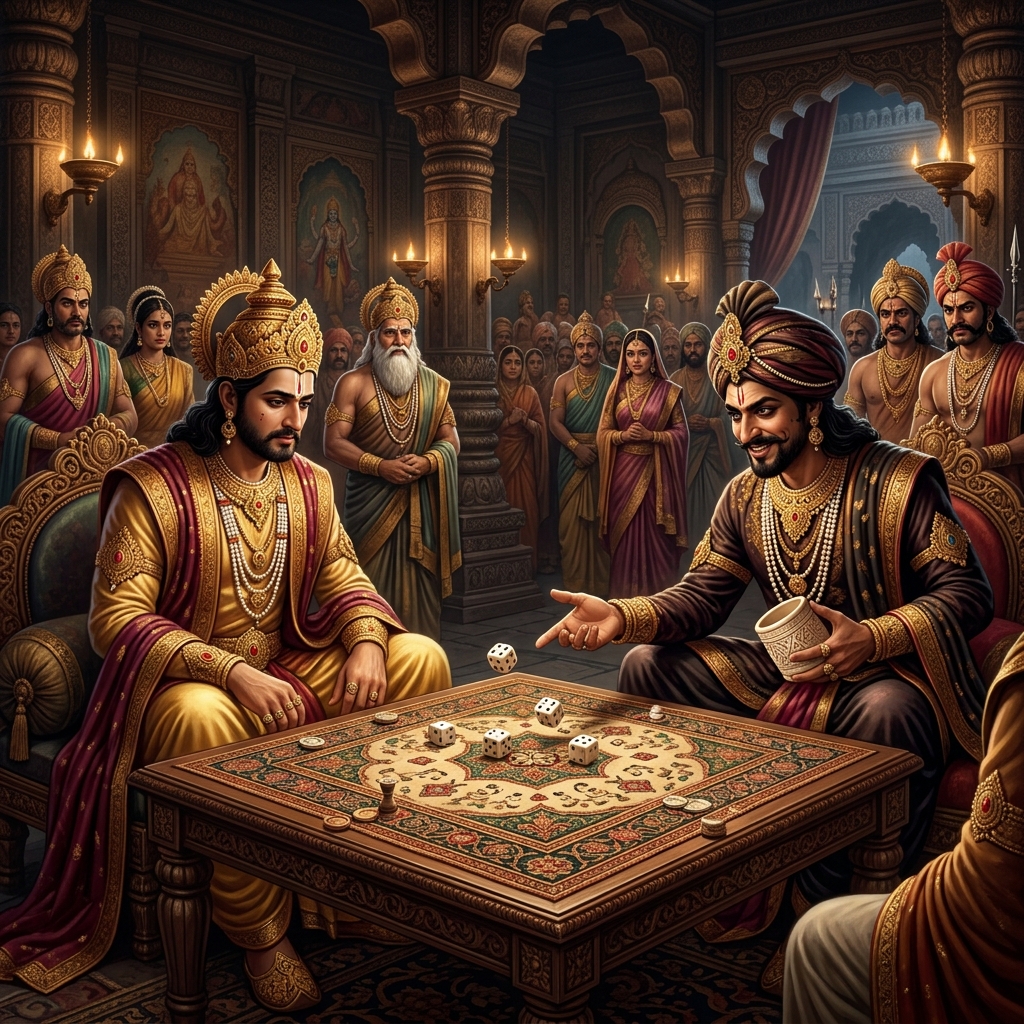
Shakuni, who hated the Pandavas with a patient and sleepless hatred of his own, smiled at his nephew's despair. "What you cannot take by war," he said softly, "you may yet win by cunning. Yudhishthira loves the game of dice, though he plays it badly. And there is no one in all the world who throws the dice as I do. Invite him to play. I will win for you all that he has - his wealth, his kingdom, his brothers, even his wife - and not a single drop of blood need be spilled to do it."
So, from the proudest triumph of Yudhishthira's life, the road bent quietly toward catastrophe. The Rajasuya had made him emperor of the earth. But in the same hall, beneath the same enchanted roof, a fall had been laughed at and a humiliation had been born - and from that humiliation would come the game of dice, and from the dice the exile, and from the exile, in the fullness of years, the great and terrible war of Kurukshetra. The seeds of destruction had been sown in the soil of the greatest glory.
Dharma Lesson
The Rajasuya story contains a profound teaching about divine patience and justice. Krishna endured ninety-nine insults with grace - teaching that even God exercises restraint. But when the limit was reached, divine justice was instant and absolute. The story also warns of how triumph can breed envy, and envy can destroy everything.