The Theft of Rukmini
How Krishna Won His Queen at the Edge of a Wedding
A Child Marked for a Reckoning
In the kingdom of Chedi, on a night of dim stars, a child was born to King Damaghosha and his queen, and the midwives recoiled when they uncovered him. He had four arms, like a god of war, and a third eye burning in the center of his forehead. The wail that rose through the palace was not the cry of an ordinary infant. It was a low, scraping sound, and the lamps along the corridor guttered as though a cold wind had passed.
The king summoned every astrologer and rishi within reach, and they examined the child in silence. One spoke at last. "He bears the marks of a great enemy of the divine. He cannot be killed by sword or fire until a certain one touches him - and when that one takes the child into his lap, the deformities will fall away. The third eye will close, the extra arms will drop, and you will know the hand that is, in time, to take his life."
Years later, when Krishna and Balarama came to Chedi as guests, the queen placed the infant in Krishna's lap to test the prophecy. The third eye closed. The two extra arms withered and fell away. The boy became, in appearance, an ordinary prince, but his mother fell weeping at Krishna's feet and begged a boon. "If this child must one day die at your hands, lord, forgive his insults. Bear with him. Spare him until the count is full."
Krishna smiled, and there was both compassion and certainty in it. "A hundred insults, mother. I will forgive a hundred. The hundred-and-first, he shall die." The boy was named Shishupala. He grew into a king of black and brilliant temper, a friend of mighty Jarasandha, and a hater of Krishna who counted, in silence, every forgiven offense as a miser counts coin.
This is the tale of how that hatred came to its sharpest point, and of a princess far to the south who set the whole quarrel in motion - not by malice, but by love. For in those same years, in the prosperous land of Vidarbha, a girl was being raised whose choice would draw Krishna and Shishupala into a collision that the world would not forget.
The Princess of Vidarbha
King Bhishmaka of Vidarbha ruled from the great city of Kundinapura, and he had five sons and a single daughter. The sons were warriors of repute, the eldest among them named Rukmi, proud and quick to anger. But it was the daughter who drew the talk of poets across the land. Her name was Rukmini, and her beauty had become a kind of legend that travelled faster than the merchants who carried it.
From her earliest girlhood, Rukmini had listened to wandering minstrels and to the Brahmins who came and went from her father's court. Again and again, in their songs and their tales, one name returned: Krishna of Dwaraka, the dark prince of the Yadavas, slayer of the tyrant Kamsa, lifter of mountains, whose wisdom was as famous as his courage and whose deeds did not seem to belong wholly to the world of men. Each story she heard added a thread, and the threads wove themselves into a single resolve.
She had decided, long before she ever set eyes on him, that she would marry no other. It was not the foolishness of a girl in love with a rumor. Those who knew Rukmini knew her to be grave, intelligent, and steady. She had measured the man against every prince whose name reached her, and she had found that none stood beside him. In her heart she was already his, and she waited only for the proper hour to make the thing known to her father.
But the proper hour did not come kindly. Her father loved her and would gladly have given her to Krishna, for the alliance was a worthy one and the bridegroom worthier still. The obstacle was her brother. Rukmi had grown up in the shadow of older enmities, and he had bound himself in friendship to Shishupala of Chedi and, through him, to Jarasandha of Magadha, the most powerful king of the age and Krishna's most relentless foe. To Rukmi, Krishna was not a hero but an upstart cowherd who had defied the established order, and the thought of giving his radiant sister to such a man filled him with disgust.
So Rukmini kept her counsel, and watched, and feared. She knew her brother's will was iron, and she knew that her father, for all his love, was old and weary of conflict and would not easily cross his hot-tempered son. She prayed to the goddess for a path, and she waited, and she did not have long to wait - for events moved faster than her hopes.
The Betrothal to Shishupala
Rukmi did not wait to be asked. Before the question of his sister's marriage could be raised by anyone who might favor Krishna, he moved to settle it himself. Against the quiet wishes of his father, and without consulting the wishes of his sister at all, he arranged that Rukmini should be given in marriage to Shishupala, king of Chedi.
It was, by the cold calculation of policy, a fitting match. Shishupala was a great king, a cousin of Krishna by blood yet his sworn enemy, and a close ally of Jarasandha. To bind Vidarbha to Chedi and Magadha was to bind it to the strongest league of kings in the land, and to set it firmly against Dwaraka. Rukmi saw in the marriage not only his sister's settlement but the sealing of an alliance and, sweetest of all, a calculated insult flung in Krishna's face.
King Bhishmaka raised his objections, but they were the soft objections of an old man who has lost the habit of being obeyed. Rukmi overbore them. The day was fixed. Invitations went out across the kingdoms. Shishupala, delighted beyond measure, set out for Kundinapura at the head of a great wedding train, his chariots heavy with gifts, his pride swollen with the prospect of carrying off the most coveted bride in the world from beneath the nose of his hated cousin.
And because the alliance was what it was, the wedding became a gathering of Krishna's enemies. Jarasandha came, with his armies. Dantavakra came, and Paundraka, and Salva, and a host of lesser kings who bore Krishna some grudge or owed Jarasandha some debt. They came not merely to witness a wedding but to stand together, a wall of crowned and armed men, certain that no single rival prince would dare snatch the bride from such a company.
Within the women's quarters of the palace, Rukmini heard the news and felt the world close around her like a fist. The man her brother had chosen was the very ally of the man who hated the one she loved. Every preparation for the festival, every garland strung along the gates, every drum that began to be tuned for the rejoicing, fell on her like the closing of a door. She had days, perhaps only hours, and she understood with perfect clarity that if she did nothing, she would on the appointed morning be led to a fire and bound for life to Shishupala. She did not weep long. She turned instead to the one act still left in her hands.
The Letter Carried by a Brahmin
There was in her father's household a Brahmin of great learning and deeper discretion, a man Rukmini trusted as she trusted no one else. In the secret of the night she summoned him, and she set before him the whole of her plight, and she put into his hands the most dangerous errand of his life.
"You must go to Dwaraka," she told him, "and you must place this message in no hand but Krishna's own. Speak it to him exactly, and let no other ear catch a word." Then she gave him the message she had composed, and it was the message of a woman who had thought clearly even while her heart was breaking.
"Hear me, lord of the Yadavas," the message ran. "Having heard of your virtues, which enter the ears and remove all distress, and of your beauty, which fulfils the eyes of those who behold it, my mind has settled on you without any shame. I am Rukmini, daughter of Bhishmaka. What well-born and discerning woman, knowing your lineage, your character, and your splendor, would not choose you as her husband? Therefore, lord, I have offered myself to you. My brother, against my will, has resolved to give me to Shishupala of Chedi, and the wedding is fixed for tomorrow. Come before that morning and take me. Do not let a jackal carry off the portion meant for the lion."
Then, with the practical wisdom that was hers, she added the manner of it. "On the day before the wedding it is the custom of our family that the bride goes out from the palace to the temple of the goddess Girija, beyond the city gate, to seek her blessing. There, away from the watch of the household and the press of the assembled kings, I shall be most easily reached. If you cannot win me by this gentle means, then I will burn this body that desired you in a hundred lifetimes, and seek you in the next. There is no other husband for me, in this world or any other."
The Brahmin hid the letter against his heart and rode out before dawn. He did not stop for sleep or comfort. He crossed rivers and plains and at last came to the gleaming island city of Dwaraka, and there, by a fortune that seemed almost arranged, he was brought without delay into the presence of Krishna. The prince received the humble traveller with full honor, seated him, washed his feet with his own hands, and asked his errand. Then the Brahmin drew out the letter and spoke the words of Rukmini.
Krishna listened to the end. He took the Brahmin's hand and smiled, and the smile was the smile of one who has been waiting a long while for a thing to ripen. "I too cannot sleep for thinking of her," he said. "I know the malice of her brother. I will go, and I will bring her away, as fire is drawn out of wood by churning."
The Ride to Kundinapura
Krishna ordered his chariot harnessed that same hour. His charioteer, Daruka, brought the great car drawn by its four famed horses, and Krishna mounted with the Brahmin beside him, that the holy man might guide him to the very place and the very moment. They drove eastward through the night, and the swift horses of Dwaraka devoured the leagues so that a journey of days was made in a single span between one rising of the sun and the next.
Balarama, Krishna's elder brother, learned of the errand only after the chariot had gone, for there had been no time to gather the clans. When he understood that his brother had ridden into the heart of a gathering of his enemies, alone but for a Brahmin and a charioteer, he did not waste breath on reproach. He armed himself, summoned what force of Yadava warriors could be readied at speed, and set out behind, knowing that where Krishna had gone there would soon be need of an army at his back.
Meanwhile in Kundinapura the city had been made splendid for the wedding. The streets were sprinkled with scented water and strewn with flowers, banners hung from every house, and the air was thick with the smoke of incense and the noise of drums and conches. King Bhishmaka, doing what an unwilling host must, had lodged the visiting kings in honor and prepared the rites. Jarasandha's host was camped beyond the walls, a sea of tents and tethered elephants. Shishupala, the bridegroom, sat crowned and garlanded among his allies, and his confidence was a thing you could see in the set of his shoulders.
Yet not all in that city wished the marriage well. King Bhishmaka's heart was heavy, and certain of Rukmini's younger brothers grieved silently for their sister's plight. And there were whispers, too, among the common people, who loved the princess and had heard the songs of Krishna as she had, and who muttered to one another that it was a cruel thing to bind such a woman to a man she had not chosen.
Through that loud and brilliant night, Rukmini lay sleepless. She had received no word that her message had reached Dwaraka, nor any sign that her plea had moved the one she had set her life upon. She did not know whether the Brahmin had arrived, whether Krishna had come, whether at the last she would be alone before the goddess with no rescuer in sight. She prayed, and trembled, and held to her single thread of hope, which was that the man she had chosen by all the songs of the world would not, at her last hour, prove to be only a song.
The Temple of the Goddess
When the day before the wedding dawned, the custom of the house of Bhishmaka was observed. The bride was brought out from the palace, wrapped in red, surrounded by her women and by guards, and led in solemn procession through the waking city to the temple of the goddess Girija that stood beyond the gate. The drums went before her, and the people lined the road, and many among them murmured prayers that were not the prayers her brother would have wished.
Rukmini walked the short road with her eyes lowered, and within the shrine she performed the rite. She washed and dressed in fresh garments, she made her offerings of water and sandal and flowers and lamps, and she bowed before the image of the goddess and poured out the true prayer of her heart. "Mother, I bow to you again and again. Grant that Krishna, the lord of my life, may become my husband." She said it many times, and the wives of the Brahmins blessed her, and she received their blessing with a folded mind, listening all the while for a sound that did not come.
The rite ended. She took up the goddess's blessing and turned, holding the hand of an attendant, to walk back toward the temple gate and the road and the waiting palanquin and, beyond all of that, the wedding fire. And it was then, as she lifted her downcast eyes for the first time toward the open gate of the courtyard, that she saw what she had prayed for and had not dared to expect.
Beyond the gate stood a chariot of polished gold, and at its reins a dark figure of unworldly beauty, calm amid the noise, his glance fixed upon her alone. She knew him at once, though she had never seen his face, for who else could he be. Her heart, which had been clenched for days, opened all at once like a flower struck by the sun, and for a moment she could not move.
Kings stood all around the courtyard, watching the bride's procession - Shishupala among his allies, Jarasandha and his lords, a wall of crowned men a hundred deep. They saw the golden chariot and the dark prince at the gate, and a low growl of recognition and alarm began to spread among them. But Rukmini did not run, and she did not falter. With the slow dignity of a queen, she walked the length of the temple courtyard toward the gate, in full view of every hostile king, as though no power in that place could touch her. Krishna leaned from the chariot, took her by the hand, and lifted her up beside him in a single smooth motion. The whip cracked. The four horses lunged. And before the assembled kings had finished crying out, the chariot was already a streak of dust upon the western road.
The Kings Give Chase
For a heartbeat the courtyard was silent, and then it broke into uproar. Shishupala, who had come to be a bridegroom and now found himself robbed of his bride before the eyes of the whole world, was struck dumb with rage and shame, and around him the gathered kings sprang to their feet shouting for their weapons. Jarasandha was loudest of all. "Shame upon us, kings," he roared, "that a single cowherd should snatch our portion from among us as a jackal snatches meat from a circle of lions. To arms! Let us not eat or sleep until we have taken him."
The great host that had gathered for a wedding turned in a moment into an army of pursuit. Chariots were yoked, elephants goaded, horsemen flung into the saddle, and the whole armed multitude poured out of Kundinapura along the western road in a thunder of wheels and hooves, the dust of their going darkening the morning sky. At their head rode Jarasandha and Shishupala and the rest, each burning to be the one to bring the dark prince down and the princess back in chains.
They did not have far to ride before they met the answer to their pursuit. For Balarama had come up with the Yadava force, and the army of Dwaraka wheeled and formed and stood across the road to shield the chariot bearing Krishna and Rukmini, and there upon the open plain the battle was joined. The kings hurled their squadrons forward in a flood, and the smaller host of the Yadavas received them and did not break.
Then the prowess of the Yadava warriors was seen, and above all the prowess of Balarama, who moved through the press like a storm through standing corn, and of Krishna himself, who turned his chariot back into the fight and loosed his arrows in clouds. Bows were splintered, banners cut down, chariots overturned, and the proud host that had ridden out so certain of victory was thrown into confusion. The horses of the kings were slain beneath them, their drivers struck down, their standards trampled in the dust.
The great allies fared no better than the rest. Their squadrons were scattered, their war-cries turned to cries of dismay, and at last the whole gathering of kings that had come to humble Krishna broke and fled the field in disorder, leaving the road to the west open and the bride beyond their reach. Jarasandha, who had been defeated by Krishna many times before in his life, ground his teeth and turned away once more, and Shishupala, robbed and beaten and shamed before every crowned head in the land, carried away from that field a wound to his pride that no time would ever heal. But one among the pursuers did not yet give up the chase.
The Oath of Rukmi
Of all the routed kings, it was Rukmini's own brother who could least bear the disgrace. Before he had ridden out from the city, Rukmi had sworn a terrible oath in the hearing of all the assembled lords. "I will not enter Kundinapura again," he had vowed, "until I have slain Krishna in battle and brought my sister back. By this I swear, and may all of you be my witnesses." Bound by that boast, he could not turn back as the others had turned, and so he drove on alone after the golden chariot with a small force of his own.
He came up with Krishna while the dust of the larger battle still hung in the air, and he challenged him with high words, calling him a thief and a coward and demanding that he stand and fight. Krishna turned to meet him, and what followed was less a battle than a lesson. Rukmi loosed his arrows, and Krishna cut them from the air. Rukmi raised his great bow, and Krishna shattered it with three shafts. He took up another bow, and that too was broken, and another, and another, until his quiver of weapons was spent.
Then Rukmi snatched a sword and rushed forward, and Krishna struck the sword from his hand. He seized a shield, and it was split. He caught up a mace, and it was knocked spinning into the grass. Pike and lance and javelin, every weapon he reached for was struck away as fast as he could lift it, until at the last Rukmi stood upon the field weaponless, his army scattered, his chariot wrecked beneath him, his pride bleeding from a hundred small humiliations.
Krishna drew his sword and raised it to take Rukmi's head, for by the law of war the man's life was forfeit, and his enmity had earned the stroke. And then there came a cry, and Rukmini herself sprang down from the chariot and ran and caught her husband by the arm. She fell trembling at his feet, her voice breaking. "Lord of the universe, you who are of godlike power, do not, I beg you, kill my brother. Do not make me, on the very morning of my joy, the cause of his death. Spare him for my sake."
Krishna looked down at her, and the wrath went out of his face. He lowered the blade. "For your sake," he said gently, "I will not kill him." But Rukmi could not be let go untouched, for the customs of warriors did not permit it, and there was the matter of his oath, which honor required to be answered in some form. So Krishna bound the proud prince with a cord, and with the edge of his sword he shaved Rukmi's head and beard and moustaches, half of each, leaving him grotesque and bald and marked with his defeat, a thing far worse to such a man than a clean death. Then, at Rukmini's renewed plea and with Balarama's grudging consent, he cut the cord and set him free.
The City of the Broken Oath
Balarama himself was uneasy at the disfiguring of Rukmi, for shaving a kinsman was a harsh and shaming thing, and he feared it would deepen the breach within the family. He went to Rukmini where she stood weeping, and he comforted her with words that carried the wisdom of the elder. "Do not grieve, gentle one, for what has befallen your brother. A man reaps the harvest of his own deeds. Your brother sought to wrong you and to dishonor my brother, and the dishonor that has come to him is of his own sowing. Set it aside, and do not let it cloud the joy that is yours."
Rukmi, freed and shaved and shaking with a rage that had no outlet, turned his ruined chariot back toward the road to Kundinapura. But before he had gone far, the memory of his own oath rose up to bar his way like a wall. He had sworn before all the kings that he would not enter his city again until he had slain Krishna and recovered his sister. He had done neither. He could not go home.
He halted upon the open plain, a defeated and humiliated man who could neither pursue his enemy nor return to his father's house, and there he made a hard resolve. On that very spot where his pursuit had ended in shame, he would build a new city and live out his days, rather than break the word he had sworn. So he founded a city upon the plain and named it Bhojakata, and there he settled, and there he ruled, and to the end of his life he never set foot again within the walls of Kundinapura, where he had been born.
It was a strange and bitter monument, a whole city raised upon a single broken pride, and it stood as a sign of what the day had cost the house of Bhishmaka. The father had lost his son to a self-imposed exile, and the son had lost his home to his own boast, and all of it had grown from one man's refusal to let his sister choose the husband her heart had chosen.
Yet even in his exile Rukmi's enmity did not die but only hardened and turned inward, a coal banked under ash. He would appear again in the long story of those times, never as a friend to Krishna, never reconciled in his deepest heart, the grudge of that humiliated morning carried within him like a splinter that the flesh will not expel. But on this day his part was finished, and the golden chariot rolled on toward the sea, bearing west the bride he had tried so hard to give away.
The Wedding at Dwaraka
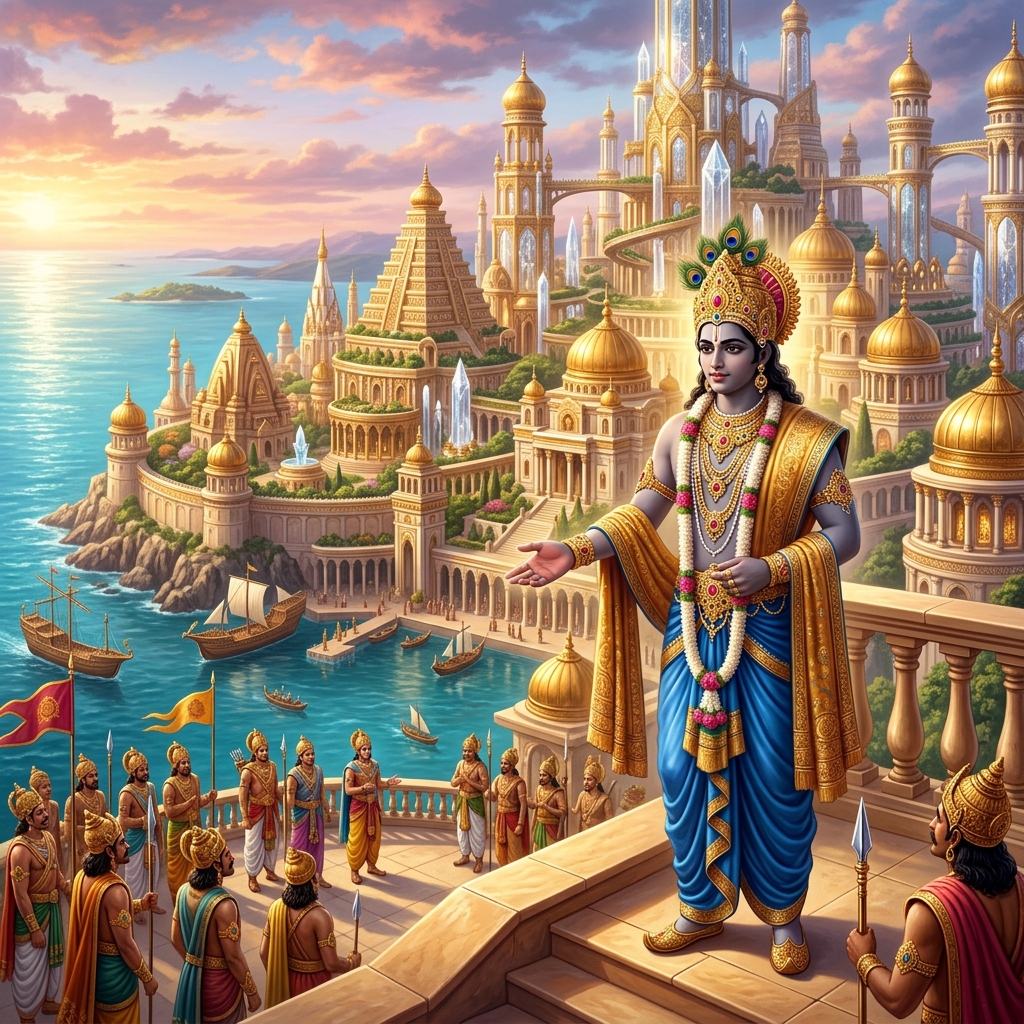
The journey westward was without further alarm, for the host of kings had been scattered and Rukmi had been turned aside, and the four swift horses of Dwaraka carried Krishna and his bride home over plain and river toward the island city by the sea. And when at last the white towers of Dwaraka rose out of the bright water, the people came pouring out to meet them, for word had run ahead of the chariot, and the whole city was glad.
Dwaraka had been made beautiful for the homecoming. Triumphal arches were raised in the streets, the houses were hung with flags and garlands, the roads were sprinkled with scented water, and conches and drums and kettledrums sounded together so that the very air seemed to rejoice. The women of the city climbed to their roofs to scatter flowers and parched grain upon the bride as she passed, and they called blessings down upon her, for the fame of Rukmini had reached even here, and they were proud that such a queen had come among them.
The elders of the Yadavas received her with full honor. Vasudeva and Devaki, Krishna's parents, welcomed her as a daughter, and Balarama, returned in triumph from the field, stood among the kinsmen with his bride-stealing brother. King Bhishmaka, when the news reached him in the south, was at heart secretly relieved that his beloved daughter had been given to the man she loved and not to the man his son had chosen, and in due season he sent his blessings and a generous dowry, that the marriage might lack nothing proper to her station.
Then, at an auspicious hour fixed by the learned, the marriage of Krishna and Rukmini was solemnized with all the sacred rites. The fire was kindled, the offerings were made, the hands of the bride and bridegroom were joined, and they walked together around the flame while the Brahmins chanted the ancient verses, and gifts past counting were given to the priests and to the poor. The festival ran on for many days, and there was feasting and music and gladness throughout the city.
So Rukmini came at last to the husband she had chosen by faith alone, and she became the first and most honored of Krishna's queens, and the love between them was such as poets would sing of long after. The danger and the dust and the terror of the temple morning were behind her now, and she who had staked her life upon a man known to her only through the songs of strangers found that the songs had told the truth.
The Seed of a Reckoning
But not every heart was glad on the morning that the conches sounded in Dwaraka. Far to the east, Shishupala carried his shame home to Chedi, and it festered in him as no wound of the body ever could. He had ridden to Kundinapura a bridegroom certain of triumph, and he had ridden home robbed before the whole assembly of kings, his promised bride borne off to be the queen of the man he hated above all others on earth. The world had laughed, and he had heard the laughter.
He could not forget it, and he did not wish to. From that day Shishupala set himself against Krishna with a steady and venomous purpose, and he counted the marriage of Rukmini foremost among the injuries he had suffered. He raided Dwaraka's allies, he insulted Krishna in open court whenever the chance arose, he spread slanders against him among the kings, and each affront was, though he did not know its true reckoning, one more added to a tally that an old prophecy had set against his life.
For the boon his mother had once begged still held. Krishna had promised to forgive Shishupala a hundred insults before the punishment fell, and Krishna kept his word with a patience that looked, to those who did not understand it, like weakness. Insult after insult he let pass, year upon year, while Shishupala, mistaking forbearance for fear, grew ever bolder and ever more reckless in his hatred, never suspecting that he was being permitted to fill a measure to its brim.
The day of the filling came at last in the hall of the Pandavas, at the great Rajasuya sacrifice of Yudhishthira, when the assembled kings chose to honor Krishna first among all the guests. Shishupala could not endure it. He rose in fury and poured out upon Krishna a torrent of abuse before the whole assembly, raking up every old grievance and not least the carrying-off of Rukmini, heaping insult upon insult past all counting. And Krishna, who had counted, sat calm until the hundredth was passed and the hundred-and-first was spoken. Then he loosed his discus, and the long-promised stroke fell, and Shishupala's head was struck from his shoulders, and a light was seen to rise from the fallen king and pass into Krishna, the strange release of a soul that had been bound to its slayer across the turning of lives.
So the elopement that began with a girl's secret letter ran on at last into that distant hall and that flashing discus, and the thread that Rukmini had spun in the dark of one anxious night reached forward through years to its appointed end. She had sought only to marry the man she loved; she had set in motion, without knowing it, the closing of an account written before she was born. And in Dwaraka, beloved and honored, the queen of the Yadavas lived on beside her dark lord, the proof that a single act of courageous love can move the wheel of great events, for good and for ill, in ways that no one, not even the wise, can wholly foresee.
Dharma Lesson
Love that knows itself before it sees its beloved is rare. Rukmini's certainty crossed half a continent in a single letter; Krishna answered it with a chariot. And mercy, freely chosen, is more terrible to an enemy than death - Shishupala lived because Krishna had been held in his mother's love, and that very mercy fed the count that would one day require him to die.