The Boy God of Vrindavan
Krishna's Childhood Among the Cowherds
The Child Carried Across the Yamuna
On the darkest night of the rainy month, in a stone cell in Kamsa's prison at Mathura, a child was born who was not like other children. He was the eighth son of Devaki and Vasudeva, and a voice from the unseen had once told the tyrant Kamsa that such a child would one day be his death. So Kamsa had locked his sister Devaki and her husband away, and he had murdered each of their infants in turn. But this eighth child glowed in the gloom of the cell like a thundercloud lit from within, dark and beautiful, and his eyes held a calm that no newborn should possess.
The guards, who never slept, slept that night. The heavy iron fetters on Vasudeva's wrists fell open of their own accord. The great barred doors swung silent on their hinges. A father gathered his son into a winnowing basket, set it upon his head, and walked out of a prison that should have held him forever.
Rain came down in sheets as Vasudeva reached the bank of the Yamuna. The river was swollen and roaring, brown with flood, and there was no boat and no bridge. He stepped in anyway, for what else could a father do. The water rose to his knees, his waist, his chest, his chin, and there it stopped, as though the river itself had bowed its head to let the child pass. Above the basket a great serpent spread its hoods like a canopy, sheltering the boy from the storm.
On the far shore lay sleeping Gokul, the village of the cowherds, and in the house of Nanda the chief, his wife Yashoda had that very night given birth to a daughter. Vasudeva slipped inside, laid his son beside the sleeping mother, lifted her daughter into the basket, and carried her back across the parting flood to the prison. When Kamsa came for the newborn at dawn, he found a girl in his sister's arms, and when he seized her to dash her against the stone, she rose from his grip into the sky as a goddess and laughed at him. "The one who will end you," she said, "is already born, and already safe."
And so the dark child woke the next morning in the cowherd country, in the arms of Yashoda, who believed with all her heart that he was her own. He had crossed a flooded river in the dead of night to begin his boyhood among the herders and the cattle, his divinity hidden under a coat of common dust.
The Demoness With Poisoned Milk
Word reached Kamsa that the child was not dead after all, that some infant in the cowherd villages across the river had cheated him. He could not know which one, and so he resolved to kill them all. Among his servants was the demoness Putana, a creature of the wilds who could take whatever shape she pleased. "Find every newborn in the herding country," Kamsa told her, "and let your breasts run with venom strong enough to wither a whole forest. Suckle them. Smile while they die."
Putana came to Gokul not as a horror but as a lovely young woman, soft-voiced and richly dressed, walking through the lanes as though she had every right to be there. The cowherd women, charmed and unsuspecting, let her pass into Nanda's courtyard. She found the infant Krishna lying alone on a small cot, his skin dark as a rain cloud, his eyes half-closed. Something in her faltered at the sight of him, but greed and fear drove her on. She gathered him up, bared her breast, and pressed him to it.
The child took hold and began to drink. But where the poison should have curdled his small body in an instant, he drank instead the very life out of her. Putana's sweet face twisted; her cry split the morning; her body swelled and lengthened back into its true and monstrous shape, gigantic and terrible. She staggered out into the open and crashed down dead, her outstretched arms flattening the fences, her fallen bulk spanning the breadth of two pastures.
The cowherds came running and found the infant seated upon the chest of the dead giantess, kicking his small legs, gurgling, entirely unharmed. Yashoda snatched him up and held him so tight he squirmed. The men passed him from hand to trembling hand. They waved cow-tails over him and chanted the names of the gods and smeared him with the dust of cows and bitter protective herbs, certain that some evil had nearly carried him off.
They did not yet understand the truth that the dead demoness now knew. No evil could touch this child. He was its ending. Even Putana, who had come to kill, had drawn her last breath against the heart of God and been carried, for that one accidental nearness, beyond all her sins.
The Cart and the Whirlwind
Kamsa would not relent, and Gokul, it seemed, was no longer safe, so the cowherds packed their carts and drove their herds deeper into the green country, toward the pastures of Vrindavan beside the Yamuna. But before they reached it, and even after, the demons came, and twice more the unseen guarded the child.
Once, on the day they marked his third month, Yashoda laid the sleeping infant in the shade beneath a heavy bullock cart, loaded high with pots of milk and curd, while she busied herself with the festival. The child woke hungry and, finding no breast near, kicked out with his small feet as infants do. His heel struck the wheel of the cart. The cart, which a dozen strong men could scarcely have moved, leapt into the air, overturned, and shattered, its pots flung wide and smashed. The cowherds came running, aghast, and found only the baby beneath the wreckage, laughing up at them. The children who had been playing nearby insisted the little one had kicked it over, and were of course not believed. But a demon called Shakatasura had hidden in that cart to crush the child, and the kick of a baby's foot had ended him.
Not long after, in the new pastures, a sudden wind rose. It was no ordinary wind. It was the demon Trinavarta, sent in the shape of a whirlwind to carry the child off and dash him on the rocks. Dust blinded the whole village; no one could see a hand before their face. When it cleared, Yashoda's arms were empty, and her wail went up to the sky. High overhead, the whirlwind demon was struggling. The infant he had snatched had grown impossibly heavy in his grip, heavy as a mountain, and clung to his neck and would not let go. Choking, the demon plummeted and broke upon a great flat stone, and there lay the child upon his chest, unhurt, while the dust settled and the mother ran weeping to gather him up.
Time and again Yashoda pressed her son to her heart and thanked every god she knew for sparing him, never once suspecting that the god she thanked lay laughing in her arms.
The Butter Thief of Vrindavan
Vrindavan in those years was a place of slow rivers and deep grass, of kadamba trees and grazing cattle and the smell of churned butter hanging over every house. And in the middle of it grew the most beautiful and the most exasperating child the cowherds had ever known.
Krishna and his elder brother Balarama, fair where Krishna was dark, roamed the village in a band of small herders, and wherever they went mischief followed. The fresh butter that the gopis, the cowherd wives, churned each morning and hung in pots from the rafters to keep it from the children, did not stay safe for long. Krishna would gather his friends, stack them one upon another, climb the living ladder of their shoulders, and reach the highest pot. He ate his fill, fed his friends, broke the pot to share the rest with the monkeys, and left a trail of buttery footprints across the swept floor for any mother to find.
The gopis came to Yashoda in a steady stream of complaints. He let our calves loose before milking. He pinched the sleeping babies to make them cry. He stole the curd and blamed it on the cat. He told us our husbands were calling us so he could steal the cream while we ran. And worst of all, they said, when we catch him red-handed and butter-mouthed, he opens those great dark eyes, and looks up at us, and we cannot for our lives stay angry, and we end up laughing and feeding him more.
That was the truth of it. The whole of Vrindavan was helplessly, joyfully in love with the boy. The very cows would turn their heads to watch him pass. When he was scolded he hung his head with such practiced innocence that the scolding dissolved into laughter. He was a thief, but what he stole more than butter was the heart of every soul in the cowherd country, and somehow no one minded the theft at all.
The Universe in His Mouth
One afternoon the children came running to Yashoda with a fresh complaint, the eldest among them breathless and indignant. "Mother," they cried, "Krishna has been eating dirt. We saw him scoop it up and put it in his mouth, right there by the riverbank."
Yashoda set down her churning and went to her son with the particular sternness a mother keeps for such moments. He stood before her in the dust, the picture of injured innocence. "Naughty boy," she said. "Have you been eating earth? Tell me the truth."
"I have not eaten any earth," Krishna answered, his eyes wide. "They are telling tales because they are angry with me. If you do not believe them, look for yourself. Open my mouth and see."
It was a fair challenge, and Yashoda took it. "Open, then," she said, and the boy obediently parted his lips.
And Yashoda looked into the mouth of her child, and there she saw the whole of the universe. She saw the sky and the four directions, the mountains and the islands and the oceans, the wheeling sun and moon and the fire and the wind. She saw the worlds of gods and sages, the rivers and the forests, the whole moving and unmoving creation. And, dizzying beyond all the rest, she saw Vrindavan itself, and the house of Nanda, and a small mother named Yashoda peering in wonder into the mouth of her child, and within that mouth again the universe, on and on without end.
A terror and a vastness seized her. For a single breath she understood that this was no ordinary boy, that she held the source of all things on her hip, that the lord of every world had chosen to be scolded by her over a mouthful of dirt. Her mind could not hold it. Who am I, she thought, and who is he, and what is this love that binds the infinite to a churning pot and a swept floor.
Then Krishna, who would not have his mother frightened, drew a soft veil of forgetfulness over her, and the vision was gone. She blinked. She found only her little boy looking up at her, and her heart filled again with simple love. She gathered him into her arms and forgot, almost, what she had seen, and was happier for the forgetting. But somewhere deep beneath the surface of her, the wonder remained.
Damodara, Bound to the Mortar
There came a morning when Yashoda decided to churn the butter with her own hands, out of love for her son, and as she worked the great wooden churning-rod the child came to her wanting milk. She lifted him to her breast and fed him, watching his face. But the pot of milk on the hearth had begun to boil over, and she set him down half-fed to rush and save it.
Krishna, indignant at being set aside, broke the butter-pot with a stone in a fit of small temper, helped himself to the butter, and ran off to feed it to the monkeys. When Yashoda returned and saw the broken pot and the buttery footprints leading away, she could not help but laugh, and then she went after him with a stick to teach him, gently, a lesson.
He ran, and she ran, and though he was the swift one who outran the wind, he let her catch him, for he could be bound by love when he could be bound by nothing else. She saw his frightened, tearful face, rubbing his reddened eyes with his small fists, and her heart melted, but she resolved to tie him up for a little while so he would learn. She fetched a rope to bind him to the heavy wooden mortar used for grinding.
The rope was a hand's breadth too short. She fetched more rope and joined it on, and still it fell short by exactly a hand's breadth. She joined on rope after rope, gathering the cords of the whole household, and every single time, no matter how much she added, the rope was short by precisely the same small measure, as though the infinite could not after all be measured by any length of cord. Yashoda grew flushed and weary and amazed, and the gopis gathered to watch and wonder.
Then the child, seeing his mother truly tired and her love truly tested, allowed himself to be bound. The last knot held. He stood tied by the belly to the wooden mortar, and from that binding he took a name that the world would keep forever: Damodara, the one bound at the waist by a rope of love. The lord whom no power in creation could constrain had let a cowherd woman tie him to a grinding-stone, because she loved him, and because he loved being loved.
The Two Trees Set Free
Bound to the heavy mortar, Krishna was left alone for a while as Yashoda returned to her work, certain that the wooden block was far too heavy for a child to drag. She did not know that her son had a reason for everything, even for letting himself be tied.
In the courtyard there stood two great twin arjuna trees, tall and ancient, side by side. They were not, in truth, trees at all. Long ago they had been two sons of the lord of wealth, Kubera, two proud and reckless youths named Nalakubara and Manigriva. Drunk and arrogant, they had once disported themselves shamelessly before the sage Narada, and Narada, to humble their pride and turn their hearts at last to the divine, had cursed them to stand a hundred celestial years as a pair of trees. Yet the sage had been merciful in his curse, for he had promised that in the fullness of time the lord himself would come to the cowherd country and release them with his own touch.
Now the child, dragging the wooden mortar behind him, crawled toward those two trees. His small body slipped easily between them, but the broad mortar tied to his waist wedged sideways and caught fast against the twin trunks. Krishna crawled on. He pulled. The mortar held, and then, with a groan that shook the earth, the two great trees were torn up by their roots and crashed down on either side of him in a thunder of splintering wood.
From the ruin of the fallen trees rose two shining beings, radiant and free, the cursed sons of Kubera restored at last to their true forms. They circled the small bound child with folded hands, their pride long since burned away by their long penance, and they praised him as the lord of all the worlds who had stooped to crawl in a courtyard so that they might be saved. "We knew you only as a distant name," they said. "Now we have seen you as a child dragging a mortar, and that is sweeter than any glory." Then they bowed and returned to their own realm.
The cowherds came running at the crash and found the two ancient trees uprooted and their child sitting unharmed in the wreckage, still tied to the mortar, looking up at them with great innocent eyes. They could make no sense of it, and they began at last to murmur among themselves that Vrindavan was no safe place, and that perhaps they should move once more.
The Dance on Kaliya's Hood
As Krishna grew from infant to boy, he began to take the calves and then the cattle out to graze, walking the pastures of Vrindavan with his flute at his lips and a peacock feather in his hair, his cowherd friends around him and the whole herd following the sound of his music. But there was one stretch of the Yamuna that no creature dared approach.
In the river's deepest pool there lived a serpent named Kaliya, a many-hooded naga whose poison was so terrible that the water around him boiled and steamed, and the very birds that flew over the pool dropped dead from the sky into it. Trees on the bank withered. Cattle that strayed too near and drank fell lifeless. Once even mighty Garuda, the eagle who feeds on serpents, had been driven from that water by a curse, and so Kaliya had grown bold and made the river his fortress, fouling it with his venom.
One hot day the cattle and the cowherd boys, parched and unknowing, drank from the poisoned pool and fell senseless on the bank. Krishna looked upon them, and then he climbed a tall kadamba tree that leaned out over the dark water, tightened his belt, and leapt.
He struck the pool like a falling star, and the water churned. Kaliya rose in fury, all his hoods flaring, and wrapped the boy in coil after crushing coil. On the bank the awakened cowherds wept and the gopis wailed, certain their beloved was lost. But Krishna swelled in the serpent's grip until the coils could no longer hold, and then he slipped free, light as a leaf, and rose dancing onto the great central hood.
And there, upon the head of the venomous king, the boy began to dance. His feet were small but they fell with the weight of all the worlds, and to the rhythm of his own flute-music, heard in the depths, he stamped down hood after hood, and the serpent's pride and poison were trampled into the river-bed. Kaliya bled and weakened and was near to death. Then up from the dark water rose the serpent's wives, the naga-women, their palms joined, and they pleaded for their husband's life. "Forgive him, lord, for he knew not whom he struck. Be gracious to women who beg."
Krishna lifted his foot. "Live, Kaliya," he said, "but leave this river forever. Go with your wives to the great ocean. And carry on your hoods the print of my feet, so that even Garuda, seeing the mark, will know you are mine and will never harm you again." The serpent bowed his bruised heads, and gathered his people, and departed for the sea. By the next morning the Yamuna ran sweet and clear, and the cowherds, who had loved the boy as their own, began to wonder in earnest who he truly was.
The Mountain on a Finger
Each autumn the cowherds of Vrindavan prepared a great offering to Indra, king of the gods and lord of the rains, for they believed it was Indra who sent the monsoon that filled the rivers and made the pastures green. Mountains of rice, butter, curd, fruit, and incense were gathered, and the whole village made ready for the festival.
Krishna, only a boy, stood in the council of the elders and quietly questioned the custom. "Why do we worship Indra, who is far away and gives us nothing we can see? It is this mountain, Govardhana, that gives our cattle grass and shade and shelter, and it is the rains that come with the turning of the seasons whether we honor anyone or not. We are herders. Let us honor what truly feeds us. Let us bring the offering to Govardhana and to the cows and to the brahmins, and let Indra keep his pride."
There was a strange certainty in the boy that the elders could not argue with, and so that year the great offering was carried to the foot of Mount Govardhana, and the cowherds circled it in worship, and the festival to Indra went unkept.
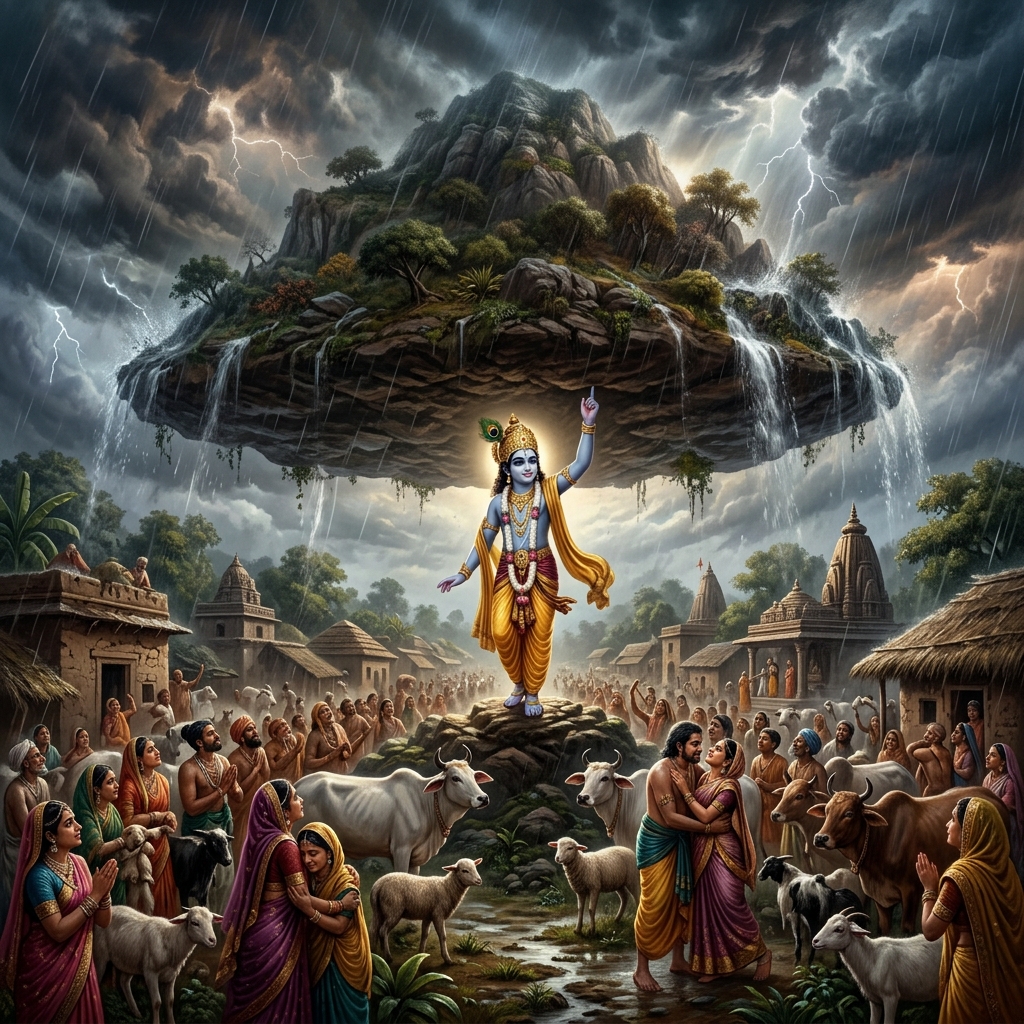
In his heaven, Indra burned with wounded pride. That a village of herders, led by a mere child, should turn from the king of the gods. He summoned the clouds of universal dissolution, the Samvartaka clouds that drown the world at the end of an age, and hurled them upon Vrindavan. The sky went black at midday. Rain fell not in drops but in ropes and sheets and walls of water. Hailstones battered the herds, lightning split the air, and the wind tore at the houses. The flood rose, and the cattle bellowed in terror, and the people clutched their children and ran to Krishna, for they had nowhere else to turn.
Krishna walked to the foot of the mountain. He reached down, slid his hand beneath an outcrop of rock, and lifted. Mount Govardhana rose into the storm, a vast roof of stone balanced upon the little finger of a boy. "Come," he called over the roar of the rain. "Bring the cattle, bring the children, bring everyone beneath. Stand close, and have no fear."
The whole of Vrindavan, every soul and every beast, sheltered beneath the lifted mountain. For seven days and seven nights Indra spent the fury of his clouds against the stone, and for seven days and nights the boy held Govardhana aloft without once shifting his feet, smiling, while the cowherds beneath gazed up at him in stunned and silent wonder. On the eighth day the clouds were emptied and the storm broke and the sun came through.
Indra himself descended, ashamed, and bowed at the boy's feet, begging forgiveness for his pride. Krishna set the mountain gently back upon its roots. "Govardhana stood today," he said. "Let pride be the thing that falls." And from that day the cowherds knew, past all doubting, that the child who had grown among them was the lord of all.
The Flute and the Raas Dance
When the harvest of the autumn was gathered and the nights grew clear and cool, the moon over Vrindavan rose round and bright and the jasmine opened along the riverbank, and Krishna took up his flute and walked out into the forest beside the Yamuna and began to play.
There has never been such a sound. The notes drifted over the sleeping village and into the houses, and they reached the hearts of the gopis, the cowherd women, and whatever they were doing they could not help themselves. Some were milking and some were cooking and some were lying beside their husbands, and all of them, hearing that flute, rose and slipped out into the moonlit night and ran toward the music, leaving their work and their homes behind, drawn by a love that asked nothing of the world and held nothing back.
They gathered on the white sands of the Yamuna under the autumn moon, and there Krishna received them. He spoke first as a teacher might, asking why they had come out alone into the dark forest, telling them gently that their place was at home, that to love virtue and duty was the truer path. But they had given him everything already, and would not turn back, and seeing the purity of a love that wanted only him and not even the reward of him, he relented, and the dance began.
It was the raas, the great circle dance. The gopis joined hands and ringed him round, and Krishna multiplied himself by his own power so that he stood between each pair of them at once, and every woman felt that he danced with her alone and held her hand and looked into her eyes, and none was slighted and none made jealous, for the one had become many to meet the many who loved him as one. They sang and turned beneath the moon, their anklets ringing, the river bright beside them, and the gods themselves leaned down from the sky to watch.
It was no ordinary night and no ordinary love. In the dance of the gopis with the flute-player on the sands of the Yamuna, the longing of every soul for the divine was made visible, and answered. The flute called, and the heart that heard it could not stay home. That was the whole of the teaching, hidden inside the play.
So the years of the boyhood passed in Vrindavan, in butter and mischief and music, in serpents subdued and mountains lifted and demons undone, in a love so wide it took in the cattle and the trees and the river and every cowherd soul. The dark child carried across the flooded Yamuna had grown among the herders with his godhood folded inside his play, and those who had eyes had seen it, and those who had only love had been given the better portion. In time he would leave for Mathura and the great work of the world. But the cowherd country would hold him always, the way Yashoda's rope had held him: not by force, for nothing could bind him, but by love, which he had let bind him on purpose, and which he never afterward let go.
Dharma Lesson
Divinity walks among the ordinary, indistinguishable from a butter-smeared cowherd child until the moment of crisis reveals it. Pride - Indra's, Kamsa's, the serpent's - is undone not by greater pride but by quiet, certain action. And sometimes the wisest course on a battlefield is to leave it.