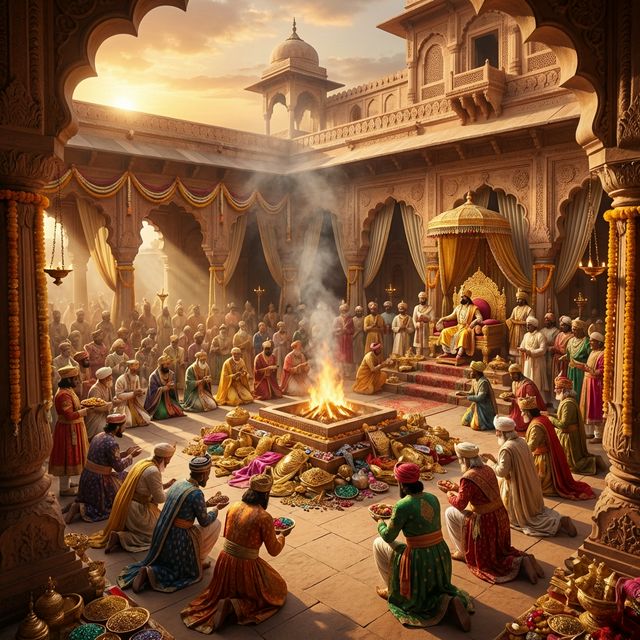
The Imperial Sacrifice
Indraprastha, Jarasandha, and the Rajasuya Yagna
The Desire for the Imperial Rite
Indraprastha had become a wonder of the world. Where there had once been only ash and snake-haunted scrub, there now stood a city of seven walls, of moats stocked with crocodiles, of broad avenues planted with mango and ashoka. At its heart was the great assembly hall raised by Maya the Asura, a marvel of illusion where floors looked like water and water looked like floors. Kings sent envoys merely to walk through it. Tribute arrived unbidden. The five Pandava brothers ruled in a peace so settled that the years seemed to have forgotten how to be cruel.
It was in this fullness that a thought took root in Yudhishthira. His brothers and his counselors had begun to murmur it to him, and the priests who tended his fires had begun to ask why a king of such righteousness, such reach, such evident favor of the gods, had not yet claimed the rank that was his by right. They spoke of the Rajasuya, the imperial consecration sacrifice, the rite by which a king becomes an emperor, a samrat, lord of lords, before whom all other crowns must bow.
Yudhishthira turned the desire over in his careful mind for many days. He did not want it for vanity. He had seen what hunger for power had done to his cousins at Hastinapura, and he feared the seed of it in himself. Yet the Rajasuya was not only ambition; it was dharma. An emperor consecrated by that rite became responsible for the order of the whole earth, for the protection of the weak against the strong, for the binding of many warring kings under one law. To refuse it out of timidity might itself be a failure of duty.
Still he hesitated. The Rajasuya could not be performed lightly or alone. It required that every other sovereign of the inhabited world acknowledge the sacrificer as paramount, whether as ally, tributary, or vanquished foe. A single great king left unsubdued and defiant would make the whole rite a hollow boast. And so, before he would commit to it, Yudhishthira resolved to seek the counsel of the one man whose judgment he trusted above all others. He sent word to Dwaraka, asking Krishna to come.
Krishna's Counsel
Krishna came from Dwaraka and was received with the joy that always met him at Indraprastha. When the brothers had embraced him and the courtesies were done, Yudhishthira laid his heart open. He spoke of the Rajasuya, of his counselors' urging, of his own fear of pride. "You see further than any of us, Krishna," he said. "You will not flatter me. Tell me plainly - should I undertake this, or is it beyond me?"
Krishna was quiet for a while. Then he said, "You have the virtue for it, the wealth for it, and the brothers for it. There is no king on earth more fit to be emperor than you. But I will not pretend the road is clear. There is one man who stands across it like a mountain across a river, and while he lives, no Rajasuya you perform will be honest."
"Who?" asked Yudhishthira.
"Jarasandha, king of Magadha. He sits in his fortress at Girivraja and calls himself the lord of the middle of the earth, and many kings already pay him fear if not love. He has crushed king after king. Even I could not stand against him in open war. Seventeen times he came against my city of Mathura, and seventeen times I withdrew rather than let my people be ground to nothing between us. In the end I led the Yadavas away to the western sea and built Dwaraka beyond his reach. That is the measure of the man."
Krishna's voice dropped. "And there is worse than his strength. Jarasandha has imprisoned scores of kings whom he conquered - they are penned in his city like cattle. He does not mean to ransom them or free them. He means to sacrifice them, all of them at once, to Lord Shiva, when he has gathered a full hundred. Already he holds eighty-six. Each new conquest brings him nearer to that horror. Those kings sit in the dark and wait to be offered like beasts on an altar."
Bhima had been listening with his great hands tightening on his knees. Now he spoke. "Then the question of the Rajasuya answers itself. Whether or not my brother becomes emperor, this man must be stopped. To free those kings is dharma enough by itself."
Krishna smiled at him. "That is exactly what I had hoped someone would say."
The Secret of Jarasandha's Birth
Arjuna asked the question that hung in the room. "If neither armies nor you yourself could break him, how is he to be killed at all?"
Krishna answered with a story. "Jarasandha's father was Brihadratha, a mighty king of Magadha who had no son. A great sage gave him a single mango, blessed so that the queen who ate it would bear a child. But Brihadratha had two queens, twin sisters whom he loved equally, and he could not bear to favor one over the other. So he cut the mango in half and gave a half to each. In time each queen bore not a child but half a child - two halves of one infant, each with one eye, one arm, one leg, half a body, split down the middle and lifeless."
"The horrified nurses wrapped the two halves and cast them out at a crossroads to be rid of the omen. There a Rakshasi named Jara found them. To carry the pieces more easily she pressed the two halves together - and the moment they touched, they joined. They fused into a single living, breathing, squalling child, whole and strong. The demoness, astonished, carried the boy back to the palace and gave him to the grieving king, telling him what had happened. Because the Rakshasi Jara had joined his sundered halves, the child was named Jarasandha - joined by Jara."
Krishna let the meaning settle. "That is the heart of it. He was made by a joining, and a joining sustains him. A blow that would kill another man does not kill him, for his body knows how to come back together. Cut him in two and the halves rejoin before your eyes. An arrow, a sword, a mace - none of it holds. There is only one way. He must be torn apart and his halves cast so far and so opposite that they cannot find each other again. And that cannot be done at a distance. It can only be done by hand, in single combat, by a man strong enough to break him and quick enough to throw the pieces beyond return."
Every eye turned to Bhima.
"It must be combat," Krishna went on. "Jarasandha is proud and observes the codes. If we challenge him man to man, he will not refuse. But we cannot go as the kings we are - the gates of Girivraja are watched, and he would muster his armies the moment a Pandava host appeared. We will go as three pilgrims, three Brahmins seeking his famous hospitality, and we will reveal ourselves only when we stand before him in his own hall. I will go. Bhima will go, for the deed is his. And Arjuna will go, for I would not have Bhima go anywhere without him."
Yudhishthira's heart misgave him to send his two strongest brothers and his dearest friend into the lair of such a man with no army at their backs. But he could not deny the wisdom of it, nor the justice of the cause. He gave his blessing, and the three set out.
Three Pilgrims at Girivraja
They crossed the breadth of the land on foot, three travelers in the plain cloth of Brahmins, their bows and their royalty alike left behind. They passed through Kuru lands and across the Ganga, through forests and over hills, until at last they came in sight of Girivraja, the fortress-capital of Magadha, ringed by five hills like a crown of stone.
They did not enter by the open gate. Instead, scorning the ordinary road as a sign of their disdain for its master, they broke through the city's three great war-drums - vast skins stretched over the mouth of the valley, hung with garlands, that Jarasandha kept as trophies of a beast he had once slain. To pass that way was an insult and a defiance, and they meant it to be. Then they climbed the wall by an unguarded path and came down into the streets of Magadha as the sun set, taking flowers and sandal-paste from a garland-maker's shop as they went, as kings might do who owned the world.
Jarasandha was a careful host, and word reached him that three Brahmins of strange and lordly bearing had entered his city by no honest road. Whatever they were, the law of hospitality bound him. He had them brought before him and received them with the rites due to holy guests - water for their feet, the offering of honey and curds, the promise of any gift they might name.
But as he looked at them he grew troubled. "You wear the thread and the cloth of Brahmins," he said, "yet you do not carry yourselves like men who beg. Your shoulders are marked where a bowstring rides. You smell of sandalwood and of war, not of the fire-altar and the study of the Veda. You entered my city by breaking my drums and scaling my wall, as enemies enter, not as guests. I have offered you my hospitality and I will keep my word. But tell me truly - who are you, and why have you come?"
The Challenge Declared
Krishna answered for the three. "You see clearly, king of Magadha. We are no Brahmins. We are Kshatriyas, and we have come to you not for your gifts but for combat. I am Krishna of the Yadavas. These are Bhima and Arjuna, sons of Pandu. We have entered your city by the path of enemies because we are your enemies, and we scorn the courtesies you offer."
Jarasandha's face hardened, but he did not flinch. "Then state your quarrel. What have I done to the sons of Pandu, or to the cowherd of Mathura who fled before me and hid himself in the sea?"
"You hold a hundred kings, or nearly," said Krishna, "penned in the dark to be slaughtered before Shiva as if men were goats. There is no crime more monstrous, no dharma more plainly broken. We have come to free them, and to put an end to the one who would do such a thing. We challenge you to single combat. Choose which of us you will fight, and let your strength answer for your cruelty."
Jarasandha laughed, a hard short sound. "I have conquered every king I have taken in fair war or open battle. They are mine by the law of arms, and what I do with them is my affair and Shiva's. As for fighting you - I do not fear three men. But I will not stoop to fight Krishna, who ran from me and is no king but a herdsman, nor a stripling like Arjuna who has barely the beard for it. If I must fight one of you, I will fight the one who is at least built like a man. The big one. Let it be him."
"Bhima," said Krishna.
"Bhima," Jarasandha agreed, and his eyes met Bhima's, and something in each man recognized in the other an equal of the body, a rare and almost welcome thing. "I have wished for years to meet a man I could not break with one hand. Perhaps you are he."
The king set his affairs in order, named his son to the throne should he fall, put off his crown and his fine cloth, and stood forth in the wrestler's loincloth. Bhima did the same. They went down into the great courtyard of the palace, and a torch-lit ring was made, and the combat began as the moon rose over the five hills of Girivraja.
The Long Wrestling
It was a combat such as the world had not seen. Two mountains of muscle closed upon each other, and the courtyard rang with the slap of palm on shoulder and the grunt of strained breath. They struck and seized and threw; they locked arms and heaved until the flagstones cracked beneath their heels; they crashed to the ground and rolled and rose again. The sound of their blows was like the felling of great trees, and the watchers in the galleries held their breath and could not look away.
The first day passed and neither yielded. They paused at dusk, for even such men must eat and sleep, and they parted as courteously as guests, and at dawn they fell upon each other again. So it went, day after day. The second day. The fifth. The ninth. They ate together at night and tore at each other by day. A strange respect grew between them, for each found in the other a strength he had never met, a will that would not break.
Krishna and Arjuna watched from the edge of the ring through all of it. And as the days wore on, Krishna saw what he had feared. Bhima was the stronger man, perhaps - he gained the upper hold more often, he threw Jarasandha more often than he was thrown. But it made no difference. Whenever Bhima dashed the king to the earth with a blow that should have ended any other life, Jarasandha simply rose again, whole, his breath unbroken, his body knitting itself back to wholeness. The wound of one hour was healed by the next. Bhima was spending his vast strength against a man who could not be worn down, and slowly, slowly, Bhima was the one beginning to tire.
On the thirteenth day Bhima at last lifted Jarasandha clean off the ground, whirled him over his head a hundred times to rob him of his senses, and brought him down across his knee, snapping his spine and breaking him near in two. For an instant it seemed done. Then the two halves of the king slithered together where they lay, fused, and Jarasandha sprang up unhurt and laughing, and the fight began again. Bhima's heart sank, for he saw now with his own eyes what Krishna had told him, and he did not know how to undo it.
The Sign of the Riven Leaf
On the fourteenth morning Bhima was near the end of his endurance. His arms shook; his breath came ragged; the king before him seemed as fresh as on the first day. Bhima glanced across the ring to where Krishna stood, asking with his eyes what he had not breath to ask aloud - how does a man kill what will not stay broken?
Krishna understood. He could not speak the secret across the ring without warning Jarasandha. So he did what was needed in silence. He stooped and took up a long blade of grass, or as some tell it a small twig. He held it up so that Bhima alone could see. Then he split it lengthwise down the middle into two halves. And he threw the two halves apart, one over his right shoulder, one over his left, in opposite directions, so that they fell far from each other on the stones.
Bhima saw. And he understood. It was not enough to break the king; the pieces had to be cast so far apart, so opposite, that they could never crawl back together to rejoin.
New strength came into him with the knowing of it - the strength that comes when a long, hopeless struggle suddenly has a way through. He closed with Jarasandha one last time. He seized him, lifted him, and once more brought him crashing down across his knee, splitting his body into two halves down the very line by which the demoness Jara had once joined them. But this time Bhima did not pause. With the halves still in his hands he hurled them apart with all the force left in him - the left half flung far to the right, the right half flung far to the left - so that they landed at opposite ends of the courtyard, facing the wrong ways, unable to find or reach each other.
The halves of Jarasandha twitched and groped toward one another across the stones, but the distance was too great and their alignment was wrong. They could not join. And so, after fourteen days, the mighty king of Magadha, who had bowed every other power on earth and had never been beaten, lay dead in two pieces on the floor of his own hall. The watchers in the galleries made no sound at all.
The Captive Kings Set Free
Krishna did not let the moment turn to slaughter. He had no quarrel with Magadha itself, only with its master's cruelty. He raised up Jarasandha's son, Sahadeva of Magadha, and set him upon his father's throne, confirming him as king and friend, so that the realm should not fall into chaos. In this Krishna showed the brothers what an emperor's victory ought to look like - not the burning of a people, but the mending of a wrong and the making of an ally.
Then they went to the prison. Krishna ordered the doors broken open, and out of the dark came the kings whom Jarasandha had penned to be sacrificed - eighty-six rulers and more, gaunt and blinking, men who had ruled wide lands and had been kept like beasts awaiting the knife. They could scarcely believe the daylight or the news of their deliverance. When they understood that the dreadful king was dead and that they were free, some of them wept, and all of them bowed.
Krishna told them who had freed them and why. "Yudhishthira, son of Pandu and lord of Indraprastha, desires to perform the Rajasuya and become the protector of all kings under one righteous law. It was for the freeing of you and the ending of this horror that we came. He asks no servitude of you, only your friendship and your acknowledgment."
The freed kings gave it gladly and more than gladly. A debt had been laid upon them that no tribute could repay, and they pledged themselves to Yudhishthira not as conquered men but as men rescued. So the three pilgrims who had entered Magadha in secret left it in triumph, with the greatest obstacle to the Rajasuya not only removed but turned into a host of grateful allies. They returned to Indraprastha, and when Yudhishthira heard all that had passed, he embraced Bhima long and said that the imperial rite had been won before it was begun.
The Conquest of the Four Directions
With Jarasandha gone and Magadha turned ally, the way was open. But the Rajasuya still required that the whole earth acknowledge Yudhishthira as paramount lord. So the four younger brothers were sent out, each to subdue one of the four quarters of the world and bring its kings into tribute or alliance, while Yudhishthira remained at Indraprastha to make ready the great rite.
Arjuna rode north. He drove his conquest up through the hill kingdoms and the cold mountain lands, past the foothills of the Himavat, against tribes whose names were strange to the central plains. He fought and won and bound them, and came home with white horses and chests of mountain gold and the tribute of the north.
Bhima rode east, toward the lands of the rising sun. He subdued the kingdoms of the eastern rivers, of Anga and the countries beyond, the same direction from which he had so lately come, and returned laden with the pearls and elephants and silks of the east.
Nakula rode west, toward the deserts and the sea and the friendly Yadava lands, where Krishna's name opened many gates. Many kingdoms of the west sent tribute without battle, recognizing the new order; those that resisted he overcame, and he came home with fine iron and the salt and silver of the western sea.
Sahadeva, youngest and quietest, rode south, on the longest and hardest road of all. He pressed past the Vindhya hills and deep into the Deccan and the far south, among peoples no northern emperor had ever ruled, and brought even the distant southern kings to acknowledge Yudhishthira. When all four brothers had returned, the wealth of the whole earth stood gathered in the storerooms of Indraprastha, and no crown of any consequence remained that had not bowed. The summons went out across the world: come to the Rajasuya of Yudhishthira, and see an emperor consecrated.
The First Honor Given to Krishna
They came from every direction. Kings and princes filled the roads to Indraprastha. From Hastinapura came the elders - Bhishma the grandsire, Drona and Kripa the teachers, the blind king Dhritarashtra with Vidura beside him - and with them Duryodhana and his ninety-nine brothers, and Karna, and Shakuni of Gandhara. Krishna came with the Yadavas. Drupada came, and the eighty-six kings whom Bhima had freed, and the lords of the four conquered quarters. Shishupala, king of Chedi, came as well, and he came knowing what he came to do.
The great rite unfolded over many days with the slow grandeur of the ancient ceremonies. Priests chanted the sacred hymns; offerings burned in the fire-pits; the smoke of the consecration rose for days into the sky. Gifts beyond counting were given to Brahmins and to guests. The whole world seemed to have gathered under one roof in peace.
Then came the moment of the agrya-puja, the offering of the first and highest honor, by which the assembly names the single most worthy person present and reverences him before all others. The choosing of that one was given to the eldest and wisest, and so it fell to Bhishma. He did not hesitate. "Among all these kings and sages," he said, "there is one who is the foremost in valor, in wisdom, in righteousness, in every quality that men revere. Krishna of the Yadavas is the sun in whose light the rest of us are stars. Let the first honor be given to him."
Yudhishthira agreed with a glad heart. Sahadeva carried the offering to Krishna - water for his feet, sandal-paste for his brow, fine cloth and the gifts of honor - and the assembly rose to acknowledge it. Krishna received it modestly, as he received all things. To most of those present it seemed the rightest act of the whole rite, the recognition of the one being in the hall whom even the gods deferred to.
But not to all. In the place where the kings of the lesser thrones sat, one man had risen to his feet, his face dark with fury, and he had begun to speak.
The Hundred Insults of Shishupala
Shishupala, king of Chedi, strode into the open center of the hall so that all could hear him. He was a kinsman of Krishna's, and an old enemy, and a man fated to this hour. "Are there no kings left in the world," he cried, "that you heap the highest honor on a cowherd? Is there no warrior in this hall more fit than a man who tended cattle, who stole butter as a child, who fled like a coward from Jarasandha and hid in the sea? You pass over Bhishma, over Drona, over the kings of ancient lines, to bow before a herdsman who is not even a king. This Rajasuya is a mockery, and the man who chose this honoring is a doddering fool."
The hall stiffened. Many warriors reached for weapons. But Krishna sat unmoved, the garland of honor still about his neck, his face unchanged. He was counting, and only he knew why.
For there was an old vow behind his stillness. At Shishupala's birth the child had been born monstrous, with three eyes and four arms, and a voice had foretold that the one whose touch would make the extra eye and arms fall away would also one day be his death. When the infant Krishna took the child on his lap, the third eye vanished and the arms dropped, and his mother, knowing then who would kill her son, had begged Krishna for a boon. Krishna had promised her that he would forgive Shishupala a hundred offenses before he struck him down. All these years he had kept the count.
Now Shishupala poured out the offenses, one upon another, faster and fouler. He reviled Krishna's birth, his parents, his foster-home, his cousins, his wives. He mocked his flight from Mathura. He sneered that Krishna hid behind women and behind the love of his elders, that he had stolen Rukmini who had been pledged to another, that he was no god but a trickster and a thief. The insults rolled out, the eightieth, the ninetieth, while the assembly looked from the raging king to the silent one and could not understand the silence.
"You hide forever behind your aunt and your mother's skirts," Shishupala spat at last, "as you always have, you coward, you - "
That was the hundredth.
The Discus and the Seed of Envy
Krishna let the hundredth insult fall and be finished. Then, his voice quiet enough that the whole silent hall heard every word, he told the assembly of the vow he had made to Shishupala's mother, and that the count of pardons was now full. "I promised to bear one hundred offenses," he said. "I have borne them. He has spent them all, and now he begins upon the rest, and that I will not bear."
He lifted his right hand. The Sudarshana, the flaming discus that lived upon his finger, came alive and rose, and he released it. It crossed the hall in a single streak of white light. Shishupala's head, still wearing the scorn of his last word, fell from his shoulders to the floor, and his body stood an instant longer before it dropped.
Then the assembly saw a thing that silenced even those who had thought Krishna only a man. A small bright radiance rose out of the fallen body of Shishupala - a light long pent within him - and it crossed the hall and entered into Krishna where he sat, and was gone, merging into him as a river enters the sea. For the soul of Shishupala had been bound to Krishna across more than one birth, and in his death the long enmity was at last consumed in the very being he had reviled. The hall understood then what they had been watching: not a quarrel between kings, but the closing of a circle that had turned for ages.
The last obstacle was gone. The Rajasuya was completed in full. Yudhishthira was consecrated emperor, samrat over the kings of the earth, and the rite was acclaimed the most splendid the world had known. The kings paid their tribute, gave their blessings, and in time departed to their own lands.
But not every heart that left Indraprastha left it glad. Duryodhana had watched it all - the wealth beyond counting, the kings of the world bowing, his hated cousin crowned emperor, the very hall of illusion where he himself had stumbled into a pool he mistook for marble while Draupadi's women laughed from a gallery above. He had seen Yudhishthira raised as high as a man could be raised, and himself made small in the seeing. Envy went into him like a slow poison that day, deep and patient, and it did not leave him. He rode home to Hastinapura turning it over with his uncle Shakuni, and out of that envy, in the months to come, would grow the game of dice and all the long ruin that followed. The most glorious day of the Pandavas held within it the seed of their longest sorrow.
Dharma Lesson
Empire is built on patience as much as on victory: Krishna counted Shishupala's hundred insults for decades; Yudhishthira counted no insults at all and was crowned. Friendship pays its own debts - Sudama walked home to a mansion he never asked for. And one who cannot be killed in halves may still die if no one will let his halves rejoin.