The Frontier City of Gandhara
Far in the northwest, past the Indus, where the land rises toward the mountain passes into Central Asia, stood Takshashila, a city already old by the time the Mahabharata's last generation came to know it. It belonged to the wider world of Gandhara, the kingdom of Shakuni's house and of Gandhari, the Kuru queen mother, whose brother had once schemed an entire dynasty into ruin from a court not far from these same roads, and it had long served as a gateway between the plains of the Ganga and Saraswati and the trade routes running north and west, its markets accustomed to caravans, its walls built to answer raids from the passes rather than from the heartland kingdoms further east.
Nothing in Takshashila's long history before the epic marks it as remarkable, a border city doing what border cities do, watching over roads and collecting the tolls of travelers passing between two worlds. It becomes central to the Mahabharata's story only at the story's very end, in the reign that follows the Pandavas' own generation, when a king's death by snakebite and his son's answering rage bring a Kuru army to this frontier for the first and only time the epic records. What happened here, in the space of a single terrible rite, decided both the near destruction of an entire race of serpent-beings and, almost as an aside to that violence, the first time the Mahabharata itself was spoken aloud to a human king, the city's dark chapter and its future glory as a seat of learning rooted in the very same ground.
The Death of Parikshit
Parikshit, Arjuna's grandson and the last king to sit the Kuru throne, had been born under strange protection, the one child spared when Ashwatthama's final weapon before the war's end had scoured the Pandava women's wombs, kept alive in Uttara's belly only because Krishna himself had entered the child unborn and stood between him and the fire. He grew to rule well, but a moment of thoughtless disrespect toward a meditating sage brought a curse down on him from the sage's young son: within seven days, the boy swore, the king would die of snakebite, delivered by Takshaka, king of serpents.
Parikshit did not treat the curse lightly. He had a palace built on a single pillar, sealed against every crack a snake might use, guarded day and night by physicians skilled against poison. Takshaka, learning of these precautions, did not attempt force. He sent his own serpents disguised as ascetics bearing fruit as an offering, and when the king, satisfied nothing was amiss, bit into one of the fruits, a small worm crawled out of it. Parikshit, half in jest, said that since evening was near and the danger past, the worm could stand for Takshaka himself, and touched it to his throat. It became Takshaka in that instant, wound itself around the king, and struck.
Tradition already bound that serpent king's name to the far northwest before this day. Some hold that Takshashila itself, the rock of Takshaka, carried his name long before Janamejaya ever marched on it in answer for this killing, the city and the snake linked in memory even before the epic's last generation made that link into a battlefield.
Janamejaya's Vow
Janamejaya, Parikshit's son, was still young when the news of his father's death reached him, and grief in him hardened at once into a vow: every serpent living would answer for what Takshaka alone had done. His priests told him such a rite was possible, a sarpa satra, a sacrifice of snakes, in which the proper mantras spoken over a consecrated fire would draw every serpent in creation down into the flames whether they willed it or not.
Before he could hold the rite, Janamejaya first had business at Takshashila itself. Whether because the city stood on Takshaka's own ground in the Gandhara borderlands or simply because it lay along his march, the young king brought his army north and subdued the frontier city, folding it under direct Kuru control before turning back to the work of vengeance. It was there, by most tellings, or in a great sacrificial ground raised for the purpose near that same city, that the priests built the fire pit and began the recitation that would summon every snake born.
The rite worked exactly as promised, and worse than anyone had reckoned on. Serpents of every kind, from the humblest field snake to Vasuki's own kin among the great serpent lords, found themselves drawn helplessly out of their homes and into the sky above the fire, falling in endless streams into the flames no matter how they twisted to resist. Takshaka himself, warned of the danger, had gone to Indra for shelter, but even a god's protection would not hold forever against a sacrifice built to consume every snake alive.
Astika's Boon
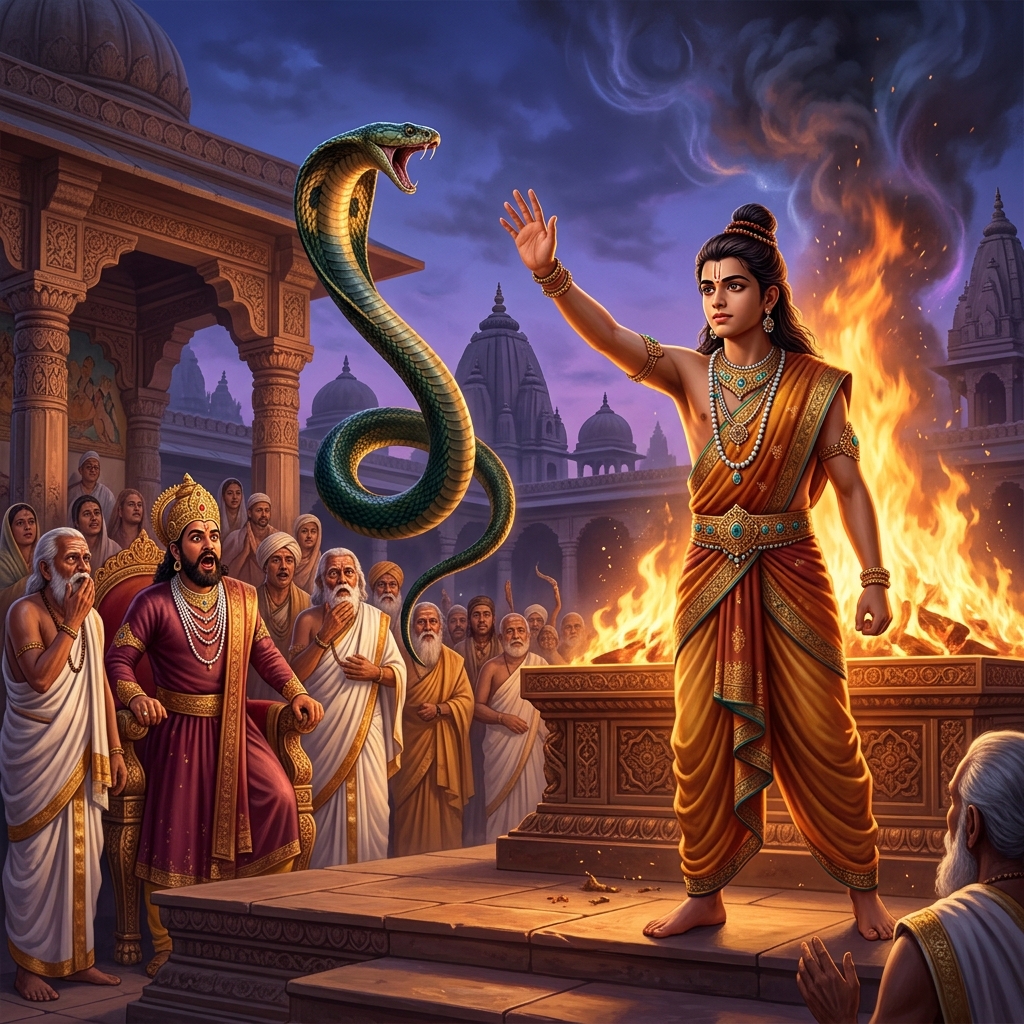
The slaughter might have ended only when every serpent born was ash, had a boy not stood outside the sacrificial ground and asked to be let in. Astika was born of a snake princess and a sage, kin to the very race being burned, and he had come to Takshashila for exactly this purpose, prepared by his mother's people to plead for a stop long before the rite ever began. Janamejaya's priests, wary of a stranger interrupting so solemn and so costly a ceremony, would not let him speak at first, but a king mid-sacrifice is bound by custom to grant a worthy guest some honor, and Janamejaya, recognizing the boy's evident learning, offered him a boon before he had even heard the request.
Astika asked only that the sacrifice stop. Janamejaya, having given his word, could not refuse outright, though his priests urged him to finish what had already claimed so many serpent lives. At that very moment, as the king wavered, Takshaka himself came hurtling down out of Indra's sky toward the fire, the pull of the rite finally strong enough to overcome even a god's shelter, and there, in the story's most remembered image, the great serpent hung suspended in mid-air over the flames, neither falling in nor released, while Janamejaya made his decision. He honored his word. The fire was extinguished, Takshaka spared, and the remaining serpents of the world left to their lives, the fuller account of that plea and its cost belongs to Astika's own story, but its ending was decided at Takshashila.
The First Telling of the Bharata
With the killing stopped and the great sacrifice's fires banked, Janamejaya kept his court gathered at the site a while longer, and it was there that Vyasa's disciple Vaishampayana came before the king and, at the sage Vyasa's own instruction, began to recite the whole vast poem his teacher had composed: the story of the king's own great-grandfathers and their cousins, the game of dice, the years of exile, and the war on Kurukshetra's field that had brought the Kuru line down to Janamejaya alone. It was, by the tradition's own reckoning, the first time the Mahabharata was spoken aloud before a human audience, a king who had just been party to a slaughter of serpents sitting to hear how his ancestors' pride and dharma alike had shaped the world he inherited. How Vyasa first shaped that telling belongs to its own account, but its first hearing happened here, at Takshashila.
The city did not stay marked only by fire and grief. In the centuries the epic's tradition remembers after Janamejaya's reign, Takshashila grew into the ancient world's great seat of learning, a university city drawing scholars from across the subcontinent and beyond to study medicine, grammar, and statecraft under its teachers. That later fame sits oddly beside the city's role in the epic, a serpent sacrifice and a king's private grief giving way, a few generations on, to lecture halls and libraries, but tradition insists on the same ground for both, as if the story that was first spoken here needed exactly this frontier city, poised between vengeance and wisdom, to be the place where it was finally told.
Dharma Lesson
Janamejaya's fury shows how grief for one death can be turned into a sacrifice that nearly destroys an entire race before a single boy's honest plea and a king's kept word restrain it. That the epic itself was first spoken at the same site, over the ashes of that near catastrophe, suggests that story and memory are what finally civilize vengeance.