The Faithful Disciple
In the hermitage of the sage Veda, the years of a long studentship had at last come to their close. Among all the pupils who had served at that fire, none had served as Utanka served. He had risen before the others to gather the kindling, he had carried the water and tended the cattle, and through every season he had borne his preceptor's burdens as if they were his own. When Veda was absent on the business of kings, it was Utanka who managed the household, who kept the sacred fires alive, and who guarded the dignity of the ashram as though his master still walked within its walls.
Veda had watched this devotion over the long years, and he was deeply pleased. There is no wealth a teacher prizes more than a disciple whose obedience springs from love rather than fear, and Utanka's obedience had always been of that rarer kind. So one morning the sage called the young man to him and spoke the words every student waits to hear.
"Utanka," he said, "your studies are complete. You have served me faithfully and learned all that I can teach. Go now, with my blessing. Become a householder, and may every good fortune attend your path."
Utanka bowed and touched his preceptor's feet, but he did not turn to leave. There was something in his heart that would not let him depart so lightly, and after a moment he raised his head and spoke. "Master, I cannot go empty-handed. Tell me what gift I may bring you, what fee I may render for all that you have given me. Command me, and I will fulfil it before I take a single step toward a home of my own."
Veda smiled, for this too was the mark of a worthy pupil. The guru-dakshina, the parting gift of the disciple, was no small matter in the ancient houses of learning. It was the seal upon a teaching, the proof that knowledge had been received with a grateful heart and not merely taken. "You are generous to ask," the sage replied. "But I am content with your service alone, and I need nothing. Go and live in peace."
The Earrings of the Queen
Utanka would not be satisfied by his master's refusal. "It is not fitting," he insisted, "that a disciple should leave without rendering some service in return. If you yourself desire nothing, then permit me to ask the lady of the house. Surely there is something I may do to please her, and so honour you both."
Veda heard the earnestness in his voice and yielded. "Very well. Go to my wife and ask her what she would have. Whatever she names, do it, and let that be your gift."
So Utanka went to the inner rooms and stood respectfully before his preceptor's wife. He told her of his master's permission and of his own wish to give a parting gift before he departed. "Mother," he said, "command me. There is nothing too difficult, nothing too distant. Only name the thing you desire, and I will fetch it for you."
The lady considered. There was indeed one thing she had long wished for, and the holy day was near upon which she would most wish to wear it. "Four days from now," she told him, "there will be a sacred observance, and I must appear among the wives of the brahmins adorned as befits the household of a great teacher. Go to King Paushya. His queen, Madayanti, possesses a pair of earrings unmatched in all the world. Beg them of her, and bring them to me, that I may wear them on that day. Do this, and good fortune will follow you all your life."
Utanka bowed low. The task was set. He would go to the court of Paushya and ask for the earrings of the queen, and he would not return without them. With his heart steadied by purpose, he took up his staff and set out upon the road, leaving the quiet hermitage behind him for the open country and the long way to the king's city.
The Bull and the Stranger on the Road
The road to King Paushya's country was long, and Utanka walked it alone with the dust of many miles upon his feet. He passed through fields and forests, fording streams and climbing low hills, his mind fixed upon his errand. But the journey he had undertaken was no ordinary one, and the powers of the unseen world had already taken notice of the disciple who walked toward danger without knowing it.
Upon the road he came at last upon an astonishing sight. There stood a bull of enormous size, vast as a mountain, and upon its back was seated a man of great and shining presence. The stranger looked down upon Utanka and spoke to him in a voice that carried the weight of command.
"Utanka," said the man, "eat the dung of this bull. Do it, and do not hesitate. Your preceptor too once ate of it. Eat, and go your way."
Utanka recoiled, for the command seemed against all custom and cleanliness. But then he remembered the words, and remembered too that obedience to a wise instruction had carried him this far. He recalled that his own master, in his time, had not refused. Trusting that there was meaning in the strangeness, he steadied himself and obeyed. He ate, and he drank the water that was offered, and then, mindful of the proprieties, he turned to continue his journey.
What Utanka did not know was that the great bull was Airavata, the celestial elephant of the gods taken in the form of a bull, and the man upon its back was Indra himself, the king of the heavens, who had taken a private liking to the disciple of his friend. What Utanka had swallowed was no ordinary thing but amrita, the nectar of immortality, given in disguise. By this hidden grace he was made proof against death, so that the perils awaiting him in the depths of the earth would not be able to destroy him. Unaware of the gift he carried within him, Utanka walked on toward the city of the king.
The Court of King Paushya
At length Utanka came to the city of King Paushya and was brought before the throne. The king received the young brahmin with the courtesy due to a man of learning, and Utanka, after the proper greetings, declared his errand plainly. "I have come, O King, as a suppliant. I seek a gift, the earrings worn by your queen, which I would carry to the wife of my preceptor as the offering of a grateful disciple."
Paushya was a generous monarch, and the request of a brahmin upon such a sacred mission was not to be denied. "The earrings belong to the queen," he said. "Go to her chamber and ask of her directly, and what she grants, take freely with my blessing."
Utanka went as he was bidden, but when he entered the inner apartments he could not at first find the queen at all. He returned to the king, troubled. "O King, I went to the chamber, yet I could not see her. The queen was not to be found."
Paushya reflected, and understanding came to him. "You must have approached while still unclean from your journey," he said. "My queen is so devoted, so pure in her conduct, that she cannot be seen by any who is impure. Purify yourself with proper care, and then go again, and she will appear before you."
Utanka took the king's words to heart. He cleansed himself according to the full rite, washing his hands and feet and rinsing his mouth, performing each act of purification with attention and reverence as the scriptures prescribed. Then, clean in body and composed in mind, he entered the chamber once more.
The Queen's Warning
This time, when Utanka entered the inner chamber, the queen Madayanti was there before him, radiant and gracious, visible now that he had made himself pure. He greeted her with respect and told her of his quest, of the wife of his preceptor and the holy day upon which she wished to be adorned, and of the king's leave to ask the gift directly of her.
The queen heard him gladly. There was no reluctance in her, for she honoured the cause for which the earrings were sought. Without hesitation she took the magnificent ornaments from her ears and placed them into the hands of the young brahmin. They were jewels such as the world had seldom seen, brilliant and beyond price, the envy of gods and demons alike.
But as she gave them, her face grew grave, and she spoke a warning that Utanka would have done well to weigh more heavily than he did. "Take them, and may they serve their good purpose. But guard them well, and do not set them down carelessly upon the road. These earrings are coveted by many. Takshaka, the king of the serpents, the lord of the nagas, desires them above all things and has long sought to seize them. Be watchful every moment of your journey, for if you give him the smallest opening, he will take them from you."
Utanka thanked the queen with a full heart and took his leave. He left the city of Paushya carrying the treasure he had been sent to win, and the earrings glittered in his keeping as he set his face toward the long road home. The first half of his errand was accomplished. He could not yet know that the harder half lay still before him, and that the warning the queen had given was no idle caution but the shadow of a real and waiting danger.
The Theft
The road back was as long as the road out, and the day grew hot as Utanka travelled. After many miles he came to a place where clean water ran, and his thirst and the dust of the way moved him to stop and refresh himself. Mindful of purity, as he had been taught, he wished to perform his ablutions and his rites before eating the small store of food he carried. But to do these things he needed his hands free.
Upon the road, a little distance off, he had noticed a strange figure: a naked mendicant, a wandering beggar who seemed to flicker at the edge of sight, now present, now gone, watching and waiting. Utanka thought little of him. He set the precious earrings down upon the ground for a moment, only a moment, while he stepped aside to take the water and begin his purifications.
It was the moment the waiting figure had hungered for. In an instant the mendicant darted forward, snatched up the earrings, and fled. Utanka cried out and gave chase, and as he ran he saw the beggar's form melt away. The disguise fell from him like a discarded cloak, and there in its place was the true shape of the thief: Takshaka, king of the serpents, vast and gleaming, his coils flashing in the light. The naga had taken the earrings, just as the queen had foretold he would, in the one careless instant Utanka had allowed.
Takshaka did not pause to gloat. He slid swiftly toward a great hole in the earth, a fissure that opened down into darkness, and into it he poured his long body and vanished. Utanka reached the edge of the hole only to see the last of the serpent's tail disappear into the depths. The earrings of the queen, the gift he had promised, the fee for his preceptor, were gone into the underworld of the nagas. And the holy day was near.
Digging into the Underworld
Utanka stood at the mouth of the hole and did not despair. He had given his word, and a disciple's word was a sacred thing. The serpent had fled into the earth; very well, he would follow into the earth. He seized a staff and began to dig, driving it down into the narrow opening, widening the way, forcing a passage where the serpent had slipped through as water slips through sand.
It was a labour beyond the strength of any ordinary man. The earth was hard and the way grew dark, and the deeper he dug the heavier the work became. Hour upon hour he toiled, sweat upon his brow, his hands torn, his arms aching, his determination unbroken. He thought of the wife of his preceptor and the holy day drawing near, and he thought of the shame of returning empty-handed, and these thoughts gave strength to his weary limbs.
Indra, watching from above, did not forget the disciple he had favoured upon the road. The king of the gods saw the young brahmin labouring against the very earth itself and was moved. He sent down his own weapon, the thunderbolt, the vajra, and bade it enter the staff in Utanka's hands. At once the work that had defied him began to yield. The blessed staff bit through the stubborn ground, the passage opened wide, and the way down into the world of the serpents lay clear before him.
Utanka set his feet upon that downward road and descended. Behind him the daylight dwindled and was lost, and around him rose the strangeness of the under-realm. He had passed out of the world of men into Nagaloka, the vast and wondrous kingdom of the serpents, a place no mortal walks and returns from unchanged. Somewhere in that endless dominion was Takshaka, and somewhere were the earrings, and Utanka went on to find them.
The Wonders of Nagaloka
The serpent world unfolded around Utanka in marvels beyond reckoning. It was an immense realm, its palaces shining, its halls vast and strange, peopled by serpents of every kind and colour, some terrible and some beautiful, coiled in numbers past counting. Utanka, a single mortal in that boundless place, did not know where among the thousands of dwellings Takshaka had hidden himself.
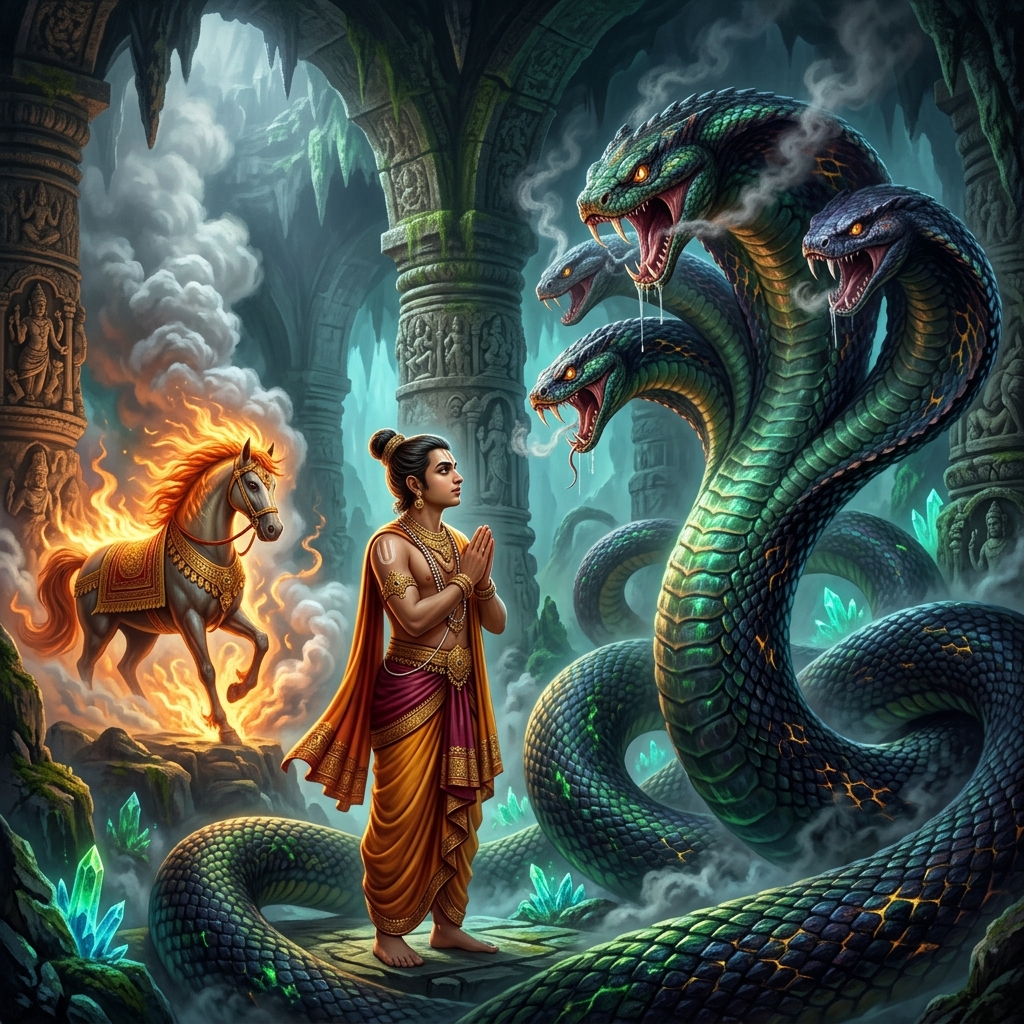
Then there appeared to him a series of wonders, signs set in his path whose meaning was deeper than they seemed. He beheld two women at a loom, weaving a great cloth upon a frame, and the threads they wove were black and white together, the one crossing the other without end. He saw a wheel turning, a mighty wheel with twelve spokes, and it was set in motion by the hands of six boys. And he saw a man of noble bearing standing beside a tall and splendid horse.
Utanka did not understand at once what he beheld, but he sensed their majesty, and his heart turned to praise. He lifted his voice and sang hymns to the serpents and to the powers before him, glorifying the great race of nagas, naming their lords, and praising the wonders that surrounded him. For the two weavers of black and white were Day and Night, weaving the unending cloth of time. The wheel of twelve spokes was the Year, with its six seasons, two to a season, turned by the boys who were the divisions of time. And the man with the horse was a power of the heavens, watching to see what the mortal would do.
Pleased with the reverence and the praise of the young brahmin, the man spoke to him kindly. "Your hymns have honoured us, and I am well disposed toward you. Ask, and I will grant you a boon. What do you most desire in this place?" Utanka answered without hesitation. "Only this: that all the serpents may come under my power, so that I may recover what is mine."
The Smoke that Filled the World
The man beside the horse looked upon Utanka and gave him his instruction. "Then blow into the body of this horse," he said, "and your wish shall be accomplished." Now this horse was no creature of the stables of men. It was a celestial being, a form of Agni, the god of fire himself, and within it lay a power that could undo the serpents' hidden kingdom.
Utanka did as he was told. He set his mouth to the horse and breathed into it with all his strength, and at once a thing of terror came to pass. From every opening of the great horse there burst forth fire and smoke. Clouds of choking black smoke rolled out in vast billows, pouring through the halls and palaces of the serpent world, filling every corridor and hollow, rising into every chamber. The flames followed, leaping and spreading, and the air of Nagaloka grew thick and dark and unbreathable.
The serpents, who had thought themselves safe in their deep dominion, were thrown into panic. The smoke stung their eyes and burned in their throats, and the fire crept toward their dwellings, and there was no part of their kingdom that the spreading terror did not reach. The whole realm seemed on the point of being consumed, and the proud nagas who had defied a single mortal now trembled before the power he had loosed among them.
Foremost among the frightened was Takshaka. The serpent king, who had stolen the earrings in a careless instant and fled into the earth so confident of his safety, now saw his entire world choking in fire and smoke because of that theft. There was no defiance left in him. Clutching the stolen earrings, he came forth from his hiding place, hurried through the smoke to where Utanka stood, and surrendered the treasure into the brahmin's hands, begging only that the burning be ended. The earrings were recovered.
The Gift Delivered in Time
Utanka held the earrings once more, but his relief was crossed at once by a new fear. The holy day was almost upon him. The wife of his preceptor had asked for the earrings to wear upon that very day, and now he stood in the depths of the serpent world with the appointed hour racing toward him. Even if he climbed back to the surface and ran without resting, the distance was too great and the time too short. He had won the treasure only to lose the purpose for which he had won it.
The celestial powers who had watched over him did not abandon him at the last. The man with the horse, seeing the brahmin's distress, offered him the swift help he needed, and the same blessed horse that had filled the serpent world with smoke now carried Utanka up out of the underworld and across the wide miles to the door of his preceptor's hermitage. By that grace he arrived at the very moment the lady had need of the ornaments, neither too early nor too late.
The wife of the preceptor had bathed and dressed for the sacred observance and was at that instant lamenting, for the earrings had not come and the hour had arrived. In her disappointment she had begun to think ill of the disciple who had promised and failed. But even as the thought formed, Utanka stood before her, travel-worn and triumphant, and placed the magnificent earrings of Queen Madayanti into her hands.
She received them with joy, and her displeasure turned at once to blessing. The disciple had kept his word against every obstacle the world above and below could set in his path. He had paid his guru-dakshina in full. Veda too was pleased beyond measure, and praised Utanka for his perseverance and his courage, and gave him every blessing a teacher can bestow. The quest was complete, the debt of the disciple discharged with honour.
The Seed of the Snake Sacrifice
The errand was finished, but something had been kindled in Utanka that would not be put out. He had completed his task, yet he had not forgotten by whom he had been wronged. Takshaka, king of the serpents, had stolen from him in a moment of trust and had dragged him through ordeal and peril for the recovery of what was already his. The memory of that injury settled into Utanka's heart and hardened there into a steady and burning enmity. He resolved that the serpent king would not go unpunished for the trouble he had caused.
Utanka knew, as the world of his time knew, that Takshaka had committed a far greater crime than the theft of a pair of earrings. It was Takshaka who had slain King Parikshit, the grandson of Arjuna, the noble monarch of the Kuru line, biting him at the appointed hour so that the king died of the serpent's venom. And Parikshit's son, Janamejaya, now sat upon the throne, ruling the kingdom his murdered father had left him, while the serpent who had killed that father lived on unpunished in his hidden realm.
So Utanka turned his steps toward the court of the Kurus and came before the young king Janamejaya. He spoke to him not as a flatterer but as a goad, with words sharpened to rouse a son's just anger. "O King, you pass your days in pleasant pursuits as though all were well, but you do not attend to the deed that cries out for an answer. The serpent Takshaka killed your father, the great Parikshit, and yet that serpent lives, unavenged and unafraid. How can a son rest while his father's murderer goes free? Rouse yourself, and do what duty and love alike demand of you."
The words struck deep. Janamejaya's grief for the father he had lost flared into resolve, and he summoned his counsellors and his priests and asked them how the wrong might be answered. They told him of a great rite, a sacrifice of fire by which all the serpents of the world might be drawn into the flames and Takshaka with them. Thus from the enmity of one wronged disciple was born the Sarpa Satra, the great Snake Sacrifice of Janamejaya, the very assembly at which, in time, the whole vast tale of the Mahabharata would come to be recited and remembered for all the ages of the world.
Dharma Lesson
True devotion to one's guru is tested not in comfort but in adversity. Utanka's relentless pursuit of the divine earrings through impossible dangers demonstrates that a sincere student will overcome any obstacle to honor the sacred bond between teacher and disciple.