The Forest Named for an Instant
West of the Gomati, where the plain is flat enough that a traveller sees the trees long before he reaches them, there stands a forest that the sages preferred above all others for long work. It is called Naimisharanya, and nobody agrees about the name.
One account says that the sages once asked Brahma where on this earth the ground was pure enough for an uninterrupted sacrifice, and that he made a wheel of his mind and set it rolling and told them to follow it and settle wherever its rim gave way. They followed it a long distance. At this place the nemi, the rim, broke and sank into the ground, and there they stopped and lit their fire and never moved again.
The other account says that a host of demons was troubling the earth here, and that they were destroyed in a nimesha, the time it takes an eye to close and open, and the forest keeps the name of that instant. Both stories say the same thing in different words. Something turned here, and the turning was quick, and after it the ground was fit to be used.
What it was used for was a sattra: a sacrificial session of twelve years, undertaken by the sage Shaunaka as head of the assembly, with the fires kept alive day and night for the whole of that time. Hundreds of sages had come and would not leave until it was finished.
A session of twelve years leaves a great deal of waiting in it. The fires must be tended and the rites performed, but between the rites there are long empty hours in the shade, and the men sitting through them were the most learned in the world and thoroughly starved of anything new. They were, in short, the best audience that has ever assembled anywhere, and they were sitting there with twelve years to spare.
The Bard from the Snake Sacrifice
Into that clearing, some way into the twelve years, came a traveller on foot: Ugrashravas, called Sauti, a bard by birth and by trade, a man whose whole profession was to go where great things were being done and to remember them exactly.
The sages saw him coming and left the fire and came around him, and he greeted them with folded hands and waited to be asked, because that is the etiquette of his craft.
"Where have you come from?" Shaunaka asked him. "You have the look of a man who has been somewhere."
"From the snake sacrifice of Janamejaya, son of Parikshit," Sauti said. "I stood in that assembly while it burned, and I have wandered the earth since, and I have visited the sacred fords, and I have walked the plain of Kurukshetra where the eighteen armies died."
At the name of Kurukshetra the whole circle went still.
"Then tell us," Shaunaka said. "There was a story recited at that sacrifice. We have heard it exists. We have never heard it. Tell it here, from the beginning, and leave nothing out. We have time."
Sauti sat down where they set a seat for him, and the sages sat down around him on the grass with the smoke of a twelve-year fire going up behind them, and he began at the beginning, which is not the war and not the dice game but the churning of an ocean and the quarrel of two sisters over the color of a horse's tail.
He did not finish quickly. He had come to a place where nobody had anywhere else to be, and he had, in his memory, the longest poem in the world. The Mahabharata, as anyone now reads it, is the record of that afternoon and of all the afternoons after it.
The Chain of Tellers
What Sauti recited in that forest was not his own. He said so at once, as a good bard does, and the epic keeps his accounting intact, so that every reader can see exactly how many hands the story has passed through before reaching them.
At the beginning of the chain stands Vyasa, who saw the whole thing happen. He was born of Satyavati before her marriage, fathered Dhritarashtra and Pandu and Vidura at his mother's asking, and then watched his own descendants destroy each other across three generations while advising them at intervals and being ignored. When it was finished, he composed it: a hundred thousand verses, made in the mountains, holding everything from the origin of the gods to the last man walking north into the snow.
Then he taught it. He had disciples, and he gave the poem to them so that it would not depend on him, and one of those disciples was Vaishampayana.
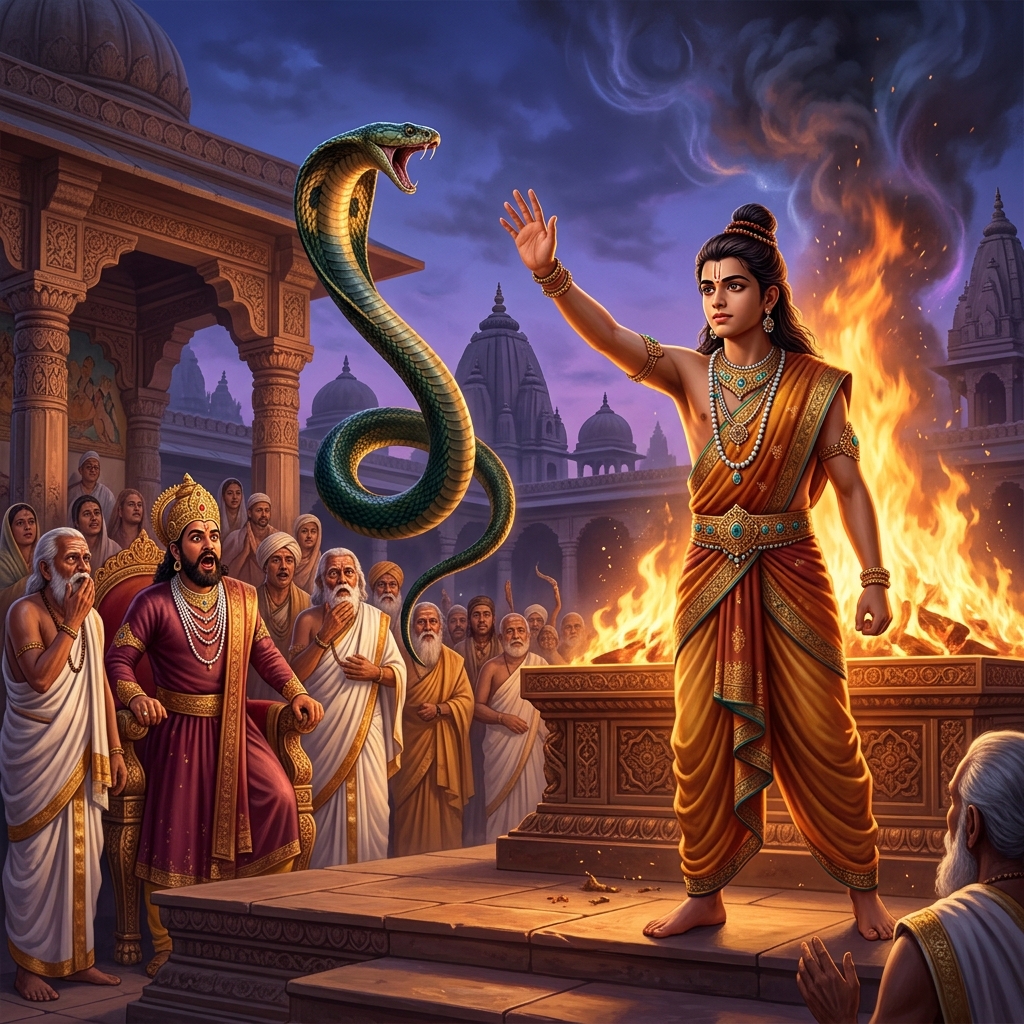
Years later, Janamejaya, great-grandson of Arjuna, sat before the fire of his snake sacrifice, having undertaken the destruction of an entire race of serpents to avenge his father's death by snakebite. Vyasa came to that assembly, as he came to every assembly that mattered, and the king asked him what had happened between his ancestors, why the cousins had fallen out and why so many had died. Vyasa turned to his disciple and said, tell him. And Vaishampayana told the whole epic to Janamejaya, in the hearing of that court, with Vyasa himself sitting there to confirm it.
Sauti was in that hall. He heard it as it was told, kept it entire, carried it out across the country on foot, and set it down again in a forest of sages twelve years into their fire. Vyasa saw it, Vaishampayana recited it, Sauti repeated it, and the sages of Naimisha listened. Every copy since has been another link on the same chain.
The Bard's Seat and Balarama's Anger
Naimisha has one other visitor whom the epic will not let anyone forget, and he came while the war itself was burning.
Balarama, elder brother of Krishna, had taught mace fighting to both Bhima and Duryodhana and refused to lift a weapon for either of them. Rather than watch, he went on pilgrimage, walking the fords along the Sarasvati for the whole duration of the eighteen days, and in the course of that walking he came to Naimisha, where the sages were seated at their session.
The assembly rose to receive him, as an assembly rises for a prince. One man did not. Romaharshana, a bard of the same profession as Sauti and in fact his father, sat on the high seat of the reciter, in the middle of telling, and did not get to his feet.
What the seat meant and what the birth meant collided in an instant. Balarama saw a man of a bard's rank keeping his seat before a kshatriya. He struck him with the tip of a blade of kusha grass, and Romaharshana died where he sat.
The forest went silent, and then the sages spoke, not in fear but in grief and reproach. He had killed a Brahmin and killed him in the middle of an unfinished twelve-year rite, and both of those were ruin. Balarama did not argue. He accepted the sin as his own and asked what could be done, and the atonement they set him was not a punishment but a repair: he undertook a vow, he destroyed the rakshasa Balvala who had been fouling their sacrifice year after year, and he gave the dead bard's son the seat, the office, the fame of his father and long life besides. Then he went back to his pilgrimage. He reached Kurukshetra in time to see the last duel and not to prevent it.
Wherever the Epic Is Told
The son who received that seat was Ugrashravas Sauti, and it is worth holding the two scenes side by side. In one, a prince kills a bard for staying seated. In the other, that bard's son sits in the same forest, on the same office, and holds the entire history of that prince's family in his mouth, and gives it to the world.
The sages of Naimisha never appear again after their questions. They have no deeds. They are described only by what they do continuously, which is to listen and to ask the next question, and it is the questions that shape the poem: they ask about the churning of the ocean and get it, they ask about the snakes and get Astika's story, they ask why the cousins quarrelled and get eighteen books. Everything the world knows about Kurukshetra survives because a group of men in a forest kept saying, and then what happened.
That is why the tradition treats Naimisha as something other than a place on a map. Its name is spoken at the start of recitations and its ground is walked by pilgrims to the Gomati still, but the older claim is larger. Wherever the epic is being told, and wherever there is somebody willing to sit and hear it to the end, that ground has become Naimisha for as long as the telling lasts. The forest is not the setting of the Mahabharata. It is the shape the Mahabharata takes when it is working.
Vyasa saw it, Vaishampayana spoke it, Sauti carried it, and the sages heard it out. Nothing in the poem is more carefully preserved than the record of that arrangement, because the poem knows exactly what it is made of: not a war, but a war remembered aloud, in a clearing, by people who did not have anywhere else to be.
Dharma Lesson
Naimisha is where the epic stops being an event and becomes a teaching, because someone sat down and someone else listened. The forest also holds the warning inside that arrangement: Balarama killed a man for not rising from a seat, and had to spend the war atoning for one instant of wounded rank. A story survives only as long as there are people willing to hear it out to the end.