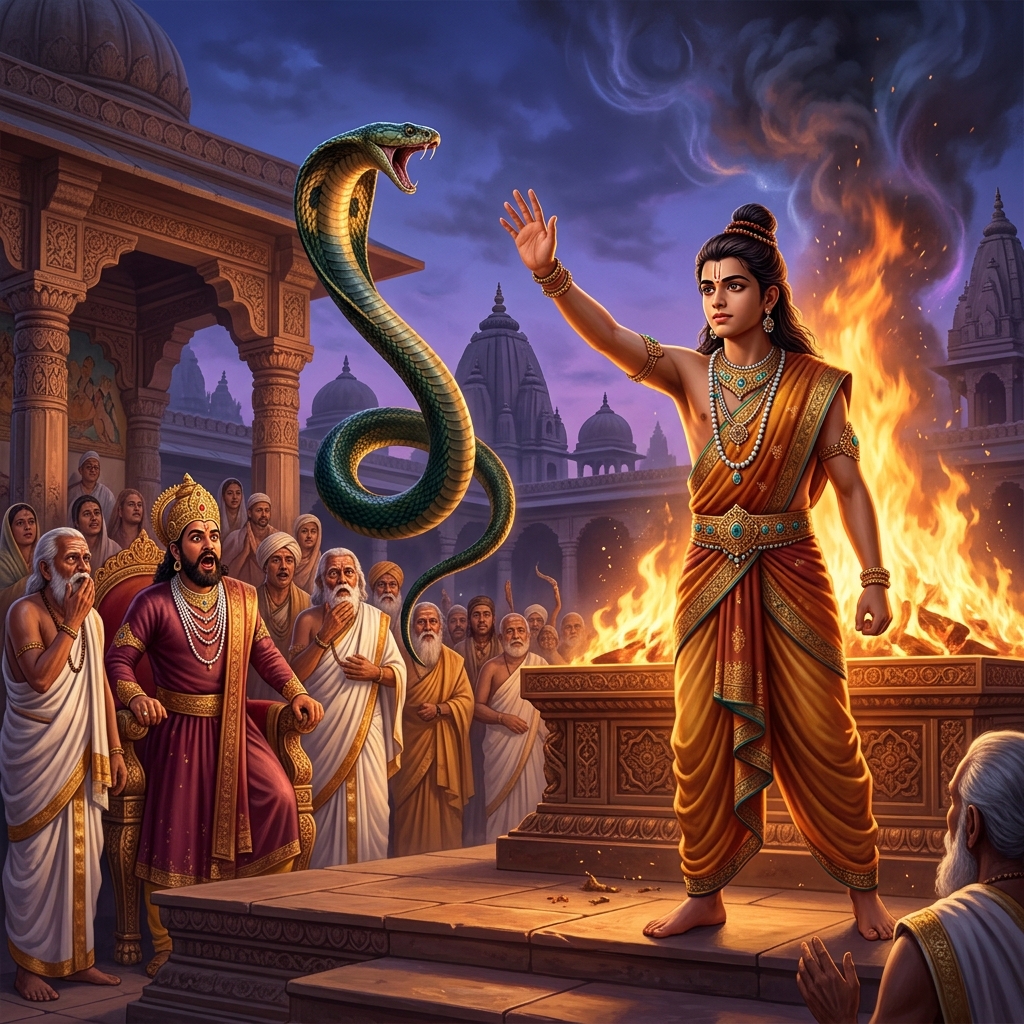
The Long Session
Janamejaya, son of Parikshit, sat at Hastinapura three generations after the war, and the war by then had become a thing his grandfathers had been in. Kurukshetra was a day's ride from his hall, and it was farmland again, and men ploughed it and found things in it and mostly did not talk about what they found.
On that plain he undertook a sacrificial session of long duration. Not a small rite that a household priest carries through in a morning, but a sattra, the kind that runs for seasons, with an encampment raised around it and priests in relays and a fire that is not permitted to go out from the first day to the last.
His three brothers were with him and served in it: Shrutasena, Ugrasena, Bhimasena, all of them young, all of them raised to think of the enclosure as the most serious place in the world.
And it is. A rite of that length is nine parts geometry. The ground is measured and marked, and once it is marked there are lines a man may cross only from the north and lines he may not cross at all. The vessels stand in an order. The grass is laid in a direction. Nothing enters that is not called in, and the whole apparatus is held together by attention, day after day, for months, until the attention becomes a raw nerve stretched over the entire field.
Into that, one afternoon, walked a puppy.
He was the son of Sarama, and Sarama is no ordinary bitch. She is the mother of dogs, the one who runs ahead of the gods and finds what is hidden, older than the kingdom, older than the ploughed field. Her sons go where they like.
This one came through the grass with his nose up and his tail moving, curious about the smell of hot ghee. He crossed a line he had no way of knowing was a line. Then he stood in the middle of the sacrificial ground, in front of four princes and a great many priests, and looked around.
What the Pup Told His Mother
The brothers were on him at once.
It was not cruelty as they would have understood the word. It was reflex, the reflex of men who have spent four months guarding a boundary and are finally given something to guard it against. They took up whatever was to hand and beat him, thoroughly enough that he did not merely run, he screamed, and the sound went out over that quiet enclosure and across the field, and he ran the whole way home with it still coming out of him.
Sarama heard her son before she saw him.
She let him get his breath. Then she asked, and her questions were not comforting ones, because she was old and knew how the world assigns blame and wanted to know exactly what she was holding.
'Why are you crying? Who struck you?'
'The king's brothers. At the sacrifice on the plain.'
'Then tell me what you did. Did you steal? Did you take anything off the ground?'
'No.'
'Did you lick the offering? Ghee spilled by an altar is a hard thing for a young dog. Did you lick it?'
'I did not lick anything.'
'Did you go close and stand over it? Did you look at it?'
'I did not even look at it,' the pup said. 'I did nothing at all. I came in and I was standing, and then they were hitting me.'
Sarama sat with that a while.
She knew her sons. A young dog that has done something has a particular way of telling you it has not, hurried and full of detail, and this was not that. This was a child reciting a list of things he had not done because he could not work out which one he was being punished for, and finding at the end of the list that there was nothing on it.
That was the moment the thing changed shape. A dog beaten off an altar is an ordinary afternoon in any kingdom that has ever existed. A dog beaten for nothing is a statement about the men who did it, and about the man they answer to.
Sarama got up and went out toward the plain.
The Curse on the Ground
She came onto the sacrificial ground herself, in the middle of the day with the fires going and the priests at their work, and she did not stop at the boundary.
The recitation faltered. It is very difficult to keep chanting while an animal that is plainly not an animal walks up a marked enclosure toward the king, and the last of the voices died out before she reached him.
Janamejaya stood up.
'This son of mine,' Sarama said, 'did not lick your butter. He did not take anything from your ground. He did not stand over your offerings and he did not look at them. He has just told me so, and he does not lie to me yet, because he is too young to have learned why anyone would.
'He did nothing, and your brothers beat him.
'Understand me, king. I am not here about a dog. If he had stolen I would have had nothing to say to you. But where there is no offence and the blow falls anyway, the blow does not stop with the one who takes it. It goes somewhere. It has to.
'So it will come back on you, and it will not come the way you expect, because you did not see this coming either. Danger will fall on you out of a clear sky, from a direction you are not watching, over a thing you have not thought about in years. That is the shape of what you have done, and that is the shape in which it returns.'
Then she turned and went back the way she had come, past the fires, past the four young men, and out through the grass, and nobody said a word until she was out of sight.
Janamejaya sat down again. The priests took up the recitation from where it had broken, because a session of long duration cannot be halted while its patron recovers himself. The fire was fed. The measured days went on being measured.
But the king was not in it any more. He sat through the remaining weeks of his own sacrifice the way a man sits through a meal after bad news at the table, present in every particular and attending to none of it.
The Hunt for a Priest
When the session was finally completed he went back to Hastinapura and began looking for a brahmin.
He was not subtle about it. He wanted a purohita of real weight, someone with enough accumulated power to stand between a king and a curse and take the impact. He sent men out, received candidates, was satisfied by none of them. A frightened king is easy to sell to, and Janamejaya was frightened, but he could tell a great ascetic from a well-spoken one.
He was hunting one day, out past the edge of the settled country, when he came on a hermitage he did not know, and in it an ascetic named Shrutashravas in the middle of a long austerity, and beside him a young man.
The young man was called Somashravas, and there was something in his face that made the king get off the horse.
'Give me your son,' Janamejaya said, when he had made his salutation. 'I want him for my priest. There is a curse standing over me and I need a man who can meet it.'
'Then you should know what he is,' said Shrutashravas. 'He was not born to a woman. He was born of a serpent that swallowed what my austerity gave up into the water. He is powerful in a way I did not arrange and do not fully understand. He can absolve any sin you can commit except a sin against Mahadeva, and he can perform any rite you can name.
'And he has one habit that will cost you. Whatever a brahmin asks of him, he gives. He does not weigh it and he does not consult you. If you can live with that, take him. If you cannot, ride on and say nothing more about it.'
'Then he is my priest,' said Janamejaya, who was a king and understood a price when he was quoted one.
He took the young man back to Hastinapura and installed him, and called his brothers together, the same three, and told them plainly: this man is to be obeyed in everything, without question and without argument. And they agreed, having learned at least that much on the plain.
Out of a Clear Sky
After that the reign was good for a long while, which is how these things usually go.
The curse did not sit on the king's shoulder. It went where such things go, into the back of the mind and then further back, and by the time Janamejaya was a settled ruler with campaigns behind him he had stopped turning around to check for it. He remembered the dog the way a man remembers a bad dream from a decade ago: an event that had certainly happened and had come to nothing.
Then a brahmin named Utanka arrived at his court, burning about a pair of earrings and a serpent king who had stolen them, and in the course of pressing his own grievance he told Janamejaya how his father Parikshit had actually died, and by whose fangs, and how long the court had let him grow up not knowing.
That was the unforeseen danger. It came not as an army or a poison but as a piece of information, from a stranger, out of a clear sky, over a thing the king had not thought about in years, exactly as she had said. What it opened was the great snake sacrifice, and the fire, and the boy Astika who closed it down with a sentence. Those are told in their own places.
And there is one more turn to it, the one worth keeping.
At that same sacrifice, in the pause after the fire was quenched, Janamejaya asked what had really happened to his ancestors, and Vaishampayana, the pupil of Vyasa who had the whole of it by heart, sat down in front of the king and began to recite. The Bharatas, the dice, the exile, the eighteen days. The entire epic was spoken aloud for the first time in a hall that a dog's curse had helped to assemble.
Sarama had promised him harm and had delivered something stranger. She had made a king who could not stop asking what he had done, and out of that asking came the only complete account anyone has of the house he was born into.
The first crack in a reign is the cruelty that costs nothing. Sometimes what comes through the crack is the truth.
Dharma Lesson
Nobody in that enclosure thought they were doing anything. Beating a stray away from the offerings was housekeeping, and it took four seconds, and it cost the men who did it nothing at all. That is exactly what made it dangerous: the first crack in a reign is almost always the cruelty that is free, done to something that cannot answer, in front of people who see no reason to object.