The Last of the Pandava Line
When the great war at Kurukshetra had ended and the Pandavas had passed at last into the mountains, the kingdom of the Bharatas came to rest upon a single pair of shoulders. Parikshit, son of Abhimanyu and grandson of Arjuna, was the sole surviving heir of the Pandava line. He had been struck even in the womb by the burning arrow of Ashwatthama, and only the grace of Krishna had drawn breath back into his still little body. For this reason men called him Vishnurata, the one given by Vishnu, and they looked upon his reign as the gift of a god.
In Hastinapura the young king grew into a ruler worthy of his ancestors. He governed with justice, protected the weak, performed the sacrifices, and honored the brahmanas. Under him the fields were heavy with grain and the cattle without count, and the people forgot, for a little while, the long sorrow of the war that had emptied the world of its heroes.
But Parikshit was, above all things, a hunter. He loved the chase as his grandfather had loved the bow, and the deep forests that bordered the Ganga drew him again and again away from his throne. It was this single passion, harmless in itself, that the wheel of fate would seize upon to bring the line of the Pandavas to the very brink of its end.
The old men of the court, who remembered everything, sometimes spoke quietly among themselves of the curse that lay upon the race of kings, of serpents and of sages, and of how no man, however blessed, walks free of the destiny his fathers wove. Parikshit did not hear them. He was young, and the morning was bright, and the deer were running in the woods.
The Silent Sage and the Dead Snake
One day Parikshit rode far into the forest in pursuit of a wounded deer. He had pierced it cleanly, yet the creature fled on, leaving a thread of blood through the undergrowth, and the king followed alone until his horse was lathered and the sun stood high. The deer he never found. Worn out, parched, and angry at his failure, he came at last upon a sage seated in deep meditation beneath the trees.
This was Shamika, a rishi of great penance, who at that hour had taken a vow of silence and sat motionless with his senses gathered inward, neither seeing nor hearing the world. Beside him stood a cow with her calf. Parikshit approached and asked, in the parched and irritable voice of a tired man, whether a wounded deer had passed that way. The sage, sunk in his vow, gave no answer. He did not so much as lift his eyes.
The king asked again, and again was met with silence, and something small and ugly rose in him that he could not master. He took the bow from his shoulder, and with its tip he lifted a dead snake that lay nearby and draped it across the shoulders of the silent sage, looping it about his neck like a garland of mockery. Still the rishi did not stir, did not curse, did not open his eyes. He bore the insult as he bore all things, in stillness.
Already, as he turned his horse for home, shame was cooling the king's anger. He had done a low thing to a holy man for no fault of the man's at all. But the deed was done, and a king cannot recall the past. He rode back to Hastinapura with a weight upon his heart that all his power could not lift.
The Curse of Shringin
Shamika had a son named Shringin, a boy of fierce penance and fiercer temper, proud of his austerities and quick to wrath. He was away when the king passed, but a companion ran to him and told him gleefully how a king had hung a dead snake about the neck of his meditating father and ridden off laughing. The blood rushed to the young brahmana's face.
"Who is this drunken king," he cried, "who insults my father as though he were no more than a leper at the road's edge? Hear me, all of you, and the deed I do this day. Because he has cast a dead serpent upon the shoulders of my sinless father, within seven nights the serpent Takshaka, king of snakes, shall burn this wretch with his venom and send him to the house of Yama." And taking water in his palm, he loosed the curse with all the heat of his gathered penance, so that it could not be undone.
When Shamika at last roused himself from his meditation and learned what his son had done, he was filled not with pride but with grief. "You have done wrong, my child," he said gently. "We dwell in this king's realm and eat the fruit of his protection. He was weary and thirsty, and he knew not my vow. It is not for us to repay a small fault with so great a doom. Forgiveness is the strength of the ascetic, not anger. Now your fire cannot be recalled."
The boy hung his head, but the word was spoken and the world was bound by it. Then Shamika, out of pity for the king, sent his disciple Gauramukha hastening to Hastinapura, that Parikshit at least might be warned, and might use the seven nights granted him to seek what protection a man can seek against the death that walks toward him.
The Tower Against Death
When Gauramukha came before the king and told him all, Parikshit did not rage and did not weep. He had known, from the moment he draped that dead snake, that he had set some dark thing in motion, and now he knew its name. He bowed his head and accepted the justice of it, for he had wronged a holy man. But a king has a duty to live, and so he summoned his ministers and his physicians and set about the defense of his single, precious life.
Upon a single great pillar they raised a tall mansion, and there the king took up his dwelling. Guards stood at every approach. Physicians skilled in poisons and in their antidotes were stationed at his side day and night, with healing herbs and powerful mantras ready in their hands. Brahmanas who knew the secret arts of countering venom surrounded him, chanting without pause. No one came up to the king without being known and searched. Neither bird nor beast nor stranger could pass the cordon of his watchmen. High above the earth, walled in by men and mantras and medicine, Parikshit conducted the affairs of his kingdom and waited.
The days slid by, one and then another. The sun rose and set over the tower, and each evening that the king lived seemed a small victory wrested from the jaws of the curse. Below, the city held its breath. Above, the king governed and prayed and counted the hours, and let himself begin, very cautiously, to hope. Six of the seven days passed in this way, and on the dawn of the seventh he was still living, still guarded, still high above the reach of any creeping thing.
But the curse of a brahmana, once loosed, is patient and sure, and Takshaka the serpent king had already set out upon the road.
The Worm in the Fruit
Takshaka, lord of serpents, knew of the tower and the guards and the chanting brahmanas, and he was wary. As he glided toward Hastinapura he met upon the road another of his kind, a learned snake named Kashyapa who was hurrying in the same direction. Takshaka, in the guise of an old brahmana, asked his errand. "I go to the king," said the snake, "for I have the power to draw out any venom and to revive any man the serpents slay. I will save him, and be richly rewarded."
Takshaka revealed himself. "It is I, Takshaka, who am sworn to kill this king by a curse no skill can undo. Turn back. You cannot save one whom fate has marked." The two contended, and to settle it Takshaka struck a great banyan tree with his fangs, and the mighty tree was burned to ash in an instant by his venom. Then the brahmana-snake, with his art, gathered the ash and restored the tree whole and green as before. Takshaka saw the man's power was real, but he was a king of guile. He offered Kashyapa wealth beyond what any reward would bring him, and asked only that he turn aside. Kashyapa, after reading in his heart that the king was indeed doomed past saving, took the gift and went home.
Now Takshaka came on alone to the city of the tower. He sent ahead certain serpents disguised as ascetics, bearing as gifts to the king kusha grass, water, and ripe fruit. The guards examined the holy-seeming visitors and found nothing amiss, and the offerings were carried up. Takshaka himself had become small, a tiny copper-colored worm, and had crept into one of the fruits, hiding within its flesh where no eye could find him.
Evening was drawing on. The seventh day was nearly spent. The king, weary of fear and half persuaded that he had outlasted the curse, took up one of the fruits the holy men had brought and said lightly to his ministers, "The sun is almost down and I feel no venom near me. Let the curse do its worst now if it can. Come, let us eat these fruits together and make merry."
The Death of the King
Parikshit broke open the ripe fruit in his hand, and there within its flesh he found a small worm, copper-dark, with black eyes that fixed upon him. The king looked at it and a strange calm fell over him, the calm of a man who has come at last to the appointed place after long running. He turned to those around him and said with a wry, fearless smile, "The sun has set. I have no more fear of poison. Let this little worm become Takshaka and bite me, that the word of the sage may be made true and no brahmana's curse fall barren."
With his own hand he lifted the worm and set it upon his neck. In that instant it swelled and grew, uncoiling into the vast and terrible form of Takshaka, lord of serpents, who wrapped himself about the king with a hiss like a wind through fire. The ministers fled crying out. Takshaka roared, and sank his fangs into the throat of Parikshit.
The venom of the serpent king was such that the mansion upon its pillar burst into flame as Takshaka rose from it and fled blazing into the sky, a streak of fire crossing the evening like a parting of the heavens. When the smoke cleared, the king lay dead. The last grandson of Arjuna, the child given back by Vishnu, the sole bearer of the Pandava line, had gone to join his fathers, slain by a worm in a fruit upon the seventh day, exactly as the angry boy had decreed.
Grief swallowed Hastinapura whole. The priests performed the rites, and the ashes of the great king were given to the river. And the throne passed to his son, a boy who would carry in his heart, all his life, the manner of his father's death and the name of the serpent who had dealt it.
Janamejaya's Vow
The boy who came to the throne of Hastinapura was Janamejaya, son of Parikshit. He grew into a strong and able king, was anointed in due season, and took a wife and ruled his people well. But the shadow of his father's death lay always upon him, and when at last he was a man grown and learned the full and bitter tale, his grief turned to a cold and burning purpose.
His ministers told him all of it: how the sage had been insulted, how the boy had cursed, how Takshaka the serpent had come in the guise of a worm, and how, worst of all, the snake Kashyapa who might have saved the king had been bribed away by Takshaka upon the very road. The more Janamejaya heard, the higher rose the fire in him. "This Takshaka," he said, "this lord of serpents, slew my blameless father by craft and corruption, and turned aside the one man who could have healed him. I will not rest while the race that bore him crawls upon the earth."
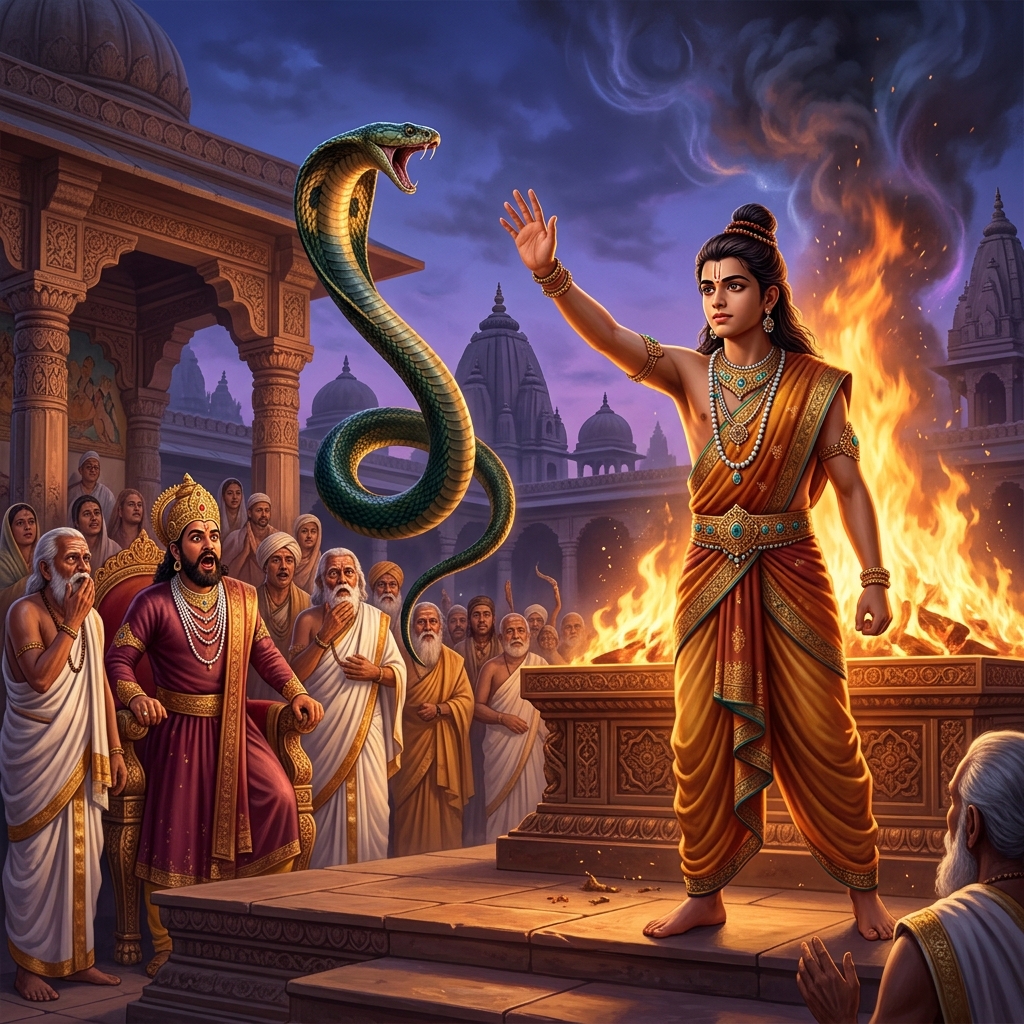
Then the king conceived a dreadful vow. He would perform the Sarpa Satra, the great snake sacrifice, a rite of which the brahmanas spoke in low voices, whose mantras were said to be able to summon every serpent that lived and draw it helplessly into the fire. By this sacrifice he would avenge his father, and not upon Takshaka alone, but upon the whole serpent kind, root and branch, until not one remained beneath the sky.
He summoned the most learned priests of the age, those who knew the secret and terrible portions of the Veda, and he commanded them to prepare the ground, to raise the altar, and to kindle the fire of the sacrifice that would, he swore, leave the world forever free of snakes.
The Burning of the Serpents
The priests measured out the sacrificial ground and built the altar according to the ancient rule. They consecrated the king and seated him within the enclosure, and they kindled the fire. Then those brahmanas, clad in black, their eyes reddened by the smoke, began to pour the offerings of clarified butter into the flames while chanting the mantras of summoning, each syllable a hook cast out into the wide world to find and seize the serpents.
And the serpents came. Drawn by a power they could not resist, snakes of every kind and size were lifted from their holes and rivers and forests, from the sky and the earth and the dark country beneath, and were hurled wailing through the air into the roaring fire. The great and the small came, the venomous and the harmless, the proud nagas with jeweled hoods and the least worm of the field, all dragged to the same blazing end. They twisted and cried out and called upon one another by name as they fell, and the fire received them all and would not be filled.
The stench of burning flesh and fat hung over the land. Streams of serpents poured into the flames hour upon hour, day upon day, until the very race seemed about to be unmade. In Nagaloka, the underworld realm of the serpents, terror reigned. The mothers among the nagas clutched their young and the elders cried out that the end foretold had come upon them, that the whole of snake-kind would be cinders before the sacrifice was done.
And Takshaka, against whom all of it was aimed, was nowhere to be seen, for he alone of the serpents had a refuge that the others did not.
The Mother Who Was Promised a Savior
Long before any of this, in the deep ages, there had lived a great sage named Jaratkaru, an ascetic so devoted to penance that he had resolved never to marry and to let his lineage end with himself. One day, wandering, he came upon certain beings hanging head downward over a dreadful pit, clinging by a single thread that a rat was steadily gnawing through. They were his own ancestors, suspended between heaven and the abyss, and the thread was the last of his line. "We fall," they told him, "because our son will take no wife and beget no son to save us. Only a child of yours can lift us from this pit."
Moved to the heart, Jaratkaru agreed to marry, but he set strange conditions: his bride must share his own name, and must be given to him freely, and he would not himself provide for her. It seemed an impossible price. But far away in the realm of serpents, Vasuki the serpent king had heard an ancient prophecy of his own. His mother had once cursed the serpents that they would burn in the sacrifice of a king named Janamejaya, and the only escape foretold was this: that Vasuki's sister, named Jaratkaru like the sage, should be wedded to the sage Jaratkaru, and that the son born of them would halt the sacrifice and save the snakes.
So Vasuki sought out the sage and offered his sister, whose name matched the sage's own, given freely, asking nothing. The conditions were met as if fate itself had arranged them, and the marriage was made. From that union was born a boy, radiant with the brilliance of the brahmana and the serpent both, and they named him Astika, which means "He Is," for his very being was the affirmation that the line would not fall and the serpents would not perish.
The child grew swiftly under the teaching of the sages, mastering the Vedas and the austerities, wise far beyond his years. And his mother, the naga princess, watched the smoke of Janamejaya's sacrifice darken the sky and knew that the hour her son was born for had come.
Astika at the Sacrifice
Vasuki the serpent king came to his sister in his anguish. "The fire devours our people," he said. "Even now I feel the mantras tugging at my own coils. The time has come for which your son was born. Send Astika to the king, that the prophecy may be fulfilled and our race delivered." And the mother turned to her son and said, "Child, you were given to me to save the serpents, and Vasuki my brother and all your kindred. Go now, and do the work for which you came into the world."
The boy bowed and set out for Hastinapura and the blazing sacrificial ground. When he came to the gate of the enclosure the guards would have turned the child away, but Astika, though young, lifted his voice and began to praise the sacrifice, and such was the beauty and depth of his words that all who heard fell silent. He hymned the great rite itself, comparing it to the sacrifices of the gods and the ancient kings; he praised the fire and the priests who tended it; he praised King Janamejaya as the equal of Indra and Yama in justice and might.
So perfect and so learned was the praise from the mouth of so young a boy that the king and the priests and all the assembly were filled with wonder and delight. Janamejaya looked upon the radiant child and his heart was won. "Though he is a boy," the king said, "he speaks like an aged sage. He has honored my sacrifice as none other has. I am moved to grant him a boon." And to the boy he said, "Ask of me whatever you wish, learned one, and it shall be yours."
The high priests grew uneasy at this and pressed the king, for the great moment of the rite was at hand. They redoubled their chanting, calling upon Takshaka by name, for the chief of serpents had until now escaped the fire by hiding, as his ancestor Parikshit's slayer, beneath the very throne of Indra in heaven, with the god's promised protection wrapped around him.
Stay! The Sacrifice Halted
The power of the mantras grew until it overmastered even the protection of Indra. The chanting priests poured the offerings and called Takshaka's name with such force that the serpent king was torn loose from his refuge. Indra himself, with his throne and all, was dragged toward the fire, for he had sheltered the doomed snake. In terror Indra cast Takshaka away to save his own seat in heaven, and the lord of serpents, abandoned, came plummeting down out of the sky toward the open mouth of the flames, his bright coils tumbling helplessly through the air.
In that very instant Janamejaya, true to his word, turned to the boy and bade him name his boon. And Astika, raising his hand, cried out with all the gathered power of his birth and his austerities, "O King, if you are pleased with me, then this is my boon: let this sacrifice come to an end. Let no more serpents fall into the fire."
The king's face fell, for this was the one thing he had not foreseen. "Ask gold," he pleaded, "ask cattle, ask whatever else your heart desires, learned boy, but not this." Yet Astika would ask nothing else, and the king was bound by the word of a king, which cannot be broken. Above the altar Takshaka hung suspended in the air, halted in his fall, frozen a hand's breadth above the flames by the power of the young sage's cry of "Stay! Stay! Stay!" - neither falling nor freed, while the assembly held its breath.
Janamejaya bowed to dharma. "Let it be as you have said. Let the sacrifice cease." The priests laid down their ladles, the chanting fell silent, and the fire, no longer fed, sank toward embers. Takshaka and the remnant of the serpents were saved, and the prophecy was fulfilled. Astika returned in joy to his mother and his uncle Vasuki, who blessed him as the deliverer of their race.
And it was here, in the long intervals of this very sacrifice, that the whole great history of the Bharatas had been recited. For while the fire burned and the serpents fell, the sage Vaishampayana, disciple of Vyasa, had sat before King Janamejaya and told him, from the beginning, the entire tale of his ancestors - of Shantanu and Bhishma, of the Pandavas and Kauravas, of the dice and the exile and the war at Kurukshetra. So the saving of the serpents and the telling of the Mahabharata are bound together forever, the one the frame and the other the story it holds.
Dharma Lesson
Compassion and wisdom can halt even the most destructive cycles of revenge. Young Astika stopped the annihilation of the serpent race not through force, but through the power of righteous speech and the courage to stand before a king consumed by vengeance.