The Epic Composed
Vyasa at Badarikashrama, Astika at the Snake Sacrifice, and the Story First Told
The Sage Who Had Seen Everything
When the great war was finished and the rivers of Kurukshetra ran clean again, and when Yudhishthira had ruled long and the Pandavas had at last walked north toward their deaths, there remained one man who had stood at the edge of all of it and watched. He was Krishna Dvaipayana, called Vyasa, the arranger, the man who had divided the one Veda into four so that the men of the failing age could hold it. He was the son of the fisher-woman Satyavati and the wandering sage Parashara, born on an island in the Yamuna, dark of skin, matted of hair, terrible and gentle at once.
He was grandfather to the whole quarrel. It was Vyasa who, at his mother's bidding, had fathered the blind Dhritarashtra, the pale Pandu, and the wise Vidura, so that the line of the Kurus would not fail. From those three sons had flowed the hundred Kauravas and the five Pandavas, the dice game, the exile, the embassy that failed, and the eighteen days of slaughter. Vyasa had moved through all of it like a shadow at the rim of the fire. He had come to Gandhari and given her a hundred sons from a single ball of flesh. He had come to Kunti in her grief and to Dhritarashtra in his blindness. He had counseled and warned and consoled, and he had been heeded by no one in the matter that mattered, and he had watched the family destroy itself exactly as he had foreseen.
Now he was old beyond counting and heavy with all that he had seen. He withdrew from the courts of men and climbed to his hermitage at Badarikashrama, high in the Himalayas where the air is thin and the Ganga is still young and loud among the rocks. There the snows came down to the door of his hut, and the only sounds were water and wind and, far off, the bells of pilgrims. He sat among the deodar trees with his disciples about him, and he turned his face inward, and he began to consider the thing he had carried for sixty years.
He meant to make a poem of it. Not a hymn, not a chronicle, but a poem so vast that nothing true could be left out of it - the whole rise and ruin of his house, and woven through it all the law that governs the rising and the ruin. He would call it the Bharata, the tale of the Bharatas, and because of its weight men would one day call it the Maha-Bharata, the great tale. He sat in the cold light off the snow and let the first verses begin to gather in him like clouds before rain.
What Is Here May Be Found Elsewhere
For three years Vyasa composed in his mind. He fasted and grew pure, and he gathered the whole of it into himself before he let a single line escape into speech. He did not invent; he remembered and arranged. He had been present at the births and the deaths. He had heard the speeches in the assembly hall and the curses spoken in the forest and the last whispered words of dying men. All of it he set in order, in the secret architecture of his thought, until the poem stood complete within him, unwritten, waiting.
It was to be a hundred thousand verses, longer than any song any people had ever made or would make. Yet length alone was not its boast. Vyasa meant the poem to contain the four aims by which a human life is measured and judged. There would be dharma in it, the law, the duty that holds the world from collapse. There would be artha, the getting and keeping of wealth and power and kingdoms. There would be kama, desire and love and the long ache of wanting. And there would be moksha, the release at the end of all wanting, the freedom that the whole long story is finally pointed toward.
He knew, sitting there in the snow-light, what he had made. And so he set into the work itself a boast that was also a promise, a single line that scholars and storytellers would repeat for as long as the poem was spoken. Whatever is here concerning dharma and artha and kama and moksha, he declared, may be found elsewhere as well. But whatever is not here is to be found nowhere. There was no human situation, no grief or temptation or hard choice, that the poem did not somewhere hold up to the light. A man could lose his kingdom in it, or his wife, or his sons, or his faith, and find his own face looking back at him out of the verses.
The poem was finished in him. It lacked only one thing. It existed nowhere but in the memory of a single old man on a mountain, and memory dies with the body that holds it. The Bharata had to be written down, set into letters that would outlast him, so that the men of later and lesser ages, who could not hold such a thing in their heads, might still receive it. Vyasa needed a scribe. And no ordinary hand would serve, for the verses, once they began to flow, would come faster than any mortal could ever set them down.
Brahma's Counsel
Vyasa sat troubled by the difficulty. He needed a writer swift enough to keep pace with a flood of inspired speech, and wise enough to understand what he wrote even as he wrote it, for a scribe who does not understand will mangle the meaning and pass on a corrupted thing. Where in the worlds was such a being to be found?
He composed his mind and called upon the Grandfather of all the worlds. And Brahma, the four-faced lord seated upon the lotus, the maker of the universe, came down to the hermitage at Badarikashrama out of regard for the sage. The snows seemed to shine the brighter for his coming. Vyasa rose and folded his hands and stood with his head bowed, and when he was bidden to speak he set a seat for the god and circled it in reverence and then took his own place near it, glad and humble at once.
"Lord," Vyasa said, "I have composed in my mind a poem that is held in high honor. In it I have set down the mystery of the Veda and much else besides. I have told of the births of the great and the deeds of the wise, of the vastness of the universe, of the law and the love and the ruin of my own house. I have woven into it the wandering of souls through their many lives, and the working of dharma in the affairs of men, and the rites and the regions and the very nature of mankind. All of it stands complete within me. But no one upon the earth, Grandfather, can write the poem down, for I will speak it faster than mortal hands can move. Grant me a writer worthy of the work."
Brahma smiled, well pleased with the sage's design and with his reverence. "For your great poem," the god said, "because of your knowledge of the truth, I name your speech the highest, and I bless the work. No poet before you has equaled you, and none shall surpass you. As for a writer fit for so great a labor, think upon Ganesha. Call to mind the lord of beginnings, the remover of obstacles, the elephant-headed son of Shiva and Parvati. He alone among the powers has the swiftness and the understanding that your work demands. Summon him to be your scribe."
And with that counsel given, Brahma rose from his seat and vanished, returning to his own region. Vyasa remained, comforted. He turned his thoughts at once to the god whom the Grandfather had named.
The Bargain of Two Conditions
Vyasa called upon Ganesha in his heart, and the god of beginnings came. He came in his strange and gentle majesty, the broad elephant head set upon the body of a man, the single great tusk, the small bright eyes that missed nothing, the rounded belly in which all the worlds are said to be contained. He came because where a great and worthy work is begun, the lord of beginnings is rightly present.
Vyasa honored him and set him a seat and offered him worship, and then he spoke his need. "Lord of obstacles, gracious one, become the writer of the Bharata which I hold composed within my mind, and which I am ready now to speak."
Ganesha considered the sage and the labor he proposed. Then he gave his answer, and there was a condition folded into it. "I will write your poem," he said, "on this understanding. My pen must not stop. If once it pauses for want of words to write, then I lay it down and the writing is finished. Dictate to me in an unbroken stream, or do not dictate at all."
It was a hard condition, for no man composing a poem of a hundred thousand verses can speak it all without ever once stopping to think. Yet Vyasa was not called the arranger for nothing. He bowed and accepted, and then, in his cleverness, he laid down a condition of his own, gentle as a snare. "So be it, lord. I will not pause. But you, for your part, must not write down any verse that you have not first wholly understood. Set nothing on the leaf until its meaning is clear to you."
Ganesha, who understood all things, smiled and agreed at once, saying only the syllable that means it shall be so. He did not see the trap inside the courtesy, or perhaps, being a god, he saw it and was pleased by it, for it made the contest worthy. They had struck their bargain. The one must never stop speaking; the other must never write what he did not yet grasp. And in the narrow space between those two conditions, Vyasa meant to find room to breathe.
The Knotted Verses
They settled to the work in a great cave at Badarikashrama, where the light fell green through the mouth of the rock and the river's voice came up from below. Ganesha sat with a heap of palm-leaves and a reed cut to a fine point, his huge head bent, his hand poised. Vyasa sat across from him, drew the poem up out of the deep place where it had waited, and began to speak.
The verses came from him in a river. He sang the line of the Kurus from its founding, the tangled births, the loves and the curses, the boys growing into the men who would destroy each other. Ganesha's pen flew across the leaves, never lifting, never slowing, the letters falling into place as fast as the words were spoken. For long stretches the two of them were a single engine of creation, the speaking and the writing braided into one motion, and the pile of finished leaves grew and grew.
But Vyasa was a man, and there came moments when the next passage was not yet shaped in him, when he needed a breath to find the right turn of a delicate scene or to weigh one phrasing against another. By the bargain he was forbidden to stop. So he used the door his own condition had cut. Every so often he would compose, in the very flow of his speech, a verse so dense and knotted that its meaning was hidden three layers deep - the kind that scholars came to call a kuta, a tangle, a riddle-verse. Such a line might use a single word in two senses at once, or fold a whole grammatical puzzle into half a line, or hide its sense behind a wall of allusion.
When one of these knots arrived, Ganesha, bound by his own promise to understand before he wrote, was forced to halt his racing pen and bend his great mind to unraveling it. And in those stolen moments, while the god sat puzzling out a tangle, Vyasa drew breath and composed ahead, laying up a store of clear verses to pour out the instant the god looked up again. It is said that in the whole vast poem there are some thousands of such knotted lines, scattered through it like stones set in a stream, each one a moment that the maker bought for himself by his wit. So the unstoppable pen was matched against the unfathomable verse, and the poem went forward, and neither broke his word.
The Broken Tusk
On and on the dictation ran, through days that the snow shortened and lengthened again, through the slow turning of the seasons outside the cave. Vyasa did not weary of speaking, and Ganesha did not weary of writing. The god's devotion to the labor was without limit. He had given his word that his pen would not stop while the words still flowed, and he held to it past every weariness of the body.
Then, at the height of the work, with the verses pouring out clear and swift and the god writing at his fullest speed to keep the bargain, the reed pen failed. It split at the point, or wore through, and in an instant it was useless. To stop and cut a new pen, to search and trim and fit it, would mean a pause; and a pause, by the dread condition, might end the whole work forever, might leave the great poem half-written and lost. The flood of Vyasa's verse was running on and could not be called back.
Ganesha did not hesitate. He reached up to his own face and laid hold of one of his great curved tusks, and he broke it off whole. The pain of it he set aside as nothing beside the work. He sharpened the broken end and dipped it and bent again to the leaves, and the writing went on without the loss of a single line. From that day the elephant-headed god has been shown with one tusk whole and one tusk broken, and men who see his image remember why - that he gave a piece of his own body rather than let the poem of the Bharatas falter.
With the tusk for a pen he wrote on, tireless, through the rest of the dictation, while Vyasa sang the dice game and the disrobing of Draupadi, the long years in the forest, the year hidden at Virata's court, the embassy that failed, and then the war itself - the falling of Bhishma upon his bed of arrows, the death of Abhimanyu within the wheel, the slaying of Karna and of Duryodhana, the night-raid that ended the camp, and at the last the bitter, hollow victory and the long going-out of the Pandavas. The tusk moved across the leaves, and the whole of it was caught and kept, a hundred thousand verses, eighteen books, the longest poem the world would ever hold.
The Five Disciples
When the last verse was spoken and the last leaf was written, the great labor came to its rest. Ganesha laid down the tusk that had served him as a pen. The poem that had lived only in one old man's memory now lay before them, complete, in a mountain of inscribed palm-leaves, a thing that could be carried out of one mind and into the world. The god of beginnings, his work honorably finished, took his leave and returned to his own region, and the cave at Badarikashrama was quiet again with only the river's sound.
But a poem written and shut in a box is no better than a poem unwritten. The Bharata had to be carried in living voices, learned and spoken and passed on, if it was to reach the assemblies of men. So Vyasa gathered his disciples about him - five of them, sons of sages, who had grown up at his feet in the hermitage and were fit to receive the trust. There was Sumantu, and Jaimini, and Paila, and Suka, who was Vyasa's own son, and Vaishampayana. To these five the sage taught the whole of his poem.
He taught it as it was sung in those days, by the ear and the tongue and the memory, line laid upon line until the whole of it was held entire in each disciple's mind. They learned the births and the curses, the four aims of life woven through the tale, the knotted verses and the clear, the eighteen books from first to last. Each of the five received the full poem and would carry it outward along a different road, so that if one line failed the others would keep the song alive. In this way the Bharata was set loose into the keeping of men.
Among the five, one was marked for a particular destiny. Vaishampayana had learned the poem most perfectly, and it would fall to him to be the first to speak the whole of it aloud before a king and a great assembly. Vyasa, looking ahead with the sight that had never failed him, knew the occasion at which it would be told - a terrible sacrifice, not yet begun, in the reign of a king not yet born when the Pandavas first drew breath, a great-grandson of Arjuna who would come to the fire-pit burning with the need to hear how his house had risen and fallen. To that occasion Vaishampayana and the poem were both, in their time, bound.
The Sacrifice of Janamejaya
Three generations after the war, the throne of the Kurus at Hastinapura was held by Janamejaya, son of Parikshit, who was son of Abhimanyu, who was son of Arjuna. Parikshit had ruled well and died strangely, bitten by the serpent Takshaka in fulfillment of a young sage's curse, struck down within a tower of glass that all his guards could not keep safe. The grief and the anger of that death passed down to his son.
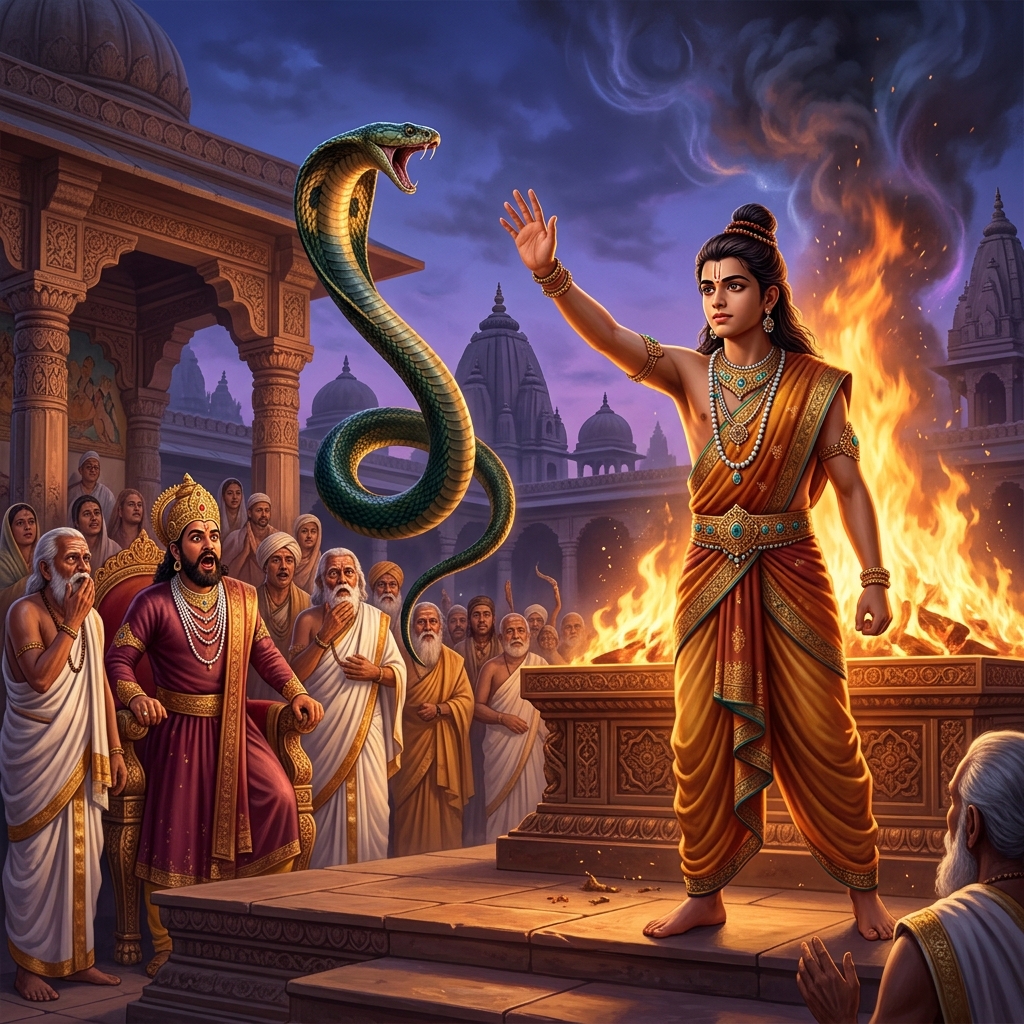
Janamejaya, grown to a king of fierce will, resolved upon a vengeance to match the wound. He decreed the Sarpa-yajna, the snake sacrifice, a rite of terrible power. A great trench of fire was dug and kindled, and the priests began the mantras that drew serpents helpless out of every corner of the world, summoning them through the air to fall into the flames. Day upon day the serpents came and burned, and it seemed the whole race of snakes would be ended and Takshaka himself dragged at last to the fire.
Into that grim assembly, where kings and sages were gathered about the burning trench, came the young Brahmin Astika, half serpent by his mother's line and sent to save his kindred. He praised the king so beautifully that Janamejaya, moved, offered him any boon he chose, and Astika at once asked that the sacrifice be stopped and the serpents spared. A king's word given cannot be unsaid, and so the fire was quenched and Takshaka, already in mid-flight toward the flames, was turned back to safety. The killing ended. But the great gathering of kings and sages did not disperse.
For there came also to that assembly, in the long days while the sacrifice ran, the sage Vyasa himself, ancient now beyond reckoning, and with him his disciple Vaishampayana. And Janamejaya, having ended one reckoning with the past, turned to another. He longed to know the whole truth of his ancestors - how the Kurus and the Pandavas had come to destroy one another, what the quarrel was and how it grew, what his great-grandfather Arjuna had done and suffered. Vyasa bade Vaishampayana speak. And there, among the cooling ashes of the snake-sacrifice, before the king and the assembled sages, Vaishampayana opened his mouth and began to recite the Mahabharata, the whole of it, from the first births to the last going-forth, exactly as his master had composed it and taught it to him.
The Bard in the Naimisha Forest
Among those who heard Vaishampayana recite the great poem at Janamejaya's sacrifice was a man who would carry it further still. He was Ugrashravas, called Sauti, the son of the bard Lomaharshana - a suta, of the storytelling caste, whose calling it was to wander among the sacrifices of kings and gather up the old tales and bear them onward. He had stood in the assembly at Hastinapura and heard the whole of the Bharata from Vaishampayana's own lips, and he had taken it into his memory and made it his own.
In his wanderings afterward, Ugrashravas came at last to the Naimisha forest, the Naimisharanya, where the air is sweet and the trees stand thick along the river, and where the sages of the world gather for their long sacrifices. There the ascetics under their elder, Shaunaka, were performing a sacrifice that would run twelve years. They saw the bard approaching and welcomed him, for they knew his kind brought stories, and they gathered round and asked him where he had been and what he had heard.
He told them. He had come, he said, from the great snake-sacrifice of King Janamejaya, where he had heard the marvelous and sacred history composed by Krishna Dvaipayana Vyasa and spoken aloud by Vaishampayana. The sages of Naimisharanya, hearing this, were filled with longing, and they begged him to tell them that very history, the whole of it, the tale of the Bharatas with all its law and all its sorrow. Ugrashravas consented gladly. He took his seat among them, and he began.
So the poem passed through another voice and into another assembly. It is in this outermost telling that the Mahabharata, as the world receives it, is framed - a bard in a forest repeating to a circle of sages what he had heard a disciple repeat to a king, what that disciple had learned from the sage who had composed it and seen it written by a god. Voice within voice within voice, like the rings of a tree around its heart, and at the center of them all the silent figure of Vyasa, who had carried it for sixty years before he ever let it be spoken.
The Fifth Veda
By these framing voices the great poem went out into the world and was not lost. From the cave at Badarikashrama where a god broke his own tusk to set it down, to the disciples who carried it in living memory, to Vaishampayana at the snake-sacrifice and Ugrashravas in the Naimisha forest, the Bharata passed from mouth to mouth and ear to ear, gathering listeners as a river gathers waters, until there was no land where men gathered to hear tales that did not somewhere know it.
Men began to call it not merely a poem but an itihasa, a thing that thus indeed happened, a history of the way the world had truly been in the days of the great kings. And more than that, in their reverence, they set it beside the most sacred things they possessed. The four Vedas Vyasa himself had once divided and arranged; and now the people said that this poem of his was a fifth among them, the fifth Veda, fit to stand with the others because it held within its long unfolding the same truths the Vedas held, but opened out into story so that every soul, even the simplest, even those forbidden the older scriptures, might enter and be taught.
For the boast of the maker had proved true. Whatever there was of dharma, of artha, of kama, of moksha, was somewhere in the poem; and what was not in the poem was nowhere to be found. A man could open it at his grief and meet Yudhishthira gambling away the world; at his rage and meet Bhima swearing his oath; at his doubt and meet Arjuna laying down his bow between the armies; at his longing for release and meet the long final road into the mountains, where one by one the great ones fell, and only a king and a dog walked on toward the gate of heaven.
And far away at the head of it all, in the high cold air of Badarikashrama, the old sage who had seen everything sat at last in silence, his work done, his house ended and yet not ended, for he had bound it into words that would outlast every kingdom. Vyasa had taken the ruin of his own blood and made of it a lamp for the whole age. What is here, he had said, may be found elsewhere. What is not here is found nowhere. The poem was loose in the world now, and it would never again be silent.
Dharma Lesson
Every story has to be heard before it is over. The Mahabharata was composed by a grandfather and recited at a king's sacrifice meant to kill his father's killer - and the sacrifice was stopped by a young Brahmin asking only to spare the small. A dog's complaint at the wrong door can be a warning of a curse you have not yet earned. Listen to the small voices first.