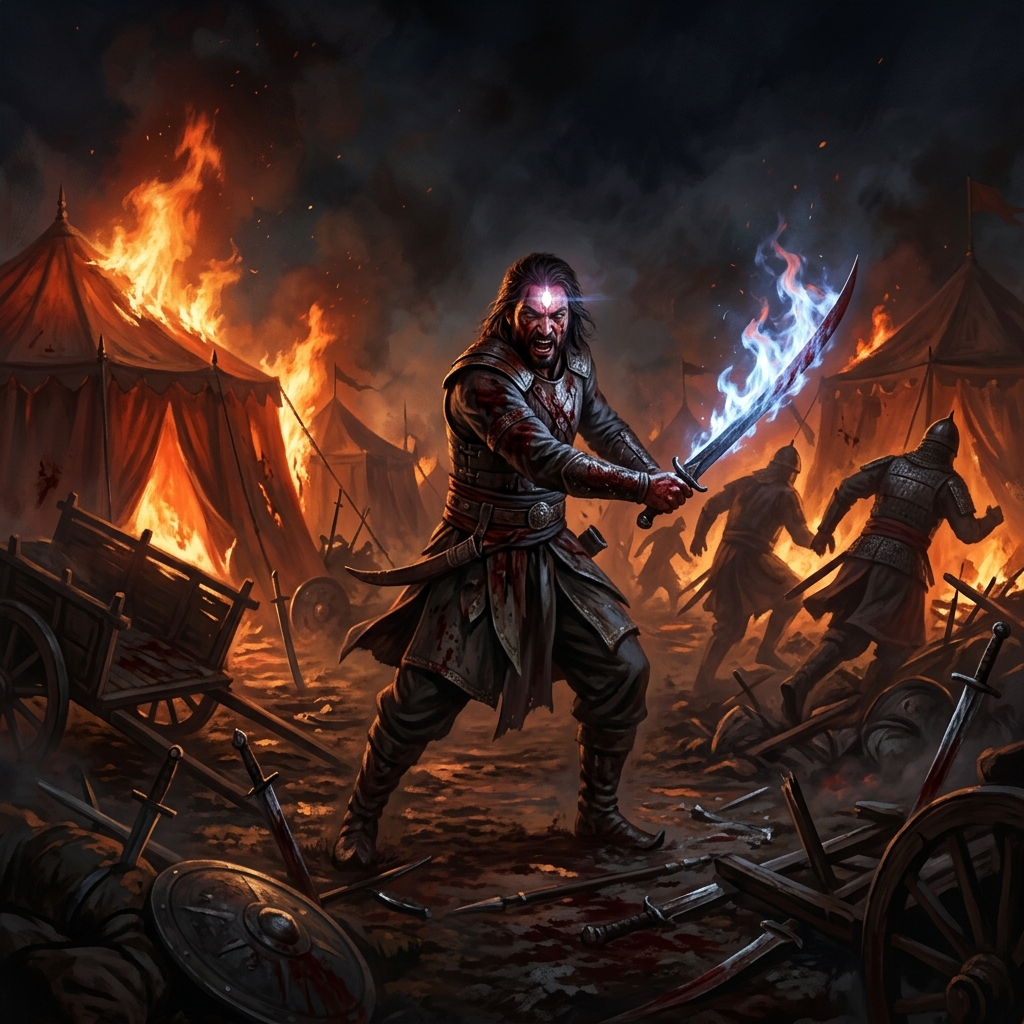
The Aftermath of War
The Night Massacre, the Women's Lament, and a Curse on Krishna
The Silence After the Eighteenth Day
When the eighteenth day ended, the war ended with it, and the silence that followed was worse than any sound the war had made. For eighteen days the plain of Kurukshetra had roared - conch and drum, the scream of horses, the crack of bowstrings, the war cries of men who would not see the next dawn. Now there was nothing. The conches were still. The drums lay split in the dust. The wind moved over a field that stretched to the horizon in every direction, and everything it touched was dead.
Eighteen armies had come to this plain. Of all the millions who had marched here, only a handful walked away. Five Pandava brothers. Krishna. Satyaki and Yuyutsu. Kripa and Kritavarma and Ashwatthama on the broken side, and these last had crept away in the night to do a final terrible thing. Of the hundred sons of Dhritarashtra, not one remained. Of the great teachers, Bhishma lay on a bed of arrows refusing to die and Drona was already ash. The earth itself seemed to have been emptied of a generation.
In Hastinapura, in the inner apartments of the palace, the old blind king Dhritarashtra sat with his hands open in his lap and waited for news he already knew. Beside him sat his queen, Gandhari, who had worn a blindfold every day of her married life so as not to see more of the world than her sightless husband could. She had borne a hundred sons. She had a knowledge in her body, the way mothers do, that they were gone, all of them, every one, the whole hundred. She did not weep yet. She was saving it.
Sanjaya came to them at last, the charioteer who by Vyasa's gift had seen the whole war from a distance and reported it day by day. His voice was hollow. "It is finished," he said. "Duryodhana has fallen. They are all fallen. There is no one left to fight." And then he could not say any more.
Dhritarashtra fell from his seat to the floor like a tree coming down. Gandhari sat very straight and still. Somewhere in the palace a single woman began to wail, and then another, and then the whole house of women took up the cry, and it rose through the corridors and out the high windows into the evening, the first of the grief that would not stop for a generation.
The Women Go Out to the Field
At dawn the gates of Hastinapura opened, and out of them came not an army but a river of women.
They came in their thousands. The wives and mothers and daughters of the dead, the queens and the servants both, the old women who had buried sons and the young brides who had been married a single season. They came without their veils, their hair unbound and streaming, their ornaments torn off and left behind, because there was no one left to be beautiful for. They came barefoot over ground they had never in their lives been permitted to walk. Behind them came the few surviving men, and Dhritarashtra led by the hand, and Gandhari in her blindfold, and Krishna, and the five Pandavas walking with their heads bowed like criminals rather than victors.
The road to Kurukshetra was long, and as they walked the women lamented, and their lament had a terrible rhythm, the names of the dead called out over and over. "Where is my son? Where is my husband? Where is my brother who went out laughing?" The dust rose around their feet. Vultures wheeled ahead of them in the sky, showing them the way to the field.
Then they came over the last rise and saw it, and the sound stopped. For a moment no one could make any sound at all.
The whole plain was bodies. Men and horses and elephants heaped together where they had fallen, swords still gripped in dead hands, banners trampled into the mud, the great war chariots broken and tilted with their drivers crushed beneath them. The carrion birds rose in clouds and settled again. Jackals slunk between the heaps. The smell came up off the field like a wall, and many of the women fell where they stood.
Then they ran. They broke and ran out onto the field, each woman searching, stumbling over the dead, turning bodies to see the faces, calling the names. A queen found her son with his armor still bright and his face untouched, looking only asleep, and she lay down beside him in the mud and would not get up. A young wife found her husband torn beyond knowing and could tell it was him only by a ring on a hand. Mothers held the heads of dead sons in their laps and combed the matted hair with their fingers as they had when the boys were small. Over the whole field the lament rose again, but broken now into ten thousand separate griefs, each woman alone with her own dead in the middle of a multitude.
Gandhari Removes the Blindfold
Gandhari stood at the edge of the field on Krishna's arm. For all the years of her marriage she had kept her eyes bound, choosing the dark so that she would share her husband's dark. But the field was full of her sons, and she meant to find them, and she meant to see them. With her own hands she lifted the blindfold from her eyes.
The light came in. The first thing she ever saw with those long blinded eyes was the slaughter of her hundred children.
She walked out among them, and one by one she found them, for the strength of the curse she would soon pronounce was already gathering in her, and by some power of grief she went to each of her sons in turn without error. She found Dushasana, who had dragged Draupadi by her hair into the gambling hall long ago, lying with his chest torn open where Bhima had drunk his blood. She found the others scattered across the field, the whole hundred, and wept at each one, and at last she came to Duryodhana.
He lay by the lake where he had fallen, his thigh shattered by Bhima's mace, the great body of the man who had been her firstborn and her favorite and the engine of the whole war. She sat down in the dust beside him and took his broken head into her lap, and for a long while she could not speak at all.
Then she lifted her face to where Krishna stood, and the grief in her hardened into something else, and she spoke, and her voice carried across the whole field so that everyone fell silent to hear her.
"Look at them, Krishna. Look at my sons. Look at the wives who are widows and the mothers who are childless. This was a kingdom. Now it is a graveyard with a throne in the middle of it. I do not say my sons were innocent. Duryodhana was proud and cruel and would not give a needle's point of earth without war. But you, Krishna, you were the friend of both houses. You could have stopped it with a word and you did not, because a larger purpose served you better than peace. You let it come. You stood over it. And so I curse you."
The Curse Upon Krishna
The whole field had gone still around her. Even the carrion birds seemed to hold their wings. Gandhari, queen of a vanished house, with the head of her dead firstborn in her lap, spoke the curse that all her grief had been distilling into.
"You let the Kuru house destroy itself, Krishna, kinsman against kinsman, until not one of my line was left to light the funeral lamps. So let it be with your own. Thirty-six years from this day, your clan, the Yadavas of Dwaraka, shall perish exactly as my sons have perished. Your kinsmen, your friends, your sons and grandsons, the whole proud strength of your people, shall turn upon one another in a drunken brawl over nothing, brother killing brother, until none of them are left alive. You shall stand in the middle of it and not be able to stop it, as you would not stop this. And you yourself, lord of the Yadavas, you who let so many die, you shall die alone. Not in battle, not gloriously. Alone in a forest, struck down by a hunter's careless arrow, far from any face you love. Your city of Dwaraka, the most beautiful city ever built, shall sink beneath the sea and leave no trace. Let no power in heaven or earth undo what a mother who has buried a hundred sons now lays upon you."
Krishna stood and let her finish. He did not argue. He did not flinch. When she was done he bowed his head to her, gravely and with respect, as a man bows to a thing he has accepted.
"So be it, mother," he said quietly. "I take your curse. It is just, and it is also already true. The Yadavas have grown insolent with prosperity and idle with peace; they were going to bring this on themselves whether you spoke or not. You have only given a date and a name to what was already coming. I will go to it when it comes, and I will not run from it."
Thirty-six years later, in the city of Dwaraka, the Yadavas would quarrel at a festival and fall to fighting, and the whole clan would slaughter itself in a single drunken evening exactly as she had said. Krishna would walk out into a forest afterward and lie down beneath a tree, and a hunter named Jara, mistaking the sole of his foot for the ear of a deer in the brush, would loose an arrow and pierce him, and he would die there alone. And the sea would rise and take Dwaraka. Every word of the curse would come true. Krishna knew it as she spoke it, and he accepted it as his own, and helped her to her feet, and led her on across the field of her sons.
Kunti Beside an Unclaimed Body
Among all the mourning women that day there was one who carried a grief no one else could see, and who had carried it for nearly her whole life. Kunti, mother of the five Pandavas, walked the field apart from the rest. She was not looking for a son she had raised. She was looking for a son she had given away.
Long ago, before her marriage, as a girl, Kunti had received a mantra from the sage Durvasa that could summon any god to give her a child. Curious and frightened, alone, she had spoken it once to test it, and the sun god Surya had appeared and could not be refused. A son was born to her, golden, with armor of light fused to his skin and earrings of the sun, and she, an unmarried girl in terror of disgrace, had set the baby in a basket and floated him down the river. A charioteer found him and raised him. The world came to know him as Karna.
Karna had grown into the greatest archer of his age and the truest friend Duryodhana ever had. For the whole of the war he had fought against the Pandavas, hating them, hated by them, the dark mirror of Arjuna. On the seventeenth day Arjuna had killed him, had loosed the fatal arrow while Karna stood helpless beside his stuck chariot wheel, on Krishna's urging, because there was no other way Arjuna could ever have won. The Pandavas had cheered the death of their greatest enemy. Not one of them knew they had killed their own eldest brother.
Kunti knew. She had known the whole time. She had gone to Karna secretly before the war and begged him to change sides, and told him the truth of his birth, and he had refused with terrible courtesy. He would not abandon Duryodhana who had loved him when no one else would, but he promised her that of her sons he would kill only Arjuna or be killed by him, so that whatever happened she would still have five sons living. He had kept the secret to his grave to spare her.
Now Kunti found his body on the field. The golden armor was gone, peeled from him by the curses that had stripped his protections at the end. He lay like any other dead man. She knelt by him in the dust where no one was watching and wept for the firstborn she had thrown away, the son she had let her other sons kill, the secret she had kept until it was too late for it to do anything but wound. Then she made a decision. The war was over. The reason for the secret was gone. Her sons would have to be told.
Kunti Reveals the Truth of Karna
When the funeral rites began, the Pandavas set about cremating the great dead with the honors due to kings. And Yudhishthira, ever scrupulous, asked who should perform the death rites for Karna, the great archer, so that no warrior of his rank should go to the next world without offerings.
Kunti came to her sons then, and she could not hold it any longer. "Karna," she said. "You ask who should give the offerings for Karna. I will tell you. His brothers should. You should. He was my son. He was born to me before any of you, born to me of the sun god Surya when I was a girl, and in my fear and my youth I set him on the river and let him go. He was your eldest brother. The man you killed yesterday, the man you have hated all your lives, was the firstborn of my body, and you must give him a son's offerings, because you are his brothers."
The Pandavas stood as if struck by lightning. Yudhishthira looked at her, and then at the place on the field where Karna's body lay, and then back at her, and the whole shape of his life rearranged itself around this one sentence. The enemy he had feared and hated for decades. The archer whose mere presence on the field had made him despair. The man Arjuna had shot down beside a stuck wheel. His brother. His eldest brother. They had killed their own eldest brother to win a kingdom of corpses.
Arjuna's face went grey. He had loosed the arrow. He, of all of them. He had killed his own brother with his own hand and cheered the doing of it.
Yudhishthira sat down heavily on the ground. "All this time," he whispered. "Mother, all this time you knew, and you said nothing. If you had told us, if Karna had known himself to be our brother and we had known him, there would have been no war. The five of us and Karna together, no power on earth could have stood against us, there would have been nothing for Duryodhana to fight over. You had only to speak, and a hundred thousand men would be alive, and our brother would be alive, and I would not have his blood on me. One word, mother. One word held back, and look at the field."
He wept then, the king of the world, in front of everyone. And in the bitterness of that hour, with the field of the dead spread out around him, Yudhishthira pronounced a curse of his own, born of pain rather than wisdom, but spoken with the force of a man who never lied. "For this," he said, "for the secret kept until it could only wound, let it be that no woman shall ever again be able to keep a secret hidden in her heart. Let women carry no concealed thing safely. Let it always come out." It was an unjust curse and he knew it even as he said it, but the grief had to go somewhere, and that is where he sent it.
Yudhishthira Wishes to Renounce the World
Something broke in Yudhishthira that day and did not mend for a long time. He had never wanted the war. He had agreed to it only when every path to peace was closed; he had offered to settle for five villages and been refused. He had believed, somewhere, that winning would make it right. Now he had won, and the winning was a field of dead kinsmen and a slain brother he had not known he had, and the throne he had fought for was a chair set in a sea of widows.
He would not be comforted. "What is a kingdom worth," he said, "that is bought at this price? I have killed teachers who taught me to walk, elders who held me as a child, cousins I played with, and now I learn I have killed my own eldest brother. The scriptures call this victory. I call it the greatest sin a man has ever committed, and I committed it for a throne. I do not want the throne. Let Bhima have it, or anyone. I am going to the forest. I will live on roots and fruit, I will harm no living thing, I will spend what is left of my life trying to wash this off my hands. A king must order more killing as long as he lives. I will not be a king. I will be a beggar and an ascetic, and maybe in time the gods will let me forget the smell of this field."
His brothers were appalled. Bhima, who had never in his life understood his eldest brother's scruples, was nearly shouting. "You would throw away everything we suffered for? Thirteen years of exile, Draupadi dragged by her hair, the insults, the war itself, all of it so that you could run off to the forest and leave the world with no king at all? That is not dharma, brother, that is despair wearing the mask of dharma. The sin, if there is sin, is not washed away by abandoning your duty. It is paid for by ruling well."
Draupadi spoke too, who had more reason than anyone to want the victory honored, having been the spark of so much of it. Arjuna spoke. Krishna spoke. Vyasa came, and Narada, and the great sages, and they reasoned with him through the long days while the pyres burned. They told him the kingdom needed a righteous king now more than ever, that to abandon it was itself a desertion, that a man does not escape his karma by running from his post, that the one who can rule well and refuses to is more guilty than the one who rules badly because he must.
And they told him there was one teacher left who could answer him better than any of them, one man still alive who could tell a grieving king how to carry the unbearable. Bhishma, the grandsire, lay on his bed of arrows on the field, waiting by his own will for the right hour to die, and he had within him the accumulated wisdom of a lifetime, and he would not take it with him until he had given it to Yudhishthira.
The Funeral Fires
The funeral rites went on for many days, for there were more dead than the living could easily burn. Yudhishthira, though his heart was set against the throne, would not let the dead go unhonored, and so he poured himself into the rites as a way of not thinking.
By his command every fallen warrior was treated as a king. The bodies were gathered from the field, friend and enemy alike, the great captains and the nameless foot soldiers, and they were washed and anointed and laid on pyres of fragrant wood with their banners and their weapons beside them. Duryodhana and his ninety-nine brothers were burned with full royal honors, by the order of the very cousins they had wronged, because death had ended the quarrel and a warrior is owed his fire. Drona was honored, and Shalya the king of Madra, and Jayadratha, and all the lords of distant lands who had come to die on this plain. Karna above all was given a son's full offerings, the rites poured out for him at last by the brothers who had not known him.
The pyres burned day and night until the whole horizon glowed, and the smoke rose so thick that it hid the sun, and the rivers that ran from Kurukshetra carried the ash of a generation down toward the sea. The women came each to their own fire and gave their husbands and sons to the flames and afterward went down to the river and offered the water that the dead would drink in the next world, calling each name as they poured.
Then, on Vyasa's counsel, a strange and merciful thing was done. The grieving were brought to the bank of the Ganga in the evening, and by the power of the great sage the dead were granted to rise once, gloriously, out of the river, in their armor and their beauty, all the enmity washed away, brothers and cousins and friends again as they had been before the dice and the war. For one night the living and the dead spoke together and forgave one another, and the women embraced husbands they had thought lost forever. And at dawn the dead went back into the river, and those among the widows who could not bear to be parted again followed them into the water and went with them. It was the only comfort the war ever gave, and it lasted a single night.
The Crowning Over a Kingdom of Ashes
When the rites were done, the procession turned back at last toward Hastinapura, and the long mournful column re-entered the city it had left in such grief. The streets were lined not with cheering crowds but with women in white, the widows of the war, who watched the conqueror ride in with eyes that held no triumph for him.
They crowned him anyway. The brahmins came with the sacred water and the white umbrella and the throne, and they seated Yudhishthira upon it, and they anointed him king of the whole Bharata land, lord of Hastinapura and Indraprastha and all the kingdoms that had bowed to Duryodhana. He let them do it because his brothers and Krishna and the sages had finally worn down his refusal, persuading him that a wound is not healed by the wounded man fleeing the field.
But there was no joy in the coronation. Yudhishthira sat on the throne like a man being sentenced. The kingdom he had won was a kingdom of ashes. The treasuries were full but the families were empty. In every house in the realm a woman waited for someone who would not come. The great were dead and the young were dead and the next generation lay unborn or newly orphaned. He ruled over widows.
His first acts as king were not the acts of a victor but of a penitent and a son. He went to Dhritarashtra, the blind old uncle who had lost all hundred of his children to this war, and he knelt before him and embraced him. "You are my father now," he said. "You will live in this palace as its king in all but name. Nothing will be done without your blessing. I rule in your house, not over it. Whatever I have taken from you, I give it back as a son gives to a father." Dhritarashtra, who had every reason to hate the man who had destroyed his line, wept and blessed him, and the two of them held each other in the empty house.
He honored Gandhari as his own mother. He gave Vidura, the wise uncle who had counseled peace to the last, the chief place in his council. He set Bhima and Arjuna and the twins to the work of governing. He confirmed Yuyutsu, the one son of Dhritarashtra who had crossed over to the Pandava side and so survived, in honor and trust. He took up the burden because there was no one else to take it, and he carried it without ever once feeling that he had won.
At the Feet of the Dying Grandsire
There remained one thing Yudhishthira had to do before he could begin to rule, and it was the thing that would finally begin to heal him. He went back out of the city, across the cremation grounds, to the field of Kurukshetra one more time, to the bed of arrows where Bhishma lay.
The grandsire was still alive. He had been pierced with so many arrows on the tenth day that his body never touched the ground, and he had the boon to choose the hour of his own death, and he had chosen to wait. He would not die while the sun was traveling south; he would hold on through the war and its aftermath and let his spirit go only when the sun turned north and the auspicious season came. So he lay there on the arrows through all the days of mourning, in pain, conscious, waiting, and waiting, it turned out, for this: to empty the whole reservoir of his wisdom into the broken king before he went.
Yudhishthira knelt in the dust by the bed of arrows. "Grandfather," he said, "I do not know how to carry what I have done. I have killed for a throne and the throne tastes of ash. Tell me how a man is to live after this. Tell me what a king is for. Tell me whether there is any dharma that can hold the weight of what happened on this field."
And Bhishma, dying, lifted his voice and began to teach.
He taught for a long time, while the seasons turned toward the day he had chosen for his death. He spoke of the duties of a king, how a ruler must protect the weak, how he must temper justice with mercy, how the throne is a trust held for the people and not a prize held for oneself. He spoke of dharma in its thousand forms, the dharma of ordinary times and the terrible dharma of times of crisis. He spoke of duty and grief and forgiveness, of fate and free will, of how a soul should meet death, of how the living should honor the dead and then go on living. He poured out the whole accumulated wisdom of his long and sorrowful life, the parables, the laws, the counsel of sages, the great teachings on duty and liberation that the world would remember long after the names of the warriors were forgotten.
And Yudhishthira listened, day after day, and slowly the wisdom did what the victory could not. It did not take the grief away. But it gave the grief a shape he could carry. When at last the sun turned north and the grandsire's chosen hour came, Bhishma gave up his life freely and went, having spent his dying breath teaching a heartbroken king how to live. Yudhishthira rose from the field and went back to Hastinapura to rule, not gladly, never gladly, but able now to stand under the weight. The war was over. The grief would never quite be. And the long, hard work of being a righteous king over a wounded world began.
Dharma Lesson
The end of a war is not victory but accounting. Ashwatthama avenged his father with the most dishonorable killing in the epic and was cursed to live forever with the cost of it. Gandhari's grief had power enough to seal the doom of an entire clan. And a crown won by such killing is not joy but a chair where a man weeps in private. Yudhishthira inherited the world and could not bear to be seen wearing it.