The Bhoja Chief's First Compromise
Kritavarma ruled among the Bhojas, a lineage bound by marriage and old alliance to the Vrishnis of Dwaraka, and for most of his life his loyalty to that wider Yadava family looked like nothing but virtue. He was capable, respected, the kind of chief other chiefs called on when a matter needed a steady hand rather than a brilliant one. It was exactly that reputation for steadiness that made his first compromise so easy to justify, even to himself.
When Shatadhanva, driven by greed and old resentment, conspired against Satrajit over the Syamantaka jewel and struck him down in secret, Kritavarma lent his support to the plot rather than standing against it, a debt of clan loyalty called in by men he did not want to refuse. The killing and its unraveling belong to their own telling. What matters here is what it cost him going forward: Satrajit's daughter was married to Satyaki's kin, and Satyaki, who forgot slights the way stone forgets rain, never again looked at Kritavarma without that memory standing behind his eyes.
It was a small thing, as these things go. No war came of it. Kritavarma kept his rank, his following, his place at the councils of Dwaraka, and if the Vrishni elders ever weighed his part in Satrajit's death against him, they did it quietly and let the matter rest. He told himself, as men in his position generally do, that he had chosen the side of kinship over the side of a stranger's justice, and that this was simply what loyalty to one's own required.
But a grudge, once seeded, keeps its own season. Satyaki's memory of that old conspiracy would not stay buried at the bottom of a peaceful life, and decades later, on a different shore, it would come back up through the ground at exactly the worst possible hour.
The Army Krishna Gave Away
When the great war between the cousins of Hastinapura could no longer be avoided, both sides came to Dwaraka seeking Krishna's strength, and Krishna, true to the strange fairness he brought to everything, offered a single choice to each: himself alone and unarmed, or command of the Narayani Sena, his hundred million cowherd soldiers trained and blooded in generations of border wars. Arjuna, asked first, chose Krishna himself and wanted nothing else. Duryodhana, delighted at what looked like the better bargain, took the army.
The command of that surrendered force fell to Kritavarma. It was, on its surface, an honor, leadership of one of the finest fighting bodies in the world, entrusted to a chief who had never given anyone reason to doubt his competence. He accepted it the way he had accepted every post offered to him across a long career, as a duty owed to whoever held the right to ask it of him, and did not spend long weighing what it actually meant.
What it meant became clear only once the marching began. He was leading Yadava soldiers, Krishna's own kinsmen and cowherds, against the very man Krishna himself had chosen to stand beside. Satyaki, who had refused the army entirely and come to the Pandavas as himself, watched Kritavarma's banner take its place among the Kaurava ranks and needed no old grudge to find something to despise in it. Kritavarma marched anyway. The order had been given, the post accepted, and turning back now would mean admitting that the choice had been wrong from the first day, a thing his pride would not easily allow him to say.
Eighteen Correct Days
Whatever else can be said of Kritavarma at Kurukshetra, no one could say he fought poorly or dishonestly. Day after day he led the Narayani soldiers with the same steadiness that had built his reputation across a lifetime, holding formations, answering charges, doing everything a commander owes the men who trust him with their lives. He did not seek out atrocity. He fought Pandava warriors as an enemy fights an enemy, by the old rules that both sides still mostly honored in those first weeks, and if his conscience troubled him over which banner he rode under, he kept it to himself and did his duty regardless.
His men respected him for it. His flank held when other Kaurava divisions buckled and broke, and more than once his steadiness bought time for a retreating commander to reform his lines rather than be run down in the open. It would have been easy, watching him through those eighteen days, to mistake him for simply another loyal soldier caught on what turned out to be the losing side of a war he had not started. That was, in fact, exactly how he saw himself. He was not Duryodhana, scheming for a throne. He was not Shakuni, delighting in ruin for its own sake. He was a chief who had accepted a command and carried it out with the discipline his whole life had trained into him, and by every ordinary measure of a soldier's honor, that discipline should have been enough.
But the war was ending in ways no rule had prepared anyone for, and the standard by which Kritavarma judged himself was about to be tested by a night that had no rules left in it at all.
The Gate at Night
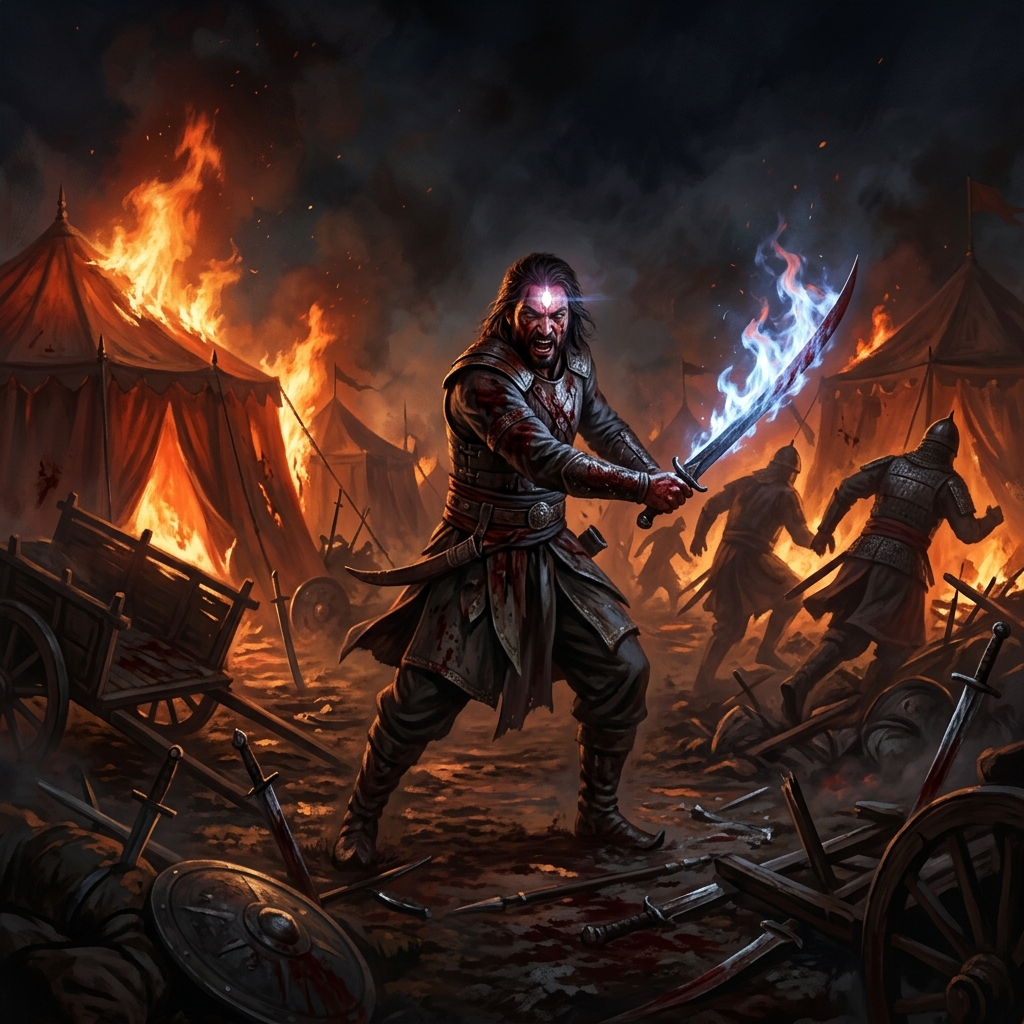
On the night after the eighteenth day, with the Kaurava army destroyed and only three men left of any consequence on that side of the field, Ashwatthama went into the sleeping Pandava camp to take a revenge no rule of war could have sanctioned, and Kritavarma stood with him. Kripa stood there too. Between them the two flanked the gate while Ashwatthama's blade did what it did to the men, and the boys, asleep inside; the massacre itself, and the ruin it left the next morning, belong to their own dark telling.
Kritavarma's part was smaller than Ashwatthama's and larger than nothing. He held a torch. He guarded the camp's exits so that no one fleeing the slaughter inside could escape it, cutting down whoever broke through the gate he had been set to hold. It was, in its way, the same steadiness he had shown for eighteen days on the open field, an order accepted and carried out without argument. The difference was that this time the order was murder, and the men dying at that gate were not armed soldiers meeting him in fair combat but boys and elders running from a slaughter they had not woken in time to fight.
He did not draw the line there that he had somehow drawn at every smaller compromise before it, the conspiracy against Satrajit, the acceptance of a command he half regretted, eighteen days of obedience to a losing cause. Each step had been defensible on its own terms, a debt of kinship, a duty of rank, a soldier's discipline. Stacked one on the other, they had walked him to a gate in the dark with a torch in his hand, and by the time the sun rose on what Ashwatthama had done inside, there was no longer a meaningful difference between Kritavarma's obedience and the atrocity it had guarded.
Prabhasa
Kritavarma survived the war that killed almost everyone else who mattered to it, and for years afterward he lived the ordinary prosperous life of a respected Yadava chief, welcomed back into the councils of Dwaraka as though the gate at Kurukshetra belonged to a different man entirely. No formal reckoning ever came for what he had done there. If Krishna judged him for it, he never said so where the histories recorded it, and Kritavarma himself seems never to have offered the kind of accounting that might have set the matter right.
It was Satyaki who kept the accounting, both grudges layered one on the other, the old one over Satrajit and the newer, heavier one over the massacre at the gate. Decades later, at a festival on the shore near Prabhasa, with wine loosening the discipline that had held the Yadava clans together through everything else, Satyaki said aloud what he had carried silently for years, naming what Kritavarma had done to sleeping men as the act of a coward rather than a soldier. Kritavarma's angry defense, and the killing that followed it, belong to the telling of that terrible afternoon, the mace-fight that ended the Yadava race in a single day.
Kritavarma's story is not the story of a villain who chose ruin with open eyes. It is the story of a capable, respected man who never once, at any single step, made a choice that looked to him like a betrayal of who he was. A debt of clan loyalty. A command dutifully accepted. Eighteen days of honest soldiering. A gate held under orders. Each step defensible, and the sum of them a massacre. Honor does not usually collapse all at once. It erodes by inches, one reasonable compromise at a time, until the man holding the torch can no longer say where his obedience ended and the atrocity began.
Dharma Lesson
Kritavarma never chose ruin outright; he accepted one reasonable duty after another, a debt of kinship, a command of rank, eighteen days of correct soldiering, until duty led him to a gate he should have refused to hold. His story warns that honor is not lost in a single dramatic fall but eroded step by defensible step, and that a man must sometimes weigh not just whether an order is his to obey, but what it has already cost him to keep obeying.