Three Survivors in the Dusk
The eighteenth day of the war at Kurukshetra had ended. The plain that had drunk an ocean of blood now lay silent under a bruised and reddening sky, and the great Kaurava host - eleven divisions strong when the war began - had been ground to nothing. Bhima had at last shattered Duryodhana's thighs in the mace-duel, breaking the law of fair combat to break the man, and the king of the Kurus lay broken on the bank of a lake, waiting for death.
Of all the warriors who had marched out under Duryodhana's banner, only three still drew breath. Ashwatthama, the son of Drona. Kripa, the old teacher who had taught both Pandavas and Kauravas in their boyhood. And Kritavarma of the Vrishni clan. They had fled the field as the last divisions collapsed, and now they wandered, dazed and hollow-eyed, away from the carnage.
None of them spoke much. There was nothing left to say. The cause they had served was a corpse, their friends were ash and carrion, and the great teachers under whom they had studied the science of arms were all slain. They turned their horses toward the lake where they had heard Duryodhana had fallen, drawn by a need to look once more upon the face of the king for whom everything had been lost.
Ashwatthama rode a little ahead, his jaw clenched, his eyes fixed on nothing. Within his chest a fire had been kindled that the dousing waters of grief only fed. He was thinking, as he had thought since that black afternoon, of his father.
Beside the Broken King
They found Duryodhana where the rumours had placed him, lying on the bare earth, his thighs crushed, his royal robes fouled with dust and blood. Beasts of prey already prowled at the edges of the dark, and he could not rise to drive them off. Yet his eyes, when he heard the hoofbeats, turned and found his three companions, and something that was almost relief crossed his ruined face.
Ashwatthama dismounted and knelt beside him. The sight of the mightiest of the Kurus laid low like a felled tree broke something in him. "O king," he said, and his voice shook, "the army is destroyed. Your brothers are slain. Of all your friends only we three remain, and we are here. That you should lie like this, you who walked the earth as its lord - this the Pandavas have done by fraud and by nothing else. Not one of the elders fell to honest war. My father they killed with a lie. Bhishma they felled from behind a eunuch's screen. Karna they shot while his wheel was sunk in the mud. Yourself they struck below the navel against all law."
He drew breath, and what came next came not as a plan but as a vow torn out of him. "Give me leave, O king. By the truth of all my austerities, by my reverence for my father, this night I shall send the Panchalas and the sons of Pandu to the house of Yama. Grant me only your sanction."
Duryodhana's lips moved. With his last strength he had a vessel of water brought, and there, lying in the dust, he consecrated Ashwatthama as the commander of what remained of his army - a commander of two men and a vow. "Go," the dying king breathed. "Let it be as you have said." Then his head sank back, and the three living men rose and left him to the night.
The Owl Among the Crows
They rode through dvaitavana darkness until weariness forced a halt, and they tethered their horses beneath a great spreading banyan and lay down beneath its branches. Kripa and Kritavarma, spent past all endurance, fell at once into the heavy sleep of the exhausted. But Ashwatthama could not sleep. He lay on his back, his eyes open to the canopy, his mind a furnace.
The banyan above him was full of crows, hundreds of them, roosting wing to wing in perfect peace, trusting the night. And as Ashwatthama watched, a great owl came gliding out of the dark - broad of wing, fierce of eye, silent as a falling leaf. It settled among the sleeping crows, and then it began to kill. It tore their throats, it broke their wings, it scattered their severed heads and limbs about the branches, and the crows that had trusted the dark died in their sleep without ever knowing what had come for them. When the owl had finished, the banyan was a charnel-house of feathers, and the killer sat content among the slain.
Ashwatthama sat up slowly. He understood that the owl had taught him. "An open assault upon the Pandavas cannot succeed," he reasoned. "They are too many, too mighty, and Krishna stands behind them. But that bird has shown me the way of the strong against the many. I will fall upon them by night, as the owl fell upon the crows - while they sleep, secure and unguarded in their pride of victory. There is no other path left to me, and I will take it though it damn me forever."
The Argument Under the Tree
He woke his two companions and laid his resolve before them. Kripa, who had lived long and seen much, was appalled. "Son of Drona," he said gently, "grief has darkened your judgement. To slay sleeping men, men who have laid down their weapons, men who trust the truce of night - this is a deed from which even the lowest of the low would shrink. There is no station in the next world for the man who does it. Rest tonight. In the morning, with Dhritarashtra and Gandhari and Vidura to counsel us, we shall decide what is right."
"You speak well, uncle," Ashwatthama answered, and there was iron in him now and no more weeping, "but you speak to a man who is already in hell. They killed my father by a lie. They have killed every law of war between us. When Bhishma fell, when Drona fell, when Karna fell, when the king himself fell - in every case the Pandavas threw away dharma to win. The treaty of fair fighting they tore up long ago. I am released from it. I have weighed my soul against my purpose, and I have chosen my purpose. Go with me or stay, but I am going."
Kripa argued on, and Kritavarma with him, but it was like reasoning with a flood. At last, seeing they could not turn him, and bound to him by the long fellowship of arms and by their own grief, the two warriors yoked their chariots and rode out behind him into the dark, toward the camp of the sleeping Pandavas. The deed would be Ashwatthama's; the gate, they agreed, would be theirs.
The Guardian at the Gate
The fortune of the Pandavas held even in their absence, for that very night the five brothers and Krishna and Satyaki were not in their own camp. They had withdrawn elsewhere, and so the tents that Ashwatthama meant to drown in blood held the army, the allies, the children, but not the five he most wished to kill. He did not know this as he rode up to the camp gate in the dead of night.
At the gate he found something barring his way that was not of the world of men. A being of monstrous size and terrible aspect stood there, tall as a tower, blazing like the sun and the moon together, clad in a tiger's skin streaming with blood, a serpent for his sacred thread, his thousand eyes and thousand mouths and thousand arms each grasping a weapon. From his very form there poured beings of fire. Ashwatthama, undaunted, loosed weapon after weapon at the apparition - blazing shafts, fierce darts, a rain of celestial arms. The guardian swallowed them all as the ocean swallows rivers, and was not moved. Every weapon Ashwatthama spent vanished into that vast and patient form.
At last, weaponless and trembling, the son of Drona understood that no force he commanded could pass this sentinel. Remembering the teaching of his elders, he saw that against a power so far beyond him only surrender could avail. He cast away his bow. He flung himself face-down upon the earth before the dreadful figure, and he understood at last whom he faced: this was Mahadeva, Shiva himself, the lord of destruction, standing between him and his desire.
The God's Sanction
Lying prostrate in the dust, Ashwatthama poured out his soul to the great god. He praised Shiva by his many names - the lord of ghosts and goblins, the blue-throated, the three-eyed, the destroyer of Tripura, the wielder of the trident, the source and the ending of all things. "To you, O lord of the universe, I offer myself as the oblation," he prayed. "I have no other refuge. Accept this self of mine, since I cannot accomplish my purpose without you." And in his desperation he raised a fire, and offered his own body into it as the final sacrifice, climbing into the flames with folded hands and a still heart.
The god was pleased, or perhaps the hour of doom had simply come round for the Panchalas as the wheel of time decreed. Shiva appeared before Ashwatthama and spoke. "Krishna has honoured me, and so I protected the Panchalas, and so long as I willed it none could harm them. But their span is run; the time of their destruction has arrived. I will withdraw my protection." And the great god gave to Ashwatthama a sword that blazed, and entered into his body, filling him with a portion of his own destroying energy.
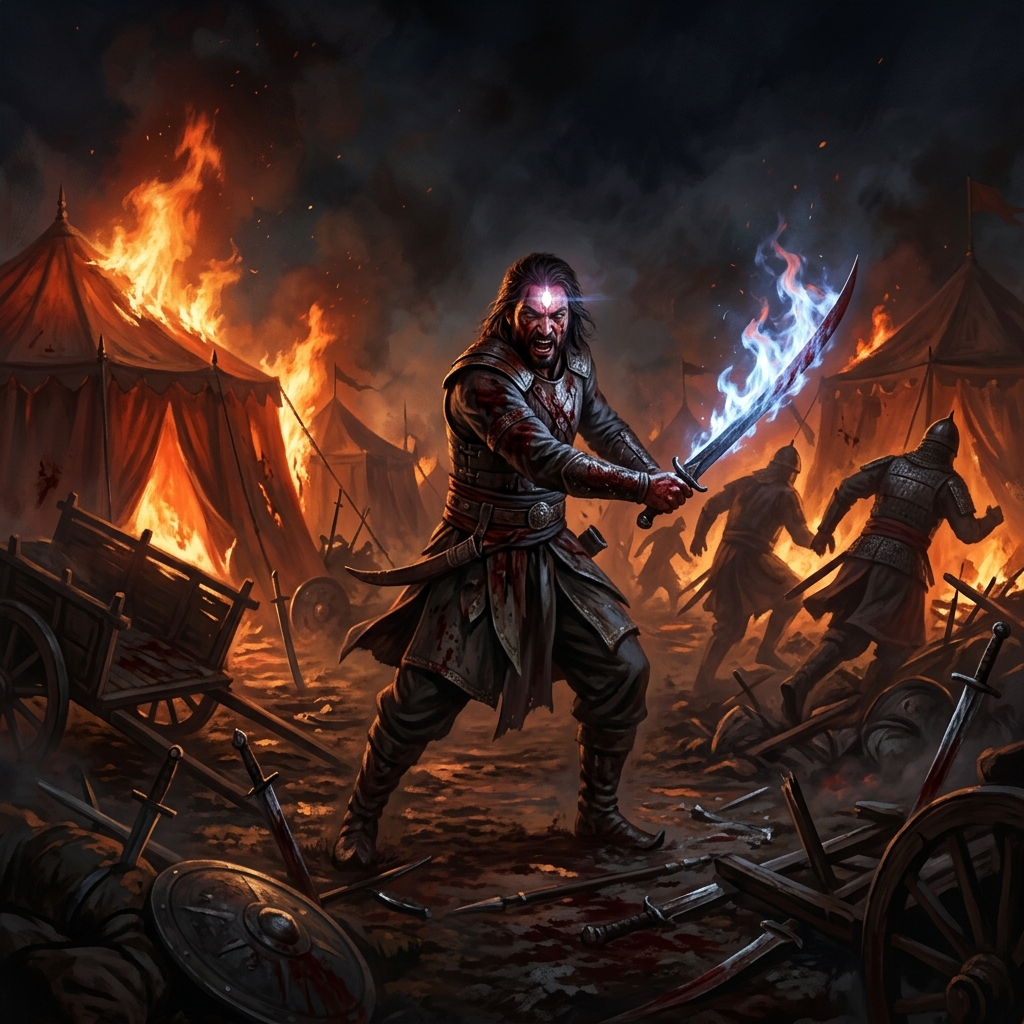
When Ashwatthama rose, he was no longer wholly himself. A god of death looked out through his eyes. Strength beyond mortal strength flowed in his arms, and the dreadful sentinel at the gate had vanished as though it had never been. The way into the camp lay open. He turned to Kripa and Kritavarma and bade them stand at the gate and let no man out alive; then, alone, the son of Drona walked into the sleeping camp with the sword of Shiva in his hand.
The Death of Dhrishtadyumna
He went first, by intent and by instinct, to the quarters of Dhrishtadyumna, the prince of Panchala who had cut off his father's head while Drona sat unarmed in the posture of meditation. The prince lay asleep on a costly bed strewn with fragrant flowers. Ashwatthama woke him with a kick, and as Dhrishtadyumna's eyes opened he seized him by the hair and pinned him to the earth with knee and hand, throttling him.
Dhrishtadyumna, half-strangled, gasped out a last request. "Son of my teacher, slay me with a weapon, that I may attain the regions reserved for the brave. Do not kill me like a beast. Let me die holding a sword."
"There are no holy regions for the slayer of his preceptor," Ashwatthama answered, his voice not his own. "You who murdered your own teacher do not deserve to die by the sword." And he beat the life out of the prince with his hands and feet as a beast is killed, and the man who had been promised by prophecy to be the death of Drona died in the dark without his weapons, even as Drona had. Dhrishtadyumna's guards and the women who attended him woke screaming, but Ashwatthama was already a shadow moving on, and where he passed, men died.
The Sons of Draupadi
The camp was waking now into confusion and terror. In the dark, men stumbled from their tents only half-armed, and Ashwatthama moved among them with the sword of Shiva, cutting them down faster than the eye could follow. He came upon the five sons of Draupadi - the Upapandavas, the children she had borne to the five brothers, young warriors all - roused by the uproar and reaching for their bows. Believing in the gloom that these were the five Pandavas themselves, or perhaps caring only that they were of the hated line, he fell upon them.
Prativindhya he struck, and Sutasoma, and Shrutakarma, and Shatanika, and Shrutasena. They fought, they loosed what arrows they could, but the strength in him was the strength of the destroyer, and one by one he overcame them and sent their souls into the night. So perished the children of Draupadi, in a single hour, mistaken in the dark for greater men, slain in the camp where they had thought themselves safe behind a victory already won.
Shikhandi too he found - Shikhandi, born to be the instrument of Bhishma's fall - and clove him in two from crown to groin. The aged Virata, the king of the Matsyas in whose city the Pandavas had hidden, and Drupada's surviving kin, and warrior after warrior of the Panchalas and the Srinjayas and the Matsyas, all met the sword that night. Some he killed with the blade, some he trampled, some he flung into the fires that now rose. The shrieks of men and beasts and elephants filled the camp, and through it all walked the son of Drona, tireless, terrible, his work the work of Yama himself.
Fire at the Gates
The few who kept their wits fled toward the gates, hoping the open country would save them. There, in the red light of the burning tents, they ran straight onto the swords of Kripa and Kritavarma. The two warriors had set the camp afire at three points, and now they stood at the only ways out and cut down every fugitive who reached them. No one passed. Men who escaped the sword within died on the spears at the gate, and the wounded who crawled out were thrown back into the flames.
All the long night the slaughter went on. The camp that had held the flower of the Pandava host, that had echoed at sunset with the songs of victory and the laughter of men who believed the war was won, became one vast pyre. By the cold hour before dawn it was finished. Thousands lay dead. The army of the Panchalas was no more; the sons of Draupadi were no more; the great captains of the victorious side, who had outlived eighteen days of open war, were destroyed in a single night of treachery.
When at last the killing was done and the silence came, Ashwatthama stood among the dead, drenched in blood, the borrowed god draining out of him, and felt the first stirrings of what he had become. The three survivors mounted their chariots and rode hard for the lake where Duryodhana lay. They found the king barely living, and Ashwatthama told him all - the death of Dhrishtadyumna, of Shikhandi, of the five sons of Draupadi, of the whole host. A flicker of fierce joy crossed the dying king's face. "What neither Bhishma nor Drona nor Karna could do, you have done," he whispered. "Now I die content." And Duryodhana's spirit left him.
The Pandavas Return to Ashes
When the sun rose, the survivors of the catastrophe carried word to the Pandavas. The faithful charioteer of Dhrishtadyumna, having escaped, came weeping to Yudhishthira and told what had been done in the night - how the camp had been butchered in its sleep, how the children were dead, how Panchala was extinguished.
Yudhishthira fell to the ground as though struck by lightning. The brothers gathered him up, but grief had unmanned them all. They rode back to the camp they had left, and the sight that met them was beyond bearing: their kinsmen, their allies, their friends, lying in heaps and ash, and among them the five young bodies of Draupadi's sons. They had won the war and lost everything for which a war is fought.
Draupadi was sent for. When she came and saw her five sons laid out in death, and her father's line cut off, she fell senseless to the earth, and when she woke she did not weep so much as burn. She sat down before Yudhishthira and declared that she would fast to death unless the slayer of her children was made to pay - and unless they brought her, as proof, the celestial gem that had been set in Ashwatthama's forehead at his birth, the jewel that guarded him from fear and hunger and the weapons of gods. "Bring me that gem," she said, "set upon the head of your brother as a sign that justice is done, or I will die here." Bhima, who needed no urging, seized his mace and his chariot and set out at once to hunt the son of Drona down.
The Duel of Brahmastras
Bhima found his trail and gave chase, and Arjuna and Krishna followed swiftly behind, for they feared what a cornered Ashwatthama might do. They came upon him at last on the bank of the Ganga, near the hermitage of Vyasa, sitting among ascetics, his body smeared with dust, clad in bark. When he saw Bhima bearing down and the chariot of Krishna and Arjuna behind, terror took him, and he reached for the last and most terrible thing he had.
He took up a blade of grass, and into it he infused the Brahmashira, the weapon of the supreme being, the astra that ends worlds. "For the destruction of the Pandavas!" he cried, and loosed it, and a fire sprang up that seemed as though it would consume all the three worlds together. At Krishna's command, Arjuna invoked his own Brahmastra to neutralize it, bowing first to all the gods and to his teachers, and the two weapons of cosmic fire rushed together with a glare that frightened every living creature and made the very sages tremble.
Then Vyasa himself, with the sage Narada, stepped between the two blazing weapons, standing in the path of the fire. "O heroes," Vyasa commanded, "withdraw these weapons. Such arms were never meant to be turned against men." Arjuna, who knew both the launching and the recall of the Brahmastra, folded his hands and drew his weapon back into himself. But Ashwatthama, who had learned only how to release the Brahmashira and never how to recall it, stood helpless. "I cannot withdraw it," he confessed. "I do not know the way."
The Curse of the Wanderer
"Then where shall it fall?" said Vyasa. "A weapon once loosed must strike. Direct it where you will, but it cannot be unmade." And Ashwatthama, his hatred outliving even his fear, turned the unstoppable fire upon the one target by which he could still wound the Pandavas past all healing. "Let it fall," he said, "upon the wombs of the women of the Pandava line, that not even an unborn heir may survive them." He aimed the Brahmashira at the womb of Uttara, the young widow of Abhimanyu, who carried within her the last hope of the dynasty.
Krishna's face, which had smiled through so much, went terrible. "This child shall not die," he said. "Wicked one, you have struck at the unborn, and your weapon will indeed slay the infant in the womb - but I shall give it back its life, and it shall live long and rule, and the line of Pandu shall not end with you." The weapon fell; the child within Uttara was burned and stilled; and in time Krishna, by the power of his truth and his divinity, revived the dead infant in the womb. The child, born from near the very edge of extinction, was named Parikshit, and he would carry the Kuru line forward.
Then Krishna turned to Ashwatthama and pronounced the doom that fit the deed. "You will not die, for death is too clean for you. For three thousand years you shall wander this earth alone, friendless, speaking to no one. The stench of blood and pus shall cling to you; sores and disease shall be your only companions; and you shall haunt trackless wastes and desolate places, longing for the death that will not come." And the gem set in his brow from birth was cut away and carried back to Draupadi, who, seeing the proof of justice, would not let them kill the son of her husband's teacher, but let him go - wounded, gemless, and cursed - to begin his endless, lonely wandering, while the Pandavas turned back at last to bury their dead.
Dharma Lesson
Revenge is a poison that destroys the avenger. Ashwatthama, a noble Brahmin warrior, allowed grief and anger to override his dharma, committing the unforgivable sin of murdering sleeping children. Krishna's terrible curse demonstrates that while victory can be flawed, acts of pure, unprovoked cruelty and the targeting of the innocent invoke the harshest divine justice.
Common Questions
What is the Brahmashira astra?
The Brahmashira is the most destructive weapon in the epic, a step beyond the brahmastra and capable of consuming worlds. Ashwatthama had learned to launch it but never to recall it, while Arjuna knew both. When the two were released against each other, sages had to intervene to stop the earth burning.
What curse did Ashwatthama receive?
Unable to withdraw his Brahmashira, Ashwatthama redirected it into the womb of Uttara, Abhimanyu's widow. Krishna revived the child as Parikshit and cursed Ashwatthama to wander the earth for three thousand years, friendless and unspoken to, his sores running with blood and pus and never healing.
Is Ashwatthama immortal?
He is a chiranjivi - deathless, but not blessed. The curse binds him to three thousand years of wandering without company, healing or the release of death. Folk traditions across India still report sightings, and the epic frames his deathlessness as a punishment harsher than execution would have been.
What did Ashwatthama do in the night raid?
After the war had formally ended he entered the sleeping Pandava camp with Kripa and Kritavarma, killed Dhrishtadyumna, Shikhandi, Draupadi's five young sons and nearly everyone else, then burned it. The victory the Pandavas woke to had lost almost everything it had been won for.