The Old Lion Takes Command
When Bhishma fell on the tenth day, pierced by Arjuna's arrows and laid upon his bed of shafts, a heavy silence settled over the Kaurava host. The grandsire had been their shield, their certainty, the one warrior whose mere presence held the line. Now he was gone from the fighting, and the army drifted like a ship without a helm. Duryodhana, his pride bruised and his hopes shaken, summoned Karna for counsel, and it was Karna himself who named the man who must lead next. "There is none greater now than the preceptor," he said. "Let Drona, who taught us all the use of arms, take the command."
So on the field of Kurukshetra, beneath a sky still grey with the smoke of ten days of slaughter, Duryodhana approached the old brahmin who had been guru to Kauravas and Pandavas alike. He folded his hands and begged Dronacharya to assume the supreme command. Drona, son of Bharadwaja, master of every celestial weapon, accepted with grave eyes. He was an old man, his beard white, his frame lean, but in his hands a bow became a thing of terror, and few living warriors could stand against him.
"I will lead your armies, prince," Drona said. "But know that I taught the Pandavas as I taught you, and Arjuna is the finest pupil my hands ever shaped. I cannot promise you his death. Ask of me something I can give."
Duryodhana, ever cunning, leaned close. "Then give me Yudhishthira," he said. "Take the eldest Pandava alive. If we hold the King of Dharma as our captive, the war is ended without his brothers ever needing to die. We will gamble with him again, and exile them again, and the throne is ours forever."
Drona considered this. To capture rather than to kill suited his heart, for he loved his pupils even as he fought them. "If Arjuna can be drawn away from his brother's side," he answered, "I will seize Yudhishthira and deliver him to you. This I vow." And the Kaurava camp erupted in cheers, believing the war already half won.
The Vow to Seize the King
At dawn the conches sounded, and Drona arrayed his forces in a great battle formation, a vast wheeling array bristling with chariots and elephants, designed to drive a wedge straight toward Yudhishthira's standard. The old preceptor rode at its head, and where he passed the Pandava ranks broke like reeds before a flood. His arrows came in unbroken streams, blotting out the sun, and warriors fell by the hundreds without ever seeing the hand that slew them.
The Pandavas understood his purpose at once. Wherever Drona thrust toward the center, Arjuna wheeled to meet him, and the two would lock in combat so fierce that the very gods were said to gather in the sky to watch. But Duryodhana had learned the lesson of Drona's words. He sent the Trigarta brothers, the Samshaptakas, the sworn warriors who had vowed to slay Arjuna or die, to challenge him at the far end of the field. Bound by the laws of honor, Arjuna could not refuse a direct challenge. Day after day he was drawn away to the south, leaving his eldest brother exposed to the old lion's hunt.
With Arjuna gone, Drona pressed his advantage without mercy. He surrounded Yudhishthira again and again, his chariot a blur, his bowstring singing. Only the desperate valor of Bhima, of the twins Nakula and Sahadeva, of Dhrishtadyumna and Satyaki and the Panchala host, kept the King of Dharma from Drona's grasp. The Pandava brothers fought shoulder to shoulder, sweating and bleeding, hurling back wave after wave, and each evening they returned to camp knowing that the day they failed would be the day the war was lost.
Krishna, holding Arjuna's reins on the distant flank, watched the dust rising over the center and grew grave. "As long as the preceptor holds his weapons," he murmured, "he cannot be overcome. Not by Arjuna, not by Bhima, not by all of us together. We must find another road, or this old man will undo us one day at a time."
The Wheel of Death
There came a day when Drona arranged his army in the chakravyuha, the wheel formation, a spiraling labyrinth of warriors that turned and closed upon itself like the coils of a serpent. It was a deadly art, and on all the field of Kurukshetra only four men living knew how to pierce that wheel and how to come safely out again: Krishna and Arjuna, who were both drawn far to the south fighting the Samshaptakas, Drona himself, and one other who was not present. The Pandava army stood baffled before the slowly grinding wheel, unable to break in.
But young Abhimanyu, the son of Arjuna and Subhadra, scarcely sixteen years old, spoke up. "Father taught me how to enter the chakravyuha," he said. "I heard it while I lay in my mother's womb. I can break the formation and open the way. Only I never learned how to come out again." Yudhishthira, pressed beyond endurance, made the hardest of choices. "Open the gate, brave boy, and we will follow close behind you. We will guard your back. Only break the wheel."
So Abhimanyu, radiant and fearless, drove his chariot straight into the spinning array and tore it open, and the Pandava host surged after him. But Jayadratha, king of Sindhu, who had received a boon from Shiva to hold back the Pandavas for a single day, planted himself in the gateway and sealed it shut. The brothers were locked out. Abhimanyu was inside, alone, a lion cub surrounded by the entire Kaurava army.
What followed was both glorious and shameful. The boy fought like a god, scattering chariots, breaking bows, felling great warriors, until the Kaurava commanders, unable to best him in fair combat, surrounded him six at once. Drona, Karna, Kripa, Ashwatthama, Kritavarma, and others struck him from every side. They cut his bow, killed his horses and his charioteer, and broke his sword and shield. Disarmed at last, the boy lifted a chariot wheel above his head as his final weapon, and only then did the assembled warriors close in and beat him down. Abhimanyu died in the dust, sixteen years old, and the heavens wept.
Grief and the Tightening Noose
When Arjuna returned from the southern flank and learned that his son was dead, slain by a circle of warriors against every law of combat, his grief was a thing terrible to behold. He swore upon the setting sun that he would kill Jayadratha before the next day's end, or walk into the fire himself. That vow he kept, but it cost the Pandavas dearly, for the days that followed were a furnace of loss, and through all of it Drona stood unmoved at the heart of the Kaurava line, untouchable, magnificent, and merciless.
The old preceptor seemed to grow only stronger as the war ground on. He invoked weapon after celestial weapon, the agneyastra of fire, the vayavyastra of wind, and once, in his fury, the dreaded Brahmastra itself, which could lay waste to whole regions. The Pandava soldiers melted before him. Their ranks thinned by the thousand, and no shield could be raised against the rain of his arrows. He fulfilled his vow of slaughter so completely that the field grew choked with the slain.
Night after night the Pandava council gathered in their tent, exhausted and despairing. Yudhishthira sat with his head in his hands. "We cannot kill him," he said softly. "While he holds his bow, no force on earth can stand before the preceptor. He will grind us to nothing, day after day, until not a Pandava soldier remains alive to bury us." Around him his brothers were silent, for they knew it was true. Bhima clenched his great fists. Sahadeva stared at the lamp. Even Dhrishtadyumna, fire-born and fierce, had no answer.
Then Krishna spoke, and his voice was low and certain. "There is one thing, and only one, that the preceptor loves more than victory and more than dharma itself. It is his son, Ashwatthama. The old man's heart is bound to that boy with a love beyond all reason. If Drona could be made to believe that Ashwatthama has fallen, his soul would break, and his hands would let the bow slip. Disarmed, even Drona is mortal. There is no other way."
Krishna's Stratagem
A heavy silence followed Krishna's words. They all understood what was being proposed, and it sat ill with every man in the tent. To defeat the invincible preceptor they would have to deceive him, to wound him through his love for his only son, to break a heart before they broke a body.
Arjuna was the first to refuse. He rose, pale with anger and sorrow. "I will not do it," he said. "This is the man who placed a bow in my hands when I was a child. He taught me everything I know of arms. He loves me as a son, second only to Ashwatthama himself. I will not buy victory with a lie told against my own guru. Let us die honestly rather than win this way."
Krishna turned to him, his dark eyes steady. "I know your heart, Arjuna, and it does you honor. But hear me. This war is not a contest of single men. Behind you stand the lives of all who follow Yudhishthira, the lives of women who will be widowed and children who will be orphaned if dharma loses this field. The preceptor fights for a cause he himself knows to be unjust. He has said as much. Against such a foe, when no honest path remains, the wise have always held that a stratagem to save the many is not the same as a lie told for gain. The sin of it, if sin there be, let it fall upon me."
But though Krishna reasoned long, Arjuna would not be moved, and the noble Nakula and Sahadeva also shrank from it. Only one man, his patience worn to nothing by the endless dying of his soldiers, was prepared to act. Bhima, the mighty second Pandava, slammed his fist down. "While we sit here debating the cleanliness of our hands," he growled, "the old man kills a thousand of our men every hour. I will not watch them die for the sake of my conscience. There is more than one Ashwatthama in this world. Leave it to me."
The Elephant Named Ashwatthama
Bhima strode out from the tent and onto the field of battle with a purpose hard as iron. Among the war elephants of the allied kings there was a great bull elephant, a mountain of grey muscle with tusks like spears, and by chance it bore the very name the gods had set in motion. It belonged to Indravarman, the king of Malava, and it was called Ashwatthama. Bhima had marked it well.
He seized his terrible mace, the weapon that had crushed a hundred champions, and bore down upon the beast. The elephant trumpeted and charged, but Bhima sidestepped its rush and brought the mace down upon its skull with all the force of his enormous frame. The blow split the great head, and the elephant crashed to the earth, dead in an instant, the ground trembling beneath its fall.
Then Bhima lifted his blood-streaked face toward the Kaurava lines and filled his lungs and roared so that the cry carried over the entire battlefield, over the clash of arms and the screaming of horses. "Ashwatthama is slain! I have killed Ashwatthama! Ashwatthama is dead!" Again and again he bellowed it, his voice a thunder that rolled across the plain of Kurukshetra.
The words struck Drona like an arrow to the chest. For one terrible heartbeat the old preceptor faltered, his bow trembling in his grip, his face draining of all its fierce color. But then reason reasserted itself, and he shook his white head. He knew his son. He knew the boy's strength and his celestial weapons and the boon of long life that lay upon him. "You lie, son of Pandu," he called back, though his voice shook. "My Ashwatthama cannot be slain by such as you. This is some low trick." Yet a cold seed of doubt had been sown in him, and it would not be plucked out. There was, he knew, only one man in either army who had never in his whole life spoken a single untrue word.
Ask the One Who Cannot Lie
Drona wheeled his chariot and drove it through the chaos of battle until he came within hailing distance of Yudhishthira, the eldest of the Pandavas, the King of Dharma. There was no man living whose word the preceptor trusted more. It was said, and believed by all, that Yudhishthira would not utter a falsehood to gain the lordship of the three worlds, and that for this perfect truthfulness his chariot rode forever four fingers' breadth above the ground, never quite touching the common earth that other men trod.
"Yudhishthira!" the old man cried, and his voice was no longer the voice of a commander but of a father. "You have never lied. In all your life no untruth has crossed your lips. Tell me truly, I beg you, is my son dead? Has my Ashwatthama been slain? Bhima says it, but Bhima would say anything. From you I will hear the truth, and only the truth. Tell me."
In that moment Krishna drew close to Yudhishthira and spoke swiftly into his ear, low and urgent. "If the preceptor fights but half a day longer, your army will be ash and your cause will be lost. To protect dharma itself you must speak now. Remember, the wise have said that to save the lives of many, a single bending of the truth is no sin, and the merit of it outweighs the cost. Speak, son of Kunti."
Yudhishthira's whole soul recoiled. He had guarded his truth all his life as a miser guards his only treasure; it was the foundation of who he was, dearer to him than his crown or his brothers or his own life. To break it now, even to win the war, was to break himself. He looked at the old guru's pleading face, and he looked at the bodies of his dying soldiers heaped upon the plain, and the weight of the choice nearly crushed him where he stood.
Whether Man or Elephant
At last Yudhishthira made his decision, the heaviest of his life. He lifted his voice so that it might carry to the preceptor across the din of war. "It is true," he said. "Ashwatthama is dead." Those words rang out clear and strong, in the voice of the man who never lied, and they pierced the old guru to the heart.
But Yudhishthira could not make himself speak an outright falsehood. So even as he proclaimed the death aloud, he added under his breath, in a whisper meant for his own conscience and for whatever gods were listening, the truth that emptied the lie of its body: "the elephant." Ashwatthama hatah, iti naro va kunjaro va. Ashwatthama is dead, be it a man or an elephant, I do not surely know.
Krishna had foreseen this. In the very instant that Yudhishthira spoke, the great Panchajanya conch was sounded and the war drums of the Pandavas thundered, and Bhima roared again, so that the small soft words were drowned and swallowed in the noise of the battlefield. Drona heard only the first thing, spoken aloud in the unbreakable voice of the King of Dharma: "Ashwatthama is dead." The qualifier never reached his ears.
And in that same instant a thing came to pass that no one on the field could fail to mark. Yudhishthira's chariot, which had ridden all his life four fingers above the ground in token of his flawless truth, sank softly down, and its wheels at last touched the bloody mud of Kurukshetra. The blessing of his perfect honesty had departed. For the sake of dharma he had spoken a thing meant to deceive, and the heavens, which keep stricter accounts than men, would not pretend it had not happened. The King of Dharma rode an earthbound chariot now, like any other mortal.
The Guru Lays Down His Arms
When the words of Yudhishthira reached Drona, the old preceptor's strength left him as water leaves a broken vessel. The one man who would not lie even for the kingdom of heaven had said that his son was dead. There was nothing left in him to doubt with. His grief was total and instant, a grief that hollowed out the whole world.
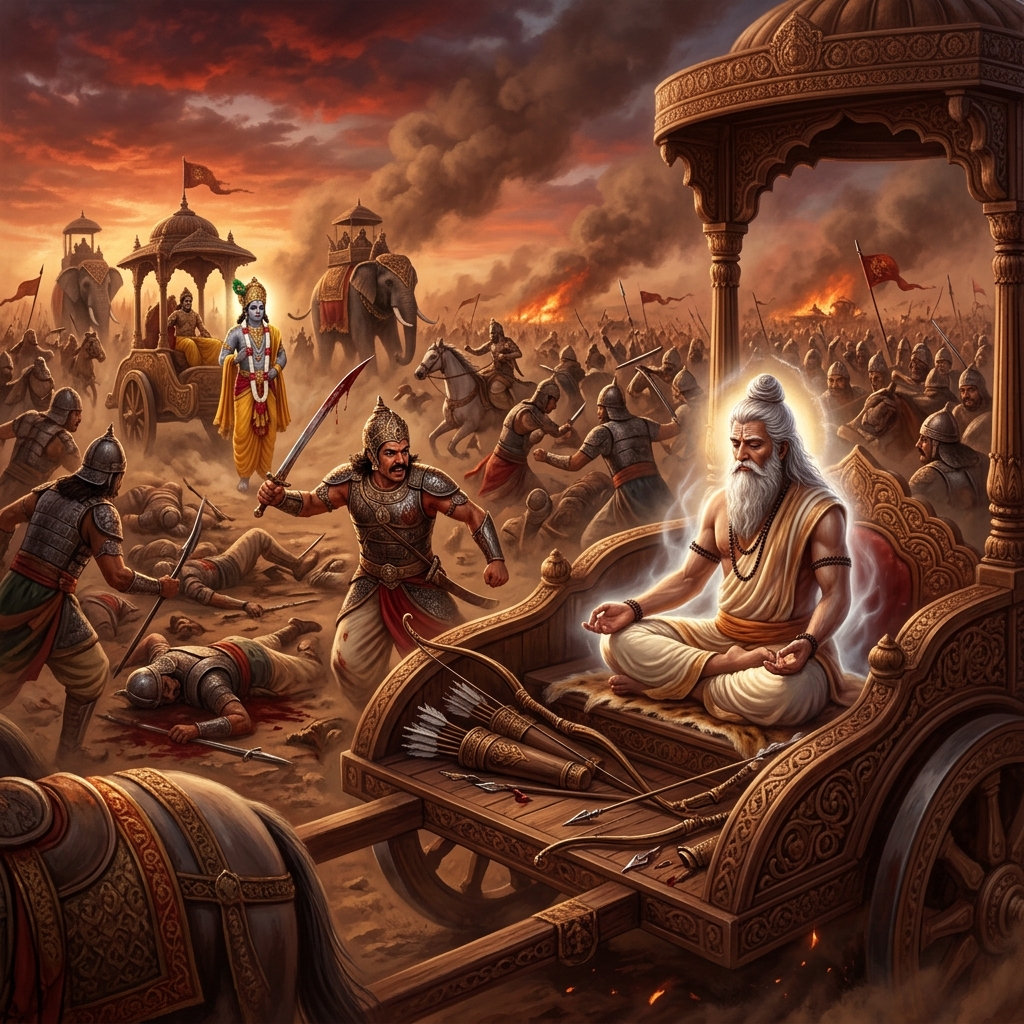
The great bow slipped from his fingers. The celestial weapons, the arrows that had blackened the sky and devoured armies, fell from his hands and clattered upon the floor of his chariot. The old man who had been a terror to all the worlds sat down where he stood, lowered himself cross-legged, and closed his eyes. He gave up the fight. "My son is gone," he murmured. "What is victory to me now? What is this war, or this kingdom, or this old body?"
In that moment of utter surrender, Dronacharya turned to the only refuge that remained to him. He withdrew his senses from the world, fixed his soul upon the Supreme, and sank into the deep stillness of yoga. He prepared to abandon his body by his own will and depart for the higher worlds, as the greatest sages were said to be able to do. It is told that even then a radiance gathered about him, and that holy rishis appeared in the upper air to receive the soul of the preceptor who had once been a peerless master of the sacred arts.
The whole battlefield seemed to hold its breath. The invincible commander of the Kaurava host sat unarmed and unmoving upon his chariot, defenseless as a child, his eyes shut, his hands empty, his heart already half departed from the field of Kurukshetra.
Dhrishtadyumna's Vengeance
There was one man on that field who had been born for this very moment. Dhrishtadyumna, prince of Panchala, had sprung fully grown and armored from the sacrificial fire that his father Drupada had kindled for a single purpose: to bring forth a son who would one day kill Dronacharya. The old enmity between Drupada and Drona, the broken friendship of their youth and the humiliation that followed, had called this fire-born warrior into the world. Now his hour had come.
Seeing the preceptor seated and unarmed, lost in his final meditation, Dhrishtadyumna seized his sword and leaped from his chariot. Arjuna saw what was about to happen and cried out in horror. "No! Do not kill him! Take him captive, he is unarmed, he is meditating, he is our guru! Spare him, Dhrishtadyumna, I beg you!" Others too shouted for the prince to stop, for there was no honor in slaying a man who had laid down his arms and surrendered his life to God.
But Dhrishtadyumna would not be turned. The whole purpose of his existence burned in him, and the grief of his fallen kinsmen and the long shame of his house drove out all mercy. "This is my birthright," he said. "For this I was born from the fire." He sprang onto Drona's chariot, seized the white hair of the meditating sage, and with a single fierce stroke of his sword he severed the old preceptor's head from his shoulders.
The head of Dronacharya fell upon the field of Kurukshetra. The greatest teacher of arms the world had known, the guru of an entire generation of princes, was dead, slain not by a worthier weapon nor in fair single combat, but undone by a half-truth and a broken heart, beheaded while unarmed and at prayer. A cry of horror went up from both armies, and many on the Pandava side bowed their heads in shame even in the hour of their deliverance.
The Wrath of Ashwatthama
When the news ran through the ranks that Drona had fallen, the Kaurava army shuddered and began to break. But word of the manner of his death traveled too, and it came at last to Ashwatthama, the very son whose false death had undone his father. The young warrior, brave and fierce and beloved of his guru-father beyond all measure, learned the whole of it: the elephant slain and given his name, the lie shouted across the field, Yudhishthira's terrible half-truth, the drums and conches raised to drown the saving words, and his father beheaded unarmed and in meditation by Dhrishtadyumna's blade.
The grief and rage that took hold of Ashwatthama then were beyond all telling. He understood at once that he had not lost his father in honest battle but to a calculated deceit, a cruelty aimed straight at the old man's love. His sorrow turned to a fury so terrible that the earth itself seemed to tremble. He raged through the Kaurava camp like a wounded tiger, and his eyes burned red with the thirst for vengeance.
In his wrath Ashwatthama invoked the dreadful Narayanastra, the weapon of Vishnu that his father had taught him, a celestial fire that pursued and devoured all who stood against it with weapons raised. Only Krishna's swift counsel saved the Pandava host that day, for he bade every warrior cast down his arms and stand humbly unarmed, so that the weapon, finding no defiance, passed harmlessly over them. But Ashwatthama's hatred was not spent. It would smolder on through the rest of the war and beyond it, into the dreadful night when, mad with grief, he would steal into the sleeping Pandava camp to take his revenge in blood.
Thus ended the life of Dronacharya upon the field of Kurukshetra, the invincible preceptor brought low not by a stronger arm but by the one weakness in his mighty heart. The Pandavas had won a victory they could not have won any other way, yet it left a stain upon them that no triumph could ever wash clean. Yudhishthira's chariot rode the common earth now, and the war ground on, darker than before, toward its bitter and sorrowful end.
Dharma Lesson
The lines of Dharma are often blurred in the fog of war. Yudhishthira's half-lie was a pragmatic necessity to prevent the annihilation of his army, teaching us that rigid adherence to personal virtue (satya) can sometimes conflict with a leader's responsibility to protect the greater good. However, actions have consequences: Yudhishthira's chariot falling to the earth symbolizes that even 'necessary' sins leave a lasting spiritual mark.