Portents Over Hastinapura
Thirty-six years had passed since the great war ended, and a long quiet had settled over the kingdom. Yudhishthira ruled in Hastinapura with his brothers beside him, the wounds of Kurukshetra grown over but never wholly healed. Then, one season, the omens began.
Harsh winds rose, dry and gritty, dragging dust across the plains. Birds wheeled to the left in unnatural circles. The rivers turned and ran backward against their courses, the horizons drowned in a copper mist, and meteors fell by broad daylight. The sun rose without rays, ringed by headless trunks of fire, and the four quarters of the sky seemed to burn. Cranes called like owls in the eaves of the palace, and tame goats cried like jackals in the night.
Yudhishthira had seen such things only once before - on the eve of Kurukshetra, when eighteen armies marched to their deaths. He summoned his brothers and his ministers, and they spoke in low voices of what such signs could mean. They feared for their own people. But the omens were not for the Kurus this time. They were for the Vrishnis and the Andhakas, the proud Yadava clans of Krishna, grown rich and idle and quarrelsome in their sea-built city of Dwaraka far to the west.
Unknown to the Pandavas, the hour of an old curse had come round at last. On the battlefield after the war, the grieving Gandhari, her hundred sons all slain, had turned upon Krishna and cursed him: because he had the power to halt the slaughter and chose to let it run its course, his own clan would one day destroy itself in just such madness, and he would die alone and friendless in the forest, thirty-six years hence. The thirty-sixth year had now arrived.
The Prank Upon the Sages
Ruin, as it so often does, began with a joke. A company of great sages came to Dwaraka in those days - Vishvamitra, Kanva, and Narada among them, men whose word had the weight of fate. They walked the bright streets of the city as honoured guests.
But the young men of the Yadavas had grown insolent in their wealth. A band of them, flushed with their own cleverness, decided to make sport of the holy men. They took Samba, the handsome son of Krishna, and dressed him as a woman heavy with child, binding cloth and metal about his belly to swell it. Then they led him before the seated sages and bowed with false reverence.
"O wise ones, you who see what is hidden," they said, hiding their grins, "this woman longs for a child and cannot wait. Tell us - what will she bring forth, a son or a daughter?"
The sages were not deceived for an instant. They saw the youth beneath the woman's robes, and they saw the mockery aimed at their austerity, and a cold anger rose in them. Such men do not waste their power, but neither do they suffer scorn lightly.
"He will bring forth," they said, and their voices fell like stones into still water, "a fierce iron mace, a club of doom. And with that mace the whole race of the Vrishnis and the Andhakas shall be destroyed, every man among you, all but Krishna and Balarama alone. Krishna shall lie down in the forest and meet his death there, and the women of your house shall be carried off." Then the sages rose and walked on into the city, and the laughter of the young men died in their throats.
The Birth of the Iron Mace
Terror ran through the young men, but the curse of a sage cannot be unsaid. The next day Samba, gripped by a dreadful pain, brought forth from his body a heavy mace of iron, hard and dark and exactly as the sages had foretold. The thing was carried trembling before King Ugrasena, the elder lord of the Yadavas, and he stared at it as at a coiled serpent.
Ugrasena thought he saw a way to cheat the doom. He commanded that the iron mace be ground down to the finest powder, and that the powder be carried out and cast into the sea, that no trace of it might remain. His men ground it patiently upon stone until it was a heap of glittering dust, and they bore it to the western shore at Prabhasa and scattered it upon the waves.
But one hard knot of the iron, the size of a thumb, would not be ground; it resisted every stone. In the end they cast that nub too into the sea. A fish swallowed it, and the fish was caught in a fisherman's net, and in its belly a hunter named Jara found the lump of iron and kept it, thinking it would make a fine sharp point for an arrow.
Ugrasena went further. Knowing the weakness of his people for strong drink, he proclaimed that no liquor was to be brewed or sold within the city, on pain of impalement for any who disobeyed. The Yadavas obeyed the letter of the law and laughed at it in their hearts. They could not believe that the bright city of Krishna, raised from the sea itself, could ever come to harm.
The Reeds Upon the Shore
The iron powder did not vanish into the sea as Ugrasena had hoped. The tide carried it back and laid it along the long beach at Prabhasa, and there it sank into the wet sand and took root. From it grew a tall, stiff reed with edges sharp as razors, which the people called eraka grass. It rose in thick stands all along the shoreline, swaying in the salt wind, and no one thought it anything but ordinary grass. Yet every blade of it held the iron of the cursed mace, and waited.
Meanwhile a strange and dreadful presence began to walk the streets of Dwaraka. A man, if man he was, dark of skin, bald, hideous, with a yellow-black hue, was seen peering into the courtyards and doorways of the houses. When anyone turned to look at him straight, he was gone. The archers of the city loosed arrow after arrow at him and struck nothing.
With him came a hundred small ruins. Rats multiplied and overran the roads, gnawing the hair and nails of men as they slept. Pots cracked of their own accord upon the shelves. Cranes cried in the houses like owls, and goats howled like jackals. The women dreamed of a dark fierce female who laughed as she snatched the auspicious threads from their wrists. The very discus and the conch and the mace of Krishna, his celestial weapons, rose into the air and departed before the eyes of the people, and his great chariot was drawn off into the sea by its own horses.
Krishna watched all this and knew it for what it was. He understood that the curse of Gandhari and the curse of the sages were now bound together and could not be turned aside. He gathered the elders of the clan.
Pilgrimage to Prabhasa
Krishna spoke to the assembled Yadavas, and his words were heavy with knowledge he did not fully share. "These omens fall upon us," he said, "and they are not idle. Let us go on pilgrimage to the holy shore at Prabhasa, by the sea, and there bathe in the sacred waters and worship, and perhaps these evils may be lessened."
The Yadavas agreed, for it pleased them to make a festival of it. Word went out, and the whole clan made ready - the Vrishnis and the Andhakas, the warriors and their wives, the old men and the children. They loaded wagons with food and with great stores of wine and sweet liquor, forgetting or scorning the law against drink. They put on their finest garments and their gold, and they rode out from Dwaraka in a long bright procession toward the edge of the sea.
At Prabhasa they pitched their pavilions along the very beach where the eraka grass grew thick, and they gave gifts to the brahmanas, and bathed, and then they began to feast. The wine flowed without end. Krishna sat among them, and his elder brother Balarama, and the great warriors Satyaki and Kritavarma, and Krishna's sons Pradyumna and Samba and Aniruddha, and all the flower of the Yadava race.
As the drink took hold, the laughter grew loud and then grew harsh. Men who had been comrades for thirty years began to remember old wounds. The mead that should have warmed them turned to bile in their throats, and a darkness gathered over the festival that none of them could see for the wine in their eyes.
The Quarrel of Satyaki and Kritavarma
It was Satyaki, deep in his cups, who struck the first spark. He turned upon Kritavarma before the whole company, his eyes red with wine, and flung at him the foulest memory of the war.
"What manner of warrior are you," Satyaki cried, "who crept into a sleeping camp by night with Ashwatthama and butchered men who could not lift their hands? You slew the Panchalas in their beds, the sons of Draupadi in their sleep. No man of honour would boast of standing among the living after such a deed."
Kritavarma flushed and threw back the taunt, gesturing with his left hand in scorn. "And you, who call yourself honourable - did you not kill Bhurishravas as he sat upon the field in the vow of death, his arm already severed, his weapons laid down? You hacked the head from a man at prayer. Speak no more to me of honour."
The words could not be taken back. Satyabhama, who stood near and remembered that Kritavarma had been among those who killed her father, wept and inflamed Krishna's grief and anger. Krishna looked upon Kritavarma with a terrible eye. Satyaki, seeing his lord's wrath, sprang up and in his fury leaped upon Kritavarma and sheared his head from his shoulders with a sword, there at the feast.
Then the madness broke loose. The kinsmen of Kritavarma, the Bhojas and the Andhakas, fell upon Satyaki in a body, and Pradyumna leaped to his side, and the two were overwhelmed and cut down before Krishna's eyes. And seeing his son and his friend slain together, even Krishna's heart turned hard toward his own people.
The Slaughter of the Yadavas
Krishna rose in his wrath, and his hand closed upon a fistful of the eraka grass that grew along the shore. The moment it left the sand it changed in his grip, hardening into a heavy mace of iron, a thunderbolt of doom. With it he struck down those nearest who came against him. And when the others saw it, they too snatched up the reeds, and in every hand each blade of grass became an iron mace, deadly and sharp.
A frenzy fell upon the whole assembly that none of them could ever afterward explain. Inflamed with wine and with the working of the curse, brother turned upon brother and father upon son. The sons of Krishna and the sons of Balarama, the warriors who had never been beaten in war, fell now upon one another with the grass that was iron, and the beach ran red. Whoever plucked a single blade found a weapon to kill his neighbour, and whoever tried to flee was struck down from behind.
Pradyumna fell, and Samba, and Aniruddha, and Charudeshna, and Gada, and all the great names of the Vrishni line. Krishna's own grandsons and the grandsons of his kin died together in the storm of iron, heedless of any tie of blood. The cries and the clash of the maces drowned the sound of the sea. By the time the sun went down, the entire fighting strength of the Vrishnis and the Andhakas lay dead upon the sand at Prabhasa, slain not by any enemy but by their own hands, by grass grown from a mace ground from a prank.
When at last the killing stopped for want of men to kill, only two were left standing upon that field of kinsmen - Krishna and his elder brother Balarama, who had not been able to halt the madness any more than they had been able to halt the war.
The Departure of Balarama
Balarama, the elder, plough-bearer and teacher of warriors, looked upon the ruin of his whole race and said no word. He turned and walked away from the carnage, down the beach to a lonely place where a great tree leaned over the water, and there he sat himself down upon the sand with his back against the trunk and his face toward the sea.
He closed his eyes and turned his mind inward, withdrawing it from the world of grief, gathering his breath and his life-force into a single point as the yogins do. And as he sat there, motionless, the sages who tell this tale say that a great white serpent came forth from his mouth - mighty Shesha, the thousand-hooded world-bearer whose earthly portion Balarama had always been. The serpent slid down across the sand, glistening, and the ocean itself rose to greet it with the river-gods and the spirits of the deep, and Shesha entered the sea and was gone. So Balarama gave up his mortal body and passed out of the world.
Krishna came walking along the shore and found his brother's body empty of breath and his brother's true self departed into the waters. He stood a long while in silence. He had known this hour was set; he had foreseen the whole of it; and yet to see Balarama gone, who had carried him as a child and stood beside him through every danger, struck even him with the weight of an ending. The last of his old life had now slipped away, and he understood that nothing remained for him to do in the world but to lay his own body down.
The Hunter's Arrow
Krishna did not delay. He sent his faithful charioteer Daruka racing northward toward Hastinapura, charging him to bring Arjuna with all speed and to tell the Pandavas of the destruction of the Yadavas. "Let Arjuna come," he said, "and take the women and children of our house under his protection, for I shall not be here."
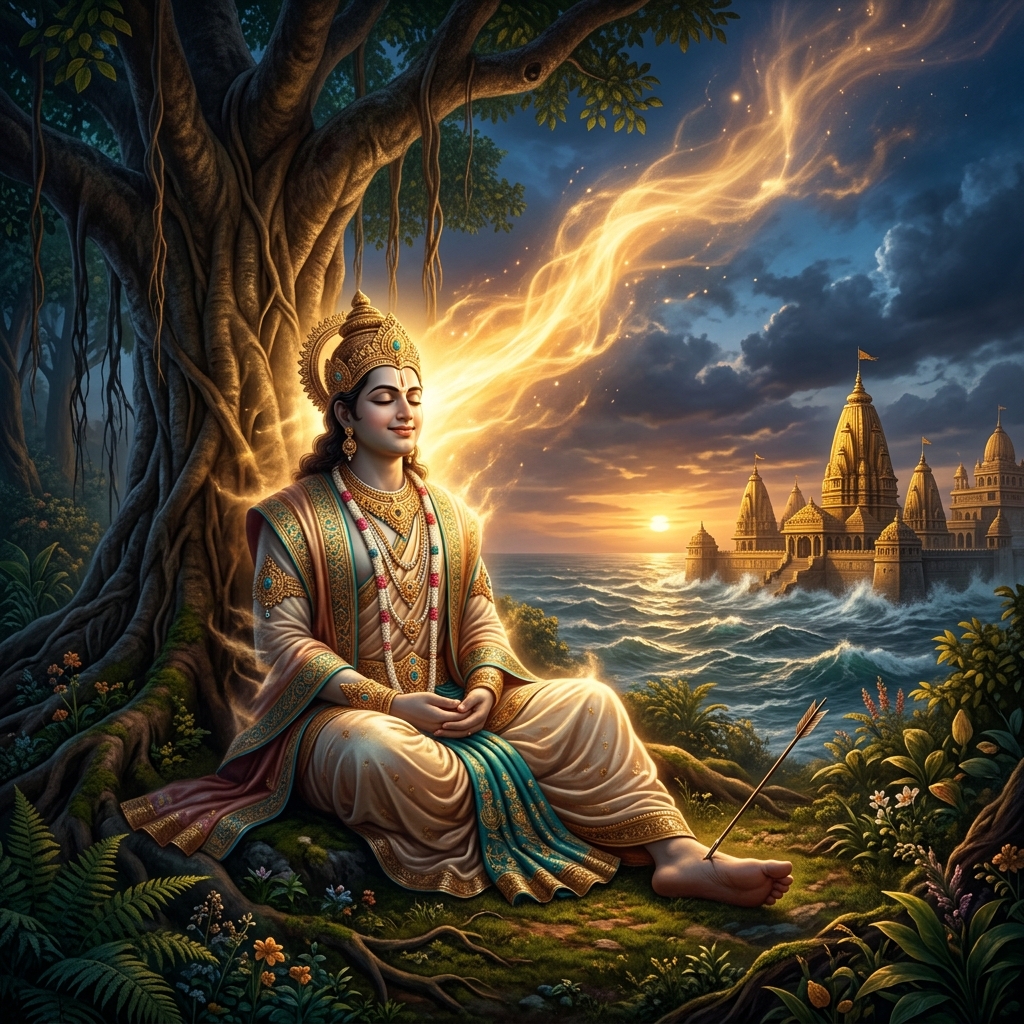
Then Krishna walked alone into the forest by the shore. He chose a quiet place beneath a great peepal tree and lay down upon the earth, drawing his body into stillness. He crossed his left foot over his right knee so that the sole of his foot, marked with the lotus and the other auspicious signs, was turned upward, and he composed his mind in deep meditation, withdrawing from the world as Balarama had done.
Through that same wood came the hunter Jara, the man in whose arrow was fixed the last unbroken nub of the iron mace. Stalking game through the undergrowth, he saw between the leaves only the pale lotus-marked sole of Krishna's foot moving slightly in the dappled light, and he took it for the face of a deer. He fitted the iron-tipped arrow to his bow and loosed it.
The arrow flew true and struck Krishna in the sole of his foot - the one mortal point of his earthly body, the heel that the iron of the curse was destined to find. Jara ran up through the brush to claim his deer and saw instead a man in yellow silk, glorious and serene, with his arrow standing in his foot. The hunter cried out and fell down in horror, begging forgiveness, beating his head upon the ground.
But Krishna only smiled and raised him gently. "Do not grieve, Jara," he said. "You have done what the long working of time required of you, and no blame is yours. Go now in peace, and may you go to the realm of the blessed." And with those words the breath went out from the body of Krishna, and the divine soul that had worn it ascended, filling the heavens with light. So passed the avatar from the earth, and with his going the age of Dvapara ended and the dark age of Kali began.
Arjuna Comes to a Widowed City
Daruka reached Hastinapura and poured out his terrible news, and Arjuna - who had loved Krishna above his own brothers, whose charioteer Krishna had been through all the war - set out at once for Dwaraka, his heart in his throat the whole long road.
He came into a city that was like a woman newly widowed. The streets that had blazed with festival were silent. The sixteen thousand wives of Krishna and the other women of the clan, the old men, and the small children wandered the courtyards weeping, with no warriors left to guard them. Krishna's aged father Vasudeva yet lived, but only just. He took Arjuna's hands and charged him to lead the survivors to safety and to perform the rites for the dead, and then, broken by grief, the old man gave up his life.
Arjuna did all that a kinsman could. He raised the funeral pyres for Vasudeva, and at Prabhasa for the bodies of Krishna and Balarama and the slain warriors, and he poured the offerings for them. The queens of Krishna, Rukmini and the others, entered the fire after their lord in the old way, choosing not to outlive him. Then Arjuna gathered all who remained alive - the women, the children, the old men, and Krishna's great-grandson Vajra, the last heir of the Yadava line - and prepared to lead them away from the sea toward the safety of Indraprastha, where Vajra would be made king.
He set out at the head of that long mournful caravan, and the people followed him because there was no one else left to follow.
The Sinking of Dwaraka and the Failing of Gandiva
Hardly had Arjuna led the people out of the gates when the sea kept its appointment. The ocean rose and reached for the city it had once given up to Krishna, and street by street, palace by palace, the golden Dwaraka sank beneath the waves. The people on the road turned and watched the towers go under one by one, until the water lay smooth and empty where the greatest of cities had stood, and only the temple of Krishna remained a little while above the flood before it too was swallowed. The sea took back its own.
Arjuna pressed northward with his helpless charges across the land of the Five Rivers. And there, on the open road, a band of common bandits, the Abhiras, saw the long caravan of unguarded women laden with wealth and fell upon it to plunder. Arjuna, who at Kurukshetra had held off the massed armies of the world, reached for his bow Gandiva to drive them away.
He could not string it. The great bow that had been his since the burning of the Khandava forest bent and would not bend; his arms had not the strength. He drew his arrows, but they were soon spent, and the inexhaustible quivers given him by the gods would no longer fill. He called upon the celestial weapons whose secret mantras he had known since boyhood, and the mantras slipped from his mind and would not come. His more-than-human power had simply drained out of him, and he stood there at last an ordinary aging man with a bow he could barely lift.
Fight as he might, he could not protect them all. The bandits carried off many of the women before his eyes, and others went with the robbers of their own will, and Arjuna could only lead the broken remnant onward, shamed and bewildered to the depths of his soul. He brought the survivors at last to the lands of the Kurus, settled the women of Krishna's house in safety, and crowned the boy Vajra king at Indraprastha.
Time Is the Root of All
Shaken to the marrow, Arjuna sought out the hermitage of Vyasa in the hills and laid the whole of it before the sage - the slaughter at Prabhasa, the deaths of Krishna and Balarama, the drowning of Dwaraka, and above all the failing of his own arm and the silence of Gandiva when he had needed it most. "How can this be?" he asked, his voice low with grief. "My strength has left me. The weapons that were mine since boyhood would not answer. I who guarded the world could not guard a caravan of women. What has become of me?"
Vyasa was not surprised, and he did not console with comfortable lies. "Do not grieve, child," he said. "Time is the root of all. Time creates the worlds and time draws them back into itself; it is the seed and it is the harvest. Krishna, who is the Lord himself, came into the world to lift a burden from the earth, and when that work was finished he laid the body aside as a man lays aside a worn garment. The Yadavas were destroyed because their hour had come, by the curse of the brahmanas and the curse of Gandhari, which were only the instruments of time.
"Your weapons came to you when their purpose came, and now their purpose is finished, and so they have gone back to the place they came from. Your strength was lent to you for a work, and the work is done. There is no shame in this; it is the law of all things. The four of you and Draupadi have ruled and fought and suffered enough. The time has come for you and your brothers to lay down the kingdom in turn and to set out upon the last road."
Arjuna bowed his head and took the sage's blessing and went home to Hastinapura. He told his brothers all that Vyasa had said, and they heard in it the closing of their age. The destruction of the Yadavas and the death of Krishna had not been a single catastrophe but the turning of the wheel itself. The bright world they had known was ended; the dark age was come; and the sons of Pandu, their work in the world finished, began quietly to prepare for the great departure that would carry them out of the story at last.
Dharma Lesson
No power, however divine, stands outside time. The Yadavas were Krishna's own kin, mighty and blessed, yet pride, drink, and a careless cruelty toward holy men brought them down exactly as the same flaws had brought down the Kauravas. The Mausala Parva is the epic's hardest mirror: even the people closest to God destroy themselves when they abandon discipline, and even Arjuna's matchless strength is a loan that time recalls.