The Great Journey
Book 17 - The Pandavas Walk North to Die, and the Dog Who Followed
Handing On the Throne
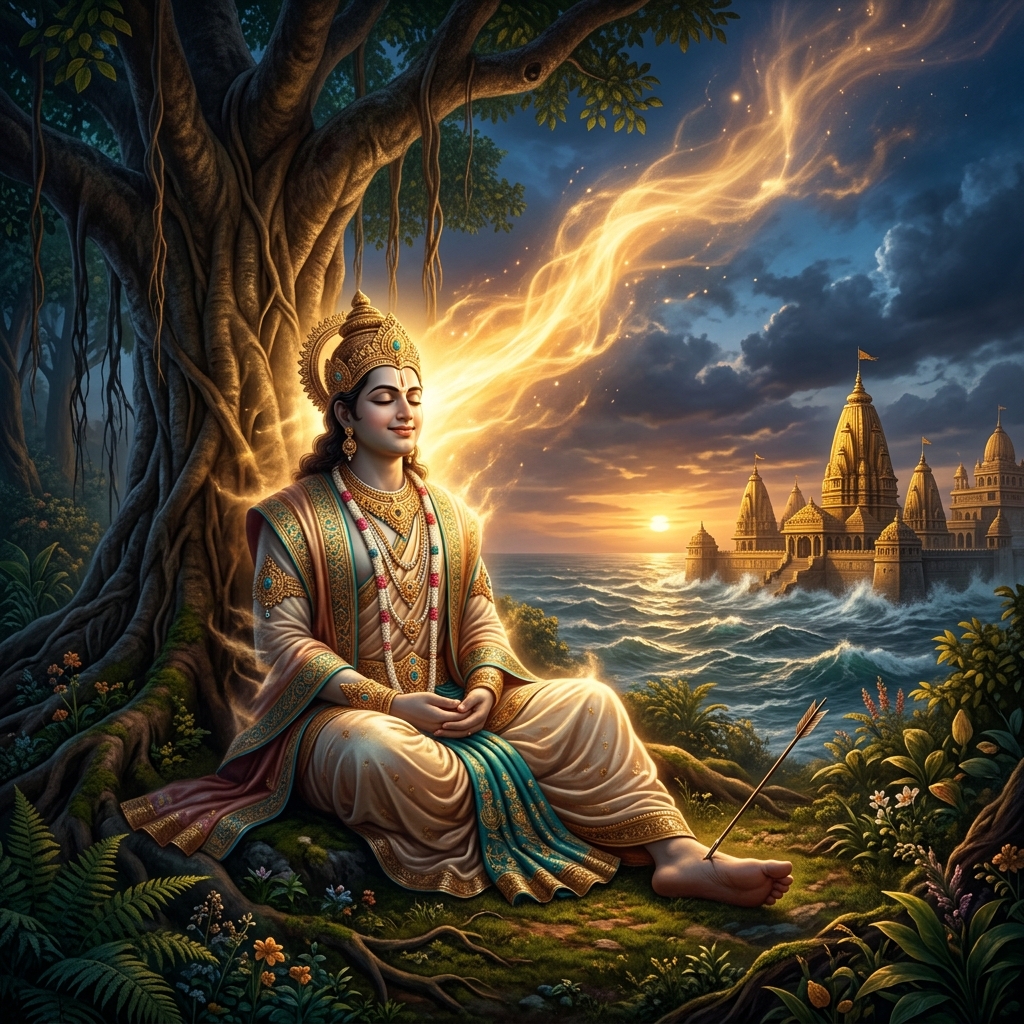
When Arjuna came back to Hastinapura from the west, the brightness had gone out of him. He told Yudhishthira all of it: that Krishna had left the world, that Balarama had gone before him, that Dwaraka itself had been swallowed by the sea, and that the Yadavas - drunk, quarrelsome, cursed - had slaughtered one another to the last man on the shore at Prabhasa. The Vrishnis and the Andhakas were no more. The Gandiva itself had grown heavy in his hands, and his old weapons no longer answered his call.
Yudhishthira heard it almost without surprise. He had felt the turning for a long time, the way an old man feels a change of season in his bones. "Time cooks all creatures," he said quietly. "This is the working of Time, and our time too has come." Arjuna could only repeat the word like an echo. "Time. Time." Bhima said nothing; the twins bowed their heads. They had all known, since the war ended, that they were living past the end of their own age. Now the man who had held the world together was gone, and there was nothing left for the sons of Pandu to do in that world but leave it well.
So Yudhishthira set his house in order. He summoned the council and the elders, and before them he installed Parikshit - the grandson of Arjuna, the son of slain Abhimanyu and gentle Uttara, the child who had been struck in the womb and given back his life - as king of Hastinapura. He was a calm, capable youth, and the people loved him. To the western city Yudhishthira sent word that Vajra, Krishna's great-grandson and the last shoot of the Yadava vine, should rule from Indraprastha and Mathura. He charged Yuyutsu, the surviving son of Dhritarashtra, to advise and protect the young kings, and he gave to Subhadra the care of guiding both. Then, his last duty done, he laid the kingdom down like a load he had carried far enough.
They Put Off Their Crowns
On the morning of their leaving, the five brothers and Draupadi went together to the temple and made their offerings, and then they did a thing the city had never seen. They took off their crowns. They took off the heavy gold and the great jewels, the rings and the armlets and the chains of office. They put aside the royal silks that had clothed them since the war, and they dressed instead in the rough bark and undyed cloth of those who renounce the world and walk out of it for good. Yudhishthira, who had been emperor of all the earth and had sat upon the throne of the world, stood at the gate in the dress of a beggar, and he was glad.
Draupadi, who had been queen, born of fire and won at a contest of kings, stood beside her husbands in the same plain cloth, her long dark hair unbound. She had walked through more grief than any of them - the loss of all five of her sons in a single night, the long years of exile, the insult in the hall of dice that had set the whole war in motion - and now she walked toward the last grief without complaint. Her face was steady. The brothers turned and made Agni, the household fire, a final reverence, and then they turned their backs on the throne forever.
The people of Hastinapura came pouring out behind them, weeping, calling after them, begging them not to go. The women of the inner palace wailed. But the Pandavas did not turn around, and they did not slow, and after a while the people could follow no farther and stood at the city's edge watching the six small figures grow smaller on the road. Only the palace animals trailed after them a little way - and one thin stray dog, brindled and ordinary, that fell into step at Yudhishthira's heel and would not be sent home.
The Bow Returned to the Waters
They did not strike north at once. First the Pandavas made a great circuit of the land they had ruled, a slow walk of farewell around the rim of the world. They went east, and then south, keeping the sacred fire that one of them carried, bathing at the holy fords, taking nothing and asking nothing. They passed the red sea of the east and the bitter salt sea of the south, six renunciants in bark and cloth, walking always with their faces toward the next horizon and never back toward the throne.
When they came at last to the shore of the western ocean, the fire-god Agni rose up before them in a towering column of flame and stood across Arjuna's path so that he could not pass. "Hear me, mighty-armed Phalguna," the god said. "Long ago, for the burning of the Khandava forest, I gave you the bow called Gandiva, mightiest of all bows, and its two quivers that never emptied. They were not mine to keep. I borrowed them from Varuna, lord of the waters. You have carried Gandiva through every battle of your life and won the earth with it. But it can go no farther than this. Give it back now to the ocean, that Varuna may take again what was always his."
Arjuna stood holding the bow that had been the instrument of his fame and of half the slaughter at Kurukshetra. It had answered his hand for a lifetime. For a moment the old archer's heart held to it. Then his brothers spoke to him gently, and he understood. Without a word, with his face set, he took up Gandiva and the two great quivers and hurled them far out over the water, and the sea opened and took them down, and they were gone. Agni's flame sank and vanished. Now the last weapon of the Pandavas was lost to them, and they were stripped of everything that had made them lords of the earth. They turned their faces north, toward the mountains, and walked on.
Northward Toward Meru
Now they walked north, and kept walking, and did not stop. The land began to rise under their feet. They left the cities and the river-plains behind them, passed through the last of the fields and the last of the forests, and came up into the foothills where the air grew cold and clean. Ahead of them, white and immense against the sky, stood the Himavat, the lord of mountains, and somewhere beyond its passes rose the golden slopes of Meru, the mountain at the center of the world, where it was said that one pure enough, and only such a one, might climb alive into heaven in his own body.
They walked in single file, as a procession walks toward something sacred. Yudhishthira went first, the eldest, the most steadfast. Behind him came Bhima, mountainous and slow now but still the strongest man alive. Then Arjuna, the archer with empty hands. Then the twins, Nakula and Sahadeva, side by side as they had been since birth. And last of all walked Draupadi, the fire-born queen, the wife of all five. No one spoke of what was coming. They climbed.
And the dog climbed with them. It was the same thin brindled stray that had followed Yudhishthira from the city gate, and through all the months of their journey it had never left him. It ate what scraps fell, drank from the cold streams, and trotted faithfully at the king's heel. The others paid it little mind, but Yudhishthira would not drive it off, and so it stayed - one small living thing among the renunciants, climbing toward the roof of the world.
Draupadi Falls
Higher and higher the path took them, until the snow lay all around and the way narrowed to a track of ice along the mountain's shoulder. The cold was a living thing now, pressing into their bones. The air had grown so thin that each breath was a labor. Still Yudhishthira went on at the front, eyes forward, and behind him the others bent into the climb.
It was Draupadi who fell first. Without a cry she stumbled, sank down into the snow, and could not rise again. Bhima, who loved her, heard her fall and turned in anguish, and a great cry broke from him. "O king! O brother! Why does Draupadi fall, here on the holy path? She never did one wrong thing in all her life. Why is she the first to go down?"
Yudhishthira did not stop. He did not even turn his head. He walked on, and his answer came back steady and even over his shoulder, though his eyes were wet. "She was devoted to all of us, Bhima, and a great soul. But she had one fault. In her heart she loved Arjuna more than she loved the rest of us; she was partial, though she never showed it. For that single failing she falls here, and cannot climb higher. Do not grieve. Walk on." And he set his face to the slope and went on, and Bhima, after one long look back, followed him, and Draupadi was left where she lay in the white silence.
Sahadeva and Nakula
They had not gone far when Sahadeva, the youngest of the twins, faltered on the ice and sank down and did not get up. Again Bhima turned, and again the question tore out of him. "Brother, why does Sahadeva fall? He served us all without a single complaint. He was the wisest man among us. Surely he had no fault at all."
Yudhishthira answered without slowing his step. "He was indeed the wisest of us, Bhima. But because of it he was proud. He believed there was no one in the world to equal him in wisdom, and he held that thought secretly in his heart. For that pride he falls. Walk on." And he went on, and Sahadeva was left behind in the snow.
A little higher, Nakula went down. The most beautiful man on the face of the earth slid quietly to the ice and could climb no more. Bhima, half blind now with grief, called out once again. "And Nakula? Why him? He was loyal, and gentle, and brave." "He was all of those things," said Yudhishthira, his voice never breaking, never turning. "But Nakula knew that there was no man so beautiful as he, and he was vain of his own beauty and thought himself above others for it. That vanity is the fault that brings him down. Brother, do not look back. Walk on." And the two who were left, the eldest and the strongest, climbed on alone with the dog, and behind them the twins lay still.
Arjuna and Bhima
Now there were only three of them on the path - Yudhishthira, Arjuna, Bhima - and the dog. They climbed in silence until Arjuna, the great archer, the conqueror of gods and men, stumbled and fell to the ice and lay there spent. Bhima cried out in pure disbelief. "How can this be? Arjuna - the finest bowman the world has ever held, who never spoke an untrue word, who never broke a vow? What fault could possibly throw down a man like him?"
Yudhishthira's voice came back grave and unflinching. "He swore once that he would burn up all his enemies in a single day, and he could not keep that boast. And he carried in his heart a scorn for every other archer alive, certain that none could match him. That pride, in so great a man, is a great fault. It brings him down here. Do not stop, Bhima. Walk on." And Arjuna was left on the snow, and the two went on, the eldest and the mightiest, with only the faithful dog still between them and the empty mountain.
Then Bhima himself, the strongest man who had ever lived, the slayer of Duryodhana and Dushasana and a hundred Kaurava brothers, felt the strength go out of his vast body, and he sank to the ice and could not rise. From where he lay he called up the mountain to his brother, and now his voice was small. "O king - tell me, before you go - what is my fault? Why must I fall too?" Yudhishthira stopped, just for a breath, and tears ran down his face, but his voice held steady and he did not turn around. "You ate too greedily, dear brother, more than your share, and you boasted of your strength and held the whole world cheap beside your own arms. That is your single flaw, and it brings you down. Do not grieve. I will see you again in the world that is coming." And then Yudhishthira walked on, alone now, all his brothers and his wife dead on the mountain behind him, with no living thing beside him but the dog.
The Chariot at Heaven's Gate
Yudhishthira climbed on, not turning, not weeping aloud, while the brindled dog trotted faithfully at his heel as it had since the gate of Hastinapura. He did not look back at the five he had left in the snow. He fixed his heart on heaven and put one foot before the other up the last and steepest stretch of the world, and the dog stayed at his side the whole way, asking nothing.
At the place where the mountain met the floor of heaven, the sky broke open with a roar of thunder, and Indra, king of the gods, came down to him in a chariot blazing with light, drawn through the air to the very edge of the mortal world. "Climb in, O great king," Indra said. "Alone of all the men who have ever lived, you have earned this. You shall enter heaven in your own living body, without dying first. Your brothers and Draupadi have shed their human forms and gone before you, and you will see them there in glory. Set aside your grief and climb up beside me."
Yudhishthira heard him, and looked at the shining chariot, and then he looked down at the dog standing patient and tired at his feet. "This dog has been devoted to me and has followed me without fail through everything," he said slowly. "It did not leave me even when my own brothers fell one by one on the path. I cannot leave it now. Let it come with me into your chariot."
The Dog Reveals Dharma
Indra shook his head. "There is no place in heaven for dogs, O king. Dogs may not enter the realm of the gods. Leave the animal here - there is no cruelty in it, no sin. You have won heaven as no mortal ever has. Do not throw away what you alone have earned for the sake of a beast."
But Yudhishthira would not move. "It is a great and ancient sin," he answered, "to abandon one who is devoted to you, one who has eaten at your hand and looked to you for protection. They say such a sin weighs as heavy as the killing of a brahmana. I will not buy heaven at that price. This dog sought my shelter and gave me its whole faith; I will not cast it off to save myself. If there is no heaven for it, then there is none for me. Without this dog I will not go." And he turned, as though he meant to walk back down into the snow and die among his brothers rather than ride alone and faithless into the sky.
At that the dog shimmered, and its lowly shape fell away, and where it had stood there now stood Dharma himself, the lord of righteousness, the god who was Yudhishthira's own divine father. The god's face shone with pride and love. "O my son," Dharma said, "how well you have done. Once, in the forest by the dying lake, I tested you in the form of a crane, and you answered me truly. Once before that I tested your patience and your honesty. This was the last and hardest test of all, and you have passed it cleanly. You would not enter even heaven itself by abandoning a creature that was faithful to you and begged your protection. For this there is no one in all the worlds who is your equal. Come now, my son - in this same living body, with no death between - come up into the realm of the gods, where eternal regions wait for you." And Yudhishthira, the most steadfast of men, climbed into the chariot of Indra and rose up living into heaven.
Dharma Lesson
Greatness does not erase small flaws, and small flaws are weighed at the end. Draupadi's partiality, the twins' vanity, Arjuna's pride, Bhima's excess - each was tiny beside their glory, yet each told on the final climb. Only Yudhishthira reached the summit, and even he was tested one last time: offered heaven itself if only he would abandon a faithful dog. He refused. Loyalty to the helpless outweighed the reward of heaven - and so heaven was given to him freely.
Common Questions
Why did the Pandavas walk to the Himalayas?
With Krishna gone and the Yadavas destroyed, they judged their work in the world finished. They crowned Parikshit at Hastinapura, Arjuna returned Gandiva to the sea, and the five brothers and Draupadi set out north toward Mount Meru, hoping to reach heaven in their living bodies.
Why did each Pandava fall on the final journey?
Yudhishthira named a hidden flaw for each as they dropped. Draupadi loved Arjuna more than her other husbands; Sahadeva was vain of his wisdom and Nakula of his beauty; Arjuna had boasted he could end the war in a day; Bhima ate and boasted to excess. Only Yudhishthira walked on.
What is the dog in the Mahabharata's final journey?
A stray that attached itself to Yudhishthira and climbed the whole way with him. When Indra's chariot arrived and refused to carry an animal, Yudhishthira declined heaven rather than abandon a devoted companion. The dog then revealed itself as Dharma, his own divine father, testing him.
Did the Pandavas reach heaven in their living bodies?
Only Yudhishthira. His four brothers and Draupadi died on the climb, and he alone reached the summit and was offered Indra's chariot in the flesh. The others attained heaven after death, which the next book, Svargarohana Parva, shows him discovering for himself.