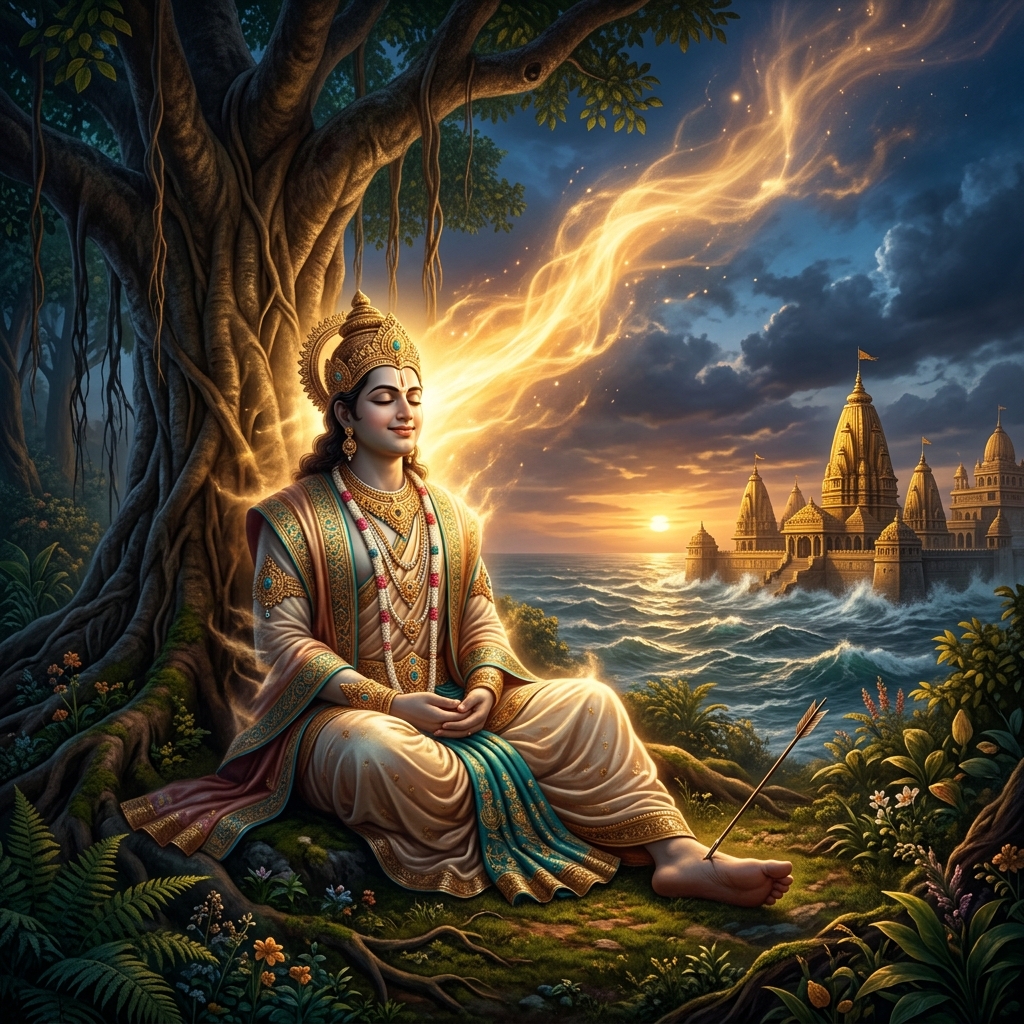
The Ascent to Heaven
Book 18 - The Last Illusion, and the End of the Story
The Ascent in Mortal Flesh
After the long march into the Himalaya, after the falling away of Draupadi and his four brothers one by one upon the slopes of Mount Meru, Yudhishthira had walked on alone but for a single faithful dog. At the very gate of the celestial regions he had refused Indra's chariot rather than abandon that creature, and in that final mercy the dog had revealed itself to be Dharma, his own divine father, testing him one last time on the threshold of the worlds. Having passed, Yudhishthira was lifted up into the sky.
He rose in his living body, a thing almost unheard of among men, the wind of the heavens cool upon a face still lined with the grief and dust of the earth. Below him the white peaks fell away; above him the firmament opened like a flower of light. He thought of all that had brought him here - the dice, the exile, the war that had swallowed an age of heroes - and he believed that the bitterness was behind him now. Surely, he told himself, his brothers had arrived before him, and Draupadi, and the great-souled men who had died for the cause of dharma. Surely heaven would be a reunion.
The gates of the immortals stood open. Music that no earthly ear had heard poured out to meet him, and the fragrance of flowers that never fade. Celestial beings came forward to honour him, and the assembled gods and sages rose at his approach, for it was no small thing that a man should enter those halls in the body he had worn upon the earth. Yudhishthira passed within, his heart lifting toward the faces he longed to see, certain that the worst sorrows of his life were finished and that only joy remained beyond that shining threshold.
The Enemy on the Throne of Heaven
What Yudhishthira saw inside the celestial hall struck him like a blow. There, upon a throne of dazzling splendour, seated among the radiance of the gods and the company of the blessed, was Duryodhana. His cousin. His lifelong enemy. The man whose greed had stolen the kingdom, whose cruelty had dragged Draupadi by the hair into the gambling hall, whose envy had drowned the whole earth in the blood of its finest sons. He sat there blazing like a planet, honoured, garlanded, at peace.
Yudhishthira turned his face away in revulsion. He did not see Bhima, or Arjuna, or the twins. He did not see Draupadi shining among the goddesses. He did not see Karna, or Drupada, or Dhrishtadyumna, or Abhimanyu, or the countless others who had given their lives in his cause. He saw only the one man he had no wish ever to look upon again.
"I do not desire these regions," he said aloud, and his voice was hard with disgust. "I do not wish to dwell here, where this man dwells in glory - this man through whose folly friends and kinsmen and the whole of the earth were destroyed, this man for whose sake we suffered exile and grief and the slaughter of all we loved. I will not look upon Duryodhana. Take me where my brothers are."
Where Are My Own?
The gods who stood near him smiled, for they understood the trial that was unfolding and the king who was undergoing it. Narada himself spoke, gently chiding. "O king of kings, restrain this grief. In heaven all earthly enmities are dissolved. Speak not so of Duryodhana. He earned this place by the death he died. He fell on the field of Kurukshetra as a kshatriya should fall, facing his foes without flinching, true to the duty of his caste. He gave his body for what he believed his right, and a warrior's death in a just cause for a kshatriya is a sacrifice that opens the doors of heaven. Here he is purified. Lay down your hatred and enter into bliss."
But Yudhishthira would not be soothed. "If Duryodhana has won heaven," he answered, "Duryodhana, who destroyed the earth out of avarice and rage, who knew neither pity nor honour, with whom we waged that terrible war - then where are those who fought for dharma? Where is Karna, my brother, invincible in battle, whom I learned too late was my mother's firstborn? Where is the great archer Drupada, and where his valiant son? Where are the children of Draupadi, cut down in their sleep?"
His voice broke as he came at last to the names that mattered most. "And where is Draupadi, the slender-waisted, the daughter of fire, faithful through every trial? Where are my brothers, Bhima and Arjuna, Nakula and Sahadeva? I do not wish to be here without them. Wherever they have gone, there I will go also. That place, and no other, is heaven to me."
The Messenger and the Downward Road
The gods looked one to another, and Indra spoke. "Since you long so for them, you shall be taken to them. A king of your virtue should dwell where his desire leads him." He summoned a celestial messenger, a being of the divine regions, and bade him conduct Yudhishthira to the place where his brothers and his wife abided.
So the messenger went before, and the son of Dharma followed. But the way did not rise toward the bright halls. It bent downward, away from the music and the light, and grew narrow and steep. The fragrance of the heavenly flowers faded behind them, and a different air came up to meet the king - heavy, sour, foul with the reek of rotting flesh and burning hair and stagnant blood.
The path was hard to walk. It was wrapped in a thick and clinging darkness through which the messenger's form could barely be seen. The ground was matted with hair and strewn with bones; the grass that grew along its edges had blades like razors. Yudhishthira pressed on, his living flesh shrinking at every step, descending into a region from which all hope and all sweetness had been shut out.
The Horrors of the Place of Torment
Deeper still the road descended, and the visions that lined it grew more terrible. Yudhishthira passed a river whose waters boiled and steamed, impossible to cross, and another that ran red and slow. He passed a forest whose every leaf was a drawn sword, and pits of burning sand, and rocks of iron heated white. He saw the instruments of punishment laid out in the murk, cauldrons of seething oil, beds of nails, blades and hooks and chains.
Clouds of stinging flies and biting insects rose around him. Crows with beaks of iron and vultures with claws of steel wheeled overhead. From every side came the wet sounds of agony, the smell of corpses, the heat of unseen fires. Bodies lay mangled along the way, and shapes moved in the dark that he could not bear to look upon. Here a man was bound and flayed, there another was boiled in a great vessel, and everywhere the cries of the suffering rose like a single ceaseless wail. It was hell itself, the region where the wicked are said to suffer, and the messenger led him through the very heart of it.
At last Yudhishthira's strength of will failed him. Sickened past endurance, his senses reeling with the stench and the horror, he said to his guide, "How much farther must we go upon this road? Where are my brothers? I can bear no more of this place." And he turned, meaning to go back the way he had come, for there seemed nothing here but cruelty and the absence of every good thing.
Voices in the Dark
As Yudhishthira turned to flee, voices rose out of the darkness on every side, piteous and pleading, begging him not to go. "Stay, O son of Dharma. Stay but a little. When you came near, a cool and fragrant breeze went out from your body, and our torments were eased, and we knew a moment's peace. O righteous king, tarry yet a while. While you remain, our suffering is lighter."
Moved and bewildered, Yudhishthira stopped. "Who are you?" he called into the reeking gloom. "Why do you dwell in this dreadful place? And why do you plead with me to stay?" Then from the darkness the voices answered him, each naming itself, and every name was a knife in his heart.
"I am Karna," said one. "I am Bhimasena," said another. "I am Arjuna." "I am Nakula." "I am Sahadeva." And a woman's voice, faint and full of pain, said, "I am Draupadi." All of them were there - his brothers, his wife, the brother born of the sun whom he had mourned too late - all of them crying out to him from the very midst of hell. Yudhishthira stood frozen, and the strength went out of his legs.
The Last Choice
Yudhishthira stood in the foul darkness, shaking now with grief and rising anger. "What is this?" he cried aloud, to the gods, to the heavens, to whoever might hear. "What sin have these committed, that they should lie in torment here, while Duryodhana sits blazing among the immortals? They were brave and they were truthful. They were devoted to dharma and to the sacred law. They gave away wealth, they performed the great sacrifices, they laid down their very lives in a righteous cause. Is this a dream? Has my reason failed me? Or have the gods themselves lost their justice?"
No answer came but the moaning of the tormented and the begging of the voices he loved. And so Yudhishthira made his decision. He turned to the celestial messenger and his words were steady and final. "Go back to those who sent you. Tell them I will not return. Tell them their heaven holds no joy for me. My brothers are here, and my wife is here, and Karna who was my brother is here. Wherever they are, that is where I belong. Where they suffer, there I will stay, and by my presence, if it eases them at all, I will share their pain."
The messenger departed to carry the answer to the king of the gods. And Yudhishthira sat down in the heart of hell, amid the stench and the screaming and the iron thorns, resolved to remain there forever beside his own rather than dwell in glory with their enemies. It was the truest act of his life, and it was the last and greatest test of it - and, unknowing, he had passed.
The Illusion Lifts
In the very instant of that choice, everything changed. The darkness rolled back like a curtain torn away. The stench was gone, the boiling rivers and the forests of swords and the iron thorns vanished as though they had never been. The screaming fell silent. Light came flooding in, sweet and cool, and Yudhishthira found himself standing not in any pit of torment but in the open splendour of the heavens.
Around him stood Indra and the host of the gods, and the wind from heaven carried the scent of celestial blossoms. Beside him stood Dharma, his father, who had walked with him as the dog upon the mountain, gazing on his son with love. The very ground that had been hell was now no more than air dissolving, an illusion lifted from before his eyes. The gandharvas sang, and a breeze sweet with the scent of mandara flowers moved across his brow, and he understood that he had never truly left the regions of the blessed at all.
"There is no hell here for you, my child," said Dharma. "This was maya, a vision conjured for your sake, the last of the trials a king must undergo. Be not angry. Every soul, however righteous, must taste a little of one or the other - a touch of heaven, or a touch of hell. Those whose evil is great suffer first and enjoy after; those whose good is great enjoy first and suffer the small remainder of their sins after. Because you stand foremost among the good, you were granted your brief glimpse of hell at the start, so that nothing should be left to dim your joy hereafter."
The Subtlety of Dharma
Indra took up the telling, and explained to Yudhishthira the secret accounting of the worlds. "You were shown that vision of torment, O king, for a single stain upon a lifetime of truth. On the field of Kurukshetra, to bring down the invincible Drona, you spoke the words that an elephant named Ashvatthama had been slain, and let your teacher believe his own son was dead, so that he laid down his weapons. It was a deception, however small, however needful, and by its weight you were owed one brief sight of hell. That debt is now paid in full."
"And Duryodhana," Indra went on, "whom you saw enthroned in glory - he was granted his moment of heaven not for his greed nor his cruelty, which earn their own long reckoning elsewhere, but for the one thing in him that was without fault. He died as a kshatriya is bound to die, on the field, facing his enemies, never turning his back, true to the duty of his birth. For that warrior's death in what he held to be a just cause, the gates of heaven opened to him for a season. Such is the subtlety of dharma, which weighs each deed apart and gives to each its exact due."
Yudhishthira heard, and understood, and the last of his anger and his confusion fell away. He saw that the law was not mocked, that justice ran deeper and finer than mortal sight could follow, and that the enmities which had torn the earth apart were, in the measure of the eternal, small and passing things. The hatred he had carried for Duryodhana since boyhood, the grief that had broken him at the death of his sons and his brother Karna, the rage that had risen in him at the threshold of heaven itself - all of it now seemed to him a kind of blindness, a thing of the mortal eye that the immortal eye does not share.
The Celestial Ganga
Then the gods led Yudhishthira to the banks of the heavenly Ganga, the river that flows through the three worlds, sacred mother of waters, her current bright as molten light. They bade him bathe, and he stepped down into the celestial stream.
As the divine water closed over him, the last of his mortal nature was washed away. The body he had carried living into heaven dissolved from him; the dust of the earth, the weariness of years, the grief that had bowed his shoulders since the dice were first cast - all of it was loosened and borne away upon the current. With it went the anger he had felt at the sight of Duryodhana, and the horror of the road through hell, and every remnant of enmity and sorrow. He rose from the waters in a form of light, serene, free, no longer the careworn king of Hastinapura but a being at peace beyond the reach of pain.
And as he came up out of the holy river, the heavens opened around him in their full glory, and he beheld at last all those he had longed to see, gathered in radiance to welcome him home.
The Reunion Beyond Sorrow
There stood his brothers, shining in their divine origins, free of every wound and weariness. Bhima blazed with the might that had been his, Arjuna stood in glory beside Indra his father, and Nakula and Sahadeva were radiant at his side. There was Draupadi, no longer the suffering queen but Shri herself, the goddess of fortune born for a season into the line of Drupada, shining like the lightning. And there at last was Karna, beside Surya the sun who had fathered him, his long sorrow ended, his place among the heroes restored.
He saw Bhishma the grandsire, returned to the company of the Vasus from whom he had come; and Drona, united with the splendour of Brihaspati; and Abhimanyu, and Drupada, and Dhrishtadyumna, and all the great warriors of both the armies. Even Duryodhana and his brothers were there in their celestial forms, their enmity burned away in the fire of death, reconciled in the place where quarrels do not endure. The long and bitter war that had filled the earth with corpses was, in this realm beyond time, healed and forgotten.
Thus the sons of Pandu and the daughter of fire passed into the eternal regions, beyond the sorrows of the mortal world, where brother sits beside brother and even enemies are made one in peace. There they abide, it is said, free from grief, free from fear, free from the turning of the worlds, in the radiance that has no end.
The Tale Closes at the Sacrifice
So ends the ascent of the Pandavas, and so ends the history of the house of Bharata - in heaven, beyond the reach of time, where the bitterness of the earth is washed away and even foes are reconciled. But the telling of it did not end there, for a great story must find a teller and an ear, and the deeds of the Pandavas were not meant to be lost from the memory of the world.
In Hastinapura the young king Parikshit, grandson of Arjuna, ruled long and well, and fathered a son named Janamejaya. In time Parikshit died of the bite of the serpent Takshaka, and the grieving Janamejaya held a vast snake-sacrifice to avenge his father. To that sacrifice, amid the smoke of the great fire and the assembly of kings and sages, came Vaishampayana, disciple of Vyasa who had composed the whole of this history. And there, at Janamejaya's bidding, Vaishampayana recited it from the beginning - of Shantanu and Bhishma and the vow by the Ganga, of the dice and the exile and the war upon the field of Kurukshetra, of the song that Krishna sang to Arjuna, of the last journey into the mountains and the ascent into heaven. The whole of the Mahabharata was told.
And the sages close it with a promise. Whatever may be found here concerning dharma, and wealth, and desire, and liberation, may also be found elsewhere; but what is not found here is to be found nowhere at all. Whoever listens to this history with faith is freed from sin: the one who seeks heaven attains heaven, the one who seeks victory attains victory. For this reason it is called Jaya - victory - and for as long as the rivers run and the mountains stand, it will go on being told.
Dharma Lesson
The last lesson of the epic is that the final reward turns on a single choice of the heart. Offered the bliss of heaven, Yudhishthira chose instead to share the suffering of those he loved - and only by refusing heaven did he truly earn it. The brief hell and the brief heaven of his enemy show that even the most righteous answer for their one lie, and even the cruel are credited with their one moment of courage. Beyond death, the gods balance every account, and enmity itself dissolves.
Common Questions
Why was Duryodhana in heaven?
Because he died facing battle and kept a warrior's dharma even while violating every other kind. The epic's accounting is proportional: each man is credited with what he did right and answers for what he did wrong, so Duryodhana's brief heaven is as exact as Yudhishthira's brief hell.
What was Yudhishthira's final test?
Shown Duryodhana enthroned and his own family absent, Yudhishthira demanded to be taken to his brothers and was led through a foul hell where he heard Karna, Draupadi and the Pandavas crying out. He chose to stay and share their suffering rather than return to heaven - and the illusion dissolved.
Why were the Pandavas shown in hell?
Briefly, for their single failures - above all Yudhishthira's half-truth about Ashwatthama, which cost him a moment there. The vision was also a test. Once he refused to leave his family, it broke; he bathed in the celestial Ganga, shed his mortal body, and was reunited with them all.
How does the Mahabharata end?
With reunion and release. Yudhishthira sheds his body in the celestial Ganga and rejoins his brothers, Draupadi, Karna and the rest, each returned to the divine origin they came from. The closing teaching is that the final reward turns on a single choice of the heart.