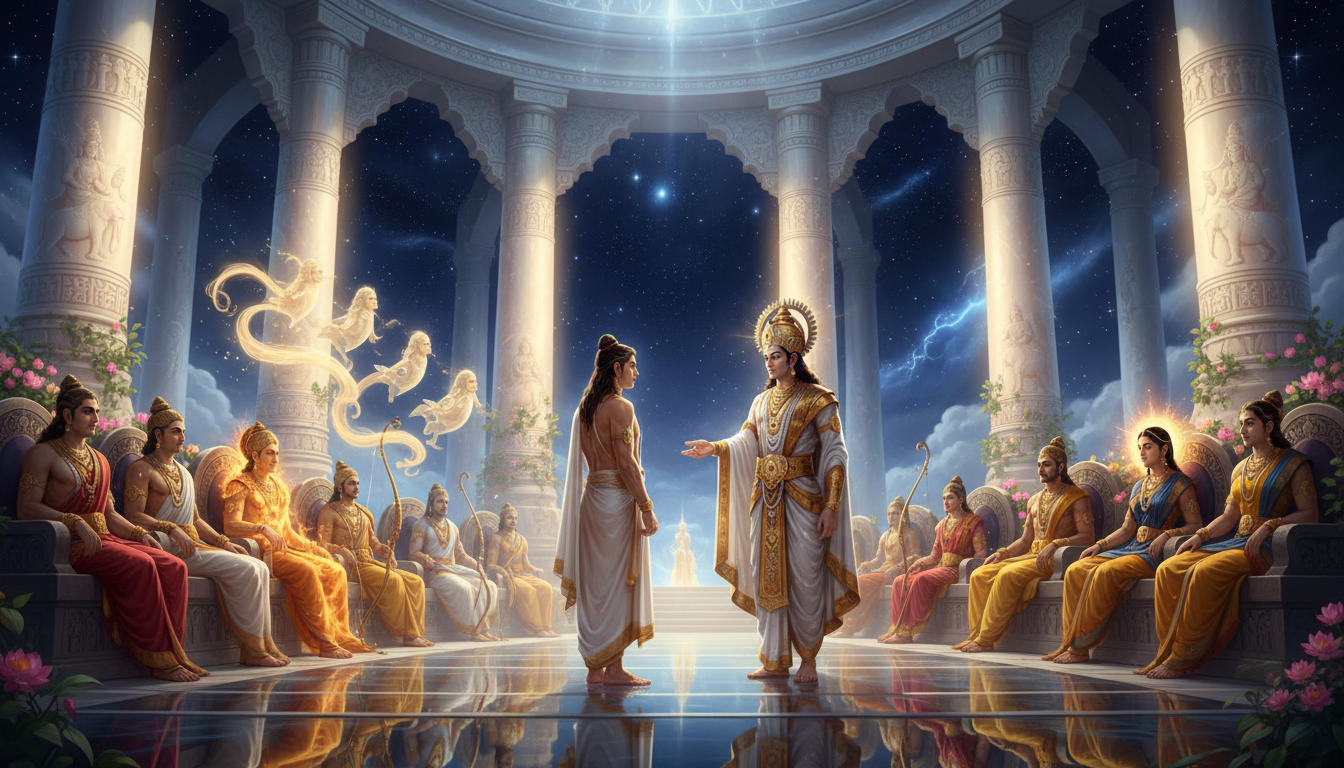
Divested of All His Enmities
Vaishampayana said: Having bathed in the celestial river Ganga, sacred and sanctifying and ever adored by the Rishis, that royal sage cast off his human body.
He had come a long way to do it. He had been shown Duryodhana on a throne and had turned around and refused the place. He had walked a road stinking of corpses to stand beside voices that said, I am Karna, I am Bhimasena, I am Draupadi, and had told the messenger of the gods to go back and say that he would stay there. He had been informed that the whole of it was the third and last of his father's tests, and he had passed it by failing to be reasonable.
Now he went into the water of the heavenly Ganga, and came out of it in a celestial form, and in consequence of that bath he was divested of all his enmities and of his grief. Not consoled. Divested. The thing was taken off him like a coat.
Surrounded by the deities, accompanied by Dharma, with the great Rishis uttering his praises, the Kuru king Yudhishthira then proceeded from that spot, and he reached that place where those foremost of men, the Pandavas and the Dhartarashtras both, freed from human wrath, were enjoying each his respective status.
The first thing he saw there was Govinda, endued with his Brahma-form. It resembled that form of his that had been seen before, on a chariot between two armies, and therefore it helped the recognition. He was blazing in it, and adorned with the celestial weapons, the terrible discus and the others, each of them standing beside him in its own embodied form, the way retainers stand.
And Phalguna was there, blazing too, adoring him. The son of Kunti beheld the slayer of Madhu also in his own form, and the two foremost of Beings, who were adored by all the gods, saw Yudhishthira come in, and received him with proper honours, as hosts do.
A Dozen Suns
In another place, the delighter of the Kurus beheld Karna.
That foremost one among all wielders of weapons was sitting there resembling a dozen Suryas in splendour, which is a thing the epic says of no one else, and Yudhishthira had last seen him in the dark on a road of corpses, calling out his own name in a voice of pain.
In another part he beheld Bhimasena of great puissance, sitting in the midst of the Maruts and endued with a blazing form. He was sitting by the side of the God of Wind in his embodied form, and anyone who had ever watched Bhima come across a field would have said that this was where he belonged and had probably been all along.
In the place belonging to the Ashvinis, the delighter of the Kurus beheld Nakula and Sahadeva, each blazing with his own effulgence: the two who had been born to Madri out of the physicians of heaven, and who had spent a lifetime being the handsome one and the clever one at the end of a line of five.
Yudhishthira went from one to another of them like a man walking through a house he has lived in and finding that every room has been rebuilt to a plan he was never shown.
They were not in one place, as a family sits. They were distributed: this one among the Maruts, those two with the Ashvinis, that one shining like twelve suns by himself. Each had gone back to the household he had come out of, and the household he had come out of was in every case not the one at Hastinapura.
This One Is Sree Herself
Then he beheld the princess of Pancala, decked in garlands of lotuses.
Having attained to Heaven, she was sitting there endued with a form possessed of solar splendour, and King Yudhishthira suddenly wished to question her. He had a great many questions. He had had them for a long time, and most of them began with the same word, which was why, and were addressed to himself.
He did not get to ask any of them. The illustrious Indra, the chief of the gods, spoke first.
"This one is Sree herself," he said. "It was for your sake that she took birth, as the daughter of Drupada, among human beings, issuing not from any mother's womb, O Yudhishthira, endued with agreeable perfume and capable of delighting the whole world. For your pleasure, she was created by the wielder of the trident. She was born in the race of Drupada, and was enjoyed by you all."
Issuing not from any mother's womb. Everybody at Kampilya had known that much: she had come up out of the fire of a sacrifice already grown, full-formed, dark and perfumed, beside a brother who had been made to kill Drona. What nobody had said, in all the years of the dice hall and the forest and the year of hiding and the war, was the other half of it: that she was Prosperity, the goddess herself, and that the whole business of the five husbands and the single garland had been arranged by Shiva before any of them were born.
"These five highly blessed Gandharvas," Indra went on, indicating five young men endued with the effulgence of fire, "were, O king, the sons of Draupadi and yourself."
The boys killed in their beds by Drona's son on the last night of the war. Yudhishthira looked at them and they were Gandharvas, and had been Gandharvas the whole time, including on the night they were dragged out from under their blankets by the hair.
The Son of Surya, Your Eldest Brother
"Behold Dhritarashtra, the king of the Gandharvas, possessed of great wisdom," said Indra. "Know that this one was the eldest brother of your sire."
The blind king was not blind. That was the first thing to be said about him and the epic does not stop to say it.
"This one is your eldest brother, the son of Kunti, endued with the effulgence of fire. The son of Surya, your eldest brother, the foremost of men, even this one was known as the son of Radha. He moves in the company of Surya. Behold this foremost of Beings."
It was said in one breath, twice, so there could be no mistake: your eldest brother, and again, your eldest brother. Karna sat in the light of the god who had fathered him, and travelled with him, and the man being told this had already carried the knowledge for a great many years and had never once been able to put it down.
Yudhishthira had said what it did to him, out loud, in front of the assembled gods, only a little while before.
"At the time of performing the water rites after the battle, I heard my mother say, do you offer oblations of water unto Karna. Since hearing those words of my mother, I am burning with grief. I grieve also incessantly at this, ye gods, that when I marked the resemblance between the feet of my mother and those of Karna of immeasurable soul, I did not immediately place myself under the orders of that afflicter of hostile ranks. Ourselves joined with Karna, Shakra himself would have been unable to vanquish in battle. Alas, his relationship with us being unknown, I caused him to be slain by Arjuna."
That was the wound he had brought up out of the world with him, and he had brought it through a river that takes enmity and grief off a man, and here at the end of it he was being introduced to his brother formally, by the king of the gods, in a hall where nobody was going to argue about anybody's caste.
Where Each of Them Was Sitting
The chief of the gods went on down the hall, naming them, and it was the strangest muster ever read out over that war.
"Among the tribes of the Sadhyas, the gods, the Viswedevas and the Maruts, behold, O king of kings, the mighty car-warriors of the Vrishnis and the Andhakas, those heroes having Satyaki for their first, and those mighty ones among the Bhojas."
"Behold the son of Subhadra, invincible in battle, now staying with Soma. Even he is the mighty bowman Abhimanyu, now endued with the gentle effulgence of the great luminary of the night."
The boy who had been surrounded by six chariots at the age of sixteen because he had been taught the way into a formation and not the way out, was sitting in the moon's light, and it suited him, and his father was in the same hall and could see it.
"Here is the mighty bowman Pandu, now united with Kunti and Madri. Your sire frequently comes to me on his excellent car."
A man who had been forbidden by a curse to touch either of his wives was sitting with both of them, and drove up to Indra's house for visits.
"Behold the royal Bhishma, the son of Santanu, now in the midst of the Vasus. Know that this one by the side of Brihaspati is your preceptor Drona."
The grandsire had gone back among the eight Vasus, which was the company he had been born out of when Ganga carried him, and which is a story the Kurus had been telling for four generations without ever expecting to see the end of it confirmed.
"These and other kings, O son of Pandu, who had warred on your side now walk with the Gandharvas, or the Yakshas, or other sacred beings. Some have attained to the status of Guhyakas. Having cast off their bodies, they have conquered Heaven by the merit they had acquired through word, thought and deed."
The Question at the Sacrifice
Janamejaya said: "Bhishma and Drona, those two high-souled persons, king Dhritarashtra, and Virata and Drupada, and Sankha and Uttara, Dhrishtaketu and Jayatsena and king Satyajit, the sons of Duryodhana, and Shakuni the son of Subala, Karna's sons of great prowess, king Jayadratha, Ghatotkacha and others whom you have not mentioned, the other heroic kings of blazing form: tell me for what period they remained in Heaven. Was theirs an eternal place there? What was the end attained to by those foremost of men when their acts came to an end? I desire to hear this, and therefore have I asked you. Through your blazing penances you see all things."
It was a sharper question than it sounds. Heaven, in this account, is not a destination and not a reward. It is a lodging, and it is paid for out of a stock of merit that runs down like oil in a lamp. The boy king wanted to know what happens at the bottom of the lamp.
Vaishampayana said: "Every one, O king of men, is not capable of returning to his own nature at the end of his deeds. Whether this is so or not is, indeed, a good question asked by you. Hear, O king, this which is a mystery of the gods. It was explained to us by Vyasa of mighty energy, of celestial vision and great prowess, that ancient ascetic, the son of Parasara, who is of immeasurable understanding, who is omniscient, and who therefore knows the end attached to all acts."
Then he gave the list, and it is the last list in the epic, and it is not a list of who won.
Each Went Back Where He Came From
Bhishma of mighty energy and great effulgence attained to the status of the Vasus. Eight Vasus, said Vaishampayana, are now seen. He had been the eighth of them once, cursed to be born a man, and the count in the sky was correct again.
Drona entered into Brihaspati, that foremost one of the descendants of Angiras: the teacher of the gods took back the teacher of the Kurus, and the man who had been born in a pot and had gone begging to Drupada for a cow was a portion of the preceptor of Heaven.
Hridika's son Kritavarma entered the Maruts. Pradyumna entered Sanatkumara, whence he had issued.
Dhritarashtra obtained the regions, so difficult of acquisition, that belong to the Lord of treasures. Kubera's country, the wealth of the north, given to the king who had held a kingdom for sixty years without ever seeing it. And the famous Gandhari obtained the same regions with her husband, which is the only sentence in the whole epic that puts those two anywhere pleasant, and it puts them there together, which is what she had chosen at the beginning by tying the cloth over her eyes.
With his two wives, Pandu proceeded to the abode of the great Indra.
And then a long roll of them, said quickly, the way names are read at a rite: both Virata and Drupada, king Dhrishtaketu, as also Nishatha, Akrura, Samva, Bhanukampa, and Viduratha, and Bhurishrava and Sala and king Bhuri, and Kansa, and Ugrasena, and Vasudeva, and Uttara that foremost of men with his brother Sankha. All these foremost of persons entered the deities.
Kansa is in that list. The tyrant of Mathura, who threw six infants against a stone and waited nineteen years for the seventh, goes back into a god along with Vasudeva, whose children they were. Nobody comments. The accounting is not moral. It is simply a return of borrowed things.
Karna Into Surya
Soma's son of great prowess, named Varchas of mighty energy, became Abhimanyu, the son of Phalguna, that lion among men. Having fought, agreeably to Kshatriya practices, with bravery such as none else had ever been able to show, that mighty-armed and righteous-souled being entered Soma. The moon had lent his son on terms, for a fixed number of years, and had them back.
Slain on the field of battle, Karna entered Surya.
That is the whole of the sentence. The man who stood in the water every morning with his hands raised to the sun and gave away whatever was asked of him at that hour, who had his armour cut off his body and handed it over on that riverbank, who was refused by his teacher and mocked in the assembly and named after a woman who had pulled him out of a river, went up into the sun. Nobody argued about his caste on the way in.
Shakuni obtained absorption into Dwapara, who is the die of the losing throw and the age that was ending, and it is difficult to think of a more exact place to put him.
Dhrishtadyumna went into the deity of fire, out of which he had walked at Kampilya with a bow in his hand and Drona's death already written on him.
The sons of Dhritarashtra were all Rakshasas of fierce might. Sanctified by death caused by weapons, those high-souled beings all succeeded in attaining to Heaven.
Both Kshattri and king Yudhishthira entered into the god of Righteousness, which is to say that Vidura and Yudhishthira turned out to be the same being twice: Dharma, wearing a servant's son in one place and a king in another, arguing with himself across a hall for eighteen years about what ought to be done.
The holy and illustrious Ananta, who had taken birth as Balarama, proceeded to the region below the Earth, and through the command of the Grandsire, aided by his Yoga power, supported the Earth.
Vasudeva was a portion of that eternal god of gods called Narayana. Accordingly, he entered into Narayana.
Sixteen thousand women had been married to him as his wives. When the time came they went down and plunged into the Sarasvati, and cast off their human bodies there, and re-ascended to Heaven, and transformed into Apsaras they approached the presence of Vasudeva. They had come out of a mountain fort in Pragjyotisha, taken as spoil, and they went out through a river, and came up on the other side as something that does not die.
Those heroic and mighty car-warriors, Ghatotkacha and others who were slain in the great battle, attained to the status, some of gods and some of Yakshas. Those that had fought on the side of Duryodhana are said to have been Rakshasas. Gradually, said Vaishampayana, they have all attained to excellent regions of felicity, some to the abode of Indra, some to that of Kuvera of great intelligence, and some to that of Varuna.
The Boy King Filled With Wonder
Sauti said: Hearing this, at the intervals of the sacrificial rites, king Janamejaya became filled with wonder.
He was a young man sitting at a fire that had been lit to burn every snake in the world, because a snake had killed his father. He had been talked out of finishing it by a boy of the serpent race named Astika, and the fire was still going in front of him while he listened. The sacrificial priests then finished the rites that remained to be gone through. Astika, having rescued the snakes from fiery death, became filled with joy. King Janamejaya gratified all the Brahmanas with copious presents, and thus worshipped, they returned to their respective abodes. Having dismissed those learned Brahmanas, the king came back from Takshasila to the city named after the elephant.
He had asked for the story of his great-grandfathers and had been given, at the very end of it, a different thing: not a judgment, and not a moral, but an inventory.
The gods of Heaven, said Vaishampayana, came to this world for sport. Having achieved their task, they ascended once more to Heaven.
The whole war, read backwards from that hall, is a company of players putting down borrowed masks. The Vasu is a Vasu again. The teacher goes back into the teacher of the gods. Prosperity, who had been walked out of an assembly hall by the hair, sits in her own form wearing lotuses. The sun's son sits in the sun. The eight sons Ganga drowned in a river and the six Devaki lost against a stone and the five Draupadi lost in a single night are all standing in one room, in their own shapes, and none of them are angry, because there is no enmity in that place and there never was any at the bottom of it.
And the thing that was actually lost, which is the forty years of ordinary human misery in between, is not given back to anybody. It is only, at the very end, explained.
Dharma Lesson
The last accounting is not a verdict on anyone but a restoration: every actor is handed back the self he set down in order to play a part. Kansa goes into a deity in the same breath as Vasudeva, and nobody comments, because the reckoning is a return of borrowed things rather than a judgment. What is never given back is the ordinary human misery of the years in between; it is only, at the end, explained.