Eight Lights Upon the Mountain
Before the Kurus had a name, before Hastinapur rose beside the Ganga, the slopes of Himavat belonged to gods who walked there as freely as deer. Among them came the eight Vasus, bright attendants of Indra's court, each a personification of some elemental glory - fire, wind, the pole star, the dawn - wandering the high forests with their wives beside them, as carefree as any family out for a season's ramble.
Their path crossed that of the sage Vashishtha, whose hermitage stood folded into a green valley of Himavat, fed by cold streams and watched over by deer that did not fear him. In that hermitage grazed a cow unlike any other: Nandini, daughter of the celestial cow Surabhi, who granted whatever her keeper wished for and asked for nothing but his care in return. She was Vashishtha's wealth and his peace, tended with the devotion a sage gives to nothing else.
Among the eight Vasus was Dyaus, the sky itself given form, and his wife's eye fell on Nandini as they passed the hermitage. She had a mortal friend, a queen who longed for such a cow, and she pressed her husband to take it for her sake - not from need, for the gods lacked for nothing, but from the simple wish to please someone she loved. Dyaus hesitated, knowing whose cow this was and what her theft might cost, but his brothers, drawn in by affection and by the thoughtlessness of beings who had never been made to answer for anything, agreed to help him. Between them they drove Nandini from the hermitage grounds while Vashishtha was away at his devotions, and vanished back into the high passes, laughing at how easily it had been done.
It was the kind of crime that only the very powerful commit without a second thought: not cruelty, not even greed, but a small indulgence taken because the taking cost the takers nothing they could see. They did not yet know that the sage whose peace they had disturbed could see a great deal further than they did.
The Sage Returns
Vashishtha came back from his prayers to find the hermitage grounds empty where Nandini should have stood grazing. He needed no messenger to tell him what had happened; a sage of his attainment could look across the world with the eye of meditation, and what he saw angered him more than the theft itself. Eight gods, sworn to uphold order among lesser beings, had stolen from a hermit's grove as if his devotion counted for nothing against their whim.
He did not rage as a wronged man rages. His anger settled into something colder and more exact, the anger of a man who has spent a lifetime mastering himself and now turns that same discipline toward judgment. He pronounced that the eight Vasus, who thought themselves untouchable in their divinity, would be born into mortal wombs and live out mortal lives, subject to the hunger, sickness, and grief they had never once had to consider.
Word of the curse reached the Vasus before it could be undone, and they returned to the hermitage in genuine fear, not of death, which held no terror for them, but of the long, grinding weight of a human lifetime. They pleaded with Vashishtha, admitting the theft had been folly, a moment's indulgence bought at a price they had not stopped to reckon. The sage, whose severity was never cruelty, allowed his judgment to bend where bending was possible. Seven of the eight, he said, had been accomplices only, drawn in by loyalty rather than desire, and so their sentence would last a single year of mortal life before they were released back to their own nature.
But Dyaus was different. He had wanted the cow's power for his wife's friend, had known the risk, and had let his brothers share a danger that was properly his alone. For him the sage fixed a harder fate: a long human life, stretching across decades rather than a single year, and within it a deliberate emptiness - no wife who would be his by right, no son to carry his name forward when he died. It was the one theft made by desire, and so it alone would be paid for at length.
A Bargain With the River
Cursed but not abandoned, the eight Vasus turned to a resource no ordinary being could call upon: Ganga, the river goddess, who moved as easily between heaven and earth as they themselves once had. They came to her with the shame of gods asking a favor of one who had watched their fall, and laid out their trouble. Seven of them needed only to be born and released quickly, without lingering in a mortal body longer than the sentence required. Dyaus alone would have to live the curse out in full, but even he asked that his portion of suffering be no greater than duty demanded.
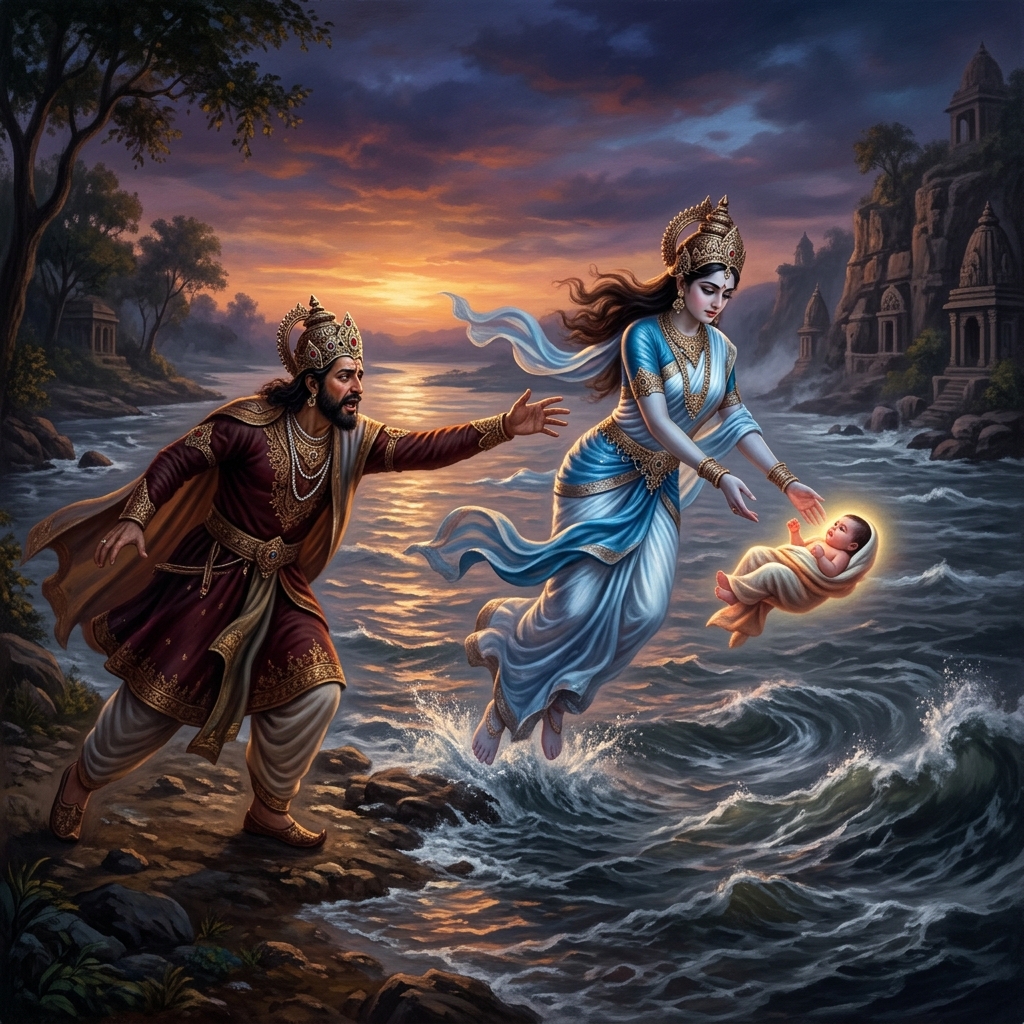
Ganga heard them and agreed to a bargain that only a river goddess could keep. She would take a mortal husband on earth, bear the eight as her sons, and as each was born she would carry the child to the water and drown him at once, returning him instantly to his true, undying nature before the curse could properly take hold. Seven births, seven swift returns to heaven - a debt paid in the space between a breath and a splash, so brief that the mortal world would barely register it as loss.
For the eighth, for Dyaus, the arrangement would differ, since his sentence could not be shortened by a river's mercy alone. Him she would keep, raising the child as far as his mortal span required him to be raised, so that the fullness of the curse - the long life, the solitude, the absence of a wife and a son of his own - could be lived out as Vashishtha had ordained. The Vasus accepted gratefully, grief already folded into their relief, for even a single mortal life among them would carry sorrow enough to remember.
How Ganga kept that bargain on the banks of the river that bears her name, drowning seven infant princes before their father's grief-stricken eyes and sparing only the eighth, belongs to another telling. It is enough here to know that the debt struck on this mountainside, in a single careless afternoon, had already begun to write itself into the fate of a kingdom not yet founded.
The Kept Son
The eighth Vasu, Dyaus, was the one Ganga did not carry to the water. He grew instead into the world he had been sentenced to, first as her son and then, in time, as the prince his mortal father recognized and claimed: the one history would come to know as Bhishma, terrible in vow, of the Kuru line. Of the drownings that came before him, of the queen's grief and the king's forbidden question that finally stopped her hand, the story belongs elsewhere; it is enough to know that he alone was permitted to live the human span the sage had measured out.
What Vashishtha had pronounced in anger on a quiet hillside became, decades later, the shape of a man's entire life. Bhishma would grow into the finest warrior and statesman his age produced, wise in counsel, terrible in battle, beloved by every generation of his family in turn - and yet the curse's second clause never loosened its hold on him. No wife would ever be his by right. No son would ever call him father and carry his name into the future. He would spend his strength instead guarding thrones that were never his own, raising sons and grandsons who belonged to other men, content - or telling himself he was content - to be the pillar upon which an entire dynasty leaned, rather than the root from which it grew.
He would not remember, in his conscious mind, the mountainside or the cow or the moment his wife-that-was had asked him for a small favor. Few who live out a curse remember its origin; they only feel its weight pressing against the ordinary shape of their days, wondering sometimes why fortune withheld from them precisely the things it gave so freely to others. Bhishma's terrible vow of celibacy, the oath by which he would later renounce marriage entirely to secure his father's happiness, would seem to the world an act of pure, chosen sacrifice. In truth the world was only watching a curse complete itself, dressed in the clothing of nobility, because that is how the gods' long sentences most often reach mortal eyes - as virtue, when they are in fact debt.
The Debt Comes Due
It is worth pausing on what this story explains and what it does not excuse. Bhishma's vow - his own, given freely, on the riverbank before Satyavati's father - was a real choice, made by a real man for reasons that were entirely his own: love for his father, and a fierce, self-denying pride in keeping his word. The curse of the Vasus did not force his hand at that moment; it had already shaped the life in which such a moment became possible, arranging things so that a boy born to be wifeless and sonless would one day find himself standing at a crossroads where wifelessness and sonlessness looked, for a moment, like the highest virtue a son could offer his father.
That is how the old stories most often speak of fate: not as a puppeteer's string pulling on each limb, but as a slow current beneath the visible water, carrying a life toward the shape it was always going to take, while the person living it believes every choice is entirely their own. Bhishma's fifty-eight days upon a bed of arrows at the end of his life, waiting through the turning of the sun itself before he would let death take him, belong to that same current - the long, drawn-out mortal span the sage had measured for Dyaus so many lifetimes before, paid out to its final hour on a battlefield that did not yet exist when the curse was spoken.
What began on a green Himalayan slope as a moment's indulgence - a wife's small wish, a god's small weakness, a sage's cow led away in an afternoon - widened, generation by generation, into the frame around one of the epic's most towering lives. The lesson the tradition draws from it is not subtle, and does not need to be: an act that costs the doer nothing in the moment may still cost the world everything in the reckoning, for heaven's bookkeeping runs longer than any single lifetime can see, and what looks like a small theft upstream can become, by the time it reaches the plain below, the entire course of a river.
Dharma Lesson
A theft taken lightly by its doer can still summon a lifetime of consequence, for the world does not weigh intentions the way the heart that acted does. Even the mightiest are answerable to those they consider beneath them, and a small indulgence taken upstream can flow into an age of sorrow downstream.