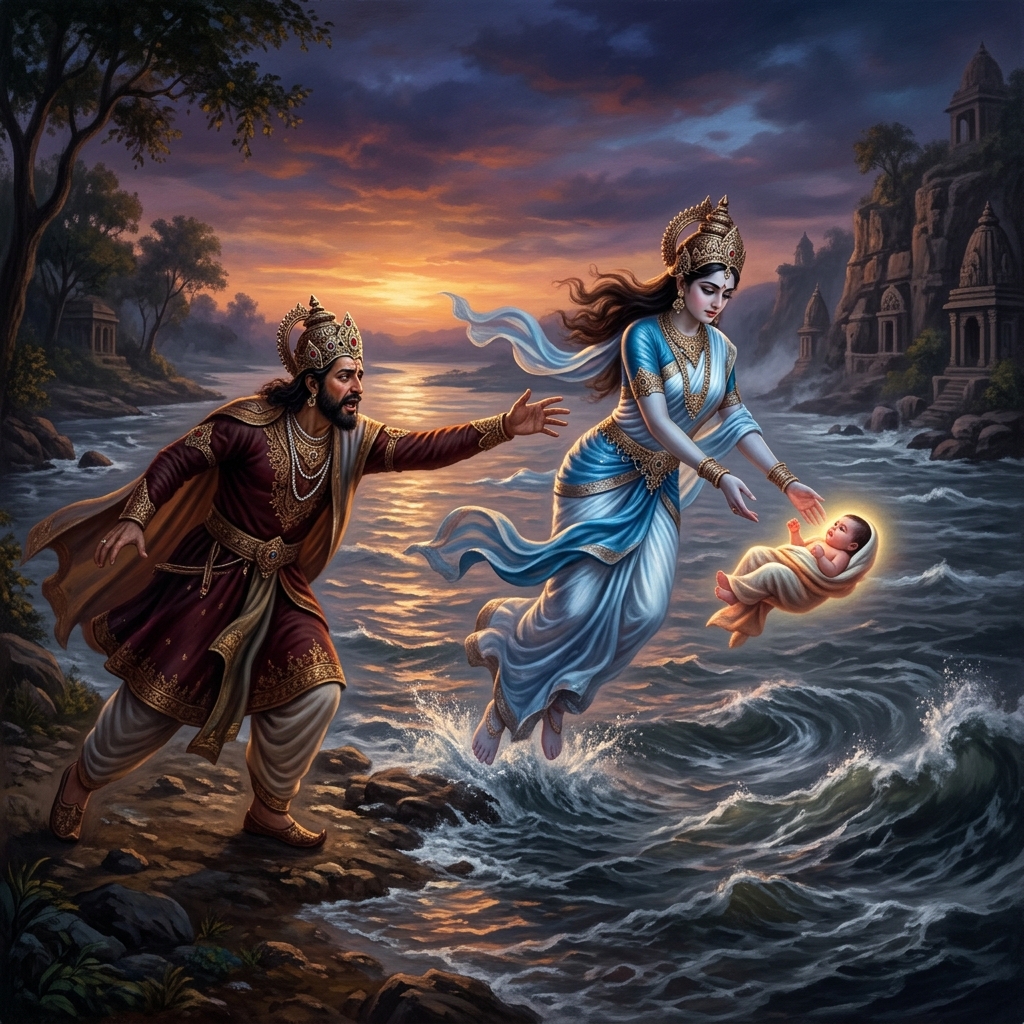
The Theft of Vashishtha's Cow
Before there was a king named Shantanu, before there was a river-queen who would break his heart eight times, there was a quarrel in the world of the gods. High above the earth dwelt the eight Vasus, radiant beings who tended the elements that hold creation together - the earth and the water, the fire and the wind, the sky and the sun, the moon and the stars. They wandered freely through the three worlds, and one day their wandering brought them, with their wives, to the hermitage of the great sage Vashishtha at the foot of holy Mount Meru.
The hermitage was a place of perfect peace. In its meadow grazed a cow named Nandini, daughter of the wish-fulfilling cow Kamadhenu. She was no ordinary animal. Whoever drank her milk, the sages said, would be freed from old age and death for ten thousand years. She shone in the grass like a small white sun.
The wife of Dyaus, the Vasu of the sky, saw the cow and was struck with longing. "Husband," she said, "who owns this wondrous creature? Whose meadow is this?"
"This is the cow of the sage Vashishtha," said Dyaus. "And this whole forest belongs to his austerity. They say her milk grants ten thousand years of unaging life to any mortal who tastes it."
His wife's eyes brightened. "I have a dear friend among mortals, a princess on the earth, beautiful and good. For her sake, my lord, take this cow and her calf. Let my friend drink the milk and never grow old. Do this for me, and there is no gift I would not give you in return."
Dyaus hesitated. He knew the cow was sacred. But love is a kind of blindness, and a husband's pride is easily steered. He called his seven brothers together and laid the request before them.
The Curse of Vashishtha
The brothers, fond of Dyaus and easily persuaded, agreed to help him. Together the eight Vasus drove Nandini and her calf away from the meadow, out of the sage's forest, taking the cow that was not theirs to take. They did it lightly, the way the powerful often do harm without weighing it, and they returned to their bright homes thinking the matter small.
Vashishtha came back to his hermitage at evening from gathering fruits and roots in the wood. He looked for Nandini in her meadow and did not find her. He searched the forest paths, calling her name, and the silence answered him. The sage was a master of inner sight; he closed his eyes, and in the stillness of his meditation he saw the whole of it - the eight Vasus, the wife's longing, the theft.
Anger rose in him, and the anger of a great ascetic is a terrible thing, for it carries the weight of all his accumulated power. "Because the Vasus, who are gods and should know better, have stolen what is sacred," he said, "they shall fall from their heaven and be born among mortals. They shall wear human flesh and know human grief."
In their high places the Vasus felt the curse settle on them like a sudden cold. Stricken, they descended at once to the hermitage and threw themselves at the sage's feet, begging his pardon. They confessed that they had wronged him and pleaded that he take back his words.
Vashishtha's heart, though stern, was not without mercy. "My word, once spoken, cannot be unspoken," he told them. "But I can soften it. Seven of you, who only followed, shall be released from your mortal bodies within a year of your birth and return to your places in heaven. But Dyaus, who instigated the deed for a woman's whim, must bear the curse in full. He shall live a long life on the earth. He shall be a man of great deeds and great renown, but he shall never marry, never father children, and never taste the ordinary joys of mortal love. That is the price of leading the others into wrong."
The Vasus bowed and accepted. But now a new fear came to them. To be born as mortals at all was a horror. Who among the women of earth would consent to bear them and then, within their first year, release them from their human shells?
Ganga Agrees to Be Their Mother
The eight Vasus, troubled and ashamed, went to the goddess Ganga, the river of heaven, whose waters fall through all three worlds and whose nature is purity itself. They told her of Vashishtha's curse and the mercy he had granted, and they made of her a strange and desperate request.
"Goddess," they said, "we must be born among mortals. We ask you to be our mother. Take human birth, marry a worthy king, and bear us as your sons. And as each of us is born, free us at once. Cast our infant bodies into your own pure stream and release us, that we may return to our places in the sky without enduring the long sorrow of a human life."
Ganga considered their plea. She was moved by their suffering, for though they had done wrong, the punishment was heavy. "I will do this," she said at last. "But I will not give myself to a man unworthy of bearing your blood. Tell me, who shall be the father of these sons?"
The Vasus had thought of this. "Among the kings of the earth," they said, "there is a line descended from the noble Pratipa. His son, Shantanu, will one day rule in Hastinapura. He is virtuous, truthful, and great-souled. Marry him, and let us be his children."
"It is well chosen," said Ganga. "I know of Pratipa and his line. I will be the queen of Shantanu, and you shall be my sons." Then she set one final condition upon the bargain, for she would not be bound forever to the world of men. "I will free you, and when the last of you is born and gone, I will return to my own nature. But the eighth, Dyaus, who must live long upon the earth - he alone I will raise, and then I shall give him back to his father, and depart."
So it was agreed. The river-goddess prepared to take a mortal queen's shape, and the Vasus, comforted, waited for the wheel of birth to turn. Far below, in the city of Hastinapura, an old king named Pratipa would soon set in motion the human half of this divine arrangement.
The Boon Granted to Pratipa
King Pratipa of the lunar line ruled in Hastinapura before his son, and for many years he had no children. Longing for a heir, he went to the bank of the Ganga and sat in deep austerity, reciting prayers and standing in meditation through the seasons, his eyes fixed on the flowing water.
One day the goddess Ganga rose from her own stream in the form of a woman of dazzling beauty, young and radiant as the blossom of the lotus. She came to where the old king sat absorbed in his devotions, and without a word she climbed onto his right thigh and seated herself there, close against him.
Pratipa opened his eyes, startled but unshaken in his composure. "Gentle lady," he said, "why have you done this? What do you wish of me?"
"I desire you, great king," she answered. "Accept me. To refuse a woman who comes to you in love is condemned by the wise."
But Pratipa was a man of perfect rectitude. "Beautiful one," he said, "I am bound by my vows. I cannot take a woman who is not of my own choosing in the proper way, nor one who comes to me thus. And there is another matter. You sat upon my right thigh. Know that the right thigh and the lap are the place reserved for daughters and for daughters-in-law. The left thigh is the place of a wife. Since you chose the right, you cannot be my wife. But you can be my daughter-in-law. I have no son yet, but when a son is born to me, I ask that you accept him as your husband. Be the bride of my son."
Ganga smiled, for this was the very arrangement she had sought. "So be it," she said. "For your sake and for the sake of the noble line of Bharata, I accept. I will marry your son when the time comes. But I set a condition upon it, and you must bind your son to honor it. He must never question my conduct, whatever I do, and he must never speak to me harshly. The day he does either, I will leave him. If he keeps this promise, I will remain with him and bring him happiness, and through me his fame shall grow." Saying this, she vanished into the river, and the old king carried her words home in his heart.
The Woman on the Riverbank
In the fullness of time a son was born to Pratipa, a boy who came into the world already serene and self-possessed, and the old king named him Shantanu, "the peaceful one," because he had earned his birth through tranquil austerity. When Shantanu came of age, Pratipa told him of the radiant woman who had appeared at the river and of the promise he had made on his son's behalf. "If a woman of surpassing beauty comes to you by the Ganga and offers herself," the old king said, "do not question her conduct, do not ask who she is or whence she comes. Accept her, and cherish her." Then Pratipa retired to the forest, leaving the throne of Hastinapura to his son.
Shantanu was a young ruler then, not yet weighed down by the throne, and he hunted often along the river Ganga, sometimes alone, his guards left at the edge of the forest. The river soothed something in him that no minister or musician could reach.
On one such morning he reined his horse at a familiar bend. A woman stood at the water's edge. Her skin was pale as river-mist; her hair fell unbound to her waist; she wore a garment the color of running water that seemed neither wet nor dry. She turned and looked at him, and the whole forest seemed to grow quiet. Shantanu's heart, accustomed to being king of itself, surrendered without resistance. He remembered his father's words, and he knew that this must be the woman of the boon.
"Beautiful one," he said, dismounting, "whether you are a goddess or a woman of the earth, I do not ask. I only ask that you be my queen. Be the wife of my heart and the lady of my house."
She did not smile, but she did not refuse. "I will marry you, Shantanu," she said, "on one condition, and you must bind yourself to it before all the unseen powers of this river. You shall never question what I do, whether it seems good to you or evil. You shall never restrain my hand, and you shall never speak to me a harsh word. The day you do any of these things, I will leave you, and you will not see me again."
He agreed without hesitation. He would have agreed to any condition. They were married that very day under the open sky, with the river itself as witness, and he brought her home to the palace of Hastinapura.
A Year of Quiet Happiness
For a year and more they lived in such happiness that the court whispered of it as something not quite mortal. The queen was as gracious as she was beautiful, attentive to her husband, gentle with his servants, dignified before his ministers. Whatever Shantanu wished, she seemed to know before he spoke it. She brought to the palace a brightness that did not fade with the seasons.
Ministers found the king patient where he had once been quick; petitioners found him generous; even his old hunting hounds slept more soundly at the threshold. The rains came when they should and the harvests were full. The kingdom flourished as if the good fortune of the king had spread outward like ripples from a stone dropped in still water.
Shantanu, for his part, never tired of her. He watched her move through the lamplit halls of an evening and could scarcely believe his fortune. He asked her nothing of her past, as he had promised, and he found that he did not need to. The present was enough. He was a man who had been given everything and had been told only that he must not be curious about how it came to him - a small price, it seemed, for such a gift.
And then she told him she was carrying his child. Shantanu's joy was complete. An heir would come to the line of Bharata; the dynasty would have its future; and the woman he loved beyond reason would be the mother of his sons. He ordered the priests to make offerings of thanksgiving and the whole city to prepare for celebration. He had no inkling, in all his happiness, of the bargain that had been struck in heaven, or of the river's patient and terrible purpose.
The First Child Returned to the River
The child was born in the dark hour before dawn, a son, perfect and whole. The queen took him in her arms, wrapped him in a single white cloth, and carried him out of the palace before the midwives had finished their work. Shantanu, woken and uneasy, followed at a distance, certain in his heart that something strange was unfolding and certain also that he could not speak.
She walked the length of the path to the river, the infant making small contented sounds against her shoulder. At the edge of the water she paused. She bent her head and kissed the child's forehead. Then she stepped into the river, walked out into the current until it reached her waist, and let the infant slip from her arms into the flowing water.
Shantanu watched his newborn son sink beneath the surface and vanish. The cry rose in his throat and stopped there. He had given his word, sworn before the powers of the river itself, that he would never question what she did. To speak now was to lose her. So he stood on the bank in the gray dawn, shaking, and said nothing.
She returned to him calm and tender as ever, her face washed of all sorrow, as though she had done something kind. She took his arm and walked back with him to the palace, and lay beside him, and he did not ask. He could not ask. He told himself there must be some reason he could not see, some meaning hidden in the act of a woman who was plainly more than mortal. But the not-knowing was a wound, and it did not close.
Seven Sons, Seven Silences
A year later there was another child, another son. And then the same walk to the river, the same pause at the water's edge, the same gentle kiss, the same letting go. And the same silent return to a husband who could not speak.
A third son. A fourth. A fifth. A sixth. A seventh.
Seven sons were born to Shantanu, and seven sons were carried to the Ganga and given to the current. The king never lifted a hand to stop her. He never asked her why. Each time, the question pressed against the back of his teeth, and each time, the memory of his oath - and the deeper, more shameful truth that he could not bear to lose her - kept his mouth closed.
The palace grew haunted by what was never spoken of. Shantanu's hair began to whiten at the temples though he was not yet old. His ministers feared to meet his eyes. Servants fell silent when the queen passed with that serene and dreadful tenderness on her face. In the city the people whispered of a curse upon the house of Bharata, of a madwoman in the palace, of a king bewitched into letting his children die.
He bore it all in silence. He told himself, in the long sleepless nights, that no woman who loved her husband as she seemed to love him could be simply cruel; that there was a purpose in it he was not permitted to know; that the price of the question was a loneliness worse than the grief he already carried. And so the years turned, and the river received son after son, and the king kept his terrible promise, and his heart wore thin as river-stone.
The Eighth Child and the Broken Promise
When the eighth child was born, another son, and the queen rose with him in her arms and turned, as she had turned seven times before, toward the door that led to the river, something in Shantanu finally broke.
He ran the length of the palace barefoot. He caught her sleeve at the gate, and his voice came out of him in a cry that was half a king's command and half a father's grief: "Stop. I beg you, stop. Who are you, that you drown your own sons one after another? What are you? Why do you do this? You are a murderess of your children - cruelest of women - and I will lose the kingdom itself before I let you take another son into that river."
She turned, the infant still in her arms. She looked at him for a long moment, and there was no anger in her eyes, only a quiet recognition that the time allotted to them had now run out. "You have spoken," she said gently. "You have questioned me, and you have called me cruel. You remember the condition. The day you did either, I told you, I would leave. I must go now. But you shall not lose this son. And before I leave you, husband, hear who I am, and who these children were, and why I did what I did. For I am not the murderess you have named me. I have been, all this while, the giver of freedom."
She led him down the familiar path and sat at the river's edge with the infant in her lap. The water lapped at her feet. The morning was very still. And the king, who had borne so much silence, sat down beside her at last to hear the truth.
The Truth of the Vasus
"I am Ganga," she said, "the river you have loved all your life without knowing my name. I came to you in a woman's form for a purpose set in heaven, and now that purpose is nearly done."
Then she told him the whole of it. "Long ago, the eight Vasus, the gods who tend the elements of the world, stole the wish-cow Nandini from the hermitage of the sage Vashishtha. The instigator was Dyaus, the eldest, who took the cow to please his wife. When the sage discovered the theft, he cursed them all to be born among mortals and to suffer the long indignity of human life. They begged his forgiveness, and he softened the curse. Seven of them, who had only followed, would be freed within a year of their birth and returned to heaven. But Dyaus, who led the others into wrong, must live a long mortal life, and never marry, and never father children, and never know the ordinary joys of a household.
"The Vasus came to me and asked me to be their mother, and to release them the moment they were born, so they would not endure the long sorrow of human years. I agreed, for their suffering moved me. The seven sons you watched me carry to the water - those were the seven Vasus. I did not drown them. I freed them. Each one I returned, pure and unaging, to his place in the sky. They are grateful to you, husband, for your silence kept the bargain and made their deliverance possible.
"But this eighth child is Dyaus himself, who must live out his long mortal life upon the earth. Him I cannot release. He is fated to be a king's son and a warrior beyond any of his age, a keeper of this dynasty when no other can hold it, a teacher and a grandsire to those who come after. And, as the sage decreed, he will never marry and never have children of his own. The curse of the cow becomes the gift of this house."
Shantanu sat with the weight of it, the seven years of silent grief turning slowly in his mind into something he could almost call mercy. His sons had not died. They had been carried home.
Ganga Takes the Boy to Raise
"This son is yours," Ganga said, "and he must live. But he cannot be raised in an ordinary way, for an ordinary life will not make the man he is meant to become. I will take him with me. I will give him to the great sages and seers of heaven to be his teachers. He will learn the four Vedas and their branches from Vashishtha himself, whose curse and whose mercy made him. He will learn the science of weapons and the use of the bow from Parashurama, mightiest of warriors. He will be schooled in statecraft, in righteousness, in every art a king's son should master. When he is grown and complete, I will bring him back to you and place him in your hands."
Shantanu's heart was torn. To lose his wife and his last son in the same hour was a grief almost too heavy to bear. But he understood now that he had been part of something larger than himself, and that the boy's destiny was not his to keep. "His name," Ganga said, looking down at the child, "is Devavrata, for he is devoted to a great vow that is yet to come. Raise no monument to your sorrow, Shantanu. You will see him again, taller than this gate and worthy of this throne."
She rose with the infant in her arms. She looked once at the king who had loved her past all reason and kept his promise past all endurance, and there was a tenderness in her face that was not part of any bargain. Then she stepped into the river. The current rose to meet her. The bright water closed over her hair, and she was gone, and the boy with her, and the bank where she had stood was only wet stone and morning light.
Shantanu walked home alone. He did not weep, for he had spent his tears across seven dawns. He ruled his kingdom and spoke of his queen to no one, and he carried in him the strange double burden of a man who has lost everything and been told that the loss is a kind of keeping.
The Return of Devavrata
The years passed in Hastinapura. Shantanu grew older and more solitary, and the memory of the river-queen faded into a private ache he showed no one. He did not marry again, and the throne had no certain heir, and the ministers murmured of the future. The king hunted still along the Ganga, but the bend in the river where he had met her he avoided, for it was too full of ghosts.
Then one day, drawn by something he could not name, he followed the river farther than usual and came upon a wonder. The Ganga, which had always flowed deep and wide at that place, ran shallow and divided, as though a great force had checked it. And there, where the water parted, stood a youth of astonishing beauty and bearing, tall and strong as a young god, holding a bow that seemed made for the hands of heroes. The boy was loosing arrows so swift and so many that they dammed the very current of the river and held it back.
Shantanu stood and watched him, struck with a strange longing he did not understand, and the youth, seeing the king, vanished from sight. The king prayed in his heart for the goddess to reveal what this meant. And Ganga rose from her stream, holding the young man by the hand, in a form the king remembered with a pang that had not dulled in all the years.
"Shantanu," she said, "here is the eighth son I bore you, the child of the river. I have raised him and had him taught by the greatest of sages. Vashishtha himself instructed him in the scriptures; Parashurama taught him the arts of war. He is master of the bow and the Veda alike. Take him now, your son and your heir, and let him bear the name his deeds will earn. He has been Devavrata. The world, in time, will know him by another name."
She placed the young man's hand in his father's hand, and then, as she had always done, she returned to the water and was gone. Shantanu, his heart full past speaking, embraced his son and brought him home to Hastinapura, and crowned him crown prince that very day. So the cursed Vasu came at last into his long mortal life - and Devavrata would one day take a vow so terrible and so unbreakable that men would forget his birth-name altogether and remember him forever as Bhishma, the dreadful one, the grandsire of the house of Bharata.
Dharma Lesson
A vow is heavier than grief. Shantanu kept his word through seven sons drowned, and the kingdom he could not have imagined came of it. Curses, too, are not always punishments - sometimes they are doorways to a duty larger than the cursed knew they could carry. Ganga drowned her children to free them. Mercy can wear a face that looks, from outside, like cruelty.