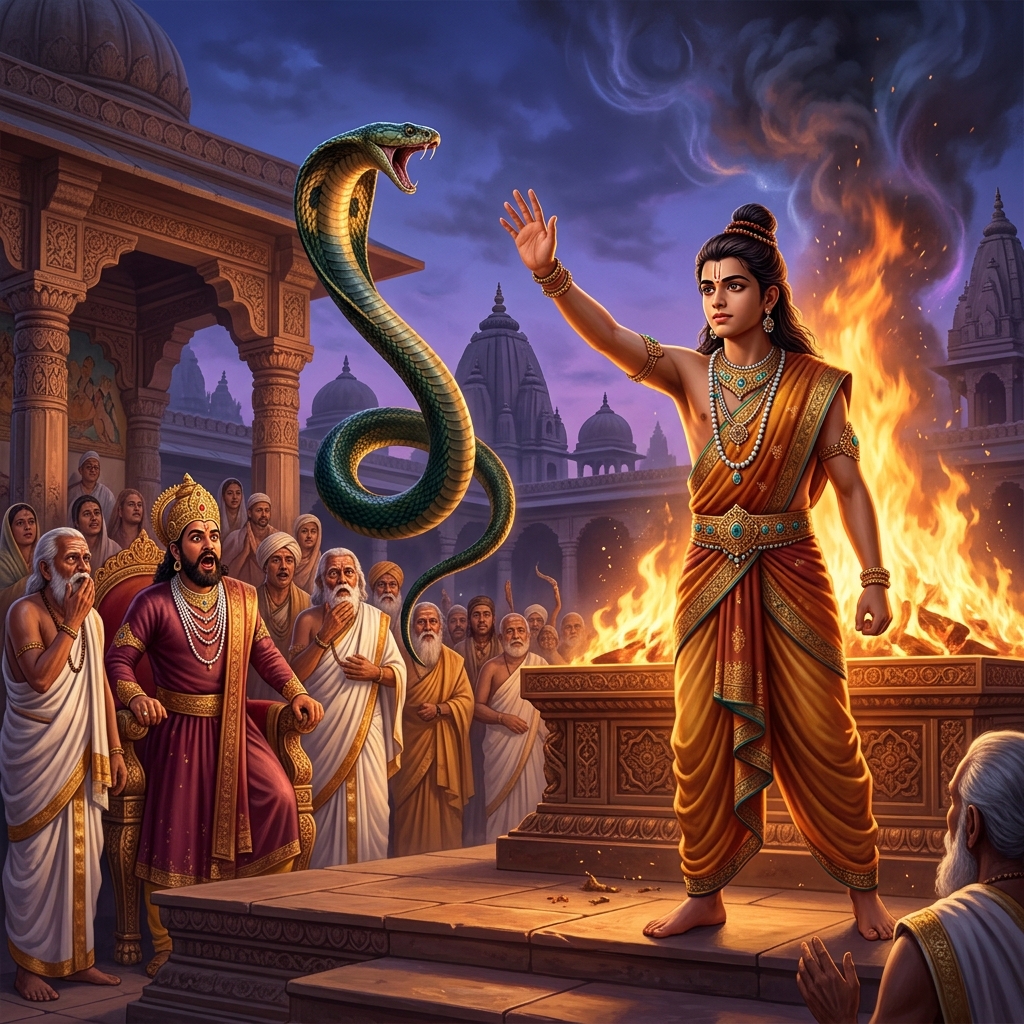
The Debt at the Fraying Root
Jaratkaru owned nothing. Not a hut, not a change of cloth beyond what covered him, not even a settled name he answered to twice in the same village, for he never stayed long enough for a name to matter. He had renounced marriage along with every other tie a man could form, choosing instead the ascetic's discipline of wandering, fasting, and a solitude so complete that even other hermits found him difficult to keep company with. He believed, with the confidence of a man who has never been tested on the point, that he owed nothing to anyone he had not chosen to owe.
He believed this until the day his own austerities opened a door he had not meant to open, and he saw, hanging head-down over a black pit, a row of figures he recognized before he understood why. They were gaunt, ash-colored, suspended by a single rope of grass so worn it had frayed to one last strand, and gnawed steadily, without hurry, by a rat that never stopped chewing.
"Who are you," Jaratkaru asked the shades, though something in his chest had already answered before they spoke, "and what rope holds you over that pit?"
"We are your ancestors," they said, and their voices carried the particular exhaustion of the long-damned rather than the fury of the newly wronged. "The rope is Time, and the rat that gnaws it is also Time, for Time takes no rest and needs no second creature to do its work. We hang here for want of a descendant to perform the rites that would let us fall, at last, into whatever rest is owed the dead. We had a son once. He renounced the world before he thought to give us sons of his own, and so the line ends with him, and so we hang."
Jaratkaru did not need to ask the son's name. The pit's darkness had already told him.
Marriage on Impossible Terms
He returned to his wandering a changed man, though nothing in his outward habits changed at all. He still owned nothing, still slept where night found him, still fasted according to a discipline no one had ever seen him break. But he had made himself one promise, spoken aloud so that no forest, no river, no passing sage could claim later that he had not been warned: he would marry, if the world could ever produce a bride who met his terms, and he set the terms deliberately at the edge of the impossible, because a renunciate who has just seen his ancestors gnawed by the rat of Time still does not wish, in his heart, to be married.
The bride, he announced to whichever trees would carry the message, must bear his own name - Jaratkaru, exactly, no variant softened for a woman's mouth. She must be given to him freely, by a guardian willing enough to offer her without being asked twice. And he would never keep her against her will for one day longer than she wished to stay.
He expected these terms to protect him from the debt rather than discharge it. No family, he reasoned, names a daughter after a stranger's austerities, and no father gives a daughter to a man who promises, in the same breath as his proposal, that he may leave at any provocation.
He had reasoned correctly about every family in the world of men. He had not accounted for Vasuki, king of the nagas, who came to him in the forest with a request phrased as a rescue and a rescue phrased as a request, and who knew a name that matched Jaratkaru's own condition exactly, because he had given that name to his own sister at her birth, long before he understood why.
A Bride Named Like Himself
"My sister is named Jaratkaru," Vasuki said, without preamble, the way kings speak when they have rehearsed a plea too many times to soften it further. "I have kept her unmarried for years past the age our customs consider decent, waiting for a man whose name matched hers, because a seer once told me only such a marriage could produce the son our people need."
He did not hide the danger behind the request. Ages before, the serpent race had been cursed by their own mother Kadru in a fit of temper over a wager lost to her sister Vinata, doomed to perish in a sacrificial fire a king not yet born would one day kindle to avenge his father - a doom only a single unborn child could interrupt, a son wise enough to beg that same king to let the fire go out before it consumed every last snake in the world (astika_and_the_snake_sacrifice).
"I do not ask you to save my race today," Vasuki said. "I ask only for a son, and I offer you exactly the bride your own vow described, freely given, never to be kept against her will."
Jaratkaru had built his conditions to be unmeetable. He found, standing before Vasuki in Nagaloka's jeweled halls, that he had instead described this exact woman with unsettling precision, and a vow spoken aloud to protect himself from marriage had become, without his intending it, an appointment he could not honor himself by refusing.
He married her that same day, in Nagaloka's court, with Vasuki himself giving her hand as her own vow-bound guardian. He set one further condition before the wedding fire had cooled: she must care for him exactly as he required, without complaint, or he would leave the instant she failed - a harsh term for a bride, but the only kind of household a man who owns nothing knows how to keep.
The Sleep He Should Not Have Kept
For a time the marriage held. Jaratkaru's wife learned his rhythms - the hours he prayed, the exact posture he required his food set down in, the silence he needed around his meditations - and kept them without complaint, because Vasuki's warning to her had been as plain as Jaratkaru's warning to Vasuki: fail him once, and he goes.
One afternoon, worn from his devotions, Jaratkaru fell asleep with his head in her lap before the sun had set, and the hour for his evening rites approached while he slept on, undisturbed. His wife faced an impossible choice with no time to weigh it. To wake an ascetic mid-sleep was its own discourtesy, one that could sour a lesser man's temper for a week. To let the sun go down unmarked, and his rites unperformed, would be a graver failure by his own declared terms. She chose, in the end, the gentler wrong: she let him sleep rather than risk his anger, and told herself the sun's setting was a small thing beside a husband's rest.
He woke to full darkness and a fire unlit at its proper hour, and did not ask which choice had cost him more before deciding it had cost him enough.
"You let the sun set on my discipline," he said, rising. "I told you the terms before you married me. I will not stay a day past the first failure, however kindly meant."
She did not argue the fairness of it. She had married a man whose only promise had been the shape of his own leaving, and she had known, from the wedding fire onward, that this morning or some morning like it was always coming.
Asti - The Child Exists
"Before you go," she said, standing in the doorway of the home that had lasted exactly as long as her first mistake, "there is one thing you should know, so that you do not leave believing your promise to your ancestors goes unkept."
Jaratkaru, already turned toward the forest, stopped.
"I am carrying your son," she said.
He said only one word in answer, and it was the word that would become the child's name for the rest of his life: "Asti." The child exists.
It was not affection that made him say it, or not affection alone. It was the debt finally, unmistakably, discharged - the ancestors he had seen gnawed by the rat of Time would have their descendant after all, a son to perform the rites that let the dead fall from their fraying rope into rest. Jaratkaru had built a marriage designed to fail on the first small unkindness, precisely because he wanted to return to his wandering the moment the debt to the dead was paid and not one hour later. His wife's single act of gentleness, letting him sleep rather than waking him, had given him exactly the excuse his vow required, and had, in the same breath, given the ancestors exactly what they needed.
He left that same hour, back into a forest that asked nothing of him and owed him nothing in return, and did not turn to see whether she watched him go. The son born from that one broken evening would grow into the sage Astika, wise enough to walk into a king's sacrificial fire and beg, successfully, for the lives of every remaining snake in the world (astika_and_the_snake_sacrifice).
Even a man who has renounced every tie in the world, Jaratkaru's story insists, still owes the dead a future. Some debts do not care how empty a renunciate's hands are - only that, in the end, they are paid.
Dharma Lesson
Renunciation does not erase the debts a soul is born owing - not to gods, not to teachers, and least of all to the ancestors whose future depends on a descendant's willingness to marry and father a child. Jaratkaru's vow was built to fail, yet even his reluctant, joyless marriage discharged an obligation no austerity alone could satisfy. Dharma sometimes asks less for love than for simple continuation.