The City Named for an Elephant
Long before the quarrel, before the vows and the dice and the burning of forests, there was a bend in the Ganga where the ground rose high enough to keep its feet dry when the river came up in the rains. A king of the line of Puru came to that rise with his people, his herds and his elephants, and there he set the first stones. His name was Hastin, and hastin is the word for elephant, and so the city that grew on the bank was called Hastinapura, the City of the Elephant.
The name fit the place. The Kuru kings bred elephants on the flood meadows below the walls, and at dusk the beasts were driven down to the water in long grey lines while the herdsmen sang to keep them steady. A traveller coming up the trunk road from the south saw first the dust of that herd, then the ramparts above the dust, then the terraces and white towers behind the ramparts, and last of all the great gate with its carved elephants standing on either side of the road.
Behind the wall lay a city built by a dynasty that meant to last: streets laid straight to the four directions, a moat fed from the river, market squares heaped with cloth and grain and iron, gardens and tanks and temples, and at the center of it the assembly hall of the Kurus, where the elders sat and the king's word became law.
Everything in this history happens because of that hall and that throne. Kings are made there and unmade there. Vows are sworn there that bind men for a lifetime. A queen is dragged into it by the hair. An envoy who is more than a man stands in it and is refused. Armies march out of its gates and do not march back.
And the Ganga runs past all of it, patient and indifferent, the same river in every generation. She gave the city its first great queen. In the end, tradition says, she took the city itself.
The King and the River
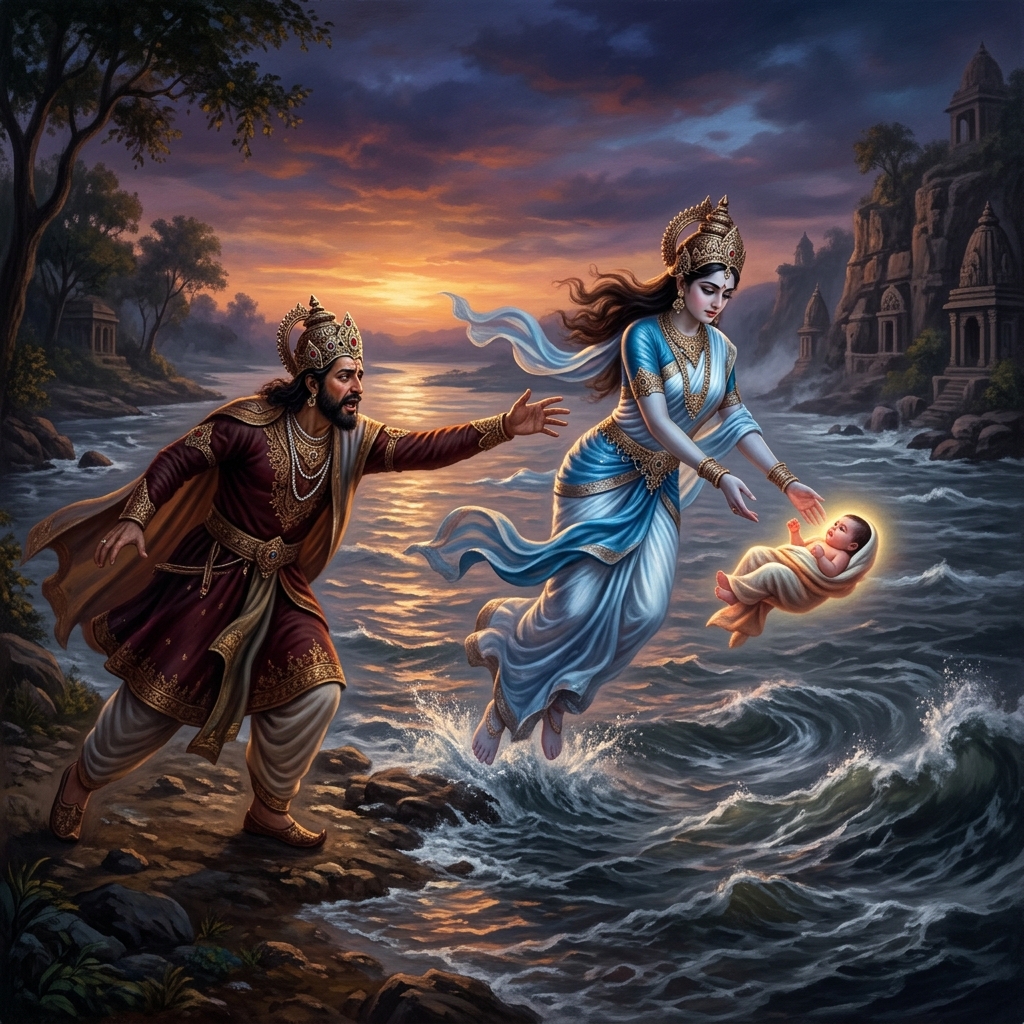
Shantanu ruled in Hastinapura when the line of Puru was already old, and he went down often to hunt along the water. On one such morning he saw a woman standing on the bank in the early light, and the sight of her emptied his mind of everything else.
'Whoever you are,' he said, 'goddess or gandharvi or some king's daughter, be my queen.'
'I will,' she answered, 'on one condition. You must never check me, and never ask me why I do what I do, however cruel it looks to you. On the day you question me, I leave.'
He agreed, because men in love agree. She bore him eight sons, and seven of them she carried down to the water and gave to the river as soon as they were born, and Shantanu, remembering, said nothing. At the eighth he could not hold his tongue, and the words broke the bargain. Then she told him who she was: Ganga herself, and the children the eight Vasus, cursed to be born as men and begging her to set them free quickly. The eighth she carried away to raise, and years afterward she brought him back to his father grown, a prince and an archer, and put him into the king's hands and went back into her water. That whole story is told in its own place.
The son was Devavrata, and he might have ruled Hastinapura in peace. But Shantanu's eye fell later on Satyavati, a fisher-chief's daughter, and her father would not give her to any king unless her sons were promised the throne.
Devavrata went to the fisherman himself. 'For my father's sake,' he said, 'I renounce the kingdom. Your daughter's sons shall rule after him.' The fisherman hesitated, thinking of the sons Devavrata might one day father. So the prince swore a second time, and the second oath was terrible. 'Then hear this. From today I take no wife and beget no child. I shall live in celibacy until I die.'
Flowers, they say, fell on the riverbank out of a clear sky, and voices in the air called him Bhishma, the man of the dreadful vow. A city had bought its succession, and the price was one man's whole life.
The Halls Where the Princes Grew
Two generations later the city was full of boys. Dhritarashtra was the elder, born blind and therefore passed over; Pandu ruled and then withdrew to the mountains; Vidura, wisest of the three brothers, advised and was never quite listened to. When Pandu's five sons came down from the hills to their uncle's house, Duryodhana and his ninety-nine brothers were already there, and Hastinapura had a hundred and five princes eating at its tables and one throne waiting at the end of it.
They grew up under Bhishma's eye and Drona's hand, and the city watched them grow. On the practice ground outside the walls the whole population came out to see the young men display what they had learned, and the day ended badly, as such days do: a stranger in golden armour walked into the arena, matched Arjuna shot for shot, and was asked his lineage before he could be allowed to fight. Duryodhana settled it by making him a king on the spot, and Karna and Duryodhana walked out of that arena bound to each other for the rest of their lives.
The worst of it happened indoors. A hall was raised for the purpose, a fine one, with a floor of polished stone and galleries for the elders, and Yudhishthira was invited to a friendly game of dice. Shakuni threw for Duryodhana. Yudhishthira lost his jewels, his chariots, his herds, his army, his kingdom, his brothers, himself, and then he staked the queen and lost her too, and Draupadi was dragged into that hall by the hair while Bhishma studied the floor and Dhritarashtra sat silent on his seat.
Only when jackals howled at the palace door did the blind king wake to what his sons had done. 'Ask me for a boon, daughter,' he said to Draupadi, and gave back the freedom of her husbands and the kingdom with them. It was undone within the hour by a second game, and the Pandavas walked out of the elephant gate into thirteen years of exile.
The old men of the city stood on the wall and watched them go, and understood, most of them, that the hall had just started a war.
The Embassy That Walked These Streets
Thirteen years later the city put on garlands for a guest it had no intention of obeying. Krishna was coming from Upaplavya as the envoy of the Pandavas, and Duryodhana ordered the road from the gate swept and watered and hung with banners, and rest-houses built along it, and gifts piled up in the palace.
Krishna rode past all of it. He greeted Dhritarashtra and Bhishma and Drona, and when Duryodhana pressed him to dine at the palace he refused, and said the thing plainly, because he had come to speak plainly: a man eats another man's food either out of affection or because he is starving, and he felt neither. He ate that night at Vidura's house instead, and the city noticed.
In the assembly hall the next morning he asked for peace and asked for very little. 'Give them five villages,' he said, 'and there will be no war. Let the sons of Pandu have five villages among all your lands, and they will be content, and these two houses will not destroy each other and every kshatriya in the world along with them.'
Bhishma spoke for it. Drona spoke for it. Vidura spoke for it. Gandhari was brought in and spoke for it. Dhritarashtra, who wanted peace the way a man wants a thing he will not pay for, said nothing that mattered. And Duryodhana answered that he would not yield land enough to stand a needle upon, not without a fight.
Then he tried to have the envoy seized in his own father's hall, which was the last error of a long series. What the assembly saw next it did not have words for afterward: the man they had been arguing with was suddenly not a man at all, and every god and every world stood in his body, and the elders shut their eyes, and Dhritarashtra, who had been blind since birth, was given sight for the length of that vision and asked to be made blind again after.
Krishna walked out through the same decorated streets, took Karna into his chariot for one last private offer, and went back to the Pandavas. 'They will not give even five villages,' he told them. 'Prepare.'
The Throne, and the River's Return
After eighteen days at Kurukshetra the survivors came back to a city of widows. Yudhishthira was crowned in the same hall where he had lost everything on the dice, and he had to be argued into taking the seat at all, because he could not see the throne without seeing what it had cost to get him onto it. He went out to the field where Bhishma still lay on his bed of arrows and was taught there, at length, how a king should rule; and then, when the old man let go of his breath at last, Yudhishthira came home and ruled for thirty-six years.
After him the line ran thin. His great-nephew Parikshit, the child Krishna saved in the womb, kept Hastinapura for a full generation and died of a curse and a serpent, and his son Janamejaya took the throne with a grievance to settle. The great snake sacrifice that Janamejaya lit was meant to end the serpent race entirely, and it was stopped short by a boy's petition; but while the fire was still burning, Vyasa's pupil Vaishampayana sat down before that king and recited, from the beginning, the whole history of his ancestors. Everything told here was first told there, by a descendant's fire, about a city the descendant still ruled.
And then, in the reign of one of Parikshit's later heirs, the river came for the rest of it. Tradition remembers a season of floods that ate the bank away, and terraces and towers going into the current, until the Kurus abandoned what was left and moved the capital south and east to Kaushambi and never went back.
So the Ganga, who had climbed out of her water one morning to marry a king of that city, took the city in the end. What survived was not the wall or the gate or the assembly hall, but the account of what was decided inside them: the vow, the dice, the refusal of five villages. A mound of old brick above a changed riverbed is all the ground keeps. The rest was carried downstream into memory, which turned out to be the more durable bank.
Dharma Lesson
A throne is only a chair until men begin sacrificing themselves to keep it filled, and then it starts eating them. Every ruin in this history can be traced back to somebody deciding that Hastinapura must stay in the family at any cost: a vow of celibacy, a blind man's love for his son, a kingdom staked on dice. The city outlived all of them and then it did not, because nothing built on the bank of a river is permanent, least of all a claim.