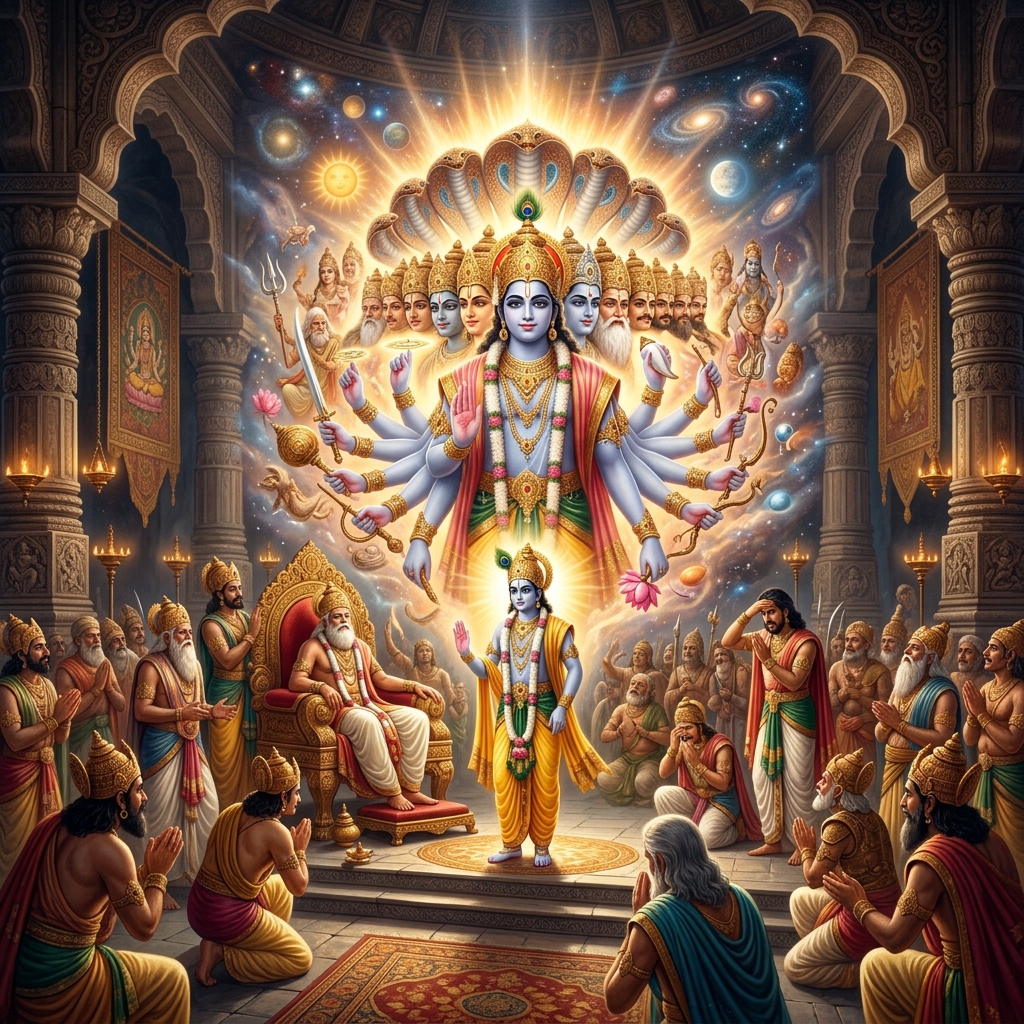
The Messenger of Peace
The Divine Revelation in Hastinapura
Council at Upaplavya
Thirteen years had passed. Twelve of exile in the forest, one of concealment in the court of Virata, and the Pandavas had fulfilled every harsh condition of the dice. Now they gathered at Upaplavya, the city on the borders of Matsya, where their allies were assembling and the dust of mustering armies hung over the plains. Yudhishthira sat among his brothers and his kinsmen, and the question that pressed upon them all was no longer whether they had a right to their kingdom, but whether that right could be claimed without drowning the earth in the blood of their own family.
Krishna had come from Dwaraka, and Balarama, Satyaki, and Drupada with his sons were there. The hall was loud with the counsel of warriors. Bhima, who had nursed thirteen years of vows against Dushasana and Duryodhana, was for war. Satyaki and Dhrishtadyumna agreed; they had armies, allies, and a just cause. But Yudhishthira, who loathed the slaughter of kinsmen more than he loved a throne, spoke quietly against the tide.
"I do not wish to destroy the Kuru race to sit upon its seat," he said. "If there is any path by which the elders, my uncle Dhritarashtra and the grandsire Bhishma, may grant us what is ours without war, that path I would walk a hundred times before I would lift a weapon against Drona who taught me, or against the children of my father's brother."
It was Krishna who shaped the decision. He rose and looked over the gathered kings, and his words were measured and grave. "Both things are needful," he said. "What is just for the Pandavas, and what is good for the Kurus. I will go myself to Hastinapura. If I can secure peace with honor, without surrendering your rights, I will have served both sides. And if I fail, then no man on earth will be able to say the Pandavas did not first seek peace with open hands. Let the blame, if there must be blame, rest where it is earned."
The Terms of Yudhishthira
Before Krishna departed, Yudhishthira set out plainly what he would accept, that his envoy might carry an exact word and not a vague longing. He did not demand vengeance. He did not demand humiliation in return for humiliation. He asked only for Indraprastha, the kingdom he himself had raised from a wilderness into a city of marvels, the kingdom that had been gambled away by a dishonest throw of the dice.
"Tell Dhritarashtra," Yudhishthira said, "that I bow to him as to a father, and to Bhishma and Drona as to my elders. I want no quarrel. Let him give us back our own half of the realm and there will be peace between his sons and mine. We will forget the forest and the gambling hall. We will forget the insult to Draupadi, if only the family is not destroyed."
Krishna listened, and then he pressed further, for he wished to know how small a peace Yudhishthira would accept rather than fight. And the answer he received was one that all later ages would remember as the very measure of a reasonable man.
"If even half the kingdom is too much for Duryodhana's pride," Yudhishthira said, "then let him give us five villages. Give Avisthala to one of us, Vrikasthala to another, Makandi, Varanavata, and one village more, any village he chooses. Let five of us hold five villages, and we will lay down our arms and be content. Surely my cousin will not refuse so little to avoid so great a ruin."
Krishna inclined his head. He knew the heart of Duryodhana better than Yudhishthira did, and he suspected even five villages would be refused. But he would carry the offer, exactly and faithfully, so that the whole world and all the gods might judge between the two houses.
Draupadi's Grief
When Draupadi heard that even now there was talk of peace, of forgiving and forgetting, a bitterness rose in her that she could not hold. She came before Krishna with her hair unbound, for she had vowed long ago in the gambling hall that she would not bind it again until it was washed in the blood of Dushasana, who had dragged her by it before the assembled Kurus.
"You speak of peace," she said to Krishna, and her voice trembled between sorrow and anger. "Have you all forgotten what was done to me? I, born of fire, daughter of a king, wife of five heroes, was dragged into a hall of men in a single garment while my husbands sat with bowed heads and the elders looked away. Bhishma was silent. Drona was silent. Dhritarashtra's sons laughed. And now you will go and ask them politely for five villages?"
She lifted the loosened mass of her hair before him. "This hair, Krishna, that Dushasana's hand defiled, I have kept unbound for thirteen years. If my husbands have grown so fond of peace that they have forgotten my shame, then I have my father and my sons, and Abhimanyu, and you. Will none of you avenge me?"
Krishna was moved, and his answer carried both comfort and a promise. "Do not weep, blessed lady," he said. "The mountains may move and the heavens fall, but my words do not return empty. You shall see the women of those who wronged you weeping as you weep now, lying upon the earth with their husbands slain. I go to Hastinapura for peace, but if peace is refused, the war that follows will not leave your enemies standing. I go so that justice, when it comes, will wear no stain of haste."
The Road to Hastinapura
Krishna set out in his great chariot drawn by the horses Saibya and Sugriva, with Satyaki beside him and a company of attendants behind. As he travelled toward Hastinapura the very omens of heaven seemed to gather around his journey. The sky was clear, yet a deep thunder rolled; rivers ran calm; the winds blew sweet and from auspicious quarters. Sages came out of their hermitages to bless the road, and Krishna paused to honor them and to ask their blessing on his errand of peace.
In Hastinapura, word ran ahead of him. Dhritarashtra, hearing that Krishna himself was coming as the Pandavas' envoy, was thrown into anxious excitement. He commanded that the road be decorated, that pavilions of rest be built along the way, that gifts of gold and maidens and jewels be heaped before the guest. He meant to overwhelm Krishna with honors and so soften the demands he carried.
But Vidura, the wise minister born of a serving woman, half brother to the king, saw through the king's purpose and spoke plainly, as he always did. "Krishna does not come for gold or gems or chariots," Vidura said. "He comes for a single thing, justice for the sons of Pandu. Do not insult him with bribes dressed as hospitality. If you wish to please him, give the Pandavas their due. That gift alone will satisfy him; no other will."
Dhritarashtra heard, but his love for his son was a sickness in him stronger than his reason, and he could not bring himself to compel Duryodhana to anything. So the pavilions were built and the gold was heaped, and the truth that Vidura spoke was set aside, as the truth so often was in that court.
The Guest Who Refused the Feast
Krishna entered Hastinapura through streets thronged with people who climbed onto roofs and walls to see him, for the fame of his deeds had gone before him into every land. He came first to the court, saluted Dhritarashtra and Bhishma and Drona, embraced those who were dear to him, and exchanged courtesies with all. Then, the day's formalities ended, he was offered the king's hospitality, a palace, a feast, every luxury Hastinapura could provide.
Krishna declined them all. To the surprise of the court, he would not eat at Duryodhana's table nor sleep beneath his roof. Duryodhana, stung, asked him why he refused the food of his hosts.
"A man should eat another's food only for one of two reasons," Krishna answered evenly. "Out of affection, or in distress. You feel no affection for me, Duryodhana, for I have come on behalf of those you hate, and I am not in distress that I should eat to survive. You have done nothing to earn my friendship, and you offer this feast not from love but from policy. The food of one whose heart is wicked, and the food given by a wicked man, neither should be eaten. I will not eat yours."
Then Krishna went instead to the house of Vidura, and there he ate the simple food of a righteous man with gladness. Kunti, the mother of the Pandavas, who had remained in Hastinapura through all the years of her sons' exile, came to him there, and she wept to hear of her children, and asked after each of them, and sent through Krishna words of fire to stiffen their resolve. "Tell my sons," she said, "that the hour has come for which a kshatriya woman bears her children. Let them not shrink from it."
Krishna's Plea in the Assembly
On the appointed day Krishna entered the great assembly hall of the Kurus, where the kings of many lands sat in their ranks, where Dhritarashtra presided in his blindness, where Bhishma the grandsire and Drona the teacher and Kripa and Vidura and the hundred sons of the blind king were gathered. Krishna rose to speak, and a stillness fell, for it was known that the words now spoken would decide whether the earth would live in peace or be turned into a field of corpses.
His voice filled the hall, gentle at first, reasoning. "I have come," he said, "to seek peace between brothers, and the welfare of both houses. The Kurus and the Pandavas are one blood. If you war upon one another, the whole earth of the kshatriyas will be consumed; the slain on both sides will be your kinsmen. Let the elders here restrain the young. Yudhishthira bows to you all. He asks only what was always his. He does not even demand his half; he will take five villages and call it peace. Give him this, Dhritarashtra, and be the savior of your line. Refuse, and you will have purchased a throne for your son with the funeral pyres of your whole family."
He turned to the warriors. "Consider Bhima and Arjuna, Nakula and Sahadeva, Dhrishtadyumna and the sons of Draupadi, and Krishna himself standing with them. Who among you imagines this host can be beaten without a slaughter the like of which the world has not seen? I do not threaten; I describe. Choose peace while peace is still in your hands. The hand that is open now will be a fist tomorrow, and then it will be too late for any words of mine."
A murmur of agreement and dread ran through the assembly. Many among the kings, hearing him, were ashamed of the path their pride had set them on, and wished in their hearts that Duryodhana would relent.
The Counsel of the Elders
When Krishna had spoken, the elders of the house rose one by one to add their weight to his plea, for they too dreaded the ruin they saw approaching. Bhishma, the grandsire, oldest and most honored of them all, fixed his gaze upon Duryodhana. "Child," he said, "listen to Krishna, who is wisdom itself and your truest well wisher. The path of war you have chosen leads only to the grave, your own and your brothers' and the whole Kuru race. The Pandavas cannot be conquered while Krishna is their friend. Make peace, and live; reject it, and you doom us all."
Drona, the teacher who had trained both sets of cousins in arms, spoke next, and his counsel matched the grandsire's. "I taught the Pandavas, and I know what they can do. Arjuna alone, with the bow Gandiva, is more than your hundred brothers. Do not make me, who love you, fight against my own best pupils in a cause that is wrong. Give them their kingdom and turn this hall of war back into a hall of peace."
Then Vidura, whose loyalty was always to the right and never to the powerful, spoke with the plainness that had earned him both honor and Duryodhana's hatred. "O king," he said to Dhritarashtra, "a son who leads his father's house to destruction should be cast off for the sake of the family. Restrain Duryodhana now, by force if you must, or weep for your hundred sons when they lie dead. One man's stubbornness will not be worth the price the rest of us must pay."
Gandhari herself, the mother of the Kauravas, was summoned, and she too rebuked her son. "He who will not be ruled by his elders and listens only to his own greed becomes the destroyer of his people," she said. "Govern your anger, my son. A kingdom won by injustice does not endure; a kingdom shared in peace is the glory of a house." But none of it reached the heart of Duryodhana, which had hardened past all softening.
The Needle's Point
Duryodhana listened to them all, to Krishna, to Bhishma, to Drona, to his father's faltering wishes and his mother's grief and Vidura's blunt warnings, and his face grew dark with offense, as though it were he who had been wronged. At last he rose, and his answer was the answer that sealed the fate of his house.
"You all speak as though I were the one at fault," he said, his voice tight with grievance. "You all take the side of the Pandavas and rebuke me, your own son, your own kinsman, in open court. What have I done? They lost their kingdom at dice, fairly, by the rules of the game they themselves agreed to play. I owe them nothing. And whatever I once was bound to give, I am bound to no longer, for they were to remain unknown through the final year and I say they failed in that."
Then came the words that would echo through the war and after it. "Hear me, and hear me clearly," Duryodhana declared. "As long as I live, the sons of Pandu shall not have so much of the kingdom as can be balanced on the sharp point of a needle. Five villages? I will not give them land enough to drive in a single needle, not without a war. Let them fight for it if they want it. I have done no wrong, and I will not yield."
A cold silence answered him. Krishna's eyes met those of the elders, and in them was the knowledge they all now shared, that the last door to peace had been shut, and shut by the very hand peace had been offered to. There was nothing left in the open palm. Only the fist remained.
The Plot to Bind the Envoy
Duryodhana's refusal was not the end of his folly. Rising from the assembly in a fury, he withdrew with Dushasana, Shakuni, and Karna, and there they conceived a treachery so reckless it horrified even some who served them. Krishna, they reasoned, was the strength and soul of the Pandavas; if he could be seized and bound here in Hastinapura, the Pandavas would be left leaderless and helpless, and the war would be won before it began.
Word of the plot reached Satyaki, who came at once to warn Krishna and the court. The hall erupted. When the design was spoken aloud, Dhritarashtra was appalled, for to lay hands on an envoy was a crime against every law of nations and gods. "What madness is this?" the old king cried. "To bind a messenger, and such a messenger? It will bring destruction on us all." Vidura denounced it, and Bhishma in anger declared that any who tried it would not leave the hall alive.
Krishna himself only laughed, and his laughter was terrible and serene. He turned to Dhritarashtra. "O king," he said, "your son in his blindness imagines I am a man alone, to be caught like a beast and tied with rope. He sees only this single form before him. Let him, and all of you, see now whether I am one, or whether the Pandavas stand in this hall already."
And as he spoke, the very air of the assembly began to change, growing dense and bright, charged as the sky is charged before lightning, and the proud men who had thought to chain him felt a fear they could not name rising in their breasts.
The Universal Form
Then Krishna revealed himself. The human shape they knew dissolved into a vision past the bearing of mortal eyes. From his body blazed a light brighter than a thousand suns, and within it the whole of creation was seen. Upon his brow were Brahma and the worlds; from his arms and breast came forth the gods, the Adityas and the Rudras, the Maruts and the Vasus. In his form stood Arjuna at one shoulder and Balarama at the other, and around him the warriors of the Vrishnis and the hosts of the Pandavas. Fire breathed from every pore; from his mouths poured flame, and within those flaming mouths could be glimpsed the future, the kings of the earth rushing in to be devoured by time.
The assembly shrank back in terror. The kings closed their eyes or fell to their knees; the hall shook as if the earth itself trembled. The gods and sages, unseen, gathered in the upper air to witness the revelation. To the blind king Dhritarashtra, who had never in his life seen anything, Krishna in his mercy granted sight for that one moment, that he too might behold the Lord of the universe standing in his court, the same Lord his son had thought to bind with a cord.
When the vision faded and Krishna stood again in his familiar form, the men of Hastinapura understood, however dimly, that the war they were choosing was no mere quarrel over fields and villages. They had been offered peace by the one who held time itself in his hands, and they had refused it. Krishna's voice, when he spoke into the shaken silence, was quiet. "I have shown you what I am," he said, "so that no man here may later say he did not know. Now I have done all that can be done."
Krishna and Karna on the Chariot
His mission in the assembly ended, Krishna prepared to leave. But before he went, he took Karna up into his own chariot, alone, and as they rode he spoke to him a secret that he hoped might yet draw one great warrior away from the doomed cause of Duryodhana, and so weaken the war he could not prevent.
"Karna," Krishna said, "you believe yourself the son of Adhiratha the charioteer. You are not. Kunti bore you before her marriage, conceived by the Sun god himself, and set you adrift upon the river in her fear and shame. You are the eldest son of Pritha, born before Yudhishthira. By blood you are the firstborn of the Pandavas, a prince of the Kuru line. Come with me. Leave Duryodhana. The Pandavas are your brothers; Yudhishthira will yield the throne to you as the eldest, Draupadi will be yours, and the whole world will bow to you. End this war by being crowned its king."
Karna was silent a long while, and when he answered there was no anger in him, only sorrow and a settled resolve. "I know it may be as you say," he replied. "I have felt it. But it changes nothing. Kunti cast me away; it was Radha and Adhiratha who raised me as their own, and to them I owe a son's duty. And Duryodhana, when all the world mocked me as a low born charioteer's son, gave me a kingdom, gave me honor, gave me his friendship, and has leaned upon my arm for thirteen years. I will not betray him now in his hour of need to gain a crown. I will stand with him, and I will fight, even knowing, as I do, that your side will win and that I shall die. Do not tell the Pandavas who I am, Krishna; let Yudhishthira not learn it, for if he knew his eldest brother fought against him he would not take the kingdom. Keep my secret until the war is done."
Kunti's Plea and the Last Word
There was one more who sought to turn Karna's heart. Kunti, his mother, who had borne him in secret and abandoned him to the river, could no longer bear to see two of her sons set to kill one another. She went down to the bank of the Ganga, where she knew Karna performed his daily worship to the Sun, and waited, and when he had finished she revealed herself to him as his mother.
"I am Kunti, who bore you," she said, weeping. "You are no charioteer's son but my own firstborn, child of the Sun. Come to your brothers. Do not raise your weapons against the Pandavas, who are your own blood." And the Sun himself confirmed her words from the sky.
Karna bowed to her, but his answer was the same he had given Krishna, gentle and immovable. "You cast me out when I was helpless," he said without bitterness, "and robbed me of the rank that was mine. Now, when I have a friend to whom I owe everything, you ask me to abandon him for the sake of brothers who would gain by it. I cannot. But I will grant you this, mother: of your five Pandava sons, you shall always have five living after the war. I will fight only Arjuna; and of the two of us, Arjuna and Karna, one shall fall, so you shall still have five, with me or in my place." With that he sent her away comforted in part and grieving in part.
Krishna returned to Upaplavya and told the Pandavas all that had passed: the offer made, the elders' pleas, Duryodhana's needle point refusal, the failed plot, the vision granted, and Karna's choice. "I have done everything," he said. "I sought peace by every road, and every road was closed against us by the pride of one man. The fault is not ours, and the gods have seen it. There is nothing now but war." And so the last hope of peace died, and the great hosts moved toward the field of Kurukshetra, where the long quarrel of the Kuru house would at last be ended in blood.
Dharma Lesson
When peace is rejected, war becomes a righteous duty (Dharma Yuddha). Krishna's mission shows that one must make every possible effort to avoid conflict, but when evil refuses to compromise, the use of force becomes necessary to protect the world. The revelation of the Vishvarupa reminds us that we are but instruments in a much larger divine plan.
Common Questions
What did Krishna ask for on the peace mission?
Five villages. Having already come down from half the kingdom, Yudhishthira offered to settle for Avisthala, Vrikasthala, Makandi, Varanavata and one more of Duryodhana's choosing - one village for each brother - and to lay down arms. Krishna carried that offer exactly, so both worlds could judge the outcome.
Why did Krishna's peace mission fail?
Duryodhana refused outright, declaring he would not yield land enough to balance on a needle's point without a war. Dhritarashtra would not overrule his son, and Bhishma, Drona and Vidura could not move him. The embassy settled the question of blame as much as it sought peace.
Why did Duryodhana try to arrest Krishna?
He meant to seize the envoy and cripple the Pandavas at a stroke, ignoring the immunity owed to a messenger. Krishna answered by revealing his cosmic form in the assembly hall, and the plot collapsed; Dhritarashtra was granted sight for that moment alone in order to witness it.
Did Draupadi want peace with the Kauravas?
No. She reminded Krishna that she had kept her hair unbound for thirteen years since Dushasana dragged her into the court, and asked whether her husbands would now beg politely for five villages. Her demand for redress stands as a counterweight to Yudhishthira's willingness to settle.