A Royal Childhood at Hastinapura
Pandavas, Kauravas, and the Lessons of Drona
A House of Many Sons
In the great city of Hastinapura, on the banks of the Ganga, the royal nursery was the noisiest place in all the kingdom of the Kurus. One hundred and five boys grew up there together, and the marble corridors rang from dawn to dusk with their shouting.
The hundred sons of the blind king Dhritarashtra and his queen Gandhari were called the Kauravas, after the founder of the line. The eldest of them was Duryodhana, born under dark omens - jackals had howled and asses had brayed on the night of his birth, and wise men had urged the king to cast the child away. Dhritarashtra had not been able to do it. So Duryodhana lived, and his ninety-nine brothers after him, with Dushasana close behind him in age and in temper.
Beside them grew the five sons of Pandu, Dhritarashtra's younger brother, who had died in the forest. These were the Pandavas. Yudhishthira was the eldest, grave and honest even as a small boy. Then came Bhima, broad as a young bull. Then Arjuna, quick and bright-eyed. Last came the twins, gentle Nakula and thoughtful Sahadeva, born of Pandu's second queen, Madri. Their mother Kunti had brought them back from the mountain to be raised in the city of their fathers.
The boys were dressed alike and fed alike. They studied their letters together, wrestled together, and slept in the same wide halls. To a visitor it looked like one great family. But underneath the surface, like a current under still water, ran a quiet and growing trouble. For these were two sets of cousins, and only one throne, and the question of who would one day sit upon it had never truly been settled.
Watching over them all stood the grand old man of the house, Bhishma, their great-uncle, who had given up his own claim to the throne long ago. He loved all the boys equally and worked to keep them as one. But not every heart in that palace was so even, and the trouble that Bhishma feared was already taking root.
The Strength of Bhima
Of all the boys, none was made like Bhima. He had been strong from the cradle. The old story told that as an infant he had once slipped from his mother's arms and fallen onto a rock, and it was the rock that shattered, not the child. As he grew, his strength grew with him until it was a thing of wonder and, for some, a thing of fear.
Bhima loved his cousins, but he loved rough play even more, and he did not always know his own power. When the boys climbed the tall fruit trees in the palace gardens, Bhima would seize the trunk and shake it until the Kauravas tumbled down like ripe mangoes, laughing and bruised. When they swam in the river, he would catch them by the hair, hold them under until they spluttered, and let them go gasping. When they wrestled, he would pick up eight or ten of them at once and roll them in the dust like a farmer threshing grain.
To Bhima it was all a great game. He bore no malice. He would haul his cousins out of the water by the armful, set them on the bank, and roar with laughter as they coughed and complained. He shared his sweets, carried the smaller boys on his shoulders, and never once used his strength in true anger.
But the hundred Kauravas did not laugh as he did. Day after day they came home with skinned knees, with lumps on their heads, with their fine clothes torn and muddy. They were the sons of the reigning king, and here was the son of the dead younger brother making them eat dirt in their own gardens. The humiliation gathered in them like a bruise that would not fade.
And in one heart above all, the bruise turned to something darker. Duryodhana, eldest of the hundred, born to believe the throne was his, watched Bhima toss his brothers about and felt a hatred take hold of him - a hatred that would never let go for as long as he lived.
Duryodhana's Envy
Duryodhana brooded. He was clever and proud, and he had been told since birth that he was the firstborn of the king and therefore the rightful heir. Yet he could see the truth that the whole court whispered. Yudhishthira was the eldest of all the cousins, older than Duryodhana himself, and the people already spoke of the grave and honest Pandava as the natural king to come. Worse, the Pandavas outshone the Kauravas at almost everything - Arjuna with the bow, Bhima with sheer force, Yudhishthira with his calm wisdom.
Of all the Pandavas, it was Bhima who galled Duryodhana most. Bhima could break any Kaurava the way a man breaks a dry twig. Bhima made him look weak in front of his own brothers, in front of the servants, in front of the whole city. Duryodhana lay awake turning it over, and a cold plan began to form in him.
He reasoned it out coldly, as men do who have already decided to do wrong. Bhima was the strongest and the most dangerous of the five. If Bhima were removed, the others could be cowed or driven out. Then the hundred sons of Dhritarashtra would have no rivals, and the throne and the kingdom would be theirs without question. The whole obstacle, he told himself, was that one broad-shouldered boy. Remove the boy, and the future opened.
He did not speak his plan aloud, not even to Dushasana, his closest brother and shadow. He smiled at the Pandavas now. He invited Bhima to play, praised his strength, walked beside him with an arm thrown over his shoulder. Bhima, open-hearted and slow to suspect, took the friendship at face value and warmed to it.
But Vidura was watching. Vidura was the half-brother of Dhritarashtra and Pandu, born of a serving woman, kept from the throne by his birth, yet wiser than any king. He missed nothing that happened in that palace. He saw Duryodhana's new smiles and did not trust them, and he quietly resolved to keep his eyes open.
The Water Pavilion at Pramanakoti
When the hot season came, Duryodhana saw his chance. He proposed a water festival for all the cousins at a pleasure garden called Pramanakoti, on the banks of the Ganga a little way outside the city. There would be swimming and boating, feasting and music, and a fine pavilion built beside the deep, slow water of the great river. Bhishma gave his blessing, suspecting nothing, glad to see the cousins enjoying themselves together.
The boys rode out in a happy procession. The garden was beautiful - lotus ponds, shade trees heavy with blossom, soft lawns running down to the water's edge. Cooks had laid out a feast of every delicacy the royal kitchens could make. The princes ate and laughed, dived from the boats, splashed and raced one another across the river, and tired themselves out in the sun.
Duryodhana played the perfect host. He moved among them filling cups, pressing food upon his cousins, attending most of all to Bhima. He had a special dish prepared for Bhima alone, sweetened to hide its taste and laced with a deadly poison called kalakuta, strong enough to kill many men. Smiling, calling Bhima his dear brother, he set the dish before him with his own hands.
Bhima, hungry as always from a day in the water and suspecting nothing, ate the whole of it and asked for more. The poison did not act at once. He went on playing as the afternoon wore down, until at last a heaviness crept into his limbs and a fog rolled over his mind. His great strength drained out of him. By the time the sun touched the river he could barely stand, and he stumbled to the cool grass at the water's edge and fell into a sleep as deep as death.
The other Pandavas, worn out themselves, did not mark where he had gone. They thought him asleep like the rest, and as evening fell the company began to gather for the journey home. Only Duryodhana kept his eyes on the still, breathing shape lying alone by the dark water.
Bound and Cast into the Ganga
Night came down over the river garden. The music had stopped; most of the princes had ridden back toward the city, and the servants were folding away the awnings. Duryodhana waited until the lawns were empty and only the poisoned, sleeping Bhima remained beside the water.
With a few trusted men he came to where Bhima lay. The great boy did not stir; the poison held him fast. They took strong creepers and shoots of cane and bound him hand and foot, winding the cords around his arms and his broad chest until he was trussed like a bundle of firewood. Bhima slept through all of it, helpless for the first and only time in his life.
Then they dragged him to the very edge of the Ganga, where the bank fell away into deep water, and they rolled his bound body off into the river. The dark current took him. He sank without a sound, down past the reach of the moonlight, down through the cold green depths, until he came to rest far below the surface in the country that lies beneath the rivers of the world.
Duryodhana watched the ripples close over the place where Bhima had gone under, and then there was only the smooth black surface of the river, giving nothing back. He believed his trouble was finished. The poison would have weakened him; the river would drown him; and even if some breath remained, the depths were the realm of the Nagas, the great serpents, and surely they would finish what the poison and the water had begun.
He brushed the dust from his clothes, mounted his horse, and rode back to Hastinapura with his men, calm and satisfied. Behind them the Ganga flowed on as it always had, carrying its secret down into the dark.
Into the Realm of the Nagas
Down Bhima went, far below the river, into Nagaloka, the underwater kingdom of the serpent-folk. There, in halls of pearl and coral lit by the glow of jewels set in the hoods of great snakes, dwelt the Nagas, ancient and powerful beings who were half serpent and half something more than human.
The Nagas found the bound boy sinking into their realm and swarmed about him, and being serpents they bit him - sank their fangs into his arms and chest and sides, again and again. But here the strangest turn of all took place. The venom of the snakes, meeting the poison of Duryodhana that still ran in Bhima's blood, did not add to it but cancelled it. The two poisons neutralized one another, and the deadly draught that should have killed him was undone.
The serpents' bites also roused him. Bhima woke at the bottom of the world, snapped the cords that bound him as easily as a man brushes away cobwebs, and rose up among the startled Nagas. He was unbound, unpoisoned, and very angry. He seized the snakes by the dozen and crushed them, and the rest fled before him in terror to their king.
The serpents went to Vasuki, the mighty lord of all the Nagas, and told him of the human child who had fallen into their kingdom and broken loose. Among Vasuki's company was an old and noble Naga named Aryaka, and Aryaka, looking on the boy, knew his face. For Bhima was the great-grandson of his old friend - through Kunti's line the boy was kin to the serpent house. Aryaka embraced him with joy and named him to the assembled court.
So the very depths into which Duryodhana had cast Bhima, hoping for his death, turned out to be the house of his own kinsmen, who received him not as an enemy but as a long-lost son.
The Drink of a Thousand Elephants
When Vasuki learned that the boy was kin to his friend Aryaka, the lord of serpents wished to honor him. He offered Bhima gems and gold from the treasures of the deep, riches such as no king of the upper world had ever seen. But Aryaka had a better gift in mind, and he asked Vasuki to grant it instead.
In the realm of the Nagas there stood certain great vessels filled with rasa, a divine essence the serpents called nagamrita - the nectar of strength. Each vessel held the might of a thousand elephants, and whoever drank from one would take that strength into his own body forever. Such a draught could not be given to an ordinary man, for it would destroy him. But Bhima was no ordinary boy.
The Nagas led him to the vessels and bid him drink. Bhima, restored now and curious, sat down before the first one, set his lips to it, and drank it dry in a single long draught. They brought him a second, and he emptied that too. One after another he drank, until he had drained eight of the great vessels of nagamrita, and into him passed the strength of many thousands of elephants.
Then a heaviness came over him, not of poison this time but of the divine essence settling into his flesh, and the Nagas laid him down on a bed in their cool halls to let it do its work. Bhima slept for eight days while the strength of the nectar wove itself into every muscle and bone of his body, knitting him into the mightiest mortal who walked the earth.
On the ninth day he woke, fully restored and immeasurably stronger than the boy who had sunk into the river. The Nagas fed him, dressed him in fine garments, and told him it was time to return to the world above. Vasuki himself gave his blessing. Then they bore him up through the deep waters and set him gently on the bank of the Ganga, at the very place from which he had been thrown, and the river closed over the way back to their hidden kingdom.
The Grief and Joy of His Return
Back in Hastinapura, the Pandavas had returned from the festival to find Bhima missing. They searched the palace, sent runners along the roads, and went back to the river garden at Pramanakoti, but found no trace of him. As the hours stretched into a day and then another, fear hardened into grief. They believed their brother drowned or slain.
Kunti was beside herself. She had already lost her husband; now it seemed she had lost her second son. She wept and could not be comforted, and she turned, as she often did, to the one man in that palace whose judgment she trusted. She went to Vidura and poured out her terror.
Vidura comforted her with quiet, careful words. He had his suspicions about Duryodhana, but he kept them to himself for now, knowing that an accusation without proof would only deepen the rift in the house. He told Kunti to take heart, that a great sage had once foretold long life for all her sons, and that Bhima was not so easily killed. "Do not despair," he said. "Wait, and watch, and say nothing."
On the eighth day - by the reckoning of the upper world, for time runs strangely between the realms - Bhima came walking back into Hastinapura. He strode into the palace alive and glowing with health, stronger and taller than when he had left, while the household still mourned him for dead.
The Pandavas fell upon him with joy, embracing him and weeping all over again, now from happiness. Kunti held her son and could not let him go. And Bhima, sitting among them, told the whole tale - the poisoned sweets, the cords, the dark fall into the river, the serpent-folk and their kinsman Aryaka, and the eight vessels of nectar that had made him strong beyond measure.
Vidura's Counsel
When Bhima named Duryodhana as the one who had poisoned him and bound him and cast him into the Ganga, a heavy silence fell. Yudhishthira's grave face grew graver still. Bhima's eyes flashed, and his new-won strength stirred in him like a storm wanting to break. He was for going at once to confront the Kauravas and repay the deed.
But Yudhishthira held him back. The eldest Pandava, even as a boy, weighed every action against what was wise and what was right. To accuse the king's son openly, with no witness but Bhima's own word, would split the house in two and might bring ruin on them all. He counselled patience and silence, and Bhima, though it cost him, obeyed his elder brother.
Kunti went again to Vidura, and this time she told him the whole story. Vidura listened, unsurprised, for he had read Duryodhana's heart from the start. He confirmed gently what they now all feared - that the prince meant the Pandavas harm and would try again. But he urged the same hard course as Yudhishthira. "Speak of this to no one," he said. "If you accuse him, you cannot prove it, and you will only sharpen his hatred and arm him with the king's favor. Bury this. Watch his hands. Guard your food, your sleep, your water. Trust few, and be ready."
It was bitter counsel, but it was wise, and they took it. The Pandavas said nothing. They smiled at the festival again the next year, ate at the same tables, swam in the same river, and let Duryodhana believe his crime forgotten - while in truth they had learned, once and for all, exactly what kind of cousin he was.
So the first attempt on the Pandavas' lives passed in silence, hidden beneath the smooth surface of the royal household. But a thing had changed that could never change back. The two houses now knew themselves to be enemies, even as they lived under one roof, and the seed of the great war to come had been planted deep in the soil of Hastinapura.
Kripa and the Coming of Drona
Bhishma saw that the princes were growing fast and that their wild strength needed shaping. Untaught power was a danger, both to the boys themselves and to the kingdom. It was time they learned the disciplines of the warrior - the bow, the sword, the mace, the chariot, and the calm command of all of them. So Bhishma sought out teachers worthy of the Kuru princes.
The first was Kripa, a Brahmin of mysterious birth, found as an infant in a clump of reeds and raised in the palace. Kripa was a master of arms, and under him the hundred Kauravas and the five Pandavas began their training in earnest. The riverside grounds outside Hastinapura now rang each morning with the twang of bowstrings and the clatter of practice weapons.
Then fortune, in the shape of a fallen ball, brought them a greater master still. One day the princes were at play when their ball rolled into a dry well too deep to reach. As they stood helpless at the rim, a lean, dark Brahmin passing by laughed at them. "Princes of the Kurus," he said, "and you cannot fetch your own ball?" He took a blade of grass, charged it with a whispered spell, and cast it down; it pierced the ball. A second blade pierced the first, and a third the second, until a chain of grass-stems lay linked from his hand to the ball, and he drew it up.
The astonished boys ran to tell Bhishma, who knew at once who the stranger must be. It was Drona, son of the sage Bharadvaja, the greatest master of weapons in the whole of Bharatavarsha. Bhishma welcomed him with honor and made him the royal preceptor of the princes, and from that day the boys' true training began.
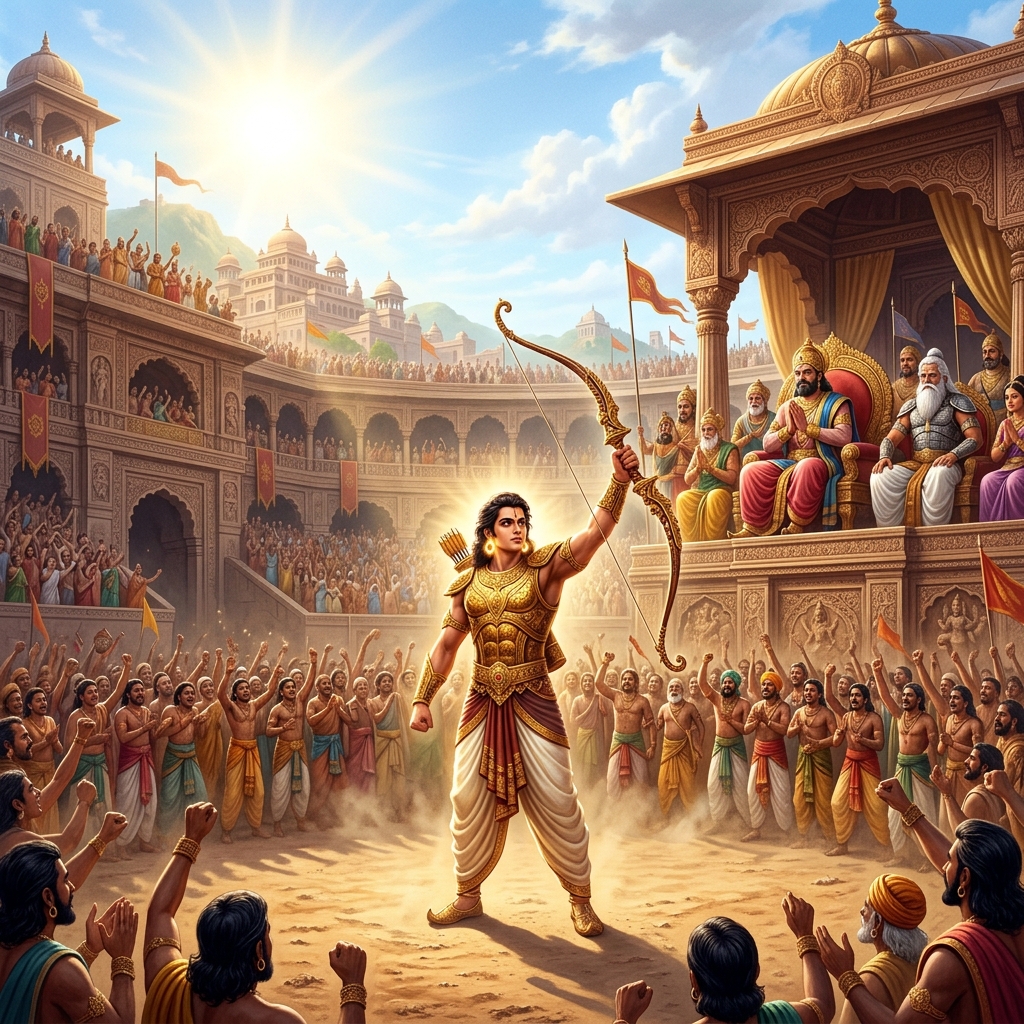
Under Drona the cousins were drilled side by side - and side by side their differences sharpened. Bhima took to the mace as if born holding one; Yudhishthira mastered the chariot and the spear; the twins Nakula and Sahadeva grew swift and deadly with the sword; and Arjuna, of them all, showed such genius with the bow that Drona's heart fastened upon him. The Kauravas, watching the master favor a Pandava above them, felt the old envy flare hotter than ever.
The Divided House
So the princes grew toward manhood in the training grounds of Hastinapura, and to the eyes of the city they were a single shining company of cousins, the pride of the Kuru line. But Drona, who watched them closely, saw the truth beneath. He saw how Duryodhana and his brothers drew always to one side and the five Pandavas to the other; how a game of arms could turn in a heartbeat into something with a real edge to it; how the cousins' laughter had a brittleness in it now.
The poisoning by the river had not been forgotten by anyone who knew of it, however little was spoken aloud. Bhima, mightiest of all since his draught of nagamrita, made a point of besting the Kauravas at every contest of strength, no longer in innocent play but with a hard satisfaction, repaying the river in his own coin. Duryodhana matched him hatred for hatred, and his envy of the Pandavas only deepened as they outshone his brothers at every turn under Drona's eye.
Vidura watched it all with a heavy heart. He saw two rivers running through one house, and he knew that one day they must meet and flood. He spoke when he could to Dhritarashtra, counselling fairness to the fatherless Pandavas, but the blind king loved his own sons too dearly and too blindly to check them. Bhishma held the family together by the sheer weight of his presence and his vows, yet even he could not reach into the hearts of the young men and pull out the poison that had taken root there.
For the wrong done by the river had taught the Pandavas to trust no kindness from their cousins, and the failure of that wrong had taught Duryodhana only that he must strike harder and surer the next time. Neither lesson made for peace. The house of Kuru was one house in name and two in truth, and everyone who had eyes to see could feel the storm gathering far off, still soundless, but growing.
Thus passed the childhood of the princes at Hastinapura. It began with a hundred and five boys playing in a marble nursery and ended with two armed camps under one roof, waiting. The friendship that should have bound the cousins had curdled into rivalry, the rivalry into hatred, and the hatred into a wound that no tutor's lesson and no elder's wisdom could heal. The seeds of the great war had been sown in the gardens and the river of their boyhood, and in their season those seeds would grow into Kurukshetra.
Dharma Lesson
A teacher's love is a balance: he can give greatness, and he can also withhold it. Drona's vow protected one student by maiming another, and the small injustice planted a seed that would bear fruit far beyond him. Karna's lie cost him the very weapons he learned. Children become what they were almost-loved or almost-betrayed into becoming.