The Curse That Killed a King
Pandu's Arrow, Kindama's Curse, and the Birth of the Pandavas
The Fortunate King
Pandu was the second son born of the line of Kuru, raised in the great city of Hastinapura on the banks of the Ganga. His elder brother Dhritarashtra had been born blind, and so, by the law of kings, the throne had passed to Pandu, who was pale of skin and strong of arm. Of all the descendants of Bharata, men called him the most fortunate, for he had won wars on every horizon and brought the rival kingdoms of the earth to bow before Hastinapura.
He had two queens. The first was Kunti, daughter of the Yadava chief Kuntibhoja, a woman of quiet depth who had served sages in her girlhood and carried secrets that even her husband did not yet know. The second was Madri, a princess of the Madra country, slender and bright, whom Pandu had won in the manner of kings. He loved them both, and they loved him, and the palace was full of the laughter of a young household that wanted only one thing more - children to carry the Kuru name forward.
Yet Pandu was a restless man at heart, and the marble corridors of the capital wearied him. He was a hunter before he was anything else, happiest with a bow across his back and the smell of wet leaves in the morning. When the cares of governing pressed too hard, he would take his queens and a company of attendants and ride north, toward the great wall of the Himalayas, where the foothills rose green and silent and the deer ran in herds through the dappled glades.
It was on one such retreat, in the forests below the snow peaks, that the thread of his bright fortune was cut. He did not know it when he set out that morning. He rose before dawn, fitted his quiver, and rode alone into the trees, glad as a boy, with no shadow yet upon him. The forest received him in silence, and somewhere within it his fate was already waiting in the shape of two deer.
The Arrow in the Glade
The sun climbed and the forest grew warm. Pandu rode through stands of deodar and pine, his eyes moving always to the shadows where game might lie. He had taken nothing yet, and the hunter's hunger was on him - that sharp, patient wanting that makes a man forget everything but the next clean shot.
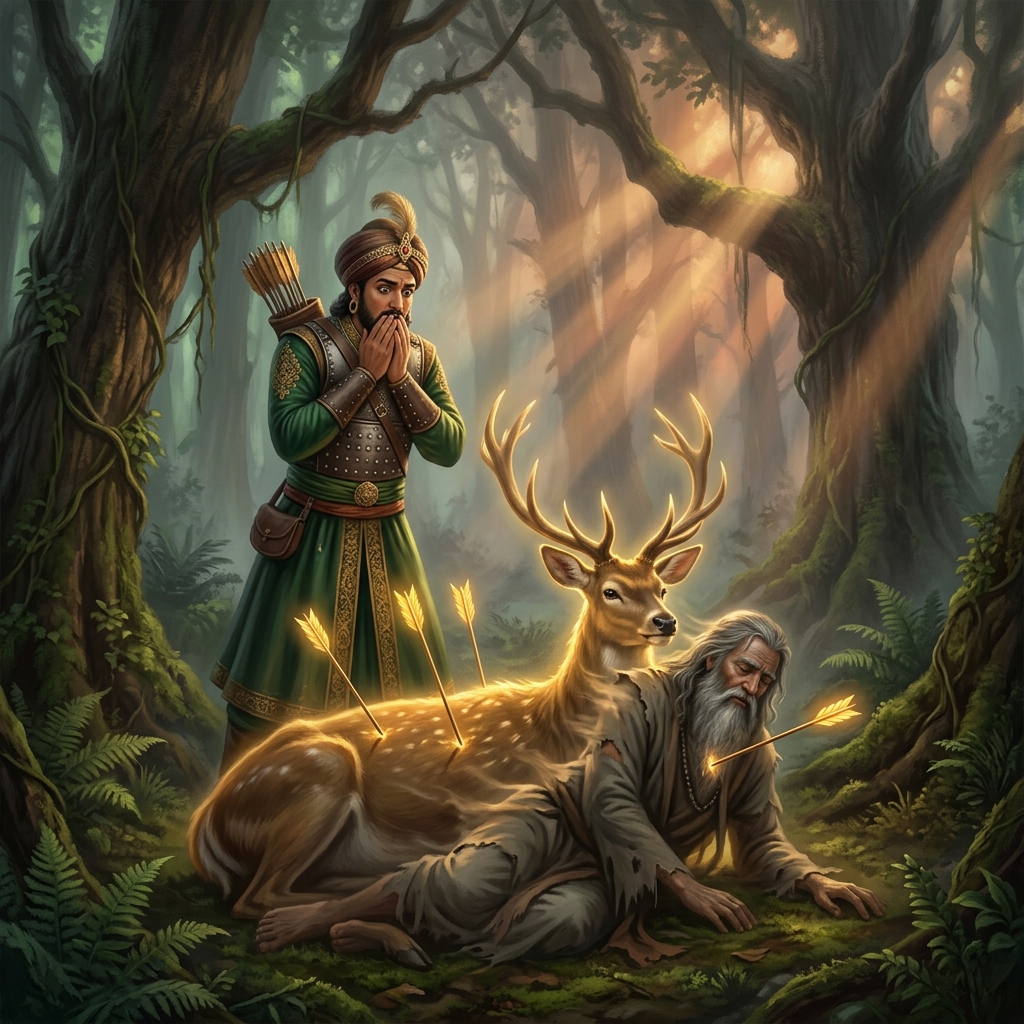
At the edge of a sunlit glade he reined in his horse. There, in the long grass, were two deer in the act of mating. The buck was tawny and large, his antlers spread, his great dark eyes half closed in the heedlessness of his joining with the doe. To Pandu, trained from boyhood to strike without hesitation, it was simply quarry, and quarry that had given him a perfect moment. He did not pause to think. He drew five arrows from his quiver, fitted them to the string, and loosed them in a single breath.
The arrows flew true. The buck was struck through the heart and the body, and he reeled and crashed into the grass. The doe sprang away into the trees and was gone. Pandu lowered his bow with the cold satisfaction of a clean kill, and walked forward through the glade to claim what he had taken.
But as he came near, the wounded buck did a thing no animal does. It lifted its head, and it spoke. It spoke in the clear, anguished voice of a man.
"Pandu," it said. "What have you done?"
The king stopped where he stood. The body in the grass shimmered and changed before his eyes. The tawny hide melted away, the antlers became matted locks of hair, and where the deer had fallen there now lay a man - a sage, tall and gaunt, with the marks of long austerity upon his face, and Pandu's five arrows buried in his breast. His blood reddened the grass, and his eyes, fixed upon the king, were full of a terrible sorrow.
The Curse of Kimdama
Pandu's bow fell from his hand. He went down on his knees in the grass beside the dying man. "Holy one," he stammered, "forgive me. I did not see. I took you for a deer, only a deer. I did not know - "
"My name is Kimdama," the sage said, and each word came on a labored breath. "I am an ascetic of these forests. My wife and I had taken the forms of deer, that we might come together among the trees away from the eyes of men, as is sometimes the way of those who have left the world but not its tenderness. We harmed no one. We asked nothing. And you, a king who knows the law, loosed your arrows upon two creatures at the very moment of their love, when even a hunter should have stayed his hand."
"I am cursed by my own ignorance," Pandu whispered. "Tell me how I may atone."
"Ignorance does not undo death," Kimdama answered. "A king is bound by dharma above all other men, and you have broken it. Hear me, then, for these are my last words and they will not lose their power when I am gone." The sage gathered the dregs of his strength, and his voice, though faint, rang with the certainty of a curse that the gods themselves would honor.
"You struck me down in the hour of my joy with my wife. So shall it be with you. From this day forward, the moment you go to either of your queens in desire, that same moment you shall die. You shall reach for love and find death waiting in its place, exactly as I have. This is no idle word, son of Kuru. It is laid upon you now and forever."
With that the sage's head fell back. His wife, who had come creeping near in her doe's form, cried out once in a woman's voice and fled weeping into the deep forest. Pandu remained kneeling in the bloodied grass, alone, while the great trees stood silent around him. He understood, slowly and completely, that in the space of a single morning his whole life had been taken from him - his hunting, his marriage, his hope of sons, and the very joy of being a man among men.
The King Lays Down His Crown
Pandu did not return to his hunting camp as a king returns from the chase. He came back hollow-eyed and broken, and when his queens and attendants gathered around him in fear, he told them all that had passed in the glade - the deer, the five arrows, the sage Kimdama, and the curse that now lay upon his life like a drawn sword.
Then he made a decision that astonished everyone who heard it. "I will not go back to the throne of Hastinapura," he said. "What is a king who can never father a son to carry his name? What is a husband who can never again approach his wives in love without dying in their arms? I have brought this upon myself by my own thoughtlessness. I will not sit in a palace and pretend that nothing has changed. I will give up the kingdom, the wealth, the comforts of the city. I will live the rest of my days here in the forest as an ascetic, atoning for the sin of Kimdama's death."
He sent word to Hastinapura. He gave away his royal ornaments, his fine garments, his weapons of war, distributing them among the brahmins of the forest. The grandsire Bhishma and the wise Vidura, when they heard, grieved deeply, but they understood that a man so wounded in spirit could not be argued back to his throne. The rule of the kingdom passed, for the time, into the hands of the blind Dhritarashtra, with Bhishma and Vidura to guide him. Pandu, who had been the most fortunate of kings, became a barefoot wanderer of the mountains.
"You need not share this hardship," he told Kunti and Madri. "Return to the city. Live in honor and comfort. No one will think the less of you."
Kunti would not hear of it. "You are my husband and my dharma," she said simply. "Where you go, I go." And Madri, the bright princess of Madra, stood beside her and said the same. So the two queens put off their jewels and their silks, dressed in the bark and deerskin of forest-dwellers, and followed Pandu north into the rising land.
The Hermitage of Shatashringa
They journeyed far into the Himalayas, past the country of ordinary men, up where the air grew thin and clean and the snow peaks shone like hammered silver against the sky. They passed mountains and forests sacred to the gods, places where sages had sat in meditation for ages of the world. At last they came to the slopes of Shatashringa, the Mountain of a Hundred Peaks, where a great community of ascetics lived among the rocks and streams.
Here Pandu put aside the last of his royalty. He matted his hair, wore the simplest cloth, and gave himself to a life of austerity and study. The sages of the mountain welcomed him not as a king to be flattered but as a fellow seeker, and they took comfort in his presence as he took comfort in theirs. He fasted, he meditated, he served the elder ascetics, and slowly the wound of Kimdama's death began to close, though it never fully healed.
For a time there was a kind of peace. The mornings on the mountain were cold and bright; the streams ran clear with snowmelt; the deer came down to drink without fear, for in that holy place no bow was ever raised. Kunti and Madri kept the simple household of a forest hermitage, gathering fruit and roots, tending the sacred fires, learning to find joy in little things. Pandu walked the high meadows with the sages and spoke with them of the soul and its release, and there were hours when he almost forgot the curse.
But one grief he could not put aside. A man without sons, the ancients taught, could not cross the dark river after death, for there would be no child to make the offerings that carry a father's spirit onward. Pandu was the last of his body's line. With him the seed of the Kurus would fail, unless some path could be found that the curse did not close. This thought sat in him like a stone, and at last, on a quiet evening among the pines, he opened his heart about it to Kunti.
Kunti's Secret
"I am tormented, Kunti, by the thought of dying childless," Pandu told her as they sat together beneath the trees. "The sages say that a man who leaves no son leaves no future, and that his ancestors go hungry in the realm of the dead. By Kimdama's curse my own body can give us nothing. Yet there are ancient laws by which a worthy man may be asked to raise sons for a husband who cannot. I would not stand in the way of it, if you were willing, that the Kuru line might not perish from the earth."
Kunti listened in silence for a long while. Then she told him the secret she had carried since she was a girl in her father's house. "There is no need for that, my lord," she said. "When I was young, I served the great sage Durvasa when he was a guest in my father's home. I tended him with such care and patience, even through his terrible moods, that when he departed he gave me a gift - a sacred mantra. By it, he said, I might summon any god of the heavens that I chose, and that god would come to me and grant me a son who carried his own divine power."
Pandu's eyes filled with wonder and with hope. "Then the gods themselves may give us what my body cannot," he breathed. "Beloved, do not delay. Call upon a god - call upon the highest and most righteous you know - that we may have a son worthy of this line."
Kunti bowed her head. She knew the power of the mantra was real, for she had tested it once long ago in fear and folly, in her girlhood, with consequences she had never spoken of. But that is another story. Here, on the holy mountain, with her husband's blessing and the future of a great dynasty in her hands, she resolved to use Durvasa's gift in the open and for a good purpose. She purified herself, and went apart to a sacred place, and when the hour was right she spoke the mantra and turned her thoughts toward the lord of dharma himself.
Sons of the Gods
First Kunti called upon Yama, the lord of dharma and justice, whom men also name Dharmaraja. The god came to her in answer to the mantra, and in time she bore a son. At his birth a voice was heard in the sky declaring that this child would be the most righteous of men, a lover of truth, a king whose word would never be broken. They named him Yudhishthira. From his first cry he carried a stillness and a gravity beyond his years, as though justice itself had taken the form of a child.
Pandu's joy was great, but a warrior thinks also of strength. At his asking, the next year Kunti spoke the mantra again and summoned Vayu, the lord of the winds. By him she bore a second son, and this child was mighty beyond all measure. The story is told that as an infant he once slipped from his mother's lap onto the rocks below, and it was the rock that shattered, not the child. They named him Bhima, and in him was the strength of a hundred elephants.
Then Pandu desired a son who would be the foremost warrior the world had ever seen, and he and Kunti undertook austerities to that end. Kunti summoned Indra himself, the king of the gods, the wielder of the thunderbolt. From him she bore Arjuna, and at his birth the very voices of the heavens proclaimed that this boy would conquer all enemies, please the great gods, and win renown across the ages. Three sons now played in the meadows of Shatashringa, each the gift of a different god, each marked for greatness.
So Kunti had borne three. But Madri, the younger queen, had borne none, and a quiet sorrow grew in her, for a wife without children carried a particular loneliness in those days. Pandu saw it, and his heart went out to her, and he asked Kunti whether she might share the secret of the mantra so that Madri too might be a mother.
The Twins of the Ashvins
Kunti, generous of heart but mindful of the mantra's great power, agreed to share it with Madri on one condition - that Madri use it only a single time. "The gift of Durvasa is not to be spent carelessly," she said. "I will teach you the words, and you may summon a god once. Choose wisely."
Madri took the mantra, and she pondered which god to call. Being clever, and wishing to make the most of her one chance, she fixed her thoughts upon the Ashvins, the divine twin physicians of the gods, beautiful and bright as the dawn and the dusk, who always come together as a pair. She summoned them both with the single use of the mantra, and from them she bore not one son but two, twins of surpassing beauty.
The elder of the twins was named Nakula, fair as the moon, who in time would become the most handsome of men and a master of horses. The younger was Sahadeva, dark-eyed and wise, who would grow into a knower of all that had been and all that was to come. So Madri, with a single use of the mantra, became the mother of two sons, and matched in number nearly what Kunti had borne.
Kunti, when she understood how Madri had outwitted the limit she had set, felt a flicker of rivalry, for now Madri's two-in-one had nearly equaled her own three. She thought, with a touch of wry regret, that she should not have given the mantra at all if it could be turned to such advantage. But the deed was done, and there was no undoing it, and in truth the household was the richer for it.
Now there were five sons on the mountain - Yudhishthira, Bhima, and Arjuna born of Kunti, and Nakula and Sahadeva born of Madri. The line of Pandu was secure. The sages of Shatashringa performed the rites of childhood for each of them, and the five boys grew together in the high meadows, fed on mountain air and the love of two mothers and the watchful pride of a father who had thought himself doomed to die without an heir.
Forest Years
The years that followed were the sweetest Pandu had known since the curse fell upon him. The five boys filled the hermitage with noise and motion. Yudhishthira, the eldest, was grave and fair-minded even as a child, settling the quarrels of his brothers with a calm beyond his age. Bhima was a whirlwind of strength, uprooting young trees in play, wrestling the others into the dust, eating enough for three. Arjuna watched everything with bright, hungry eyes and a steadiness of hand that already marked him for the bow. The twins, Nakula and Sahadeva, beautiful and gentle, followed their elder brothers everywhere and were loved by the whole community.
The ascetics of Shatashringa loved the family and watched over the boys as their own. Pandu, walking the meadows with his sons running ahead of him, felt his old grief loosen its grip. He taught them the duties of their lineage, the law of kings, the reverence owed to the gods and the wise. Kunti and Madri shared the labor of the household and, for the most part, set their rivalry aside in the common joy of raising five children in that pure and quiet place.
There were hours when Pandu almost believed the curse had withdrawn as far as a curse can withdraw. He had his heirs. He had his peace. He had a life that, though stripped of crown and comfort, was full of meaning. He gave himself more and more to austerity and meditation, walking the path of release that the sages walked, and he hoped that through such discipline he might one day even outlast the shadow that Kimdama had laid upon him.
But a curse spoken by a dying sage does not forget. It waits. It waits through long winters and gentle springs, through the laughter of children and the peace of a man who thinks himself safe. It waits for the one unguarded moment, and then it strikes. And the spring came at last upon the mountain when Pandu's guard would fail.
The Spring That Killed Him
It happened in the season when the forest of the mountain put off its winter sleep. The slopes of Shatashringa burst into bloom; the air grew warm and heavy with the scent of new leaves and opening flowers; the bees of the Himalayas grew drunk on the sweetness of the blossoms, and their humming filled the meadows. It was a season made for tenderness, and it worked upon Pandu the way the deer in the glade had worked upon him long ago - it caught him before he could think.
He was walking alone with Madri through a flowering meadow they had loved since their first season on the mountain. The other queen was elsewhere; the boys were at their lessons; the two of them were apart from all the world. Madri wore a single garment, and her beauty in that warm and blossoming air shone like the spring itself. Some old gladness, long buried under years of austerity, rose suddenly and overwhelmingly in Pandu's heart.
Madri saw what was coming into his face and she drew back, frightened. "Remember the curse," she cried, and she tried to slip from his reach. But the spring was in his blood and the warning came too late even to him. He reached for her and caught her and drew her to him in desire, and in that very instant the curse of Kimdama closed upon his chest like a fist of iron.
He had time only to see the horror dawn in Madri's eyes. Then the breath went out of him, and the strength, and the life. He fell among the flowers and did not move again. The bees hummed on. The meadow was as bright as ever. But Pandu, second son of the Kuru line, the most fortunate of kings, lay dead in the arms of his younger queen, exactly as a dying sage had foretold in a forest glade years before.
Madri's Choice
Madri's scream tore through the still air of the mountain and reached Kunti at the hermitage. Kunti came running, the boys behind her, and found Madri kneeling over the body of the king among the fallen blossoms, weeping as though her heart had broken in two.
The two queens faced each other across the body, and at once a bitter contest of grief and guilt arose between them, for each believed she should have been the one at the king's side, and each wished to die with him. Kunti, as the elder wife, claimed the right to follow Pandu onto the pyre. But Madri would not yield it. "It was for me that he died," she said through her tears. "It was in my arms that the curse took him, because I could not refuse him, because I am the cause. I cannot live carrying that. And you, my sister, must live - for you are the wiser, and the boys are five, and they will need a mother who can raise them all without favoring her own. Stay for their sake. Let me go."
The sages of Shatashringa gathered and heard the two women, and in the end they judged that Madri's claim was just, for she had been with the king at his death. A funeral pyre was built in the high meadow. The rites were spoken over the body of Pandu, and his earthly form was laid upon the wood.
Then Madri, princess of Madra, having entrusted her two small sons to Kunti's keeping, climbed onto the pyre beside her husband. She would not be parted from him in death as she had been the cause of his death in life. The fire was kindled, and Madri burned with Pandu, faithful to him to the end, and the smoke rose from the meadow into the cold clear Himalayan sky. So two who had loved went together into the realm beyond, and behind them on the mountain remained one widow and five fatherless boys.
The Return to Hastinapura
When the rites were finished, the sages of Shatashringa held council. They could not keep a widowed queen and five royal children upon the mountain forever; the boys were of the Kuru blood, heirs to a great throne, and their place was in the world of men, not among the ascetics of the peaks. So the elder sages resolved to carry Kunti and the children down from the heights and deliver them to the city of their fathers.
A company of ascetics took up the journey. They bore with them the ashes and bones of Pandu and of Madri, that the last rites might be completed in the ancestral land. Down from the snow peaks they came, through the forests and the foothills, the long road south, until at last the towers of Hastinapura rose before them on the banks of the Ganga.
The sages brought Kunti and the five boys to the gates of the city and presented them to the elders of the court - to the grandsire Bhishma, to the wise Vidura, to the blind king Dhritarashtra. "These are the sons of Pandu," they declared, "born on the holy mountain by the grace of the gods. Pandu is dead, slain at last by the curse he carried, and Madri has followed him onto the pyre. Receive his children and his queen, and let them be honored as the blood of Kuru deserves." Then, their charge fulfilled, the sages vanished from the sight of all who stood there, returning to their mountain.
The whole city mourned. The funeral rites of Pandu and Madri were performed with all the honor due a king, and Bhishma and Vidura grieved as men grieve for one taken too soon. So Kunti came home a widow, leading five small boys who did not yet know what they would become - Yudhishthira, Bhima, Arjuna, Nakula, and Sahadeva, the sons of gods raised in a mountain hermitage, now brought into the great palace of Hastinapura. There they would grow up beside their hundred cousins, the sons of Dhritarashtra, and from that meeting of the two sets of cousins would arise the long quarrel, and the great war, that the whole world would one day remember.
Dharma Lesson
An act done in ignorance is not free of consequence. Pandu's arrow killed a sage he could not see, and the curse that followed shaped not only his life but the very paternity of the heroes who would inherit the world. Sometimes the children we cannot have through our own bodies arrive by other means - and they become more than we could have made of our own.