A King at the Height of His Powers
There was a season in the life of King Pandu when the whole earth seemed to bend toward him like grass before the wind. He had subdued the kingdoms of the east and the south, broken the pride of Magadha, humbled Mithila and Kashi, and made the lords of the world come to Hastinapura with their hands joined and their treasuries open. The fame of the Kurus, which had dimmed after Shantanu, blazed again because of him. He was a man with teeth like a lion, shoulders like an elephant, and eyes steady as a bull's. Two queens of unmatched beauty, Kunti and Madri, walked at his side. By every measure the world keeps, he had everything.
Yet a restlessness lived in him that no throne could satisfy. The palace at Hastinapura, with its incense and its flatterers and its endless ceremony, began to feel like a cage of gold. Pandu had always loved the open country, the smell of crushed grass under a horse's hooves, the long silence of the forest at dawn. So, having handed the cares of the kingdom to the wise and the old, he took his two queens and his bow and went up into the wooded foothills of the great Himalaya to live as a hunter.
There, in forests of gigantic shala trees, among meadows where deer grazed without fear and waterfalls came down white off the rocks, Pandu was at last content. The siddhas and the rishis who dwelt on those slopes spoke of him with affection. He moved through the wilderness like a divine elephant wandering between two cow elephants, and it seemed to all who saw him that here was a man whom fortune had marked for nothing but blessing.
This is the thing that should be remembered as the story turns, for the story turns hard. Pandu was not a cruel man, nor a foolish one, nor a man brought low by some old sin catching up with him. He was a good king at the very summit of his life. What undid him was a single thoughtless moment - one act done without pausing to look, without pausing to feel - and from that one moment the destiny of an entire dynasty would be remade. The greatest disasters do not always come dressed as great crimes. Sometimes they come dressed as an ordinary morning's hunt.
The Hunter's Joy
Of all the pleasures the forest offered him, Pandu loved the hunt the most. It was the one art in which a king and a wild thing met as equals, matched in speed and cunning, and it stirred in him the old Kshatriya fire that the soft years of rule had nearly smothered. He hunted not for hunger - he had servants and stores enough - but for the keen, clean joy of the pursuit, the singing of the bowstring, the moment when the arrow leapt from his hand and found its mark across an impossible distance.
Morning after morning he rose before the sun, took up his great bow strung with deer-gut, filled his quiver with arrows fletched in gold, and went out alone into the deep woods. He learned the trails the antelope kept and the pools where the elephants came to drink. He brought down boar and buffalo, tigers that threatened the hermitages, and the swift dappled deer that bounded through the long grass. The rishis blessed him for clearing the predators from their paths, and the meat he took he gave freely to those who had none.
It was, in those days, an honest thing for a king to do. The law of the Kshatriya permitted the hunt, and Pandu kept that law as he kept all others, openly and without shame. He did not think of himself as a man courting ruin. He thought of himself, when he thought at all in those bright mornings, as the happiest man alive - a king who had laid down the weight of a crown and picked up instead the lightness of the chase.
But here is the quiet danger that lives inside any pleasure indulged without thought. The hunter learns to act before he reflects. The hand grows quicker than the mind. The eye learns to see only the target and not the living creature behind it. Day by day, kill by kill, Pandu was being trained by his own joy to loose the arrow first and consider afterward - and the forest, which had given him such happiness, was preparing to teach him what that habit could cost. He did not feel the lesson coming. No one ever does.
Two Deer in a Clearing
On a certain morning that began like a hundred mornings before it, Pandu went deep into a great forest thick with deer and the beasts that prey on them. The light came down green and gold through the high canopy. The air was cool and still. Somewhere a cuckoo called, and the king moved through the undergrowth with the soft, sure step of long practice, his bow ready in his hand.
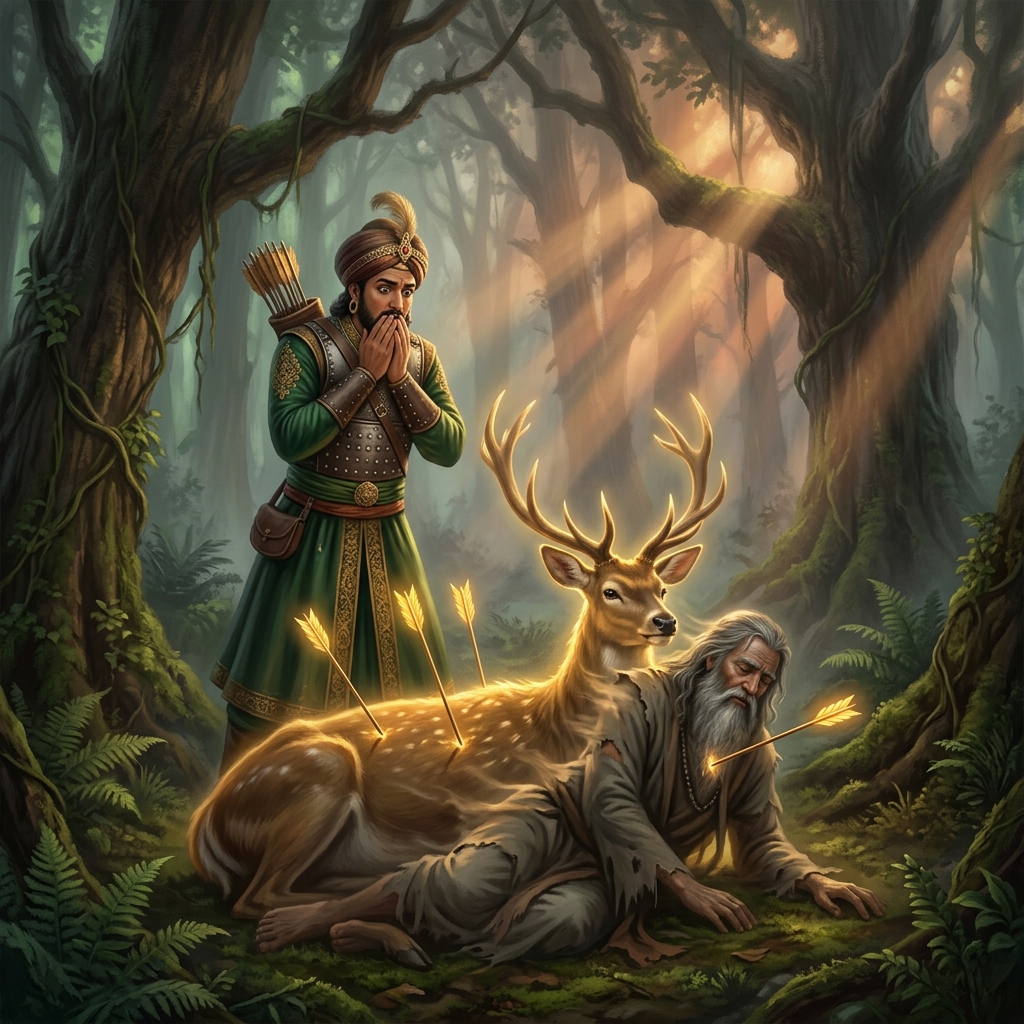
Then, in a sun-dappled clearing ahead, he saw them. A great stag, magnificent of antler and bright of coat, and beside it a slender doe. They were not grazing. They were coupling, joined together in the act of love in the way of their kind, wholly given over to one another, heedless of the world. To the eyes of a man trained only to hunt, they were simply game - two deer, close together, an easy mark, a fine prize to carry back.
Pandu did not pause. He did not wonder why these two creatures should be so lost in each other that they had forgotten all caution. He did not consider that there might be something in that sight too tender to disturb. The habit of the swift hand took over. In one fluid motion the king drew his great bow back to his ear and loosed not one arrow but five, swift and sharp and feathered in gold, one after another in a single deadly breath.
The shafts flew true. Both animals were struck through in the very midst of their union. The stag screamed - and the scream was wrong. It was not the cry of a deer. It rose from the falling creature in a human voice, raw with agony and with something even sharper than pain: a terrible, condemning fury. Pandu froze where he stood, the empty bow still in his hand, as the clearing that had been so peaceful a moment before filled with a sound that no hunter should ever hear, and the whole shining morning curdled into horror.
The Voice of the Dying Sage
The stag, pierced and bleeding, did not die as a deer dies. It lifted its head, and from its mouth came words shaped in a man's grieving voice, each one falling on Pandu like a blow.
"Even men who are slaves to lust and rage, even the worst and most fallen among them, draw back from a deed as cruel as this. Reason does not bow before the dictates of passion in such men - they keep some shred of restraint. You were born in a dynasty famed throughout the world for its devotion to dharma. How is it that you, of all men, have lost your reason so completely? How could you do this thing?"
Pandu, stunned, reached for the only answer a hunter knows. "Kings hunt deer," he said, and even as he said it the words felt thin in his mouth. "They slay them openly and by stealth alike, in the chase and in ambush. This is no sin. This is the ancient way of the Kshatriya, sanctioned by the law. Why do you reproach me as if I had done some monstrous thing?"
The dying creature would not be put off. "I do not blame you for hunting," it said, and now there was sorrow under the anger. "I do not blame you for killing game, which is indeed permitted to your kind. Learn, O King, what it is that you have truly done. I am no deer. I am a sage named Kimdama, a Brahmana unequalled in austerity and self-restraint, who has worn down his body with penance these many years. It was not from any beast's mind that I wore this shape."
Pandu listened, and the bow slid from his loosening fingers, for he began to understand that he had not killed an animal at all. He had killed a holy man - and he had killed him in a moment more sacred and more defenceless than any other a living thing can know.
What the Arrow Truly Struck
The sage Kimdama, his life draining into the forest floor, gathered his strength to make Pandu see the full shape of his wrong. He was not content that the king should die ignorant of it. A curse, to be just, must first be understood.
"Hear me, son of the Kurus," said the deer that was a man. "I had taken this shape, and joined myself to my wife who had taken the form of a doe, out of modesty. I was ashamed to perform the act of love in the sight of men, as a man among men, and so I withdrew into the body of a beast to be among beasts, where no human eye would shame us. In this innocent disguise I sought only the quiet union that all creatures are owed. And it was at that very instant - the instant of love itself, when both of us were utterly given over, helpless, defenceless, harming no one - that your arrows found us.
"This is your cruelty, and mark it well, for it is not the cruelty of the hunt. You did not strike a wary beast that had a fair chance to flee. You struck two creatures absorbed in the deepest and most vulnerable act of their lives, at the one moment when no living thing can guard itself, when desire has stripped away all defence. To kill at such a time is not the warrior's law. It is the betrayal of something the warrior's law was made to protect.
"You should have waited. You had only to wait until our union was complete, and we would have parted, and you might have hunted us then by any right you please. But you could not stay your hand even for that. So eager was your arrow, so dead was your thought, that you would not grant two loving creatures the small mercy of finishing the act of love before you ended their lives."
Pandu stood condemned not as a hunter but as a man who had forgotten, in the rush of his pleasure, to be gentle - and that, the sage made clear, was the sin for which there would be a reckoning.
The Curse
Then Kimdama, with the last of his ebbing life, pronounced the curse - and he shaped it with a terrible fitness, so that the punishment would mirror the crime exactly. As Pandu had struck love at its most vulnerable instant, so love at its most vulnerable instant would strike Pandu.
"Since you have shown such cruelty to a couple lost in love," the sage said, his voice failing but his words clear as struck iron, "this shall be your fate. When you yourself are overcome by desire, when you go to lie with a wife you love and surrender to that same act in which you slew me, in that very moment, at the very instant of your union, death will come for you. You will depart for the kingdom of Yama with your longing unfulfilled, cut down exactly where you cut me down. And the wife who is with you in that hour - she too will follow you into death, as my own beloved follows me now into hers."
Having fashioned this curse - the deadliest gift a dying man could give, for it turned the very source of life and love into an instrument of Pandu's destruction - the sage's strength was spent. The body that had borne the shape of a deer shuddered once more, and Kimdama gave up his breath. Beside him lay the doe, his wife, already gone. The clearing was silent again, but it was a different silence now, heavy and final.
In an instant, the greatest king on earth had been remade. The conqueror who had bent the world to his will could no longer touch the women he loved, on pain of dying in their arms. Every embrace was now a death sentence waiting to be carried out. The very thing other men live for had become, for Pandu, the one thing he could never have. He had loosed five arrows in a careless morning, and the world he knew had ended.
Pandu's Reckoning
For a long while Pandu could not move. He stared at his own hands, at the great bow lying in the grass, at the two still bodies before him, and the full weight of what he had done came down on him like a falling mountain. He was a man who had prided himself on self-command, on dharma, on keeping the law - and in one heedless instant he had violated something deeper than any law, and a holy man lay dead because of it.
"Even men born into righteous families," he said at last, more to himself than to anyone, "even they fall into ruin when their reason is destroyed and they let their senses lead them. My own father was conceived in a moment of unchecked desire; he himself died young because he could not master his cravings. The fault runs in me too. I am bound and dragged by the same vice, and now a Brahmana has died for it. What is the use of my kingdom, my conquests, my queens, my fame, if I am the kind of man who can do this without even pausing to think?"
The grief in him was not the shallow grief of a man caught and punished. It went down to the root. He turned the deed over and over in his mind and could find no excuse that held. The sage had been right: the hunt was lawful, but this had not been a hunt. This had been the act of a man so given over to the habits of pleasure and the quickness of his own hand that he had ceased, in the crucial moment, to be fully human. He had let the practiced reflex stand in for the living conscience, and a life had been the cost.
And there was something worse still, which Pandu grasped as he sat there in the ruined morning. The curse did not punish only him. It reached forward into time. He could have no children of his own body now, for the act that begets them was the very act forbidden to him. The Kuru line, which he had labored to make great again, would die with him unless some other way could be found. One thoughtless arrow had not merely ended a sage's life and doomed the king's own; it had reached its cold finger into the future of an entire dynasty.
The Renunciation of a Throne
Out of this reckoning Pandu made his choice, and it was the choice of a man trying to atone. He would not go back to Hastinapura to sit on a throne he no longer felt worthy of, ruling and feasting while the memory of Kimdama lay on his conscience. He would renounce everything - kingship, pleasure, possession, the whole bright life that had trained him to be careless - and become a wandering ascetic, that he might purify himself and win some better destiny than the one his arrow had earned.
"I will shave my head," he told his weeping queens, "and cover my body in dust, and beg my food, and sleep beneath the open trees with no roof and no home. I will own nothing and desire nothing. Praise and blame I will weigh the same. I will live for the welfare of all creatures and harm none, not the smallest, for the rest of my days. Only so may I make some answer for what I have done."
Kunti and Madri would not let him walk that hard road alone. "We are your wedded wives under dharma," they said through their tears, speaking almost as one. "There are other paths of penance open to us at your side. If you forsake us here, we will not live; we will give up our lives this very day." Their devotion moved Pandu past words, and he relented, and the three of them resolved to face the wilderness together. They stripped off every ornament and royal garment and gave all of it - the gold, the gems, the fine cloth - to the Brahmanas of the forest, keeping nothing of the king he had been.
He sent his attendants back to the capital with a message heavy as a funeral bell: tell them that Pandu has gone into the forest, that he has given up wealth and desire and happiness and the sweet pleasures of life, and that he turns now to penance alone. The servants wept and went. And the king who had conquered the earth walked barefoot into the high country with nothing but his two wives and his remorse, a beggar by his own choosing, carrying a curse that no penance could lift.
The Burden on the Line
Up they climbed, the three of them, leaving the world of men behind. They crossed the wooded ranges and the steep cold passes, past the dwellings of the deer-hunting tribes and the high lakes where the swans gather, until at last they came to Shatashringa, the Mountain of a Hundred Peaks. There, among siddhas and great sages who had gathered for their austerities, Pandu made his home. He gave himself to penance with the same whole heart he had once given to conquest, and the holy ones of that place came to love him for his sincerity and his sorrow.
But the curse went where Pandu went, and it would not let him rest. As his austerities deepened and the rishis around him spoke of the heavens they hoped to climb to after death, an old grief rose up in him with new force. "The childless," they reminded him gently, "do not attain the higher worlds. A man without a son leaves a debt to his ancestors unpaid." And Pandu knew it was true, and the knowing was a torment, for the one road to a son of his own body was the very road the curse had closed forever.
Here the deeper meaning of Kimdama's words showed itself. The curse was never only about one king's death. It was about a severing - the cutting of the natural thread by which a man passes his life on to those who come after. Pandu had broken, in his carelessness, the sacred continuity between two loving creatures; and so the sacred continuity of his own house was broken in turn. The line of Bharata, of Kuru, of mighty Shantanu, came in him to a wall it could not pass by the ordinary means. The whole future hung on the answer to a single question: how could there be heirs to Pandu when Pandu could never father them?
This is what one thoughtless act of violence had done. It had not stopped at the body of a sage in a forest clearing. It had reached forward through the curse and laid its weight on a dynasty yet unborn, forcing the very wheel of destiny to find some strange new path forward - because the natural path had been shut by an arrow loosed without thought on a bright and ordinary morning.
How the Curse Reshaped a Dynasty
The way forward, when it was found, came not from any power Pandu possessed but from the curse's own logic. Since the king could not beget sons himself, sons would have to be begotten through him by another grace altogether. And so the door that Durvasa's old boon had set in Kunti's keeping became the door through which the Kuru line would survive.
For Kunti carried, from her girlhood, a sacred mantra: the gift of the volatile sage Durvasa, whom she had once served with such patient devotion. By it she could summon any god she chose, and ask of him a son. Long ago, as a curious girl, she had tested it on the Sun and borne a child she had to give away in fear. Now, on the slopes of Shatashringa, that same power became the salvation of a dynasty. With Pandu's anguished blessing she called upon Dharma, the lord of righteousness, and bore Yudhishthira; upon Vayu, the wind, and bore mighty Bhima; upon Indra, king of the gods, and bore Arjuna. And to Madri, when Kunti shared the mantra with her, the twin Ashvins gave the beautiful Nakula and Sahadeva.
Thus were the Pandavas born - not by the ordinary union the curse had forbidden, but by the descent of the gods themselves into the broken place that one arrow had made. The five who would one day stand at Kurukshetra, who would carry the whole weight of the great war and the great teaching, entered the world only because Pandu's natural fatherhood had been taken from him. Out of his ruin came their greatness. The curse, meant as punishment, became in the end the very channel through which the divine entered the line of Bharata.
And the curse kept its word to the last. For all his penance and all his caution, there came a spring day on Shatashringa when the forest was in flower and Madri was beside him, and the old longing the curse had forbidden rose up too strong for Pandu to master. He reached for her - and in that very instant, exactly as Kimdama had foretold, death came for him. Madri followed him onto his pyre. So the king who once held the earth died at last in the arms of love he was forbidden to take, undone by the same act in which he had once so carelessly slain another. Let it be remembered, then, not as a tale of princes and their begetting, but as a warning written into the heart of a great dynasty: that there is no deed so small it cannot reshape a destiny, and that the cruelty we do without thinking is cruelty all the same - and the world, soon or late, exacts its price.
Dharma Lesson
Even righteous actions performed carelessly can bring ruin. Pandu was a great king and a skilled hunter, yet one thoughtless arrow destroyed his entire future. The sage Kimdama's curse reminds us that the laws of karma spare no one - not even kings.