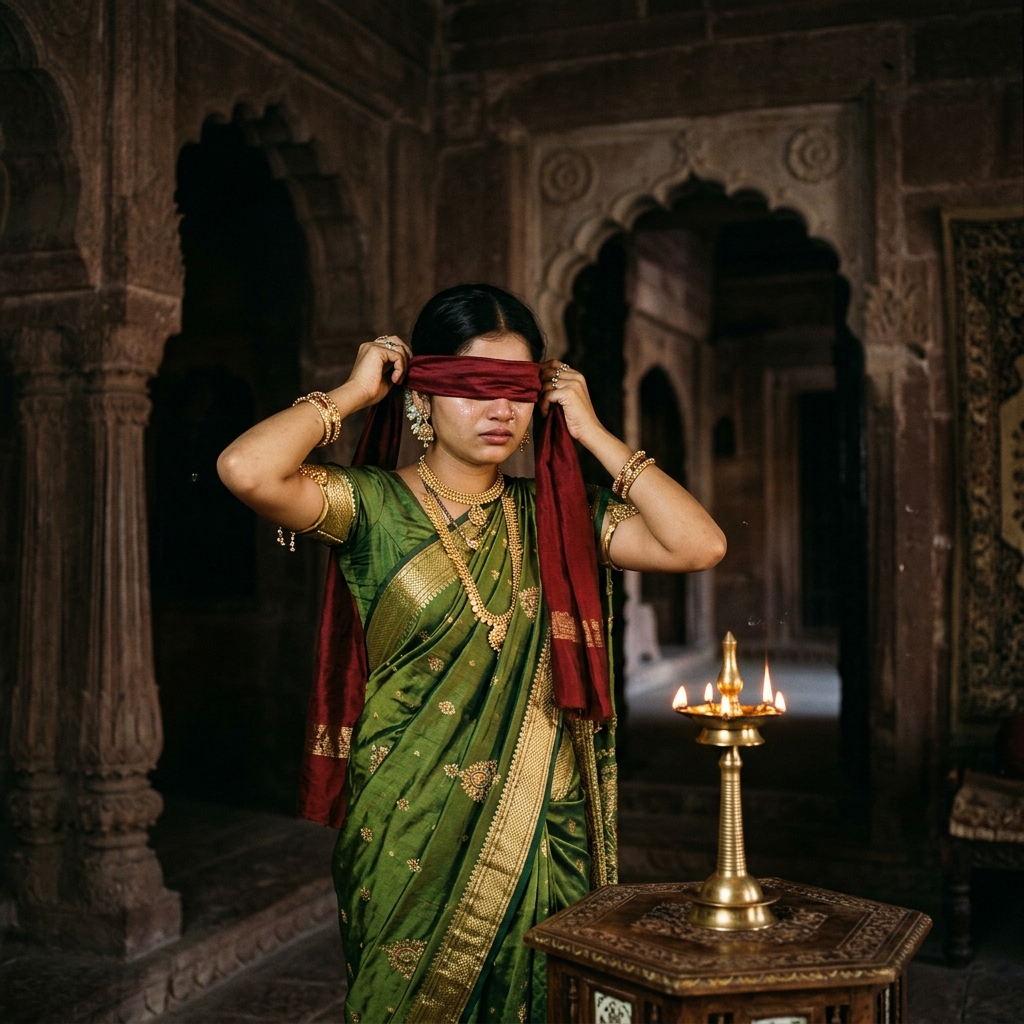
A House Without an Heir
Grief settled over the palace of Hastinapura like a fog that would not lift. Vichitravirya, the young king of the Kuru line, was dead - taken by a wasting sickness while still in the springtime of his life. He had ruled only a short while, married to the two princesses of Kashi, Ambika and Ambalika, and he had left no child behind him. The royal cradle stood empty. The great throne of the Kurus, the seat of Bharata himself, had no one to inherit it.
Satyavati, the queen mother, walked the silent corridors of the inner apartments with a heavy heart. She had buried two sons now. First Chitrangada, slain in a foolish quarrel with a gandharva. And now Vichitravirya, gone before he could give the dynasty its future. The fisherman's daughter who had risen to become queen of the Kurus saw the entire line she had married into trembling on the edge of extinction. A kingdom without a king invites war from every neighbor and ruin from within. She knew this, and the knowledge would not let her rest.
The two young widows, Ambika and Ambalika, kept to their chambers, pale and quiet, their bangles broken in the custom of mourning. They were daughters of kings, brought to Hastinapura by force and then by marriage, and now they were widows before they had truly been wives. Their futures, like the dynasty's, hung suspended and uncertain.
Satyavati understood that something had to be done, and soon. The land could not be left rulerless. Yet every ordinary path forward seemed closed. She gathered her resolve and went to the one man whose word carried more weight in Hastinapura than any crown - the towering, ageless figure of Bhishma, the grandsire of the house.
The Mother's Plea to Bhishma
Bhishma was the eldest of the house, the son of King Shantanu and the river-goddess Ganga. Long ago, so that his father might marry Satyavati herself, he had given up his own right to the throne and taken a terrible vow - never to marry, never to father children, and to serve whoever sat upon the Kuru seat. For that fearsome oath the gods themselves had renamed him Bhishma, the man of the dreadful vow. He was a warrior without equal, wise in statecraft and devoted to dharma above all things.
Satyavati came before him and spoke without disguise. The dynasty, she said, was hers to protect now, and it stood at the brink of nothing. "You are the son of the noble Shantanu," she told him. "You alone can keep this line from dying. I ask you to take up the kingdom, marry these two princesses according to proper rites, and beget children upon them. Do not let the house of Bharata become a tale of what once was. The duty falls to you."
It was, by the customs of that age, a request a queen mother could lawfully make. The continuation of a royal line was held to outweigh a single man's private vow, and Satyavati pressed exactly this point. She reminded him of his obligation to his ancestors, of the offerings the dead require from living descendants, of the chaos that follows when a throne has no rightful heir.
Bhishma listened, and his great heart was moved by her distress, for he loved the family he had given everything to serve. But his answer, when it came, was unbending as the Himalayas.
The Vow That Could Not Bend
"Mother," Bhishma said gently, "what you ask, I cannot give. You know the oath I swore beside the Ganga, in the hearing of the very gods. For my father's happiness I renounced both kingdom and progeny. The sun might lose its heat, the moon its coolness, fire might grow cold and the wind cease to move - sooner would all these things turn from their nature than I turn from the truth I have spoken."
He stood before her, immense and immovable. "I can abandon the three worlds, I can abandon the rule of the gods, but I cannot abandon truth. To break this vow would be to make my whole life a lie, and a kingdom founded upon my falsehood would be worse than a kingdom with no king at all. Ask me anything else, and it is yours. Ask me this, and I must refuse, though it breaks my heart to do so."
Satyavati saw that she could not move him, and in truth she did not wish to. The strength of his vow was the strength of the whole house. A man who would not lie even to save the dynasty was a man worth more than any heir.
Yet the problem remained, sharp and unsolved. If Bhishma would not father children, who would? Then Bhishma, who knew the old laws as well as any sage, offered the answer that the scriptures themselves provided. "There is an ancient and lawful custom for exactly such a calamity," he said. "It is called niyoga. When a man dies without a son, a worthy person - a brother, or a Brahmana of great spiritual power - may be invited by the family to beget a child upon the widow on the dead man's behalf. The child belongs to the dead husband's line, not to the one who fathers it. Let us summon a Brahmana of high merit, and through niyoga the Kuru line may yet be saved."
Satyavati's Hidden Son
Bhishma's words opened a door in Satyavati's mind, and behind it lay a secret she had carried for most of her life - one she had never spoken of, not to Shantanu, not to her sons, not to the grandsire who stood before her now.
Long before she had ever set eyes on King Shantanu, Satyavati had lived as a fisherman's daughter, ferrying travelers across the river. She had been called Matsyagandha then, the girl who carried the smell of fish about her. One day she had carried across the waters a wandering sage of immense power, Parashara, grandson of the great Vasishtha. Through divine arrangement and the sage's grace, she had borne him a son upon an island in the river. That son was no ordinary child. Even at birth he chose the life of an ascetic, and he grew at once into a being of staggering spiritual force. Because he was born upon an island - dwipa in the old tongue - and because he would one day divide and arrange the eternal Vedas into their four branches, he came to be known as Krishna Dwaipayana Vyasa.
Before he left her to go into the forest, Vyasa had told his mother: "Whenever you have need of me, only think of me, and I shall come to you." Through all her years as queen, through both her marriages and the births and deaths of her sons, Satyavati had never once called upon him. But now, with the dynasty dying and Bhishma's vow unbreakable, the moment had come.
She turned to Bhishma and revealed the truth at last. "I have a son," she said, "older than any of my children by Shantanu. He is the sage Vyasa, born to me before my marriage to your father, the offspring of the holy Parashara. There is no Brahmana on earth more fit for this sacred duty. If you consent, I shall call him, and he will come." Bhishma, hearing this, bowed his head and gave his blessing to the plan.
The Sage Appears
Alone in her chamber, Satyavati composed her mind and thought of her firstborn with all the longing of a mother and all the urgency of a queen. The summons crossed the distance between them in an instant. Vyasa, deep in his austerities in some far forest, felt his mother's call and set aside his recitation of the Vedas. In the time it takes to form a single thought, he stood before her in the inner apartments of Hastinapura.
He was a fearsome thing to behold. Years of unbroken penance in the wild had left him with matted, copper-colored hair piled high upon his head, a beard wild and tangled, eyes that blazed like coals from a face darkened by sun and ash. His body was lean and hard, his garments rough, and about him hung the harsh, smoky odor of a man who lives among smoke and forest and has no thought to spare for the comforts of the body. Yet within that rude shell burned one of the greatest spirits the world had known - the compiler of the Vedas, the seer who would one day set down the whole history of the Bharatas.
Satyavati greeted him with joy and reverence, embracing the son she had not seen in so long. Then, when the first emotion had passed, she told him plainly why she had called. She spoke of Vichitravirya's death, of the empty throne, of Bhishma's vow and the danger to the line. "My son," she said, "you came from my womb, and the Kuru house came to me through marriage. Both are equally mine, and both lay claim to your help. The dynasty will perish unless heirs are born. By the lawful custom of niyoga, I ask you to beget children upon the widows of your half-brother, that the line of Bharata may not end."
Vyasa listened, and though such matters were far from the life of an ascetic, he understood the gravity of what his mother asked. For the sake of dharma and the preservation of a noble line, he agreed.
A Condition of Patience
Vyasa consented, but he set a condition, for he knew that what he was and what the princesses expected would be very far apart. "I will do as you ask," he told his mother, "but the queens must observe a vow first. Let them be patient with me. My appearance is harsh, and my smell is harsh, and my penance has stripped from me all the softness that high-born women look for in a man. If the princess can endure my ugliness and my odor without flinching, she will conceive a son who is mighty and faultless. This is the only way."
Satyavati understood the warning in his words, but the need was pressing and she did not think the difficulty could be so great. "Let it be tonight, then," she said, eager to secure the future while the chance was before her. "Let the elder princess receive you first."
Vyasa shook his head. "So soon? Then let her at least prepare herself, and let her hold firm whatever she may see." He asked that the princess come to him willingly and steady her heart, for the quality of the child, in the wisdom of that age, was bound up with the state of mind of the mother in that hour. A heart full of fear would leave its mark; a heart at peace would bless the child.
Satyavati went herself to the chamber of Ambika, the elder of the two widows. Gently she explained what was needed of her - that for the sake of the dynasty and the memory of her dead husband, she must receive the great sage that night, and that she must be brave, for he was not pleasing to the eye. Ambika, dutiful and frightened, bowed her head and consented, though dread was already creeping into her heart. Adorned and trembling, she waited in the lamplit room for the sage to come to her.
Ambika Shuts Her Eyes
Night came to Hastinapura, and the lamps were lit in the inner chamber. Ambika lay waiting, her resolve carefully gathered, her promise to be brave fresh in her mind. Then the door opened and Vyasa entered, and every resolution she had made fell away in a single instant.
In the wavering lamplight she saw him as he truly was - the wild, matted hair, the burning eyes, the dark and weathered face, the rough garments, and she caught the powerful odor of his ascetic life. He was nothing like the gentle young husband she had lost, nothing like the princes of her father's court. A terror she could not control swept over her. And in that moment of fear, Ambika did the one thing the sage had warned against: she squeezed her eyes tightly shut and would not open them, not for an instant, the whole time the sage was with her.
Vyasa was a man of perfect knowledge, and he understood at once what her closed eyes would mean. When he came forth from the chamber, his mother Satyavati was waiting anxiously, hungry for good news. "Will she bear a worthy son?" she asked.
"She will bear a son of enormous strength," Vyasa answered, "a man with the might of ten thousand elephants, learned and wise and blessed with a hundred sons of his own. But because his mother closed her eyes in fear and would not look upon me, that son will be born blind." Satyavati's heart sank. "A blind man cannot rule the Kurus," she cried. "Give this dynasty another king, my son." Vyasa, ever obedient to his mother and to dharma, agreed that he would return once more.
Ambalika Turns Pale
So in due season the matter was tried again, this time with the younger widow, Ambalika. Once more Satyavati came and explained the sacred duty, and once more she urged courage. Ambalika listened to her sister's account of the dreadful figure who would come to her, and though she promised to be strong, the warning had already done its work upon her imagination.
When the appointed night came and Vyasa entered her chamber, Ambalika kept her eyes open - she did not shut them as her sister had done - but the sight of the sage in all his fearsome aspect drained the blood from her face. She turned white as a jasmine flower, pale with a fright she could not master, though she did not look away. Her courage held in part, but her body betrayed her terror all the same.
When the union was over and Vyasa came out to his waiting mother, he told her the truth as before. "This princess looked upon me, and so her son will not be blind. But she grew pale with fear in my presence, and therefore her child will be born pale and sickly in his color. He shall be called Pandu, the pale one." Satyavati grieved again, for though Pandu would be capable and handsome and fit to rule, she had hoped for a son untouched by any flaw.
Vyasa comforted her as best he could. "These are the fruits of fear," he said. "What is sown in that hour is reaped in the child. Yet Pandu will be a king of virtue and a father of mighty sons. Do not despair entirely." And he prepared to take his leave, for his work, he believed, was done. But Satyavati, still hungry for a flawless heir, was not yet finished.
The Maid in the Queen's Place
Determined to obtain a son free of any blemish, Satyavati went a third time to the elder princess, Ambika, asking her to receive the sage once more. But Ambika, who had not forgotten the terror of that first night, could not bring herself to face Vyasa again. The memory of his blazing eyes and matted hair filled her with such dread that no command of her mother-in-law could overcome it.
Yet Ambika dared not openly refuse the queen mother. So she devised a quiet substitution. She had a maidservant, a young woman of grace and good character, devoted and unafraid. Ambika dressed this maid in her own royal ornaments and her own fine garments, perfumed and adorned her as a princess, and sent her to the sage's chamber in her place, that she herself might be spared.
The maidservant, however, was made of different stuff than the trembling princesses. When Vyasa came to her, she received him with calm and with reverence. She felt no terror at his appearance and no disgust at his ascetic ways. She rose and welcomed him, attended to him with respect, and gave him the honor due to a great sage. Her heart was steady and her mind was at peace the whole night through.
Vyasa was deeply pleased with her - more pleased than he had been with either of the highborn queens. "O fortunate one," he said to her, "you have served me without fear and without aversion. Therefore you shall no longer be a servant. You will bear a son who is the most intelligent and most righteous man in all the world, foremost among the wise." And with that blessing he departed, his task at Hastinapura now truly complete.
Vidura, the Incarnation of Dharma
The child born of the maidservant was Vidura, and his birth carried a secret far older than the troubles of Hastinapura. For Vidura was no ordinary soul. He was the very god Dharma himself, the lord of righteousness, come to be born into the world of men. And the reason for that descent lay in an old and bitter injustice.
Long before, there had lived a sage of great austerity named Animandavya. While he sat absorbed in deep meditation, a band of thieves fleeing the king's guards had hidden their stolen goods near his hermitage. When the guards arrived and found the loot, they seized the silent sage along with the robbers, and the king, judging hastily, ordered him impaled upon a stake along with the thieves. The stake could not kill the holy man, for the power of his penance sustained his life even in agony, and at last the king learned his terrible error and freed him with desperate apologies. Animandavya survived, but the cruelty had been done.
Seeking the cause of his unmerited suffering, the sage went to the abode of Dharma, the god who measures out the fruits of every deed. "Why was such a torment decreed for me, who had committed no crime?" he demanded. Dharma answered that in his childhood the sage had once tormented small creatures, piercing insects with a blade of grass, and that this was the recompense. But Animandavya judged the punishment far out of proportion to a child's thoughtless act. In his anger he laid a curse upon Dharma himself: "For visiting so heavy a penalty upon so small and innocent a fault, you shall be born in the world of men, in the womb of a Shudra woman." And so Dharma, bound by the curse, took birth as Vidura, son of the maidservant - which was why, for all his unmatched wisdom and virtue, Vidura could never sit upon the throne, his birth marking him as ineligible to rule.
Three Sons Raised in the Palace
In time three boys grew up together within the walls of Hastinapura, brothers in name and in upbringing though each carried the mark of the hour of his conception. There was Dhritarashtra, the eldest, born blind because his mother had closed her eyes - yet endowed with the strength of ten thousand elephants, broad of shoulder and keen of mind, lacking only the sight that a king most needs. There was Pandu, born pale and somewhat sickly because his mother had blanched with fear - yet handsome, noble, skilled in arms, and beloved by all. And there was Vidura, born of the fearless maidservant - the wisest of the three, calm and far-seeing, a fountain of counsel and of righteousness, though his birth set him apart from the throne.
Bhishma, who had given up his own children for the sake of the house, raised these three grandnephews as if they were his own sons. He saw to their education in the Vedas, in statecraft, in the use of weapons, in the duties of princes. Under his guidance and the care of the family priests they grew strong and accomplished, and for a time it seemed that the dynasty, so lately at the brink of extinction, had been pulled back to safety. The empty cradle had been filled threefold, and the line of Bharata went on.
When the boys came of age, the question of the throne could no longer be deferred. By the laws of the land a blind man could not be crowned king, for a ruler must see his realm, lead his armies, and read the faces of those who come before him. So Dhritarashtra, eldest though he was, was passed over. Vidura, wisest of all, was barred by the circumstance of his birth. The crown therefore came to Pandu, the middle brother, who was anointed King of Hastinapura, while Dhritarashtra remained the elder in years and Vidura became the great minister and adviser of the realm.
The Shadow Over the Dynasty
So the niyoga of Vyasa saved the Kuru line, but it did not save it cleanly. Every choice made in those fearful nights left a long shadow that would stretch across generations. The dynasty lived, but it lived divided against itself from its very root.
Dhritarashtra, the elder, carried in his blindness a lifelong sense of injury. He felt that the kingship had been denied him by an accident of birth, that by all the laws of seniority the throne should have been his. That grievance would harden over the years into a deep and stubborn attachment to his own sons, and above all to his eldest, Duryodhana - an attachment so blind in its own way that it would override justice, ignore wise counsel, and steer the whole house toward catastrophe. The seed of the great war of Kurukshetra was planted, in part, in the resentment of the king who could not see.
Pandu's pale and uncertain health, too, would shape what followed, for it was tangled up with the fate that drew him from the throne into the forest, leaving his brother to rule in his place and his sons to be raised among their cousins as rivals. And Vidura, the incarnation of Dharma, would stand through all the years to come as the lonely voice of righteousness in a court that did not wish to hear it - warning, pleading, and ultimately unheeded as the family rushed toward ruin.
Satyavati had done what she set out to do. The line of Shantanu and Bharata did not die in that generation. Yet she lived long enough to glimpse the troubles gathering, and when her end drew near, she withdrew from the palace into the forest with the widowed queens, leaving the world before the storm broke. The Kuru house went on - blind king, pale king, and wise minister together - bearing within itself, from its very rebirth, the fault lines along which it would one day be torn apart.
Dharma Lesson
Duty sometimes demands what the heart cannot bear. The practice of niyoga - where Vyasa fathered children for the continuation of the dynasty - was accepted by all as necessary dharma, yet the revulsion of the mothers shaped the very nature of their children, teaching us that the spirit in which duty is performed matters as much as the act itself.