A Brother Without a Bride
The grief of the Kuru house had barely settled. Chitrangada, Satyavati's eldest son, lay dead, slain in a long war upon the plains by a Gandharva of the same name, and Bhishma had lit the funeral pyre with his own hands. Now the throne of Hastinapura rested upon a boy, Vichitravirya, the younger son, and Bhishma ruled as his guardian until the prince should come of age.
The years passed. The boy grew into a youth, slender and handsome, gentle of temper and fond of pleasure. And Satyavati, watching her one surviving son, was seized by an old and natural fear. The line of Shantanu had narrowed to a single thread. If Vichitravirya were to die childless, the great house of Bharata would be extinguished forever, and all the offerings of the ancestors would cease.
She summoned Bhishma, the towering son of Ganga who had renounced both throne and marriage by a dreadful vow, and laid her worry before him. "My son is of an age to wed," she said. "Find him a worthy bride, that the dynasty may not perish. You alone have the strength and the wisdom to secure it."
Bhishma bowed his head. He had sworn never to rule and never to take a wife, but he had not sworn away his duty to the throne he protected. The continuation of his father's line was the very burden he had taken the terrible vow to uphold. He would find a bride for his half-brother, and not one bride only, but brides fit for a king.
Word of the Svayamvara
Word came to Hastinapura that the King of Kashi was holding a svayamvara for his three daughters. The princesses were renowned across the land for their beauty - Amba the eldest, Ambika the second, and Ambalika the youngest - and kings were riding from every quarter to contend for their hands.
A svayamvara was the proudest of all weddings, for in it the bride herself walked among the assembled suitors and set the garland upon the neck of the one she chose. To be invited was an honor. To be passed over was a wound that princes carried to their graves.
Bhishma considered the matter and saw at once that the three princesses, sisters and equals, would make fitting queens for the Kuru house. Yet he noticed too that no invitation had come to Hastinapura. Whether by oversight or by design, the King of Kashi had not summoned the Kurus to the contest. For a lesser man this would have ended the matter.
But Bhishma was no ordinary suitor, and he had not come to court a bride for himself. The shastras, he knew, named eight forms of marriage, and among them was one reserved for the warrior caste - the marriage by valor, in which a kshatriya carried off a maiden by force after defeating all who stood against him. It was held an honorable and even a praiseworthy thing for a man of arms. With this in his mind, the son of Ganga ordered a single chariot yoked and drove alone toward the city of Kashi.
The Hall of Kings
The great hall of Kashi blazed with the wealth of a hundred kingdoms. Kings sat upon raised seats in their finery, garlanded and perfumed, their armor laid aside, their eyes turned eagerly toward the inner doors from which the princesses would come. Bards sang the lineages of the assembled monarchs, and the air was thick with sandal smoke and the murmur of proud men measuring one another.
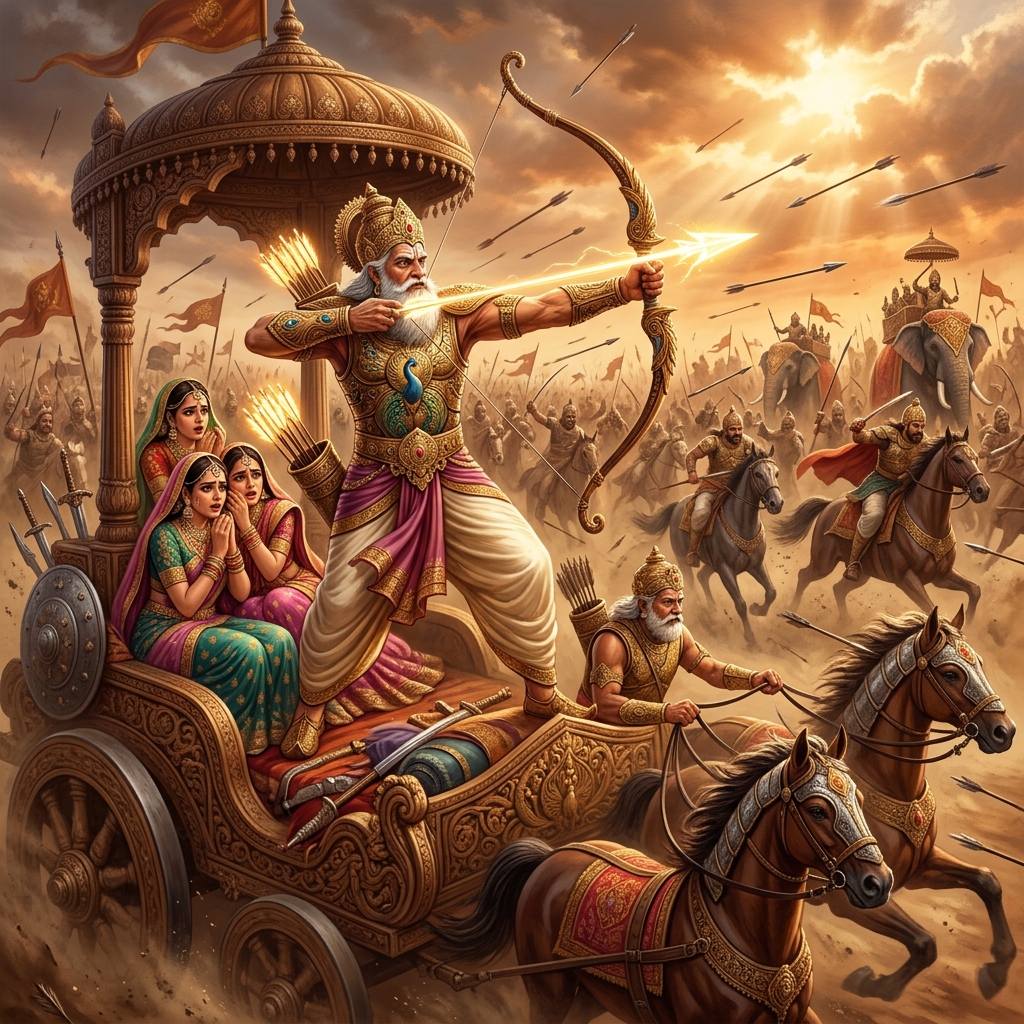
Into this glittering company drove Bhishma, alone in his chariot, grey at the temples and immense of frame, his bow already strung. The kings stared. Some knew him by sight, the dread son of Ganga whose vow had become a legend; others knew him only as an old warrior who had come uninvited and unannounced.
Then the three princesses entered, robed and adorned, the garlands of choosing in their hands. They moved hesitantly down the rows of suitors, and every eye in the hall followed them, and not one eye in the hall was watching the grey old man in the lone chariot near the doors.
That was the moment Bhishma had waited for. He did not slow. He did not deliberate. In a single sweeping motion he reached out and lifted all three maidens up into his chariot, as a great bird stoops and seizes its prey, and set them beside him before any man in that hall had risen from his seat.
The Challenge
For an instant the hall was struck dumb with disbelief. Then it erupted. Kings sprang from their seats with cries of fury, calling for their armor, calling for their bows, calling down curses upon the brazen stranger who had dared to lay hands upon the brides before their very eyes.
Bhishma did not flee. He wheeled his chariot and faced the seething assembly, and he lifted his voice so that it carried over the uproar like a war-conch over a battlefield. "The wise have declared," he proclaimed, "that the giving of a maiden adorned with ornaments, the selling of a daughter, and the rest are all lesser forms of union. But the maiden seized by force from a gathering of kings, after the suitor has vanquished all rivals, this the learned hold to be the highest marriage for one of the warrior caste!"
"Therefore I, Bhishma, carry away these maidens by strength. Strive with all your might, you kings, to take them back from me, for I stand here resolved to conquer you or to fall!"
Having flung down this challenge, he set the trembling princesses behind him, took up his great bow, and drove from the hall of Kashi out into the open road, the daughters of the king carried away in the face of the whole assembled chivalry of the earth.
The Pursuit
The kings did not bear the insult. They flew to their chariots, snatched up their weapons, and poured out of the city in a roaring flood, biting their lips with rage, resolved to cut down the thief or die. Behind Bhishma the dust rose in a vast cloud as the chivalry of many kingdoms gave chase across the plain.
They overtook him and ringed him round, and the sky grew dark with their arrows, a tempest of shafts loosed from every side at the lone chariot. But Bhishma stood unmoved at the center of the storm. As clouds pour rain upon a mountain that does not feel it, so the kings rained arrows upon the son of Ganga, and he received them all and was not shaken.
Then he answered them. He bent his terrible bow and loosed, and his arrows flew in such numbers and with such fury that the heavens seemed roofed over with them. He cut the bows of the kings in their hands, he severed their banners, he struck down their charioteers, he split their chariot-poles and felled their horses, all the while shielding the three frightened maidens at his back.
Such was the skill and the speed of his hands that the watching kings, even in their wrath, cried out in wonder. One man, alone and on a single car, was holding at bay the gathered monarchs of the world, as the gods of old had stood against the demon hosts.
Shalva of Saubha
Of all the suitors, none burned hotter than Shalva, the king of Saubha. For Amba, the eldest of the three, was beloved of Shalva and he of her, and to see her carried off before his eyes was a torment past bearing. He pressed his car forward through the press, shouting to Bhishma to stand and fight.
"Stay, stay!" Shalva cried, and Bhishma, hearing the challenge of a single brave foe, turned his chariot like an angry lion rounding upon a hunter. The other kings drew back to watch, for they saw that here was a duel worthy of their gaze.
The two warriors fell upon each other, and the air between them was hidden by their flying shafts. Shalva fought with the desperate strength of a man fighting for his heart's own love, and for a time he matched the son of Ganga blow for blow, so that the kings raised a shout of "Excellent! Excellent!" at his valor.
But Bhishma was Bhishma. He gathered his wrath, and with smiling lips he covered Shalva's chariot in a sheet of arrows. He cut down Shalva's horses, he slew his charioteer, he shattered his bow and broke his standard, and brought the king of Saubha low and helpless upon the field. Yet he did not kill him. For the sake of the maidens, and because Shalva had fought with honor, Bhishma spared his life and let him withdraw, beaten, to his own kingdom. Then the son of Ganga turned his chariot homeward and bore the three princesses to Hastinapura.
Amba's Confession
In Hastinapura the princesses were received with all the honor due to brides of the royal house. Satyavati embraced them; the city made ready for a wedding; and Bhishma, his hard task accomplished, prepared to give the three daughters of Kashi to his young half-brother Vichitravirya as became their station and his own.
But as the rites were being arranged, Amba, the eldest, came before Bhishma with her heart in turmoil. She gathered her courage, and in the hearing of the elders she spoke.
"Listen to me, O most virtuous of men," she said, "for I will tell you the truth. Long before this day, in my own heart, I had chosen Shalva, the king of Saubha, to be my lord. And he too had set his love upon me, and my father knew of it and did not forbid it. Had the svayamvara gone its course, I would have placed my garland upon Shalva and no other."
"You have carried me here by the law of the strong, and I do not deny your right by arms. But it is not lawful for a woman whose heart is already given to wed another man. Knowing this, O wise one, do as your own dharma instructs you, and let me go."
Honorably Released
Bhishma heard Amba out, and his great heart was moved. He was a man who held dharma above his own desire, above the throne itself, above life - for he had proven as much with the most fearful vow ever sworn. He would not, for the sake of his brother's marriage, take to that brother's house a woman whose love already belonged to another.
He took counsel with the priests and the elders, the Brahmanas learned in the sacred law, and they confirmed what his own conscience told him. A maiden who had already given her heart and been accepted by her chosen lord could not rightly be married elsewhere.
So Bhishma honored Amba's plea. He released her with courtesy and with the blessings of the elders, and gave her an escort of aged Brahmanas and her own nurse to attend her, and sent her on her way to Shalva of Saubha. The two younger sisters, Ambika and Ambalika, who had no such bond, he kept for the wedding, and in time bestowed them upon Vichitravirya.
Amba set out for Saubha with a lightened heart. She believed her ordeal was ended. She believed she went now to the husband of her own choosing, and that fortune, having frowned, had at last turned its face toward her. She did not know that the cruelest stroke of all still lay before her.
Rejected at Saubha
Amba came at last to the city of Saubha and stood before Shalva, the king for whom her heart had longed. She told him all that had passed: how Bhishma had seized her from the svayamvara by force, how she had confessed her love for Shalva before the Kuru elders, and how the son of Ganga, knowing the truth, had set her free to come to him. "I am yours," she said. "I have always been yours. Take me, my lord, as your queen."
But Shalva turned his face from her. The wound of his defeat festered in him, and his pride could not bear what had been done. "You were seized in the sight of all," he said coldly, "and carried away in Bhishma's chariot before my very eyes. Bhishma vanquished me upon the field and took you for his house. I will not now take to wife a woman who has been the prize of another man, who has dwelt under the roof of another and ridden in his car. Go where you please. I cannot receive you."
Amba pleaded with him. She wept; she swore that Bhishma had never looked upon her but as a daughter; she reminded him of all that had been between them. But Shalva, gnawed by the shame of his beating, drove her from his presence as a hawk drives off a lesser bird, and would not be moved. The gate of Saubha closed against her.
Nowhere to Turn
So Amba stood alone outside the walls of Saubha, cast off and homeless, a princess of Kashi who now belonged to no house upon the earth. Shalva would not have her. She could not return to Hastinapura, for Bhishma had given her leave to depart and she had refused that path. She could not go back to her father's house in Kashi, for she had been carried from the svayamvara and shamed before the world, and the doors of her childhood were closed to her.
Grief gave way slowly to a colder thing. She looked upon her ruin and asked herself who had wrought it, and the answer rose plain before her. It was Bhishma. It was Bhishma who had broken into the svayamvara and torn her from the choosing. It was Bhishma whose chariot had carried her away before Shalva's eyes and given Shalva his pretext. Every road of her sorrow ran back to the son of Ganga.
The escort of Brahmanas who had come with her counseled her gently and went their way. Amba turned from the gate of Saubha, but she did not turn toward despair. In the depths of her heart a single resolve was hardening into iron. She would have justice upon the man who had unmade her life, though it cost her this birth and the next.
"Bhishma is the root of my misery," she said to herself. "I will not rest, in this body or in another, until I have brought about his fall." And so the wronged daughter of Kashi set forth upon the long and terrible quest that would one day return, across the gulf of years and even of death, to stand before the son of Ganga upon the field of Kurukshetra. But that is another tale.
Dharma Lesson
Strength without wisdom creates suffering. Bhishma's abduction of the princesses, though done to secure brides for his brother, ignored the desires and agency of the women themselves. Amba's resulting vow of vengeance shows that the consequences of unchecked power are far-reaching and devastating.