The Weight Before the Word
There is a kind of sacrifice that happens in a single morning and then asks to be paid for across a whole lifetime. This is the story of such a sacrifice, and of the man who carried its weight from the riverbank of his youth to a bed of arrows in his last winter. His name at birth was Devavrata. The world would come to call him Bhishma, the Terrible One, and the terror in that name was not cruelty. It was the dreadful size of what he gave up.
He was the son of King Shantanu of Hastinapura and the river goddess Ganga, and he had been raised as no ordinary prince. The sages had taught him the Vedas. Parashurama himself had trained his arm. Brihaspati and Shukra, preceptors of gods and demons, had poured statecraft and wisdom into him. He was the crown prince of the Kuru line, and the whole city had set its hopes upon him as a man sets a lamp in the window against a long night. Everything that a dynasty could wish for in an heir, Devavrata already was.
And so the cost of what he would do can only be understood by first seeing what he had to lose. He stood at the head of a kingdom that was already, in all but ceremony, his. He was young, strong, beloved, unmatched in arms, and free, his future open before him like the Yamuna stretching toward the horizon.
Then his father fell silent with an unnamed grief, and Devavrata, who could not bear to watch a thing he loved waste away, set out to learn its cause. He did not yet know that to cure his father's sorrow he would have to lay down, one by one, every single thing that made his own life worth living. He only knew that his father was suffering. For a son of his nature, that was enough to set the whole tragedy in motion.
A Father's Unspoken Grief
King Shantanu had come back from the banks of the Yamuna a changed man. He had met a fisherman's daughter named Satyavati, a woman around whom the air itself seemed sweetened, and he had wanted her for his queen. But the fisher chief who raised her had named a price the king could not bring himself to pay. The son that Satyavati bore, and no other, must inherit the throne of Hastinapura. To agree was to disinherit Devavrata, his firstborn, his pride, the heir the city already loved. So Shantanu had said nothing, swallowed his longing, and ridden home to sicken in silence.
The court whispered of illness, but no physician could find its root in the body, because it was not in the body. Devavrata watched his father grow thin and grey and would not let it stand. "The realm is at peace," he said, kneeling by him. "No enemy stirs at our borders. The treasury is full. Why then do you sit like a man already in mourning, and why will you not share even with your own son the grief that eats you?"
Shantanu turned the question aside with talk of mortality, of how Devavrata was his only living son and rode too eagerly into danger, of how a dynasty resting on a single heir was a single lamp in a great wind. It was true, and it was also a curtain drawn across the truth. The king would not name his real wound, because to name it was to ask his son for something no father should dare ask.
But Devavrata was not a child to be soothed by half answers. He went instead to the old charioteer and minister who had served the house since before his birth, and from that loyal man he learned the whole of it, plainly told: the woman on the river, the fisher chief's condition, and the throne that stood like a wall between his father and any peace. The prince listened. And as he listened, a resolve gathered in him that he did not pause to weigh, because to weigh it honestly would have been to feel, in advance, the full crushing measure of its cost.
The Crown Set Down
Devavrata did not go to the fisherman's settlement as a supplicant slipping in by a side door. He went as a prince of Hastinapura, and he took with him a council of aged Kshatriyas as witnesses, so that whatever he said would be said before the world and could never afterward be unsaid. This care was itself a kind of foreknowledge. A man who arranges witnesses to his own promise already senses that the promise will need to outlast every temptation he will ever feel to break it.
He stood before the fisher chief in the open air, by the slow brown water. "I have come to ask for your daughter on behalf of my father, the king," he said. "Name your condition again, that all these elders may hear it."
The chief repeated it without softening. The son of Satyavati must be king. No other claim could stand against his.
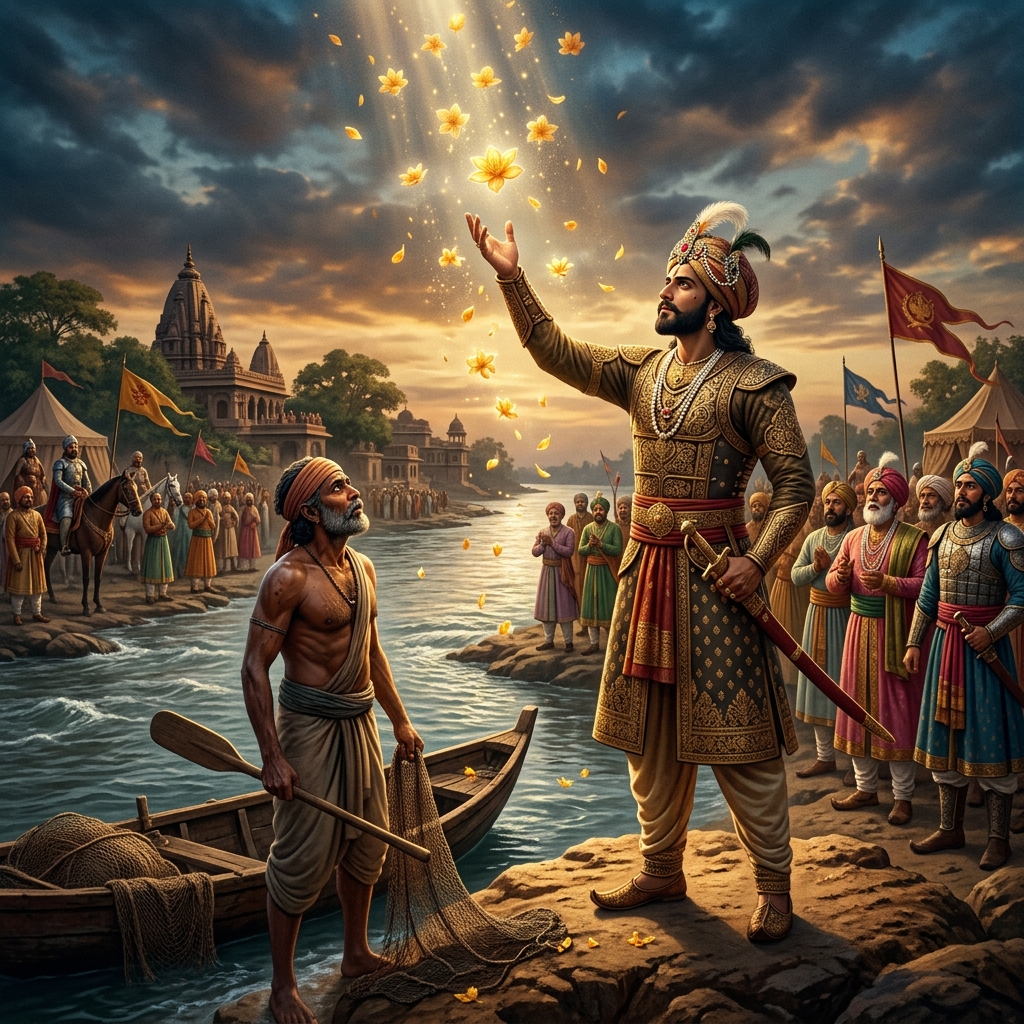
Then Devavrata laid down the first of the things that had been his since birth. "Hear me," he said, and his voice carried over the river and into the memory of the men who stood there. "I renounce my right to the throne of Hastinapura. The son your daughter bears to my father shall be king, and I will be the first among all men to bow before him."
The elders murmured, for it was an extraordinary thing, a crown prince setting aside a kingdom for the sake of his father's heart. Consider what it was he surrendered in that one sentence. Not a luxury, not a privilege, but the entire shape his life had been built toward. The training, the expectation, the love of a whole people, the work of governing well that he had been raised from infancy to do. He gave it away as another man might hand over a cloak. And he believed, in that moment, that the giving was finished.
It was not finished. The fisher chief, shrewd in the way of men who have bargained all their lives, looked at the strong young prince standing there in the fullness of his youth, and found the one gap that the renunciation had left open.
The Terrible Vow
"I do not doubt your word, O Prince," the fisher chief said. "But you will marry one day, and have sons of your own, and they will be lions. What is your renunciation to them? When you are gone, they will look upon the throne their father gave away, and they will reach for it, and there will be blood. Your word binds you. It does not bind your children."
It was a true fear, and a cruel one, because it could only be answered in a single, terrible way. Devavrata saw at once what would close it, and what closing it would cost. There was no clever middle path, no oath he could swear that left him any future of his own. The fisherman had asked, in effect, whether the prince would give up not only his crown but his very line, his marriage, his children, the ordinary human inheritance of love and continuance that even the poorest man on that riverbank possessed.
"You are afraid of my sons," Devavrata said, and his voice rang out so that not one of the witnesses could later claim to have misheard. "Then know this. I take here, before these elders and before the gods, the vow of lifelong celibacy. I will never take a wife. I will never father a child. The seed of my body will end with my body. Let no son of mine ever trouble the descendants of your daughter, for I will have no sons. I give up not only the crown but the very hope of a line of my own, so that my father may have his happiness."
For a moment there was no sound but the river. Then, from a clear sky, flowers fell. They drifted down upon the prince's shoulders and into the dust at his feet, and a voice out of the heavens, the voice of the gods and the gandharvas and the great rishis together, rang over the gathering. "Bhishma!" they cried. "He is Bhishma, the one of the terrible vow!" And by that name, Bhishma, the Terrible One, Devavrata would be known forever after, until his birth name was nearly forgotten beneath it.
The gods named the vow terrible. Not wicked, for it was made in pure love, but terrible in the older sense: too great to look at directly, too heavy to be asked of any man, and now sworn beyond all recall by a youth who had everything and chose to keep none of it.
A Father's Helpless Gift
The fisher chief, his hairs standing on end at what he had just witnessed, gave his daughter at last. But Bhishma had not won a bride for himself. He had won one for his father, and the thing he had spent was everything a man calls his own future. He handed Satyavati up into the chariot and drove her to Hastinapura to become his father's queen, and there he served her, this woman whose marriage had cost him the world, with the simple courtesy of a son. He never once let her see the weight he carried on her account.
When Shantanu learned the full measure of what his son had done, he did not rejoice. He wept. He had wanted a woman, and his son had paid for that wanting with his whole life, with marriage and children and a kingdom all surrendered in an afternoon. No father, the king understood, should ever be owed so terrible a debt by his child, and there was now no way under heaven to pay it back.
Shantanu could not return the crown, nor the wife, nor the children Bhishma had renounced. Those were gone past recall, sealed by an oath the gods had blessed. But the king, overwhelmed by a love that had no other outlet, gave what little remained in his power. He laid his hands upon his son and granted him a boon that no warrior before or since would ever hold. He gave Bhishma Iccha Mrityu, death by his own will alone. No weapon, no wound, no sickness, no slow turning of the years could take Bhishma's life against his wish. He would die only on the day he himself chose to die, and not one moment before.
The court received it as a marvel, the highest protection a guardian of the dynasty could be given. The gods had named the youth, and now no enemy could so much as end him. What greater shield could a warrior carry? Yet Shantanu, in his grief, had handed his son a gift with a cruelty folded deep inside it, and the years would unfold that cruelty slowly.
The Curse Inside the Boon
A man who cannot die is a man who must endure. He is denied the one mercy that releases other men from their grief, the merciful accident, the quiet failing of the heart in old age, the disease that closes a chapter no longer bearable. Bhishma could be granted none of these. Whatever came, he had to stand and watch, and go on standing.
Think, then, of what this meant for a man who had already given up everything that makes a life sweet. He had no wife to grow old beside. He had no children to carry his name or close his eyes. He had no crown to occupy his days with the work of ruling. He had set all of it down on a riverbank in his youth. And now he could not even be released by death from the long emptiness that those renunciations had made of his years. Every loss that would have ended an ordinary man's life would instead merely pass through Bhishma and leave him standing, whole and undiminished, in a hall grown emptier than before.
The boon made him the permanence of the dynasty. He became the one fixed thing in a house where everything else aged and died and was replaced. Kings would rise and fall around him; he would remain. And permanence, for a man who has surrendered all the soft and living parts of a life, is not a kindness. It is a sentence to outlast everyone and everything he is bound to serve.
Bhishma bowed and accepted it as he accepted all things, with a calm that those around him mistook for serenity and that was, more truly, the iron discipline of a man who has resolved that no one will ever be allowed to see the cost. He had decided, somewhere on that riverbank, that since the price could not be unpaid, it would at least be paid in silence. That silence would be the texture of the rest of his enormously long life.
Bound to the Throne, Whoever Sat On It
Here lies the deepest wound the vow concealed, and it was many years in revealing itself. Bhishma had not merely sworn off marriage and a crown. By the inner logic of his own sacrifice, he had bound himself to the throne of Hastinapura itself, and not to any particular man who happened to sit upon it. The entire purpose of his renunciation had been that whoever held the kingdom would hold it without challenge from him. And so, having given the throne away so completely, he owed his sword and his counsel to the seat forever, regardless of who occupied it and regardless of whether they deserved a single hour of his service.
While Shantanu lived, this cost nothing, for Bhishma loved his father and served him gladly. But Shantanu died, and Satyavati's sons came and went like brief lamps. Chitrangada fell in battle while still young. Vichitravirya died without an heir, leaving the Kuru line teetering on the very edge of extinction. It was only through the intervention of the sage Vyasa that the next generation was born at all: the blind Dhritarashtra, the pale Pandu, and wise Vidura born of a serving woman.
And Bhishma raised them. The man who had renounced children of his own now poured into these grandnephews everything that a father gives, and then poured it again into their children after them, the hundred Kauravas and the five Pandavas alike. He cradled them as infants, taught them the use of arms, settled their quarrels, and loved them all without distinction. He was the only continuity the house had left. The grandsire, the pitamaha, who had given up fatherhood entirely and ended by fathering, in spirit, the whole of the next two generations of Kurus.
It was the strangest fruit of his vow. He had sworn never to have a family, and the vow had handed him the largest and most divided family in the world to grieve over. For as those grandnephews grew, the old loyalty to the throne began, quietly, to turn against everything his heart knew to be right.
The Grandsire Who Could Not Look Away
As the cousins grew, the rivalry between Duryodhana and the sons of Pandu hardened into hatred, and the loyalty Bhishma had sworn so long ago revealed itself for what it had always secretly been. His oath bound him not to righteousness but to the throne, and when Duryodhana seized the kingdom by cunning and refused to return the Pandavas their rightful share, when injustice sat openly and unashamed in the hall of Hastinapura, the vow did not free Bhishma to leave. It chained him to the chair. He had sworn to serve whoever ruled, and Duryodhana ruled.
Imagine the loneliness of it. In that hall sat the oldest man in the kingdom, who had held both sets of cousins as newborns, who had taught them all to draw a bow, who loved them and was loved in return, and who could do almost nothing to stop them from destroying one another. He saw exactly where dharma lay. He simply was not free to act upon what he saw.
When Draupadi was dragged into the assembly and the attempt was made to strip her bare before the court, Bhishma was there. He saw it happen. The most fearsome warrior of the age, the man no weapon could kill, sat among the elders and could offer only that the question of dharma was subtle, that he could not say with certainty where right lay when a man had gambled away first himself and then his wife. It was the answer of a man whose hands were tied by his own oath, and the silent reproach in Draupadi's eyes upon him in that hall was a wound that the bed of arrows would later only finish.
He was the still center of a house tearing itself in two, and his every renunciation had closed around him like the walls of a narrowing room. He had renounced a wife, and he was alone. He had renounced sons, and had only grandnephews who would not heed him. He had renounced a crown, and was bound to defend whatever tyrant wore it. He ate at the king's table, slept under the king's roof, gave the king his honest counsel, and the king ignored him. There is no deeper loneliness than to be honored by everyone and heeded by no one, to be the most powerful man in a kingdom and the most powerless to bend its course.
Fighting for the Side His Heart Refused
When the cousins at last marched out to the field of Kurukshetra, the terrible vow demanded its final and most bitter payment. The war was, plainly and to every honest eye, a war between dharma and adharma, between the wronged Pandavas seeking only their rightful share and the Kauravas who would sooner burn the world than yield a single acre of it. Bhishma knew which side was just. He said so aloud. He told Duryodhana to his face that the Pandavas could not be defeated, that Krishna himself stood with them, that the cause Duryodhana fought for was rotten to its root.
And then he put on his armor and took the field as commander of the Kaurava host, against the very men whose right he had just affirmed.
This is what fifty years of keeping the vow had made of him. A man of perfect skill fighting with all of it for a cause he believed to be wrong, killing soldiers in the defense of a king he could not respect, because half a lifetime before he had sworn to serve the throne of Hastinapura, and Duryodhana sat upon it. He carved out for himself the one small freedom his conscience could still claim. He laid down a private condition: he would not kill the five Pandavas, the sons of the line he loved most. But fight he would. The oath left him no other road, and he had never in his long life found a way to walk off a road his vow had set him on.
For ten days he commanded the Kaurava army, and the field ran red, and he cut down soldiers by the thousand in service of a war his heart refused, sparing only the five he had raised from infancy. He was a man torn exactly in half, the upper half loyal to right, the lower half loyal to the throne, and the seam between them was his daily agony. He had bought his father a single marriage on a riverbank long ago, and the price, paid out across a whole lifetime in small daily increments, had finally come due all at once on a battlefield where the grandsire killed and killed for a cause he despised.
The Bed of Arrows
Bhishma himself, weary past all telling, showed the Pandavas the way to end his ten days of slaughter. He could not be killed against his will, that was the boon. But he revealed that he would not lift his weapon against one he regarded as a woman. On the tenth day, the Pandavas set Shikhandi, who had been born a woman and become a man, at the front of Arjuna's chariot. When Bhishma saw Shikhandi he lowered his bow, exactly as he had said he would, and Arjuna, weeping behind him, loosed arrow after arrow into the body of the grandfather he loved.
The arrows came so thick that when Bhishma at last toppled from his chariot, he did not touch the earth. He lay suspended on the shafts that pierced him from every side, a bed of arrows holding the old man up off the ground he had served so faithfully and so long. Both armies stopped. The warriors who had been killing one another a moment before set down their weapons and gathered in silence around the fallen grandsire, and Kaurava and Pandava wept together over the man whose vow had bound them all into this ruin.
And now the cruelty folded into that long-ago boon came fully into the light. Bhishma did not die. He could not, for he himself had chosen the hour of his death, and this was not the hour. The sun stood in the wrong quarter of the year, the inauspicious southern course. So the man who alone among warriors could choose his own death chose to wait, and lay upon his bed of arrows through the rest of the war and beyond it, awake and pierced and in pain, while the dynasty he had given his entire life to serve fought on to its terrible conclusion around him. When they offered him a soft pillow for his hanging head, he refused it and asked instead for Arjuna's arrows to prop his neck, fitting, he said, for a warrior. When he asked for water, Arjuna pierced the earth beside him so that a clear spring rose to his lips.
Free at Last to Speak
He lay there for fifty-eight days. The boon that had once seemed the greatest of gifts now held him upon the field of Kurukshetra, conscious upon a pillow of arrows, while the war ground to its end around him, while Duryodhana's hundred brothers died one by one, while the victory he had foretold came to pass exactly as he had said it would and brought no joy to a living soul.
And in that long dying, the final irony of the terrible vow revealed itself. The grandsire who had been silenced by his oath through the whole of his life now became, upon his deathbed, the great teacher of right conduct. With nothing left to defend and no throne left to be chained to, Bhishma was free at last to speak. To Yudhishthira, the new and grieving king, he poured out everything: the duties of rulers, the nature of dharma, the conduct of a just life, all the wisdom that his vow had prevented him from ever putting into action while it might still have saved the house from this slaughter. The chains fell away only when there was nothing left for them to hold.
At last the sun turned north, the auspicious season came, and Bhishma exercised the gift that had so long been a burden. He withdrew from his body by his own will, on the day of his own choosing, and the arrows released the soul they had held so long to the earth. So ended Devavrata, son of Ganga, who on a single morning by the Yamuna had heard a fisherman's small fear and answered it with the whole of his future.
Look at the full account of what the vow took. He had given up a wife, and he died alone, surrounded by no family of his own making. He had given up children, and he lay among the corpses of the children he had raised and loved. He had given up a crown to keep the throne whole and unchallenged, and the throne had shattered anyway, and he had been forced to fight in its defense against everything he knew to be right. The vow that the gods themselves had blessed with falling flowers had bought his father one happy marriage, and it had cost Bhishma every other thing a single human life is able to hold. That is why they named it the terrible vow. Not because the man who made it was wicked, for he made it in love, but because of the weight it was terrible enough to demand, year upon silent year, from the one who kept it faithfully to the very end.
Dharma Lesson
True sacrifice lies in renouncing what you desire most for the sake of another's happiness. Devavrata's terrible vow - to remain celibate for life so his father could marry Satyavati - earned him the name Bhishma and set in motion the chain of events leading to the great war.