The House of Lac and the Demons
The Pandavas' First Exile
The Jealousy of Duryodhana
In the white-pillared halls of Hastinapura, the people had begun to speak a name too often for Duryodhana's comfort. They spoke of Yudhishthira - of his patience, his fairness, his unhurried wisdom - and they said, openly in the streets and quietly in the council, that the eldest of Pandu's sons should one day wear the crown. They praised Bhima's strength and Arjuna's matchless bow. They forgot, it seemed to Duryodhana, that there were a hundred sons of Dhritarashtra, and that he was the first of them.
The jealousy worked in him like a slow poison. He had tried before to be rid of the brothers and had failed; the memory of those failures only sharpened him. He went to his father, the blind king Dhritarashtra, and poured his grievance into the old man's ear. "Father, while these five live and grow in the love of the people, your sons are nothing. The kingdom slips toward them. Send the Pandavas away from the city, even for a season, and let the people forget their faces."
Dhritarashtra loved his nephews; he had raised them. Yet he loved his own sons more, and his love for Duryodhana was a weakness he could never master. He listened, and he wavered, and at last he did not say no. "There is a festival," he murmured, half to himself, "in Varanavata, in honor of Lord Shiva. A pleasant town. The Pandavas might go there a while, to honor the god and to take their ease."
Duryodhana bowed and withdrew, and behind his lowered eyes a plan was already taking shape, dark and complete. He would not merely send the Pandavas away. He would send them somewhere from which they would never return.
The Counsel of Shakuni and Karna
That night Duryodhana gathered the men whose minds ran in the same channel as his own. His uncle Shakuni came, the gambler from Gandhara whose every word was a wager laid against the Pandavas. Karna came too, the son of the charioteer who was no charioteer's son, bound to Duryodhana by gratitude as iron is bound by heat. Dushasana sat near his brother, eager and cruel.
"My father has all but ordered the Pandavas to Varanavata," Duryodhana told them. "The town will be glad of them. They will be far from Bhishma's eye and Vidura's tongue. The question is what we do with so rare a chance."
Shakuni smiled his thin smile. "A chance like this comes once. To send them away and let them come home is to gain nothing. They must go away and stay away - forever."
"Then let them die," said Duryodhana, "but not by any blade we can be seen to hold. No assassin in the night, no poison at the feast. Those leave a trail. Let it look like an accident, a misfortune, a thing the gods sent. Let the whole world weep for them while we weep loudest of all."
Karna, who had no love for the Pandavas and least of all for Arjuna, leaned forward. "Fire," he said simply. "Fire devours the proof along with the men. A house that burns in the night, a festival lamp tipped over, a tragedy. Who could say it was anything else?"
Duryodhana's eyes gleamed. "A house," he repeated. "A beautiful house, built only to burn." He summoned then a man he trusted in such matters - a counsellor and craftsman named Purochana - and into his hands he laid the whole of the scheme.
The Mansion of Lac
Purochana rode out from Hastinapura ahead of the Pandavas, with masons and carpenters and carts that did not carry ordinary stone and timber. He came to Varanavata, the festival town on the broad bend of the river, and there he chose a fair piece of ground a little apart from the houses of the people. On it he raised a palace.
It was, to any eye, a wonder. Tall and gracious, with airy chambers and gardens and a high gate, it was a residence fit for princes, and the townsfolk marvelled at it as it rose. But Purochana, obeying his master, had mixed into every part of it the seeds of its own destruction. The walls were daubed with lac and the resin of trees. Hemp and oil-soaked jute were packed within them. The beams were of the most flammable woods; the plaster was kneaded with clarified butter and dried sap. Even the matting and the hangings were chosen to feed a flame. The whole great house was a single torch waiting only for a spark, and Purochana built it so that the spark, when it came, would come from the doorway and trap whoever slept inside.
He named the place pleasantly and called it a gift of welcome. He took up his own lodging in it, by the gate, the better to keep watch over his charges and to choose his hour. He meant to wait until the Pandavas had grown easy and unsuspecting, until a night when sleep lay heaviest on them, and then to set the doorway alight and walk away into the dark while the family of Pandu burned. To the world it would be a festival mishap, a lamp overturned, a sorrow without a culprit. So Purochana believed, and so he waited, well pleased with his work.
Vidura's Coded Warning
Nothing of cruelty was ever truly hidden in that court, for the wise Vidura watched everything. Half-brother to the king, born of a serving woman but wiser than any prince, Vidura had marked Purochana's sudden errand, the carts of lac and oil, and the too-easy laughter with which Duryodhana spoke of the journey. He understood the whole of it, and his heart was wrung, for he loved the sons of Pandu as his own.
He could not denounce the prince. To accuse a king's heir of murder without proof would only hasten the deed and turn the blind king against the very nephews Vidura sought to save. So when the Pandavas came to take their leave, Vidura walked a little apart with Yudhishthira, and he spoke to him in the secret tongue of the wise, the mleccha speech that only the two of them shared, so that no listener could carry the words to Duryodhana.
"He who is wise," Vidura said quietly, "understands the counsel of his friends and saves himself from danger. There is a weapon that is not made of steel and does not cut the body, yet it can destroy a man utterly - it is fire, and the man who knows this guards against it. The dweller in the forest survives the burning of the forest, for he makes himself like the wind, which knows all paths, and like the porcupine, which has dug its tunnels before the hunter sets the field alight. The blind do not find their road by the stars; the unsteady do not reach their goal. Remember this, son of Kunti, and you will not perish."
Yudhishthira listened with a still face and answered in the same hidden speech, "I have understood." Then aloud, for the others to hear, he thanked his uncle for his blessing, and Vidura returned to him only the ordinary farewells of an elder. But each knew the other's mind, and Yudhishthira carried the warning away folded in his heart like a hidden knife.
The Journey to Varanavata
When the day came, the Pandavas set out for Varanavata with their mother Kunti, and a great crowd went with them to the edge of the city to see them off. The people did not wish them gone. They wept and called blessings after the five brothers, and some among them, the elders and the learned, murmured darkly that no good purpose sent such men away on the eve of a festival. Yudhishthira heard their grief and answered them gently, urging them to obey the king and bear no malice, and so calmed them, though his own heart was heavy.
They travelled the road in the slow dust of summer and came at last to Varanavata, where the townsfolk poured out to greet them with garlands and lamps and the gladness of an honest welcome. The Pandavas accepted it graciously and went among the Brahmins and the chief men of the town, receiving their homage, and only then did Purochana lead them to the dwelling he had prepared.
They came to the great house of lac, and the brothers walked through its airy halls and admired its gardens as guests should, smiling and giving thanks. But Yudhishthira, with Vidura's warning loud in his memory, ran his hand along a wall and bent close, and he caught at once the smell of fat and resin, of jute and dried sap, of all the things that burn. He drew Bhima quietly aside.
"Smell the walls, brother," he said low. "This is a house of lac. They mean to roast us in it while we sleep. Our uncle warned me, and he warned truly."
Bhima's hands closed into fists. "Then let us leave it tonight, or break Purochana's neck and have done."
"No," said Yudhishthira. "If we flee, or kill the man, Duryodhana will only try again where we cannot see the knife. We will show no fear. We will live here as easy guests, and we will prepare our escape in secret, and we will choose our own hour - not his."
The Miner and the Hidden Tunnel
Vidura had not trusted to his coded words alone. Before the Pandavas reached Varanavata he had sent ahead a man skilled in the digging of mines and tunnels, a friend devoted to his cause, who found Yudhishthira out in private and spoke to him in the same hidden speech Vidura used, so that Yudhishthira would know him for a true messenger. "Vidura sent me," the miner said. "On the fourteenth night of this dark fortnight, Purochana means to fire the doorway of your house. I am here to make you a road out from under it."
Yudhishthira embraced the man as a brother. So the work began, carried on in deepest secrecy. By day the Pandavas walked the town, honoured the festival, hunted in the woods around so that they would know every path, and treated Purochana with such warm and trusting courtesy that the man grew certain they suspected nothing. By night, in an inner chamber, the miner dug. He sank a shaft in the floor and drove a tunnel outward beneath the foundations, beneath the gardens and the outer wall, on toward the cover of the forest and the bank of the Ganga beyond. The earth he carried out was scattered where it would not be seen. The mouth of the tunnel within the house was hidden under the floor and covered over, so that even a careful eye passing through the chamber would mark nothing wrong.
The brothers slept lightly through that year, their weapons always near, taking it in turns to keep watch. They lived patiently, as Yudhishthira had counselled - smiling guests by day, diggers and watchers by night - and they let Purochana believe that his hour was drawing near while in truth their own road to safety lengthened beneath his feet, span by span, toward the trees.
The Almsgiving and the Sleeping Guests
When the tunnel was finished and ready, Yudhishthira judged that they should not wait for Purochana to choose the night. They would choose it themselves, and they would turn the assassin's own fire against him. But first the deception had to be made complete, so that the world would believe the Pandavas truly dead and search no further.
Kunti, by her son's design, proclaimed a great almsgiving in the house of lac, a feast of charity such as a pious family makes to honour the gods. Many came, ate, drank, were given gifts, and went their way as the day waned. But among those who lingered late into the night was a poor wandering Nishada woman of the forest tribes, who had come with her five grown sons to share in the food and the wine. They drank deeply of the strong liquor that flowed at the feast, far more than was wise, and when at last the night was old and the other guests had gone, the six of them lay down within the house, heavy with drink, and fell into a sleep from which nothing would easily wake them.
Kunti looked on them with sorrow, for she was a kind woman and took no joy in what their presence would make possible. Yet fate had set them there, six sleepers where six of her own family had been thought to sleep, and she did not turn them out into the night. Their charred bones, when the morning came, would be counted as the bones of Kunti and her five sons, and the searchers would look no further. So the Nishada woman and her sons slept on in the doomed house, while in another chamber the Pandavas waited, fully awake, for the hour they themselves had chosen.
The House in Flames
When the town was wrapped in sleep and the festival lamps had guttered out, the Pandavas made ready. Bhima rose, took up a torch, and went first to the quarters by the gate where Purochana lay sleeping, the man who had built the house only to burn its guests. There Bhima set the fire. He kindled the doorway of Purochana's own lodging, so that the maker of the trap was caught in the first of it, and the flames ran up the resin-soaked walls and sealed his fate before he could rise.
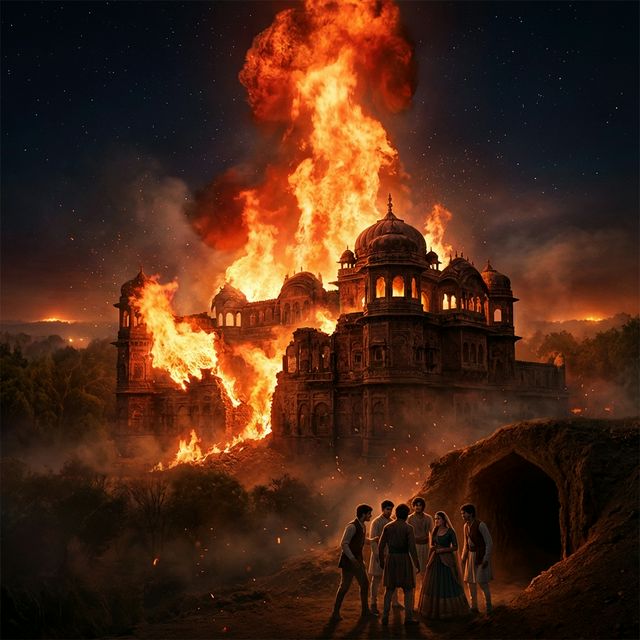
Then Bhima fired the great house itself in several places at once. The lac and the oil and the hemp took the flame greedily, and in moments the whole mansion was a roaring tower of fire that lit the night for miles and threw its red glare across the river. The heat was monstrous; the timbers cracked like thunder; the gardens themselves caught and burned.
While the front of the house went up, the five brothers and their mother slipped down through the hidden mouth of the tunnel in the inner chamber. They crawled through the close dark earth, the roar of the fire muffled to a distant growl above them, and pressed on along the road the miner had dug until at last they came up among the trees on the far side of the gardens, beyond the outer wall, with the cool night air on their faces and the Ganga gleaming through the branches.
Behind them the house of lac burned to its foundations. Purochana perished in the flames he had prepared for others, and so did the Nishada woman and her five sons, lost in their wine-deep sleep. By the time the people of Varanavata woke and ran to the blaze, there was nothing to be done but watch it die to embers and ash.
Believed Dead
In the grey of morning the townsfolk of Varanavata gathered at the smoking ruin and wept. They raked through the cooling ash and found among it the burned body of Purochana, and the charred bones of a woman and five men. "Alas," they cried, "the noble Pandavas and their mother have perished in the fire, and this villain Purochana, the king's man, has burned with them by the will of wicked Duryodhana, for surely it was he who set this snare." Some among them said it openly, that the house had been built to kill, and they cursed the prince's name. Others feared to speak. But all believed that Kunti and her five sons lay dead in the embers, for who would imagine that six other sleepers had taken their place?
Word was sent to Hastinapura, and the city was thrown into mourning. The people grieved without pretence, for they had loved the Pandavas, and the wailing in the streets was loud and true. Bhishma wept; Drona was stricken; and Vidura, who alone of them all knew the truth and could not tell it, bowed his head and let the others believe him as sorrowful as themselves, while in secret his heart was glad. Dhritarashtra ordered the rites of the dead performed for his nephews, and went through the motions of a grieving king.
Duryodhana mourned loudest of all, and behind his loud grief he rejoiced. Shakuni rejoiced with him, and Karna; the throne seemed cleared at last of every rival, the crown made certain for the eldest son of Dhritarashtra. For a season the sons of Pandu were counted among the dead, their names spoken only in sorrow, and Duryodhana believed beyond all doubt that he had won.
Into the Forest
On the far bank of the river, in the cover of the trees, the Pandavas did not rest. Speed and secrecy were their only safety now; if any word reached Hastinapura that six bodies were not their own, the hunt would begin again. They came down to the Ganga in the dark, and there, by the foresight of Vidura, a trusted boatman was waiting with a swift craft. He greeted them with words only Vidura's friend could have known, and carried them quietly across the broad current to the southern shore, and then went his way and left no trace of them.
They plunged into the deep forest beyond, travelling by night and resting hidden by day, going always away from the towns and the roads where they might be known. They put off the dress of princes and wore the bark and matted hair of ascetics, and Kunti and her sons spoke their names to no one. The way was hard. There were no horses, no servants, no comforts of the palace. Bhima, mightiest of them, carried his weary mother on his shoulder and bore up his younger brothers when the marches grew long, and his great strength was the staff on which the whole family leaned through the wilderness.
They were hungry often, and footsore, and the forest pressed close and dark around them. Yet they were alive, and free, and together, and they had slipped out of the closed fist of Duryodhana while he was yet rejoicing over their ashes. Yudhishthira looked back once toward the river and the smoke that no longer rose, and then forward into the trees, and he led his brothers and his mother southward and westward, deeper into the unknown country, toward a small town called Ekachakra where they might rest unknown for a while, and gather their strength, and wait for the day when the world would learn that the sons of Pandu had not died in the house of lac after all.
Dharma Lesson
Survival sometimes requires patience that looks like defeat: the Pandavas lived in their assassins' palace for a year, smiling at their host. And a mother's word, even said carelessly, can rewrite a life - Kunti's offhand instruction made a wife of five husbands, and the marriage that followed was the strongest in the epic.