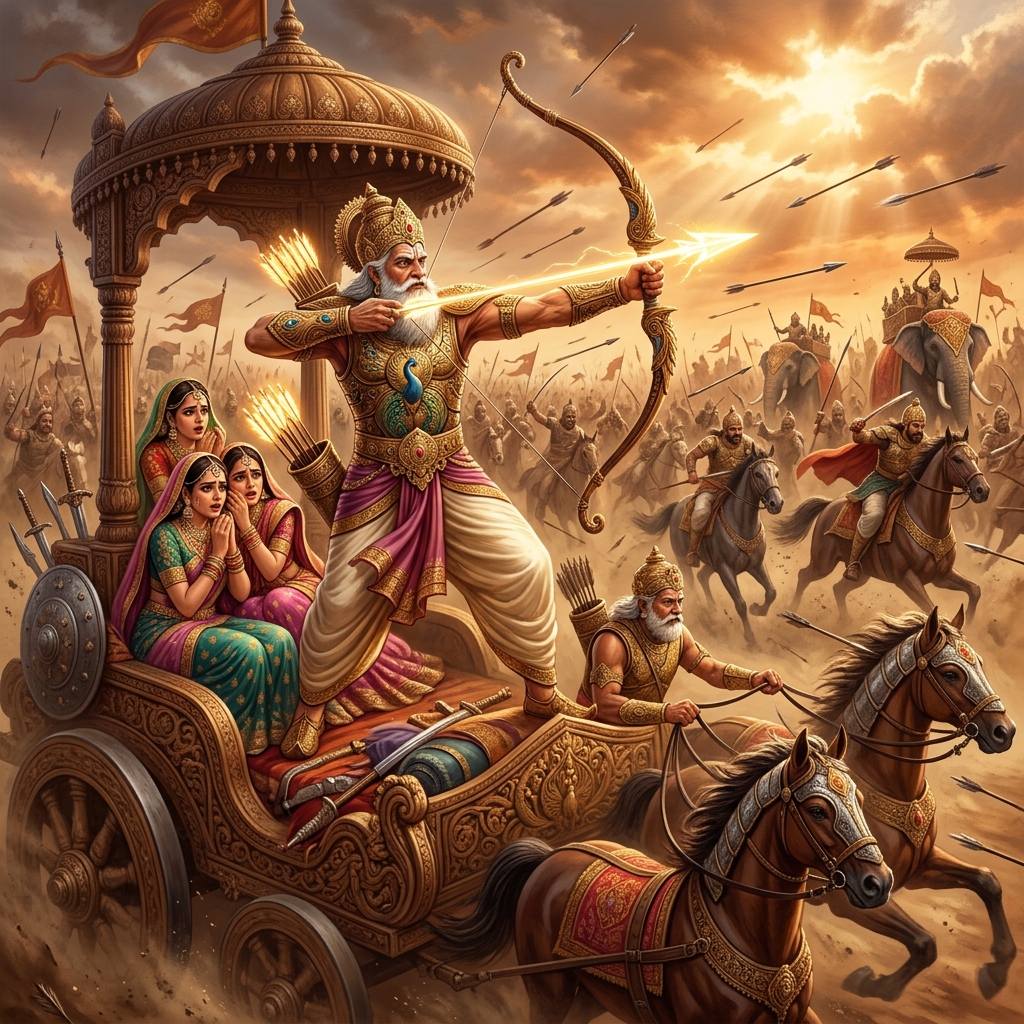
A Boy King's Boast
Satyavati, fisherwoman's daughter turned queen of Hastinapur, had borne King Shantanu a single son before his death, and upon that son the succession of the entire Kuru line came to rest while he was still barely more than a boy. He was named Chitrangada, and Bhishma, who had renounced the throne for himself so that his father's happiness might be complete, stood as regent behind the young king's seat, guiding the kingdom's affairs while the crown settled onto shoulders too young to carry its full weight alone.
Chitrangada grew quickly into his inheritance, and grew, just as quickly, into a pride that Hastinapur's court found impossible to check. He was gifted - swift with a bow, fearless in the hunt, quick of tongue in council - and each gift fed a conviction that hardened in him year by year: that no warrior living, mortal or otherwise, could stand against him in single combat. He said as much openly, to courtiers who flattered the claim and to visiting kings who let it pass rather than provoke a young ruler's temper. Bhishma, watching from beside the throne, saw in his young half-brother's boasting the ordinary vanity of youth, the kind time and defeat usually cure on their own.
But Chitrangada's boast did not stay confined to the halls of Hastinapur. It traveled, as such words do, beyond the reach of mortal kingdoms entirely, carried on whatever wind carries insult from the world of men into the world of gandharvas, those celestial musicians and warriors who move between the two realms as easily as breath. And there, in courts no mortal eye could see, it reached the ears of a king who bore the very same name: a gandharva Chitrangada, proud in his own right, who heard a mortal claiming an equal share of his name and his glory, and took the claim as an insult no celestial king could let stand unanswered.
The Namesake's Challenge
The gandharva king came down to the mortal plain not as a raider but as a rival with a grievance to settle, and he chose his ground with care: the level fields beside the Hiranvati river, where the plain of Kurukshetra opened wide enough for two armies, let alone two kings, to meet without a mountain or forest to hem them in. He sent word ahead, plain and unadorned - that a mortal calling himself Chitrangada had claimed to have no equal in battle, and that the true bearer of that name had come to correct the error in person.
The young Kuru king might have paused at the summons, might have wondered why a being of the gandharva world would trouble itself over a boast spoken in a mortal court. Instead he heard only challenge, and rode out from Hastinapur toward the Hiranvati with the eagerness of a boy who has never yet lost. Whatever counsel Bhishma offered before that ride - and a regent responsible for a kingdom's only heir must have offered some - it did not turn the young king back. Pride, once it has been spoken aloud in front of a court, is difficult to unspeak in private.
At the riverbank the two Chitrangadas met, one flesh and one born of a world where flesh bends to different laws, and the mortal king discovered at once that this was no ordinary opponent. The gandharva fought not merely with skill but with maya, the illusion-craft of his kind, bending the field itself against his rival, making arrows seem to come from directions they had not been loosed from, making the very ground uncertain beneath a mortal warrior's feet. Chitrangada of the Kurus was neither coward nor fool, and he did not flee the first exchange, nor the second. He held his ground as long as mortal skill could hold against something that was never wholly bound by mortal rules, and the duel that had begun as a single afternoon's combat stretched instead into something the chroniclers would remember for its strangeness as much as its length.
Three Years Upon the Plain
The duel by the Hiranvati did not end in a day, nor in a season. For three years, by the count the tradition keeps, the mortal Chitrangada and his gandharva namesake returned again and again to the same stretch of ground beside the river, each contest a fresh trial of a mortal king's courage against a rival whose weapons were not entirely of this world. It was not one unbroken battle but a long war of attrition fought in intervals, the young king summoned back to the field whenever the gandharva chose to renew the contest, unable to refuse without abandoning the name and the honor he had claimed too loudly to ever take back.
What sustained him across those three years was not any hope of matching maya with mortal archery alone, but the same pride that had begun the quarrel - a refusal to be the first to yield, to let a namesake from another world prove, once and for all, that the mortal Chitrangada's boast had been empty. Each time he was driven back, he returned; each time illusion turned the field against him, he steadied himself and fought on, because a king who withdraws from a duel he began himself withdraws from his own name.
But mortal endurance has a floor that celestial endurance does not share, and in the third year, on ground by the Hiranvati that would one day host a war far greater than this one, the gandharva king's illusions finally closed around the young Kuru with no gap left for him to fight his way through. The battle that ended there was brief compared to the years that had led to it - a last exchange in which skill could no longer answer sorcery - and Chitrangada, king of Hastinapur, son of Shantanu and Satyavati, fell on the plain of Kurukshetra, the very first Kuru blood the epic records being spilled on ground that would one day drink an entire age of it.
The Regent's Grief
Word of the young king's death traveled back to Hastinapur ahead of his body, and it fell to Bhishma, who had sworn away his own claim to the throne so that this line might continue unbroken, to receive it. Whatever grief passed through him in that hour, the chronicles do not linger on; Bhishma's discipline had already been tested by losses far greater, and it would be tested again by losses still to come. What mattered to the kingdom, watching him in that moment, was not his sorrow but his steadiness: the throne could not remain empty, and the boy who had held it had left no son behind him.
Satyavati, who had seen her firstborn crowned with such pride only a few short years before, now watched Bhishma turn to her second son instead. Vichitravirya, younger and gentler of temperament than his brother had been, was installed upon the throne of Hastinapur under the same careful regency that had guided Chitrangada, Bhishma standing once more as the steady hand behind a young king's seat, determined that this reign, at least, would not be cut short by a quarrel picked in vanity.
For a time it seemed the kingdom's fortunes had steadied. Vichitravirya grew to manhood, was wed in time to two princesses won for him at Kashi in a contest that is itself remembered separately, and ruled as a king should - but not for long. Consumption took him young as well, before any son had been born to carry the line forward, and Hastinapur found itself, for the second time within a single generation, staring at a throne with no heir seated upon it and a regent who had sworn, on the honor that defined him, never to claim it for himself.
What the Name Cost
Two brothers, two short reigns, and the Kuru succession left twice over without an heir - this was the harvest of a boast spoken by a boy who had never learned that greatness announced too loudly tends to summon exactly the rival it denies. Chitrangada's death by the Hiranvati was not simply misfortune; the tradition remembers it as the direct fruit of pride, a king undone not by an enemy who sought him out unprovoked but by a namesake he had insulted with his own mouth, in a boast he need never have made at all.
The crisis his death opened - two widowed queens at Kashi, a throne with no heir, a regent bound by vow from taking it himself - would not resolve through ordinary succession. It would require Satyavati to call upon a son from before her marriage to Shantanu, the sage Vyasa, and ask of him a service that itself changed the shape of the Kuru line forever: fathering heirs upon the widows in his brother's stead, the niyoga by which Dhritarashtra and Pandu, and through them the entire war of Kurukshetra, would eventually come into being. That reckoning belongs to its own telling.
What the story of Chitrangada leaves behind, on its own terms, is a warning carried in the plainest possible shape: a king who claims to have no equal has usually simply not yet met one. The gandharva who answered his boast did not seek out Hastinapur out of malice; he came because a name had been claimed that was not fully the claimant's own to boast of, and the claim itself was the challenge. Three years of courage by the Hiranvati could not undo what a single afternoon's pride had set in motion, and the first blood shed upon the field of Kurukshetra fell not in a war of dharma against its enemies, but in a quarrel a young king could have avoided simply by holding his tongue.
Dharma Lesson
Pride that boasts of having no equal tempts fate to produce one, and a name carried carelessly can summon the very rival who claims it by right. True strength lies less in believing oneself unmatched than in knowing where one's measure truly ends.