The Boy Who Counted Teeth
In the forest along the Malini, in the hermitage of Kanva, there lived a child the ascetics did not like to leave alone with the animals, and not for the child's sake.
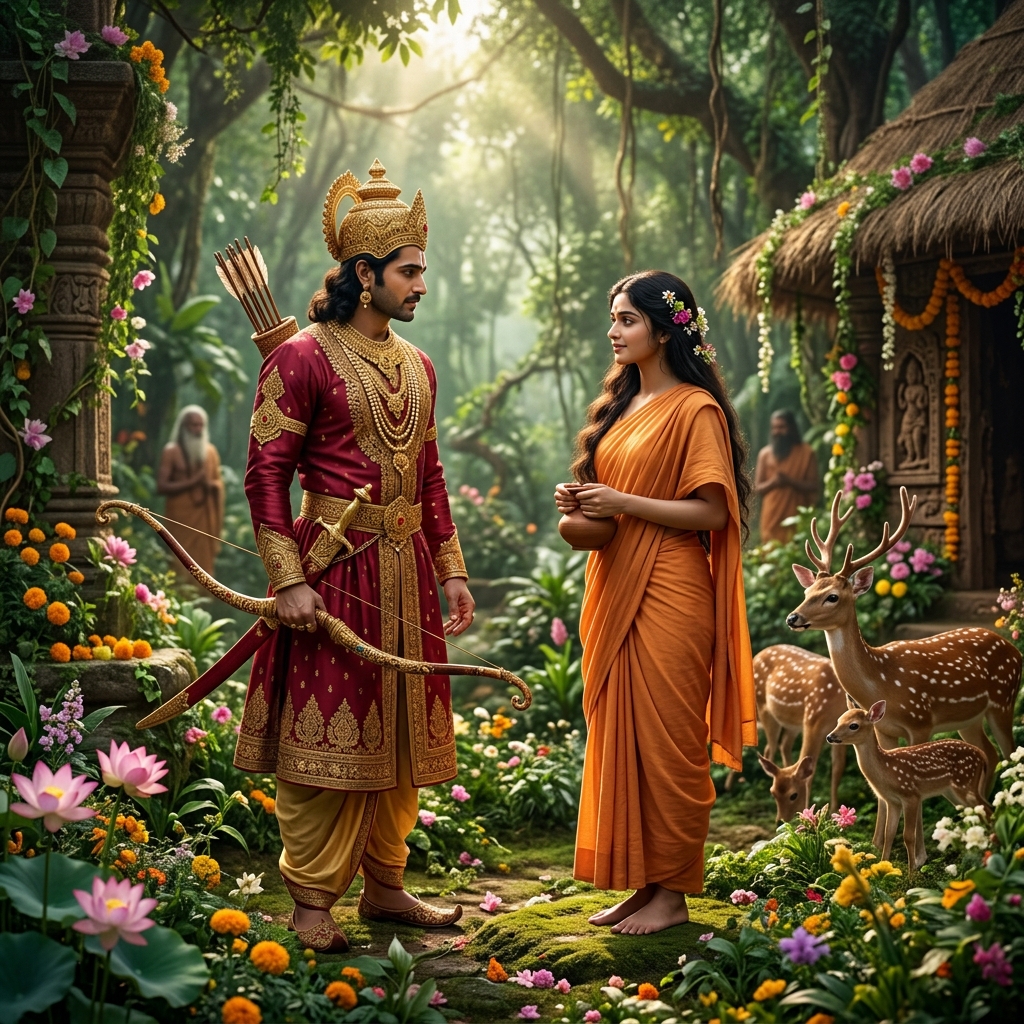
His name was Sarvadamana, the All-Tamer, and the hermits had given it to him because they could not think of anything in the world that frightened him. He was six years old, dark and heavy in the limb, and he would walk out to the rocks where the lionesses kept their cubs, take a cub by the loose skin of its neck, and drag it back to the gate of the fire-hall to be tied up there with the calves. Then he would set his thumbs against its jaws, force them apart, and count its teeth aloud, patiently, the way another boy counts pebbles, while the mother stood off in the grass and watched and did not come. The sages said among themselves that this was not a boy.
How he came to be born under trees instead of under a roof, and how his mother stood in a crowded hall and was denied before she was acknowledged, belongs to another telling.
Shakuntala raised him inside her foster-father's discipline, which was gentler than the boy and harder than the forest. He learned the hymns before he learned to ride. He carried water for the fires. And Kanva, who had washed the child's hands a thousand times, had seen what was written on the palms: the small closed circle, the wheel, the mark that is not given to ordinary men.
"He will not stay under my trees," the old sage said. "He will rule to the four seas, and afterward men will not be able to name this land without naming him."
When the boy was old enough, Kanva sent mother and son to Hastinapura with his disciples, saying that a wheel does not turn in a garden. There Dushyanta acknowledged them, and the All-Tamer of the hermitage was anointed heir to the throne of the Pauravas, and the disciples went home to their fires and their gathering of grass.
The Wheel That Was Not Turned Back
Dushyanta ruled long and well, and when he laid the burden down the crown came to his son, and men who had known the father found they had to learn a new word for the son. Dushyanta had been a great king. Bharata was something the bards had a separate name for: cakravartin, the turner of the wheel, the one whose chariot goes where he sends it and is not turned back.
He went east until the Ganga widened and stopped being a river. He went west past the sand into country where the wells were counted like treasure. He climbed against the Kirata in their hills and stood at the frontiers where the Yavana kept their outposts, and he came home each time with tribute and with the same kings still sitting on their thrones, because he had learned early that a throne emptied is a throne that must be watched forever.
He was not a burner of cities. His conquest was of a duller and more lasting kind. Roads were made safe enough that a merchant slept beside his cart. Grain moved from the districts that had it to the districts that had none, and it moved without a bribe. Cattle were given away by the ten thousand, and the giving was recorded, and the records were checked. Under Bharata a man could go to law against the king's own officer and be heard.
The bards, who exaggerate by trade, found that with Bharata they did not have to. They sang that he had bound the earth, and the earth agreed. The country between the mountains and the sea took his name and has never given it back: Bharatavarsha, the land of Bharata. His descendants inherited the name before they inherited anything else, so that centuries later, when a blind king's sons and a dead king's sons drew up their armies against each other, the heralds would still call both sides by one word, and the word was his.
The Fires on the Ganga and the Yamuna
What Bharata did with the wealth was to burn it in front of witnesses.
He raised his sacrificial grounds along the rivers, which is where the twice-born gather and where the smoke can be seen from a long way off. On the bank of the Yamuna he completed a hundred horse sacrifices. On the Sarasvati, three hundred. On the Ganga, four hundred. Then, because a hundred and a thousand are the same number to a bard, they said he performed a thousand more, and a hundred rajasuyas besides, and the posts of his altars stood along the water like a second forest planted by a man.
The horse sacrifice is not a ceremony so much as a wager. The animal is released to wander for a year with the king's warriors following it, and every land it walks into must either let it walk or fight. In all those years Bharata's horses were not stopped.
For the great sacrifice they called Govitata he sent for Kanva, and the old man came down out of the Malini forest, older now, and sat as chief priest over the fires of the boy he had once carried on his hip. When it was finished Bharata gave him a thousand padmas of gold, a fee so large that the number itself has become part of the story.
Kanva did not look at it for long.
"A king pays a priest," he said, "and a priest takes it and gives it away again, and neither of us is any different at the end of it. What is the fee actually for, son of Dushyanta?"
"For the witnesses," Bharata said. "A gift given in secret is a mood. A gift given in front of the whole country is a law. I want it known what a king is expected to do with what he takes."
The old sage went back to his forest and his grass and his fire, and told the disciples there that the wheel had turned out to be a good one.
Nine Times He Said It
He married three queens, daughters of the king of Vidarbha, and they bore him nine sons, and this is the part of the story the bards sing quickly and quietly.
Each child in his turn was carried in and laid before the emperor. Each time the court leaned forward, and each time Bharata looked for a long while at what had been put in front of him and then said the same short sentence.
"This one is not like me."
He was not speaking of faces. He was a man who had counted the teeth of lions before he could count to a hundred, who had held an empire without emptying a single throne, who had burned his treasury on riverbanks so that the giving would be on record. He looked at each son and did not find that thing, and he would not lie about it, and so he would not name any of them heir.
The mothers heard the sentence nine times. They understood, or believed they understood, what a queen becomes when her son is refused: a woman kept in a wing of the palace with nothing ahead of her. And out of that fear they destroyed the children, one after another, which is a horror the epic states plainly and does not defend.
So the greatest king the line had produced sat in the greatest empire the line had held, with the smoke of a thousand sacrifices still on his clothes, and no heir at all. He had performed every rite prescribed for the getting of sons, and the rites had been answered, and the answers had come to nothing.
His ministers told him gently that he might soften; that a small king with the right name was better than no king at all. Bharata heard them out.
"A king can lose a battle and still be a king," he said. "If I hand this earth to a man who cannot carry it, I lose every battle I ever won, and I lose them after I am dead, where I cannot answer for it."
The Standard He Left Instead of Sons
In the end he did what he had always done, which was to go to the fire.
The sacrifice he performed was for the Maruts, the host of the storm, and out of it he was given a child: a boy of the line of Bharadvaja, that sage who had been born of a quarrel and kept by neither parent and reared by the storm-gods themselves, so that the child brought to Bharata came from a house that knew exactly what it was worth to be unwanted. Bharata took him, and raised him, and named him his son, and he is remembered as Bhumanyu.
The court objected, as courts do, in the language of blood and precedent.
"You are all asking the same question," Bharata said, "and it is the wrong one. You ask whose body he came from. Ask instead what he will do at the third hour of a bad year, when the granaries are empty and the strongest man in the room wants to be told that the law can wait. A son is not the one who is born. A son is the one who bears. Let it be written that in this house the throne is owed to worth and not to birth, and let every king after me be measured against that, and let him fail if he must, but let him know he is failing."
His forefather Yayati had once taken back a thousand years of youth from his own son to spend on his own appetite; Bharata, at the other end of the same line, spent his own name to buy his country a competent man. The house never entirely lived up to it. Later Bharatas would set aside a crown for love of a father, or hold one for love of a son, and the second kind of love would burn a field at Kurukshetra.
But the standard was there, cut into the beginning of the line, and everything that came after can be measured against it. The best king the dynasty ever produced is remembered not for what he conquered but for what he refused to hand his sons.
Dharma Lesson
Bharata held that inheritance is a trust and not a possession, and that a king who hands the earth to an unfit son has stolen from everyone the son will rule. He refused to let affection do the work of judgment, even about his own blood. The dynasty that carried his name was at its best when it remembered that a throne is owed to worth, and at its worst every time a father decided otherwise.