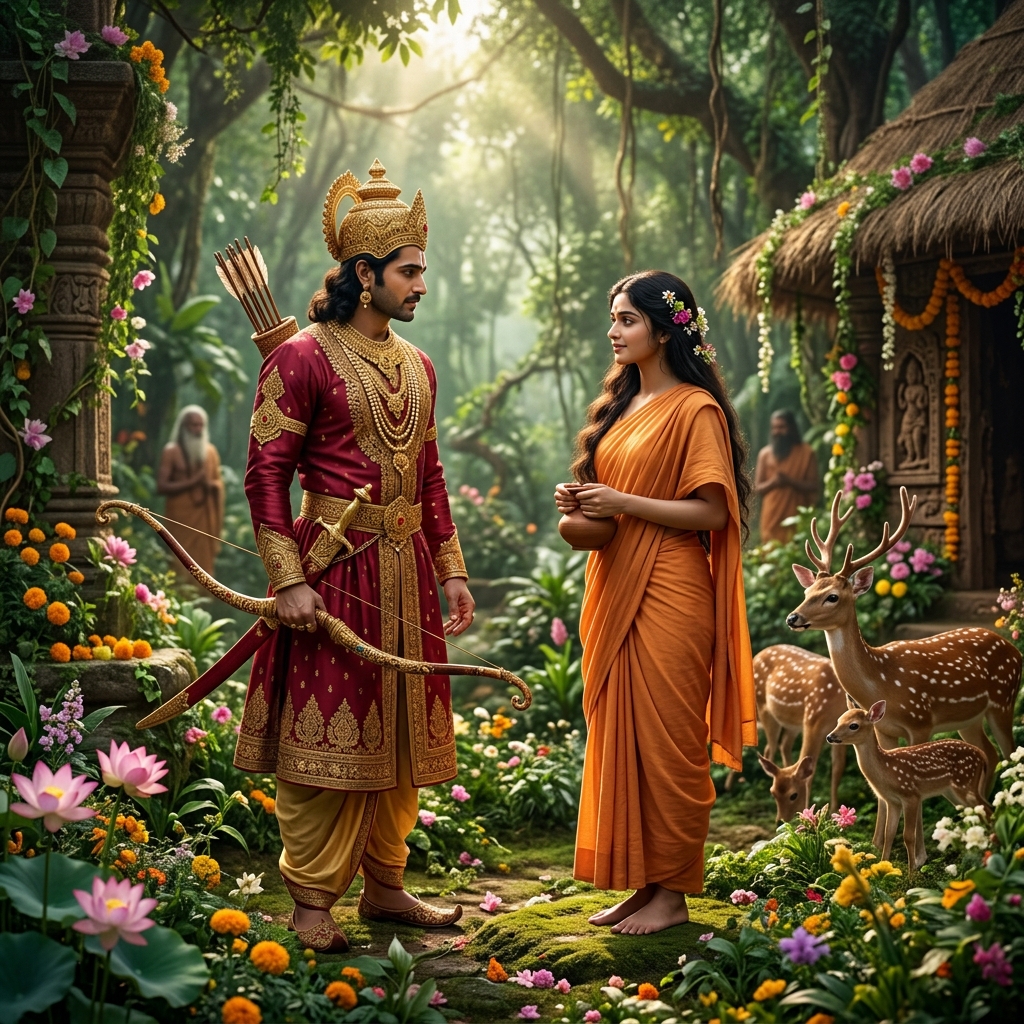
The Hunt on the Malini
King Dushyanta, lord of the earth and the foremost of the Puru line, rode out from his city of Hastinapura at the head of a vast hunting host. Chariots thundered behind him, elephants trumpeted, and horsemen raised a haze of dust that hung over the road like smoke from a great fire. For days he pursued game through wood and field, until the chase drew him deep into a wilderness no road had tamed.
The forest closed around him, dense with sal and palm, loud with the cries of peacocks and the buzzing of bees among flowering vines. The king slew tigers with his arrows and laid low wild boar with his spear, and the deer fled before his chariot in leaping silver streams. He drank from cool springs, rested in the shade of broad trees, and let the wildness of the place enter his blood.
At last the land grew gentler. The thorny scrub gave way to soft groves and singing water, and Dushyanta came upon the river Malini, whose clear current curved through the trees like a garland laid upon the breast of the forest. Swans floated upon it, and on a flowered island in its midst the birds of the Chakravaka kind called to one another across the ripples.
The king reined in his horses and gazed about him in wonder. The air here was sweet and still, untouched by the clamor of his army, and a deep peace seemed to dwell upon the banks. He felt that he had crossed, without knowing it, out of the world of men and into some blessed precinct set apart for holier work than hunting.
The Hermitage of Kanva
Following the Malini upstream, Dushyanta saw the smoke of sacred fires rising in thin blue threads above the trees, and he knew that an ashrama lay near. This, he learned, was the hermitage of the great sage Kanva, a tapasvin whose austerities were famed through the three worlds, a man whom even the gods honored.
The king would not bring war chariots and the noise of soldiers into so holy a place. He commanded his army to halt at the forest's edge and to wait, and he laid aside the marks of his rank. Dressed simply, accompanied only by his minister and his priest, he went forward on foot toward the dwelling of the sage.
As he drew near, the hermitage opened before him like a vision of the world made gentle. Deer wandered tame among the huts and took no fright at his approach. Parrots and mynahs recited fragments of the Vedas they had learned by listening. Disciples in bark garments carried water and tended the fires, and the chant of holy verses rolled softly through the groves. Heaps of grain lay drying, lotuses crowded the pools, and the whole place breathed an air of patience and purity.
Dushyanta felt his weariness fall from him. He bade his companions wait, for he wished to behold the great sage in solitude, and alone he passed through the gate of the hermitage. "Surely," he thought, "merit itself has taken the shape of trees and water here. A man might wash a lifetime of dust from his heart in such a place." So he went in, calling out a courteous greeting, seeking the master of that sacred ground.
Shakuntala Appears
No answer came to the king's greeting, for the hut of Kanva stood empty. The sage had gone to a distant place of pilgrimage to gather fruits and fuel, and the hermitage seemed for a moment deserted. Dushyanta called again, his voice gentle in the quiet, asking whether anyone dwelt within.
Then from the inner grove a maiden came forth to receive the stranger, as the duty of hospitality required. She wore the simple bark and ascetic dress of the hermitage, yet no plainness of cloth could hide what she was. Her beauty was such that the king's breath caught in his throat. She moved with the grace of one accustomed to tending wild creatures, and her eyes were large and soft and full of an innocent dignity.
"Welcome, O traveler," she said. "The sage Kanva is from home, but be seated, and let me bring you water for your feet and fruit to ease your hunger. Tell me how this hermitage may serve you." She busied herself with the rites of welcome, offering the king the honor due a noble guest, all the while wondering who this stranger of royal bearing might be.
Dushyanta, watching her, felt love steal upon him like the rising of the moon. He could not believe that one so radiant had grown up amid the austerities of a forest. "Surely," he thought, "this is no daughter of penance, but some grace fallen from heaven into Kanva's keeping." Aloud he asked her, courteously, who she was, whose child, and why so lovely a being lived hidden away in the deep woods.
The Story of Her Birth
The maiden smiled at his question and answered without shame, for there was nothing in her story she need conceal. "I am called Shakuntala," she said, "and I am known as the daughter of the holy Kanva. But the sage himself once told me the truth of my birth, and I will tell it to you as he told it to me."
"My father by blood is the royal sage Vishwamitra, who by terrible austerities rose from the rank of king to the rank of brahmarshi. The gods, fearing the heat of his penance, sent down the apsara Menaka from heaven to draw his mind from its discipline. Menaka came, beautiful beyond telling, and Vishwamitra's heart was moved, and of their union I was born upon the banks of this very Malini."
"But neither the sage nor the celestial nymph kept me. Menaka, her task accomplished, returned to the court of Indra and left me newborn upon the riverbank. Vishwamitra, recalling himself to his austerities, turned away. I lay alone among the reeds, and there the birds called shakunta gathered about me and sheltered me with their wings, so that I did not perish. For this the sage Kanva, finding me, named me Shakuntala, the one the birds protected, and he raised me as his own daughter in this hermitage."
Dushyanta listened, and his love grew deeper, for now he understood. "You are by birth a kshatriya's daughter," he said gladly, "sprung from a royal sage, and worthy of any king. I am Dushyanta, ruler of this realm. Be my queen, O beautiful one, and let me serve you with my whole kingdom. My heart has been yours since the moment you came forth to greet me."
The Gandharva Marriage
Shakuntala lowered her eyes, for the king's words stirred her own heart, yet she did not answer rashly. "My father Kanva is away," she said. "Wait but a little while, O king, until he returns, and he will give me to you according to the sacred rites, and all will be done in honor."
But Dushyanta, ardent and learned in the law, replied, "There are eight forms of marriage known to the wise, and among them the marriage of the Gandharvas, where a man and a woman join of their own desire, without rite or kinsman, is praised as lawful for the warrior caste. I am here, and you are here, and our hearts are willing. Give yourself to me by this rite, O Shakuntala, and you shall be my wedded wife, and no sin will touch us."
Shakuntala considered, and then she spoke the condition that would shape the fate of a dynasty. "If this is truly the law," she said, "and if I am to be your wife, then promise me one thing before all the powers of this place. The son that is born of me shall be your heir, named your successor and crown prince after you. Swear this, and I am yours."
"It shall be so," Dushyanta answered without hesitation. "I swear it. Your son shall follow me upon the throne, and I will bring you to my city in royal state." And so, in the hermitage by the Malini, with the forest and the sacred fires as their only witnesses, the king and the maiden were wed by the rite of the Gandharvas. For a time Dushyanta lingered there in joy. But the duties of his kingdom called him back at last, and he prepared to depart.
The Ring and the Parting
On the morning of his departure Dushyanta took Shakuntala's hands in his and gave her his promise once more. "I must return to Hastinapura," he said, "but I will not leave you here forgotten. I shall send for you with a worthy escort, an army fit to bring a queen, and you shall enter my city in honor, not in shame, and reign at my side."
Then he drew from his own finger a royal ring, graven with his seal, and pressed it into her keeping. "Take this as the token of my vow," he said. "By the letters of my name upon it you shall be known and remembered. Keep it safely against the day my messengers come for you." Shakuntala took the ring and held it close, and though her eyes shone with tears she smiled at his promises and let him go.
Dushyanta mounted his chariot and rode away through the groves, looking back until the hermitage was lost among the trees. His heart was heavy at the parting, yet full of the certainty that he would soon send for her. Behind him Shakuntala stood at the edge of the grove, watching the dust of his going settle slowly upon the path.
Then the days began their long procession. Shakuntala wandered the hermitage as one whose mind had followed the king down the forest road. She tended the deer and the sacred fires as before, but her thoughts were far away, fixed upon the city she had never seen and the husband who had vowed to call her there. She grew distracted and sighed often, and the other dwellers of the ashrama saw that her heart had gone with Dushyanta and waited only for his word.
Sarvadamana, Tamer of Lions
In time Shakuntala bore a son, and from his first days it was plain that no ordinary child had come into the world. He was radiant as fire, broad of chest and strong of limb, with the marks of universal sovereignty already upon his palms and the wheel-sign upon his hands. The dwellers of the hermitage marveled at him, and Kanva, returned long since from his pilgrimage, watched the boy grow with quiet certainty about his destiny.
By the age of six the child's strength had become a wonder of the forest. He feared no beast that breathed. He would seize lions and tigers and the great tuskers of the wood, drag them to the trees about the hermitage, and bind them fast, and then he would climb upon their backs and ride them in play, laughing, as another child might ride a wooden horse. The fiercest creatures of the wild submitted to his hands.
For this the ascetics named him Sarvadamana, the subduer of all, for there was nothing he could not master. Yet for all his ferocity in play he was gentle to the sages and obedient to his mother, and the hermitage loved him. Kanva, watching, knew that such a child was not born to grow old in a forest tending fires.
"This boy is meant to bear the burden of the earth," the sage said at last to Shakuntala. "He is a chakravartin, a turner of the wheel of empire, and his place is upon his father's throne, not here among the deer. The time has come for Dushyanta to receive his son and to honor the promise he made beside the Malini. You shall go to the king's court, and the boy with you." And he summoned disciples to escort them through the long road to Hastinapura.
The Journey to Hastinapura
So Shakuntala set out from the only home she had ever known, her son walking strong beside her, attended by the grave disciples of Kanva who knew the ways through the wilderness. They left the singing Malini behind and journeyed long, out of the deep forest and across the wide plains of the Kuru country, toward the great city of Hastinapura that ruled them.
The sage's parting words went with her like a blessing and a warning both. Kanva had sent the boy not as a suppliant but as an heir, certain of the right of his cause. Yet Shakuntala, the nearer she came to the king's gates, felt a tightening of fear within her, remembering how long the silence had lasted, how the promised escort had never come, how the years had passed with no word from the husband of her youth.
The disciples encouraged her. "You go to claim only what was sworn to you by the rite of the Gandharvas," they said. "The law is on your side, and the truth, and the witness of heaven. Be steadfast, and speak plainly, and do not let the splendor of the court silence you." And Shakuntala took their counsel into her heart and steadied herself.
At last the towers and ramparts of Hastinapura rose before them, vast beyond anything she had imagined, thronged with chariots and crowds and the bustle of empire. The hermitage girl who had grown among deer and reciting birds now passed beneath the high gates of the mightiest city of the earth, leading by the hand the boy who was its rightful prince, to stand before the king who had vowed to remember her and ask whether he would keep his word.
The King Denies Her
They brought Shakuntala into the great hall of audience, where Dushyanta sat enthroned amid his ministers and warriors, his priests and his subjects, the whole splendor of his court arrayed about him. She came forward with her son and bowed, and then she spoke, reminding the king of all that had passed between them by the river Malini.
"O king," she said, "this is your son, born of the vow you swore in Kanva's hermitage. You promised that the child of our union should be your heir. The time has come to keep that word. Receive your son and acknowledge me, your lawful wife, before this assembly, as you swore before the sacred fires that you would."
But Dushyanta, though he knew her in his heart, turned his face away. The eyes of his whole court were upon him, and he feared the scandal of a forest marriage unwitnessed, feared what the people would say of a king who took an unknown woman of the woods to be his queen upon her word alone. To guard his name and the seeming propriety of his house, he hardened his voice and denied her utterly.
"I know you not," he said coldly. "I remember no marriage, no vow, no woman of the forest. Wicked ascetic, I do not recall taking you to wife. Go where you will, but make no false claim upon my throne." The court fell silent, and Shakuntala stood stricken, abandoned before a hall of strangers, denied by the very man who had pledged himself to her with a ring and an oath.
Shakuntala's Defense of Truth
For a moment shame and grief held Shakuntala motionless. Then anger rose in her, the clean anger of one who knows the truth, and she lifted her head and answered the king without fear, her words ringing through the silent hall.
"You know the truth, O king, as well as the gods know it," she said. "Do not, because you are a great man among men, hold the truth so cheap. He who knows his own wrong and yet denies it is a thief who robs his own soul. The Self stands witness within you. Do not imagine yourself alone with your secret, for the ancient witness, the inner soul, sees every deed and knows whether you do well or ill."
"A wife is half the man, his truest friend, the root of his happiness and of his sacred duty. A son is the father reborn, his own self carried into the years to come. Look upon this child and look upon yourself, for the face of the father gazes back at you. Why then do you scorn me as though I were a stranger? I came to you in honor, and you cast me off in a crowded court as though I were a common woman. I have spoken truth and met with contempt."
"I will go," she said at last, "but do not think your denial undoes what heaven has joined. My son shall rule this earth girdled by the seas, with you or without you, for such is his birth and his destiny." And she turned to leave the hall, her son beside her, the wronged truth burning in her like a steady flame, leaving the king to his silence and his shame.
The Voice from the Sky
As Shakuntala reached the doors of the hall, ready to pass forever out of the king's sight, a great voice broke suddenly from the empty air above the throne. It was disembodied and vast, heard by every soul in that assembly, a voice without a speaker, and at its sound the whole court froze in awe.
"Cherish your son, O Dushyanta," the voice declared. "Do not despise Shakuntala. You are the father of this child, and she has spoken nothing but the truth. The mother is but the vessel; the son is born of the father and is the father himself. Bharata you shall name him, the cherished one, the son you must support. Shakuntala has told no lie. Receive her, and honor her, for the heavens themselves stand witness to her word."
The words rolled away into silence, and a great wonder filled the hall. Dushyanta rose from his throne, and now there was no coldness in his face, only joy and relief long pent within him. He came down to Shakuntala and the boy and embraced them both before the eyes of his whole court, and the lords and priests rejoiced to see it.
Then the king spoke to his ministers and explained what he had done. "I knew her from the first," he said, "and I knew the child was mine. But had I received them on her word alone, the people of my kingdom would have doubted my son's birth all his days and whispered against his right. I denied her so that heaven itself might speak and silence every doubt forever. Now the gods have proclaimed his legitimacy, and no man shall ever question that Bharata is my true and lawful heir."
Bharata, Source of a Name
So Shakuntala was raised at last to the place that had been promised her, honored as the queen of Dushyanta and the mother of his heir before the whole assembly of the Kurus. The grief of the court was turned to celebration, and the wrong of the long silence was healed by the word of the gods and the embrace of the king.
Dushyanta took the boy upon his knee and named him formally Bharata, the cherished one, the child whom heaven had bidden him support. The marks of empire were upon the boy's hands, and in him the strength of Sarvadamana, the tamer of lions, was joined to the wisdom of kings. He grew to be the mightiest sovereign the earth had known, a chakravartin whose chariot rolled unopposed to the four oceans.
Bharata's conquests and his sacrifices became the measure of greatness for all the kings who came after. He performed sacred rites whose splendor was sung for ages, and he ruled the whole earth in justice. From his name the line of his descendants took their title, and the great kings of the Kuru house were called the Bharatas after him. From him too the land itself drew its ancient name, Bharatavarsha, the country of Bharata.
And so the chance meeting of a king and a hermitage maiden upon the banks of the Malini became the root of a dynasty. From Dushyanta and Shakuntala sprang the line that would in time bring forth Shantanu and Bhishma, the blind Dhritarashtra and the pale Pandu, and at last the hundred Kauravas and the five Pandavas whose great war is the heart of the epic. The story of their love, told at the very threshold of the Mahabharata, is the seed from which the whole vast tree of the Bharata line would grow.
Dharma Lesson
A moment of forgetfulness can cost a lifetime of happiness. King Dushyanta's failure to recognize Shakuntala due to Durvasa's curse teaches that love must be protected with vigilance, and that truth eventually triumphs over all enchantments.