The Guru Who Held Death in His Mouth
In the ancient age before the kingdoms of men had grown great, the gods and the Asuras waged endless war. The two armies were evenly matched in valor, but the Asuras held one terrible advantage. Their preceptor, the sage Shukracharya, son of Bhrigu, knew the Sanjivani Vidya, the science of revival, by which a dead warrior could be raised whole and breathing from the field. When the gods slew an Asura, Shukracharya called him back to life. When the Asuras slew a god, that god stayed dead. Slowly, season by season, the heavens were losing.
The gods, in their council, saw that no weapon could win this war while one side could not truly die. The only path to victory lay in stealing the secret itself. They turned to Kacha, the bright and disciplined son of Brihaspati, preceptor of the gods. "Go to Shukracharya," they said. "Become his pupil. Serve him with such devotion that he loves you as a son, and in time he will teach you the Sanjivani. Above all, win the favour of his daughter Devayani, for what pleases her pleases him."
Kacha bowed and accepted the charge. He travelled to the capital of the Asura king Vrishaparva, where Shukracharya dwelt as royal preceptor, and presented himself humbly at the sage's feet. "I am Kacha, grandson of the sage Angiras and son of Brihaspati," he said. "Accept me as your disciple. I will keep the vow of brahmacharya and serve you faithfully for a thousand years." Shukracharya, who honoured the lineage of all great sages, looked upon the youth and welcomed him. So began the long deception that the gods had set in motion, and so the boy entered the household where Devayani lived.
Devayani's Love and the Three Deaths of Kacha
Kacha served his teacher with a flawless heart. He tended the sacred fires, gathered fuel and flowers, herded the cattle, and obeyed every command. Yet he gave special care to Devayani, the daughter of Shukracharya. He sang for her, gathered her flowers from the deep forest, and walked with her when she wished it. She was young and proud and lovely, and before long she loved him with the whole strength of her heart.
The Asuras were not blind. They understood at last who Kacha was and why he had come, and they resolved that the secret of revival must never pass to the camp of the gods. One day, while Kacha was herding cattle alone in the forest, the Asuras fell upon him and killed him, and cut his body to pieces, and fed the pieces to jackals. When the cattle came home without their keeper, Devayani went weeping to her father. "Kacha has not returned," she cried. "I cannot live without him. Bring him back to me." Moved by her grief, Shukracharya uttered the Sanjivani mantra and summoned Kacha, who tore his way out of the jackals and returned alive.
The Asuras tried again. They slew him a second time, burned his body, ground the ashes into wine, and gave the wine to Shukracharya, who drank it without knowing. Again Devayani wept and begged, and again her father called. But this time Kacha's voice answered from within the sage's own belly, for the boy was inside him. If Shukracharya revived him now, the disciple would have to burst forth and kill his teacher in the doing.
The Secret Passed and the Curse Returned
Shukracharya stood caught between two loves. He could not bear to refuse his weeping daughter, yet he could not bring Kacha to life without dying himself, since the boy lay within his own body. He saw, too, the cruel game his Asura disciples had played, mixing a man's ashes into his drink. In sorrow he understood that wine itself, which had clouded his judgment, was a thing of ruin, and he cursed it then so that no Brahmana would ever drink it again.
Then he found the only way out of the trap. "Kacha," he said to the voice in his belly, "I will teach you the Sanjivani Vidya here and now. When I revive you, you will rend my body and emerge, and I will be dead. But you will have the science, and you will at once use it upon me and bring me back to life." So the dying art of revival passed from teacher to pupil through the wall of the sage's own flesh.
When the mantra was learned, Shukracharya spoke the words of revival. Kacha grew within him and burst forth, and Shukracharya fell dead. But Kacha, now master of the very secret he had been sent to steal, at once pronounced the Sanjivani over his teacher, and Shukracharya rose alive and whole. The boy had his prize. He had served a thousand years, won a daughter's love, endured three deaths, and learned the one thing the gods desired above all. Only the leaving remained.
The Parting Curse
His thousand years complete and his vow of studentship fulfilled, Kacha asked leave of his teacher to return to the world of the gods. Shukracharya, knowing nothing of treachery in this, blessed him and let him go. But Devayani came to him before he departed, and her heart was full. "For your sake I begged my father three times to call you from death," she said. "I have loved you through all your trials. Now my studentship under you is also ended. Honour my devotion and my love. Take me as your wife."
Kacha answered gently, but he would not. "You are dear to me beyond a sister," he said, "yet I cannot wed you. I was reborn from the body of your father, who is my own teacher. Having come forth from him as you came forth from him, I am your brother by that birth. It would be sin. Do not ask this of me, blessed one, for between us such a thing can never be."
Devayani's love turned in an instant to fury, as love wounded will. "Because you scorn me," she cried, "the Sanjivani Vidya you have won shall never work in your own hands." Kacha bowed his head to the curse, but he answered it. "You curse me without cause, for I refused only what dharma forbids. So hear my word. Because of this you shall never wed any son of a sage. And though the science will not serve me, it will serve those whom I teach." With that he departed for heaven, leaving Devayani alone with her anger and her shame, and a wound that would not heal.
The Quarrel at the Well
Time passed, and Devayani's grief faded into the ordinary days of her father's house. She was the daughter of the preceptor whom even kings obeyed, and her closest companion was an unlikely one, Sharmishtha, the daughter of the Asura king Vrishaparva himself. The princess and the priest's daughter went together into the forests and gardens, attended by a thousand maidens, proud and bright as a flock of gold.
One day the company came to a clear pool to bathe, and they laid their garments and ornaments on the bank and went down into the cool water. While they sported there, the god Vayu, the wind, rose up suddenly and blew across the bank, and the heaped clothes were tangled and scattered together. The girls hurried out and dressed in haste, and in the confusion Sharmishtha, the king's daughter, took up and put on a garment that belonged to Devayani.
Devayani saw it and her old pride flared. "How dare you wear my clothes," she said, "you who are only a disciple's standing to me. Your father bows before mine. Are you so lost to shame?" The insult struck the princess like a slap, for Sharmishtha was royal, the daughter of the king whom Shukracharya served, and she would not bow her head to the daughter of a dependent.
Sharmishtha's Answer
Sharmishtha drew herself up, and her words came hot and proud. "You forget yourself, daughter of Shukracharya. My father sits upon a throne while yours sits below it. When my father gives, your father receives. He chants the praises of kings and lives upon their gifts. He begs and we bestow. You are the daughter of one who praises and asks and takes. I am the daughter of one who is praised, and asked, and gives. How then do you, a beggar's child, stand before me and demand?"
The taunt cut to the bone, for there was a galling truth in it, that a priest however holy depended on the bounty of a king. Devayani, stung past all reason, seized at Sharmishtha's garments to take them back by force. The princess, no meeker than she, struck out in her anger. And then, with the cruelty of a quarrel gone too far, Sharmishtha pushed Devayani down into a dry well that stood near the bank, and left her there, believing perhaps that she was dead, or caring little whether she lived. The princess gathered her maidens and returned to the city, and the forest grew quiet, and Devayani lay at the bottom of the waterless well with no one to hear her cries.
The King Who Took Her Hand
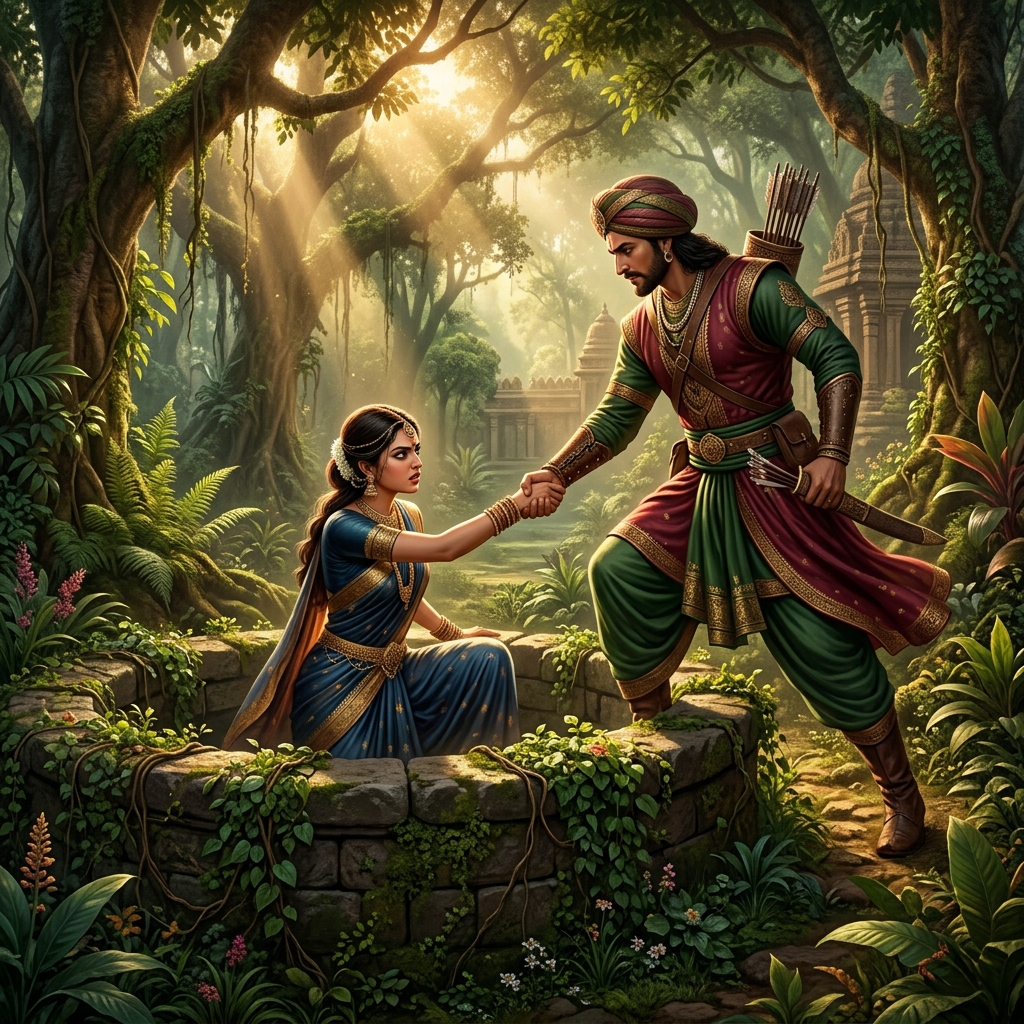
It happened that King Yayati, son of Nahusha, lord of the Lunar line and a sovereign famed for justice and valor, was hunting in that very forest. Wearied and thirsting, he came upon the old well and looked down into it, hoping for water. Instead he saw a maiden of surpassing beauty seated at the bottom, her ornaments still upon her, bright as a flame in the darkness of the pit. He was astonished, and called down to her, asking who she was and how she came to such a place.
"I am Devayani," she answered, "daughter of the great Shukracharya, preceptor of the Asuras. I have been cast down here and left to die. Reach down your hand, O king, and lift me out, for I see by your bearing that you are a man of noble birth." Yayati hesitated, for she was a Brahmana's daughter and he a Kshatriya, and to touch her was no small thing. But pity and courtesy won out. He leaned down and took her by the right hand and drew her up out of the well into the light.
When she stood before him in the sun, Devayani spoke with sudden resolve. "You have taken my right hand in yours, O king. By that act, before gods and men, you have plighted yourself to me. No other man shall ever clasp this hand after you. Be my husband." Yayati, troubled, said only that they would speak of it again, and gave her leave, and rode his way. Devayani would not return home. She sent her maid to her father with the tale of her shame, and waited at the forest's edge for justice.
The Price of a Princess
Shukracharya came in haste when he heard, and found his daughter weeping at the wood's edge. She poured out the whole quarrel, the insult, the well, the cruelty of Sharmishtha and the pride of King Vrishaparva's house. "I will not live in the city of one whose daughter has done this to me," she said. "Take me away from here, father, or be avenged." Shukracharya's heart hardened. He went to Vrishaparva and told him plainly that he would leave the Asuras and go elsewhere, taking with him the Sanjivani Vidya and all the protection it gave.
Vrishaparva was struck with terror, for without Shukracharya the Asuras would surely fall before the gods, who could no longer be denied their dead. He fell to entreaty. "Whatever Devayani demands, it shall be done," he said. "Name any price." And Shukracharya turned to his daughter and bade her speak her own terms.
Devayani named the cruelest price her pride could devise. "Let Sharmishtha, the daughter of the king, become my handmaid," she said. "Let her serve me, and a thousand maidens with her, and follow me wherever my husband shall take me, all the days of her life." Vrishaparva, with the whole Asura race hanging upon his choice, summoned his daughter and laid the bond upon her. And Sharmishtha, a princess born, bowed her royal head for the sake of her father and her people, and became the bondservant of the woman she had thrown into the well.
The Marriage and the Forbidden Bed
In time King Yayati returned, and the marriage was made. Shukracharya gave his daughter to the Kshatriya king, an unusual union of priestly and royal blood, and Sharmishtha came as part of the dowry, she and her thousand maidens, to serve Devayani in the king's house. But Shukracharya laid a strict and solemn charge upon Yayati at the parting. "This maiden Sharmishtha, daughter of Vrishaparva, is given to wait upon my daughter. Honour her in all things, but never summon her to your bed. Swear it." And Yayati swore.
Yayati took Devayani to his city of Pratishthana on the banks of the river, and there he reigned in glory, and there Devayani bore him sons. The eldest she named Yadu, and after him Turvasu, fair princes of the Lunar line. Sharmishtha dwelt in the women's quarters as a servant, and the years went by, and she watched another woman live the life that should have been hers, and bear sons, and grow content.
A day came when Sharmishtha, alone and grieving for her wasted youth, sought out the king in a quiet place. "O king," she said, "the season of a woman comes but for a time, and mine is passing in service. I am a princess by birth, and I ask of you only what dharma allows any woman to ask, the gift of children, that my life not be barren and lost. Devayani's father gave me to her, and her, and all that is hers, to you. By that I am yours also. Grant me this and commit no sin." Her words were subtle and her need was real, and Yayati, moved and persuaded, broke the oath he had sworn and went to her in secret.
The Curse of Old Age
Sharmishtha bore the king three sons in secret, and the youngest of these was Puru. For a long while the truth lay hidden in the women's quarters. But one day Devayani saw the children of her handmaid at play, and they were beautiful, and bore upon them the unmistakable stamp of royal blood. She questioned them, and in their innocence they pointed to King Yayati as their father. Devayani knew then that she had been betrayed, and that her servant rival had borne the king sons in defiance of her father's command.
In a storm of rage and grief she fled the palace and rode to her father's house, and Yayati followed her, dreading what would come. Before Shukracharya she poured out the betrayal. The sage's anger rose like fire. "O king," he thundered, "you knew dharma, and you swore an oath, and for the sake of pleasure you broke it and gave yourself to lust. For this sin, decrepit and loathsome old age shall seize you this very hour. The strength of your youth is forfeit."
At the word, the curse fell. The vigour drained from Yayati's limbs, his hair turned white, his skin loosened and withered, his back bent, and the king who had been the flower of his line stood trembling and ancient before them, an old man in a single breath. He cried out in anguish that he was not yet sated with the pleasures of life, that his desire still burned even as his body failed. "I have wronged you," he said to Shukracharya, "but I am not yet weary of living. Have mercy."
The Son Who Gave His Youth
Shukracharya's wrath cooled enough for a single mercy, for he could not unmake a curse, but he could leave a door within it. "The old age cannot be revoked," he said. "But if any of your sons will take it from you of his own free will, and give you his youth in exchange, you may bear his years in his stead. With his youth you may live and reign and seek your fill, and return it when you will." With that small hope Yayati returned to his city, a broken old man, and called his sons before him.
He went first to Yadu, the eldest. "Take my old age, my son, and lend me your youth, and after a time I will return it." But Yadu looked on the withered king and refused. "Old age brings hunger and weakness and misery," he said. "I cannot bear it." His father cursed him then, that his line should never wear the crown of empire, and from Yadu came the Yadavas, princely but kingless. One by one Turvasu and the elder sons of Sharmishtha refused as well, and each was cursed to rule no empire. Only Puru, the youngest, born of Sharmishtha, bowed before his father. "Give me your age, father, and take my youth. It is my duty and my honour." And he took the old man's years upon his young shoulders.
Clothed again in youth, Yayati reigned and revelled for a full thousand years. He drank of every pleasure the world could offer, of wealth and feasting and love and dominion, and pursued desire to its furthest reach. And at the end of a thousand years he understood a truth he could not have learned any other way. "Desire is never quenched by enjoyment," he said. "It only flares the higher, as fire fed with butter flares. The whole earth, all its grain and gold and women and cattle, is not enough for one man. The wise let go of craving, and only then are they at peace." So he took back his old age from Puru and returned to him his youth, and for that faithful gift he set Puru above his elder brothers and crowned him king. From Puru sprang the great line of the Pauravas, and after them the Kurus, into whose house the Mahabharata itself would one day be born. And Yayati, having mastered at last the lesson of the insatiable heart, gave up his throne and went into the forest to seek the peace that no kingdom had given him.
Dharma Lesson
The pursuit of eternal youth and pleasure is a fool's quest. King Yayati, even after regaining his youth through his son Puru's sacrifice, realized that desire only grows stronger with indulgence. True fulfillment comes from contentment, not consumption.