Bhishma on the Bed of Arrows
Fifty-Eight Days of Teaching, and a King Crowned at His Feet
The Fall of the Grandsire
On the tenth day of the great war at Kurukshetra, the grandsire Bhishma fell. He had asked for nothing in life but the right to choose the hour of his own death, and this boon his father Shantanu had granted him long ago: that no power in the world could take his life until he himself consented to release it. So when Shikhandi rode before Arjuna's chariot and Bhishma lowered his bow, refusing to strike one whom he counted a woman, the arrows came in such a storm that there was no space upon his body for a finger's breadth of skin. They pierced his arms, his thighs, his chest, his neck. They passed through him and quivered in the air around him like a forest of reeds.
When at last he toppled from his chariot, he did not touch the earth. The arrows that had passed clean through his body stood out from his back and held him up, so that he lay suspended a hand's height above the ground, resting upon their iron shafts as upon the cruelest of beds. Both armies stood still. The clash of weapons died away. Kauravas and Pandavas alike laid down their bows, and a silence fell over the field that had known nothing but thunder for ten days.
The warriors of both sides came forward together, without enmity, to stand around the fallen grandsire. Duryodhana came, and Yudhishthira came, and they wept the same tears. There was no man on that field, of either party, who did not love Bhishma, for he had raised them all. He had been old when their fathers were young. He had set the crown upon the head of Vichitravirya and watched the dynasty pass through three generations, and now he lay broken upon the arrows of his own great-grand-pupils, and every soul present grieved as a child grieves for a grandfather.
Bhishma's eyes were open and clear. The boon held: he would not die. But his head hung backward, unsupported, dangling over the points of the arrows, and the great old man felt the indignity of it more than the pain. He spoke, and his voice carried across the silent field. "My head hangs. Give me a pillow."
The Pillow of Three Arrows
At once the kings of the Kaurava host hurried to obey. They brought soft cushions, the finest pillows of their tents, bolsters of silk stuffed with the down of birds, and they tried to slip these beneath the old man's head. Bhishma did not even let them touch him. He smiled, though it cost him pain, and turned his eyes away from the silken things.
"These are not the pillows for a warrior's bed," he said. "A man who lies upon arrows must rest his head upon arrows. Take these soft things away. Let the best of the bowmen give me what is fitting." And he looked toward Arjuna.
Arjuna understood. His eyes filled, but his hand did not shake. He took up his bow, the Gandiva, and he chose three keen arrows. Standing at the grandsire's head, he drew the string and loosed them one after another into the ground, so that they stood upright in the earth and their feathered ends rose to meet the back of Bhishma's skull. Gently the old man's hanging head came to rest upon the three points, and there it was held, supported as he had wished.
Bhishma was glad. "This," he said, "is how a kshatriya should be pillowed. You have done well, son of Kunti. You have understood me when these others, for all their love, did not." And he praised Arjuna before the gathered kings, declaring that there was no archer living or dead who could have set that pillow but Arjuna alone, and that the duty a grandson owed had been paid in full.
Duryodhana, watching, felt the rebuke without a word being spoken against him. The soft pillows lay scattered and unwanted in the dust, and the man they had all come to comfort had taken comfort only from the hands of his enemy's finest son. The lesson hung in the air of the silent field, and no one dared put it into speech.
Water from the Earth
The day grew hot. Bhishma lay pierced and bleeding under the climbing sun, and a great thirst came upon him, as it must come upon any man who has lost so much blood. He asked for water. The Kaurava kings ran again to serve him, and they fetched cool water in golden vessels and rich sweet drinks fit for a king, and they held these to his lips.
Again Bhishma refused them. "I am no longer of the world of golden vessels," he said. "I am a man between two lives now, lying upon arrows, waiting for my hour. The water of the table is not the water for me." Once more he turned his gaze to Arjuna. "You who pillowed my head, slake my thirst also. You know the way."
Arjuna circled the bed of arrows, and then he took up the Gandiva once more. He fixed an arrow charged with the power of the gods, the Parjanya weapon that commands the waters, and he aimed it not at any enemy but downward, into the bare earth at the grandsire's right side. He loosed it. The arrow drove deep, and where it struck, the ground broke open and a jet of pure cold water sprang upward, clear and sweet and shining, and it rose to the very mouth of the fallen warrior.
Bhishma drank, and the water was the water of the Ganga herself. For the grandsire knew, as he drank, that this was his own mother come to her son in his need. Ganga, the river-goddess who had borne him and given him to Shantanu and to the world, had risen through the broken earth at Arjuna's call to comfort her child a last time. The old man's thirst was eased, and his heart was eased more, and tears ran down into the dust beside the spring.
When he had drunk his fill, Bhishma blessed Arjuna a second time before the assembled kings. "None but you," he said, "could have drawn the river to me. The gods themselves arm your hand." Then he turned, with a great effort, toward his grandson Duryodhana, who stood near with a troubled face. "You have seen," Bhishma said to him quietly, "what manner of men these Pandavas are. They are not to be conquered. Make peace, child. Even now. Make peace, and end this war while there are still sons of Bharata left alive to rule." But Duryodhana lowered his eyes and said nothing, and the grandsire sighed and let him go.
The Vow to Wait for the Sun
Now Bhishma made known the thing he had decided in his own mind. He would not die yet. The sun, in these days of the war, still travelled its southern course, the Dakshinayana, the dark half of the year in which the soul that departs is said to wander and return. The grandsire would not leave his body in such a season. He had the boon of death at will, and he chose to use it not to hasten his end but to delay it. He would lie upon the arrows, through all his pain, until the sun turned and began its northern journey, the Uttarayana, the bright path by which the liberated soul ascends and does not come back. Only then, at the auspicious solstice, would he release his life.
He spoke this resolve aloud to the kings around him. "I will wait," he said. "Let the war go on if it must, or let it end if it can, but I will lie here until the sun has turned to the north. Then I will go, and not before. Do not grieve that I linger. I linger by my own choosing, and there is a purpose in it." The number of days he must wait was great, for the solstice was far off, and all who heard him marvelled at the will of a man who would hold his soul in a pierced body through fifty-eight days of suffering rather than depart by the lesser road.
The armies, hearing this, agreed without a word that the place of the grandsire's bed was holy ground. They raised a great parasol over him to shade him from the sun, and they fenced the spot, and through all the remaining days of the war neither side made battle near it. Sentinels of both hosts kept watch over him together. Surgeons drew out such arrows as could be drawn without ending him, but many could not be moved, and these remained.
So Bhishma lay, the patriarch of the Bharatas, suspended between earth and sky, between life and death, between the two armies of his own blood, waiting for the sun to turn. And the war he had begun by leading the Kaurava host went on without him toward its terrible end, while he watched from his bed of arrows and waited, and counted the days until the bright road north should open before his soul.
Karna Comes to the Bed of Arrows
Among all the warriors who came to the grandsire's bed, none came with a heavier heart than Karna. He had quarrelled bitterly with Bhishma before the war. The old man, knowing a secret that Karna himself did not fully understand, had refused to let the charioteer's son fight under his command, and had spoken harshly of him, calling him half a warrior, so that Karna in anger had sworn not to lift his bow while Bhishma led the host. Only now, with the grandsire fallen, would Karna enter the battle. But before he did, he came alone to the bed of arrows.
He approached softly and stood at the old man's side, and when Bhishma's eyes opened and found him, Karna's voice broke. "Grandsire, it is Karna. The man you hated. The son of a charioteer who has wounded you with hard words. I have come to ask your leave to fight, and your forgiveness if you can give it."
Bhishma looked at him a long moment, and then he asked the others standing near to draw away, so that the two of them were alone. And he spoke, and his harshness was all gone. "Come closer, child. I spoke against you to hold you back, not because I despised you, but because I feared what your valour would do in this war. Hear me now, for I have not many days. I know who you are. I have known it long. You are no charioteer's son. You are Kunti's first-born, the child of the Sun god, conceived before her marriage, set adrift upon the river in your infancy. You are the eldest of the Pandavas. Yudhishthira is your brother. Arjuna, whom you hate, is your brother. They are all your brothers."
Karna stood as one struck. He had half-known it, had heard it whispered, had been told as much by Krishna and by Kunti herself, and had each time refused to let it turn him from Duryodhana, his friend who had raised him from nothing. But to hear it now from the dying grandsire, who had no cause left to deceive him, was another thing.
"I know it, grandsire," he said at last. "Krishna told me. My mother told me. I cannot use it. Duryodhana gave me a kingdom and a name when the whole world called me low-born and turned its back. I have eaten his bread and worn his friendship. I will not betray him now, on the eve of his ruin, to go and stand beside the brothers who scorned me at the contest of arms when I was a stranger. My word is given. I will fight on his side, and I will die on his side, and I do not ask to be saved from it."
The Grandsire's Last Counsel to Karna
Bhishma did not argue against Karna's loyalty, for he was a man who had himself kept a hard vow all his life, and he understood the keeping of a word better than any. But he tried once more, gently, to turn the proud warrior toward peace.
"I do not blame you for your faithfulness, my son," he said. "It is a noble thing, and few men have shown it. But consider. This war will end in the destruction of all the sons of Dhritarashtra. I have seen it. Duryodhana cannot win. Krishna stands with the Pandavas, and where Krishna stands, victory stands. If you who are the eldest brother were to go to your own blood, the killing might cease. There would be no shame in it, for you would be going home to your mother and your brothers, and the whole earth would be spared. Even now, Karna, even now, it is not too late."
Karna shook his head, and there were tears upon his face, but his resolve did not waver. "It is too late, grandsire. It was too late the day Duryodhana made me king of Anga before all the assembled lords, when I had not even a name to give. I cannot weigh the world's peace against the one debt I owe. Let me keep faith and die. That is all the dharma left to a man like me."
Then Bhishma smiled, and reached up with such strength as remained in his pierced arm, and touched the warrior's head. "So be it," he said. "Go, then, and fight, and may you fight well. You are a great soul, Karna, greater than your fortune. I withdraw every hard word I ever spoke against you. You have my blessing, freely and from the heart. Go with my love."
Karna knelt and pressed his brow to the ground beside the bed of arrows, and the old quarrel between them was healed at last. When he rose, he was calm. He saluted the grandsire and walked back toward the camp of the Kauravas, and from that day he took up his bow in the war, and fought, and in time fell, as Bhishma had foreseen, never having spoken his secret aloud nor turned against the friend who had raised him. But the reconciliation given to him on the bed of arrows went with him into battle, and he carried it like a small light, and it eased him.
A King Who Cannot Bear the Crown
The war ground on to its end. The sons of Dhritarashtra fell one by one, Duryodhana last of all, his thigh shattered by Bhima beside the lake. The Pandavas were victorious, but the victory was a desolation. The field was a sea of the dead, and among the dead were the teachers and elders and kinsmen of the conquerors. When at last Yudhishthira was led to the throne of Hastinapura and the crown was set upon his head, he could not rejoice. He had won the world and emptied it of everyone he had wished to share it with.
For days he would not eat. He had killed his elders. He had spoken the half-truth that brought down Drona. He had wagered his wife and his brothers at dice and lost them. The crown sat upon his brow like a ring of hot iron, and he told Krishna and his brothers that he would lay it down, renounce the kingdom, and walk into the forest to do penance for the rest of his life. He could not be a king. He did not deserve to be one. He did not even know what kingship was.
Krishna would not allow it. He came to the grieving king and spoke to him plainly. "Yudhishthira, there is one man alive who can answer every question that torments you. He is dying, but he is not dead. The grandsire Bhishma still lies upon his bed of arrows at Kurukshetra, waiting for the sun to turn north. He has held his soul in his body through all this war, and he has not yet released it. Go to him. Sit at his feet. Ask him everything you fear to ask. He has been waiting all his long life for exactly this conversation. Do not waste the days that remain to him."
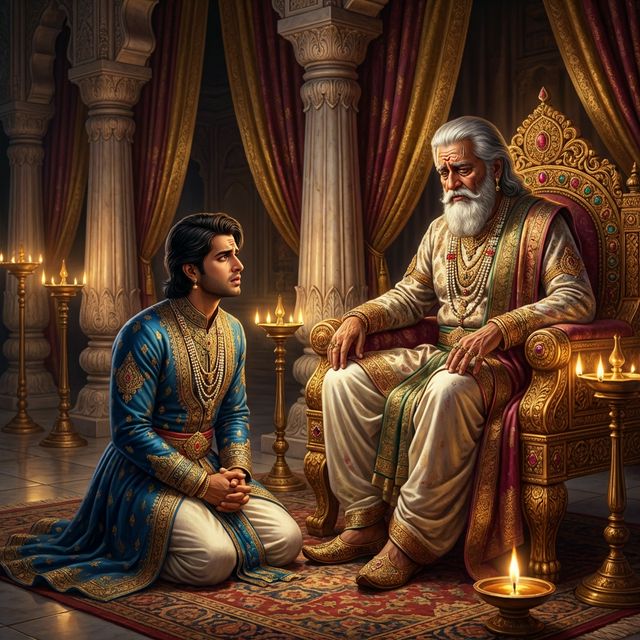
So Yudhishthira rose, and with his brothers and Draupadi and Krishna he rode out from Hastinapura to the field of Kurukshetra, where the grandsire lay. They found him beneath his great parasol, kept alive only by the spring Arjuna had shot from the earth, his body so wasted that the arrows stood out from his ribs like the bars of a cage. Yudhishthira knelt in the dust at the foot of the bed and could not lift his eyes. And Bhishma's voice came down to him as gentle as it had been when the boy was small. "What troubles you, grandson?"
The Teaching of Dharma and Kingship
"Everything, grandsire," Yudhishthira answered, his head still bowed. "I do not know how to be a king. I do not know how to deserve this throne that has cost so much. I do not even know what kingship is."
"Then I will tell you," said Bhishma. And he began the great discourse that would fill the days he had left.
Morning and evening, in long careful sessions, the dying grandsire spoke and the new king listened. He spoke of the duties of a ruler: how a king must rise before dawn, whom he should take counsel from, how he must reward the loyal and restrain the wicked, how he must guard his own person and yet never let fear make him cruel. He spoke of the four orders of society and the duty proper to each, and of the four stages of a man's life. He spoke of taxation that does not bleed the people, of justice that does not bend to the powerful, of the eighteen kinds of wrongdoing and their fitting punishments. He spoke of the arts of peace and the arts of war, of alliance and conciliation, of when a king must fight and when he must forgive.
He spoke of times of calamity, when the ordinary rules cannot be kept, and of the deeper rule that holds even then. He told old stories, many of them, of ancient kings and sages, of the origins of customs, of the gods and the ages before this one, weaving each tale into a lesson. He spoke of women and how they must be honoured, of the bonds between father and son, of debt and inheritance and the keeping of promises. And through all of it he returned again and again to dharma, the law of right action that holds the world together, turning it now this way and now that, as a jeweller turns a gem to catch the light from every side.
At last Yudhishthira asked the question he had been working toward for many days. "Grandsire, of all the dharmas, what is the highest? Which one should I hold above the rest when I cannot hold them all?" And Bhishma answered without hesitation. "Ahimsa. Non-violence. Not merely the refusal to kill, but the deep and constant care for all that lives, the unwillingness to add to the suffering of any creature, the readiness to relieve it where one can. Hold to that, child, and all the lesser dharmas will follow from it of their own accord."
Liberation and the Thousand Names
The teachings went on and on, and grew at the last toward the highest matters of all. Having spoken of the king and the kingdom, of the world and its laws, Bhishma turned to speak of liberation, of the soul and its journey, of how a man might pass beyond all duty into freedom. He told Yudhishthira of the nature of the self, deathless within the perishing body, untouched by the deeds it seems to do. He spoke of devotion and of knowledge, of the discipline that loosens the grip of desire, of the path by which a soul may cross beyond birth and death and not return.
Yudhishthira asked him then, on a certain day, the question that lay beneath all his questions. "Of all that exists, grandsire, who is the one refuge? By praising whom, by worshipping whom, may a man be freed from the fear of the wheel of birth and death?" And Bhishma, lying upon his arrows, answered by giving the king the Thousand Names of Vishnu, the Vishnu Sahasranama, the long litany of the names and aspects of the Lord who is the support and the goal of all that is. He recited the whole of it from his bed of arrows, name after name, so that the dying patriarch left to the world this last and greatest gift, a song of praise that men would chant for ages after both of them were dust.
When the recitation was done, Krishna himself, who had sat silent through so much of the teaching, smiled and confirmed that all the grandsire had said was true, for of that Lord whom the thousand names described, he himself was the living presence among them. And Yudhishthira, who had come to that field unable to bear his crown, rose at the end of the long discourse a different man. The horror had not left him, but it had been given shape and meaning. He understood now what he was to do with the kingdom he had won and the grief he carried. He had come a broken survivor, and he would go back to Hastinapura a king.
The brothers, who had listened beside him through all those days, had grown also. They had ridden out to comfort a dying old man and had instead been taught how to rule, how to mourn, and how to live. The grandsire had emptied himself of everything he knew into the children of his children, and there was nothing left in him now to give but his life itself, and that too he was ready to set down.
The Sun Turns North
Each morning through those weeks Krishna would come to the bed of arrows and ask the grandsire how he fared, and each morning Bhishma would smile and answer the same. "I am waiting, Krishna. Tell me when the sun has turned to the north." The teaching was finished. There was nothing left for him to do but hold his soul in his pierced body a little longer and watch for the turning of the year.
The sun turned north at last, on the day men call Magha Shukla Ashtami. The dawn of that day broke clear and cold, with a quality of light the Pandavas had not seen through all the long months of grief, as though the sky itself had been washed clean. Bhishma felt it upon his skin and knew his hour. "Today, Krishna?" he asked. "Today, grandsire," Krishna answered.
Bhishma asked that the Pandavas be gathered to him, and Dhritarashtra and Gandhari and Vidura, and all who loved him. He blessed each of them slowly with his eyes. He counselled the blind old king Dhritarashtra to bear his sorrow and not to hate the brothers who had been forced to slay his sons. He blessed Yudhishthira upon the throne and bade him rule with the dharma he had been taught. Then he turned to Krishna last of all and folded his pierced hands as well as he could.
"Lord," he said, "I have spoken everything I know. I have poured all of it into these children of my children. There is nothing of me left ungiven. Permit me now to go." And Krishna inclined his head and gave him leave.
The Grandsire Yields His Life
Then Bhishma closed his eyes and did the thing the yogis describe. He drew his soul upward through his body, gathering it first out of his feet, then out of his legs, then out of his belly, then out of his breast. As his soul rose, each part of him that it left behind grew still and at peace, and the arrows that pierced those parts pierced them no longer to any purpose, for he had withdrawn his life above them. The pain that had been his companion for fifty-eight days fell away beneath the rising soul like water draining from a vessel. When at last his life reached the crown of his head, he held it there a moment in perfect concentration, and then, freely and without struggle, he released it.
Those who watched said afterward that a small bright radiance rose from the old man's head and went up into the clear morning light and was lost in it, ascending by the bright northern road he had waited so long to take. And in that same instant the bed of arrows that had held him for fifty-eight days gave way. The shafts that had suspended him broke and crumbled, and his body, freed at the last, came to rest upon the bare clean earth, light as a thing that has only been waiting to be set down.
The Pandavas wept without shame, and Krishna himself had tears upon his face. The patriarch of the Bharatas, who had been old when their fathers were young, who had kept his terrible vow of celibacy through a long lifetime, who had held the dynasty together through three generations and then chosen the hour of his own death and taught a kingdom how to live before he took it, was gone.
They lifted the worn body and carried it to the banks of the Ganga, and there upon the river that was his mother they raised the funeral pyre. As the flames climbed, the goddess Ganga rose from her own current in the form of a woman of pale water and stood beside the fire, weeping silently for her son until his body was wholly given to the flame. Then, when it was done, she sank back into her stream and was gone, and the river ran on as it had always run. The grandsire had passed by the bright road north, mourned by both the armies that had been his own, and the long death upon the bed of arrows was ended at last.
Dharma Lesson
The dying have more to teach the living than the living usually want to hear. Bhishma lived past his time on a bed of arrows so that one nephew could learn how to be a king. Knowledge given in a crisis can fade - Arjuna heard the Gita and forgot it. Knowledge given in friendship sometimes lasts longer than knowledge given in revelation. Either way, what matters is not the words remembered but the life shaped by them.